Computer Organization and Architecture: Chapter 6: Next Generation Computer Architecture
Neural Processing Units (NPU)
Artificial Neural Network, ANN Processing, Key Characteristics, Applications, Manufacturers
Questions: 1. What is ANN? 2. What is the need for specialized hardware for ANN processing? 3. What is an NPU? 4. Explain the key characteristics of the NPU. 5. Give a comparison between NPU, CPU and GPU. 6. State the applications of NPU. 7. Name some major companies developing NPUs and explain how they integrate NPUs into their products.
Neural
Processing Units (NPU)
1.
Artificial Neural Network (ANN)
•
An Artificial Neural Network (ANN) is an assembly of interconnected nodes and weighted
links, inspired by the architecture of the biological brain. wwwwbord lovel
•
Nodes in an ANN are called neurons,
drawing an analogy with biological neurons. These simple functional units are
capable of learning classification problems after being trained with sufficient
data.
•
An ANN can consist of multiple layers, classified into three types: input,
hidden and output layers.
■ Input layer :
Receives the initial data (like an image or text).
■
Hidden layer(s) : Process the input
data through multiple layers, extracting features and patterns.
■
Output layer : Produces the final
result, such as a classification (e.g., identifying an object in an image) or a
prediction.
•
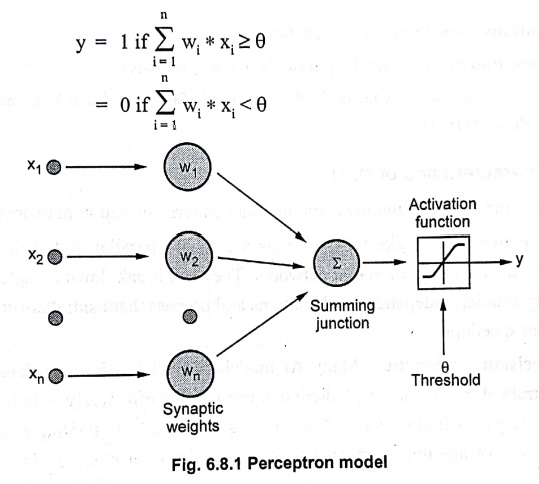
The simplest form of an ANN is the perceptron model, illustrated in Fig. 6.8.1.
It receives input signals, each with a certain "strength" (weight).
It adds up all the weighted input signals. If the total sum exceeds a certain
"threshold," specified by a simple threshold function 0, the output
1; otherwise, the output is 0.
•
The output function can be expressed as
•
The perceptron model is a linear classifier with a simple and efficient
learning algorithm. Beyond the threshold function, several other common
activation functions, such as sigmoid, tanh and step functions, are also widely
used.
2. Need for Specialized Hardware for ANN Processing
•
Although ANNs are powerful, they require extremely large numbers of:
■ Arithmetic
operations, especially Multiply ‒ Accumulate (MAC)
■ Matrix and vector
computations
■
Parallel data processing
•
Running these operations on general‒purpose processors such as CPUs is slow and energy‒ intensive.
GPUs improve performance, but modern AI applications require even higher
efficiency, especially on smartphones, IoT devices and embedded systems.
•
This led to the development of Neural
Processing Units (NPUs).
3. Processing Unit (PU)
•
A Neural Processing Unit (NPU) is a
special type of chip made to handle AI
and Machine Learning tasks
quickly and efficiently. It's like a brain for AI.
•
While GPUs are good at doing many
things at the same time (parallel processing), NPUs are even better for AI
because they are designed only for AI
tasks. They focus on the key math operations that help neural networks
learn and make predictions, such as:
■
Matrix multiplications
■
Convolutions (used in image recognition)
■
Activation functions (which help models make decisions)
•
By focusing only on these AI tasks, NPUS can work faster and use less energy
than other chips like CPUs or GPUs.
4. Key Characteristics of NPU
•
NPUs are optimized for the unique computational patterns of neural networks,
focusing on:
1. Parallel processing : Like GPUs, NPUs are highly parallel,
but their architecture is tailored to the data flow of neural networks. They
can break down complex AI problems into many smaller, independent calculations
and process them simultaneously, leading to significant speedups.
2. Low precision
arithmetic : Many AI models, especially during
inference (the stage where a trained model makes predictions), can operate
effectively with lower numerical precision (e.g., 8‒bit integers or bfloat16
instead of 32‒bit floating‒point). NPUs are designed to leverage this,
performing more operations per clock cycle with less power consumption.
3. Efficient memory
access
:
Neural networks often involve moving large amounts of data (weights, biases,
activations). NPUs are designed with optimized memory hierarchies and high‒bandwidth
memory to minimize data transfer bottlenecks and ensure a continuous flow of
data to their processing units.
4. Dedicated hardware
blocks : Instead of general‒purpose cores, NPUS
often feature specific hardware modules tailored for operations common in
neural networks, such as:
♦
Matrix Multiplication Units (MMUs) :
Similar to the systolic arrays in Google's TPUs, these are highly optimized for
fast matrix computations.
♦
Activation function units : Hardware
logic for common non‒linear activation functions (e.g., ReLU, sigmoid),
♦
Pooling and convolutional units :
Accelerators for operations frequently found in Convolutional Neural Networks
(CNNs) for image processing,
5. Energy efficiency :
A primary driver for NPU development, especially for edge devices (smartphones, IoT devices, embedded systems), is power
efficiency. By specializing in AI tasks and using lower precision, NPUs can
perform complex AI computations with significantly less power than a general‒purpose
CPU or even a high‒end GPU. This translates to longer battery life in mobile
devices and lower energy consumption in always‒on systems.
6. "On‒Device"
AI : NPUs enable AI
processing to occur directly on the device, rather than relying solely on cloud
servers. This offers several benefits:
♦
Reduced latency : Faster response
times for AI applications, crucial for real‒time scenarios (e.g., autonomous
driving, voice assistants).
♦
Enhanced privacy : User data stays
on the device, reducing the need to send sensitive information to the cloud.
♦
Reduced bandwidth : Less data needs
to be transmitted over networks, saving bandwidth and improving performance in
areas with limited connectivity.
♦
Offline capability : AI features can
function even without an internet connection.
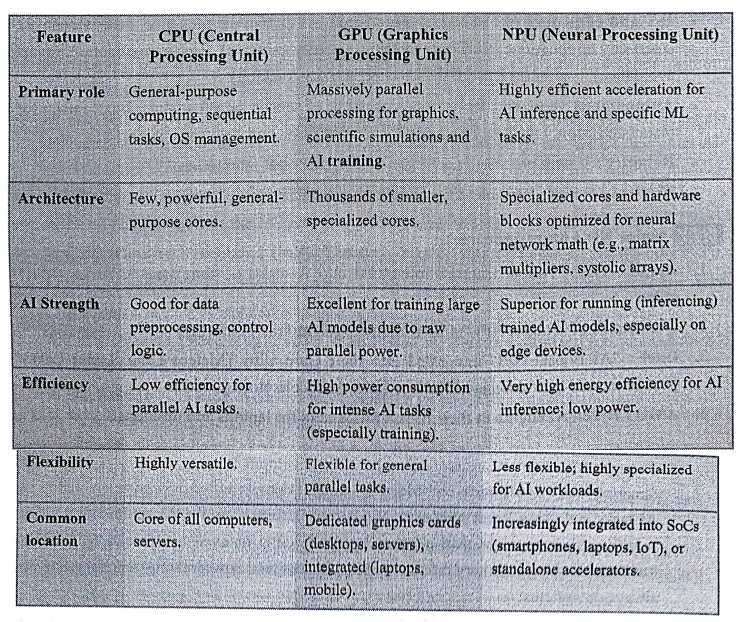
5. NPU vs. CPU Vs GPU for AI
•
The relationship between NPUs, CPUs, and GPUs is often complementary in modern
computing systems:
6. Applications of NPUs
•
NPUs are becoming ubiquitous across various domains, especially where on‒device
AI and efficiency are critical:
■ Smartphones :
Facial recognition (Face ID, Android unlock), real‒time language translation,
advanced computational photography (e.g., image enhancement, background blur,
object detection), voice assistants, gesture recognition.
■
Laptops and PCs (AI PCs) :
Features like Windows Studio Effects (background blur, eye contact correction
during video calls), AI‒powered noise cancellation, smart search, local
execution of generative AI models (e.g., for text summarization or image
generation within applications), enhanced security features.
■
Smart home devices : Voice
assistants, smart cameras (object detection, facial recognition), intelligent
thermostats.
■
IoT and edge devices :
Industrial automation (predictive maintenance, quality control), smart city
applications (traffic monitoring, security cameras), drones (navigation, object
avoidance), wearables (health monitoring, activity tracking).
■
Autonomous vehicles : Real‒time
processing of sensor data (cameras, lidar, radar) for object detection, lane
keeping, pedestrian recognition and decision‒making.
■
Robotics : Vision processing,
navigation, human‒robot interaction.
■
Medical devices : Portable
diagnostic tools, real‒time image analysis.
7. Major NPU Manufacturers
1. Apple :
Their "Neural Engine" integrated into A‒series (iPhone) and M‒series
(Mac) chips.
2. Qualcomm :
Hexagon NPU in their Snapdragon mobile platforms.
3. Intel : "AI
Boost" NPU integrated into their Core Ultra (Meteor Lake, Lunar Lake)
processors and their dedicated Habana Labs AI accelerators (Gaudi).
4. AMD :
Ryzen AI engine in their Ryzen processors for laptops and desktops.
5. Arm :
Designs NPU intellectual property (e.g., Ethos series) that other chip
manufacturers license and integrate into their SoCs.
6. Samsung :
Integrates NPUs into its Exynos mobile processors.
7. Huawei :
Developed its own Ascend series of AI processors.
8. Dedicated AI Chip
Startups : Companies like Hailo, Groq, and others
are developing highly specialized NPU / AI accelerator solutions for various
markets.
Review Questions
1. What is ANN?
2. What is the need
for specialized hardware for ANN processing?
3. What is an NPU?
4. Explain the key
characteristics of the NPU.
5. Give a comparison
between NPU, CPU and GPU.
6. State the
applications of NPU.
7. Name some major
companies developing NPUs and explain how they integrate NPUs into their
products.
Computer Organization and Architecture: Chapter 6: Next Generation Computer Architecture : Tag: Computer : Artificial Neural Network, ANN Processing, Key Characteristics, Applications, Manufacturers - Neural Processing Units (NPU)
Computer Organization and Architecture: Chapter 6: Next Generation Computer Architecture
Under Subject
Computer Organization and Architecture
CW25201 3rd Semester IT department. | 2025 Regulation | 3rd Semester 2025 Regulation
Related Subjects
Discrete Mathematics
MA25C14 3rd Semester CSE,IT,CY,AIDS departments. | 2025 Regulation | 3rd Semester 2025 Regulation
Data Structures
CS25C08 3rd Semester CSE,IT,CY,AIDS departments. | 2025 Regulation | 3rd Semester 2025 Regulation
Computer Organization and Architecture
CW25201 3rd Semester IT department. | 2025 Regulation | 3rd Semester 2025 Regulation
Object Oriented Programming
CS25C07 3rd Semester IT department. | 2025 Regulation | 3rd Semester 2025 Regulation
Web Technologies
IT25301 3rd Semester IT department. | 2025 Regulation | 3rd Semester 2025 Regulation
English Communication Skills Laboratory I
EN25C03 3rd Semester all department. | 2025 Regulation | 3rd Semester 2025 Regulation
Skill Development Course I
3rd Semester all department. | 2025 Regulation | 3rd Semester 2025 Regulation