Computer Organization and Architecture: Chapter 6: Next Generation Computer Architecture
Introduction to Multicore and Multiprocessor Systems
Characteristics, Advantages, Disadvantages, Applications, Use Cases
Questions: 1. What is a multicore system? 2. Explain the architecture and working of a multicore processor. How do multiple cores execute instructions in parallel? 3. Describe the four multicore cache organizations with examples of processors using each. 4. What are the key advantages of using shared L2 or shared L3 caches in multicore processors ? 5. State and explain the major advantages and disadvantages of multicore systems. 6. What is a multiprocessor system? 7. List and explain the advantages and disadvantages of multiprocessor systems. 8. Compare multicore and multiprocessor systems.
Introduction
to Multicore and Multiprocessor Systems
•
Modern computing systems demand higher performance, faster data processing, and
energy‒efficient operation. To meet these requirements, computer designers have
shifted from increasing clock speed to increasing the number of processing
units available for parallel execution. This evolution has led to the
widespread adoption of multicore systems
and multiprocessor systems, both of
which aim to enhance computational throughput but differ in structure and
design goals.
•
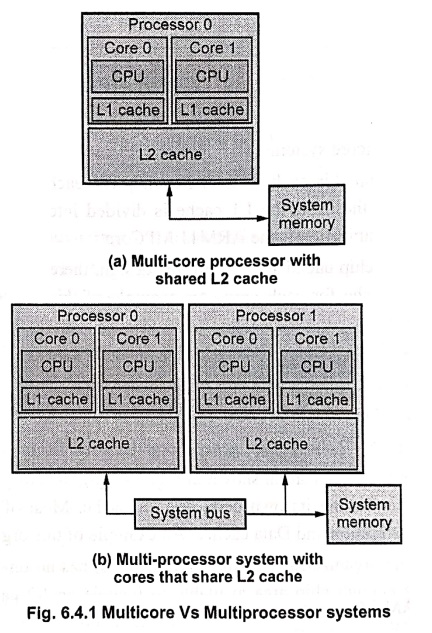
A multicore system integrates
multiple processing cores within a single physical processor chip, enabling
concurrent execution of instructions while maintaining compact design and
reduced power consumption. In contrast, a multiprocessor
system uses two or more separate physical processors within the same
computer system, allowing tasks to be distributed across independent CPUs. Both
approaches support parallelism, but each offers unique benefits and trade‒offs
in terms of performance, reliability, scalability and cost.
1. Multicore Systems
•
A multicore processor is a single
computing element that contains two or more independent processing units, known
as cores, on a single chip.
Processors with one core are called single‒core
or uniprocessor systems, whereas
modern processors commonly provide dual‒core,
quad‒core, octa‒core, or even higher core counts.
•
Each core in a multicore processor can independently fetch, decode and execute
instructions‒such as arithmetic operations, data transfers and branch
instructions. This creates the effect of having multiple processors inside a
single chip, allowing true parallel execution.
•
Since multiple cores share the processor's physical infrastructure, multicore
systems often show improved performance without proportionally increasing heat,
power consumption or physical size.
1. Key Characteristics of Multicore Systems
•
Multiple cores integrated on a single IC die or multi‒die package.
•
Support multithreading and parallel computing.
•
Each core often contains its own L1
cache, and higher‒level caches may be private or shared (L2/L3).
•
Ideal for applications that can exploit parallelism‒such
as multimedia processing, gaming, scientific computing, graphics, DSP and
networking.
2. Cache Organization in Multicore Systems
•
Cache hierarchy is a crucial part of multicore design because it influences
performance, power consumption and communication between cores. Multicore
organizations are classified according to:
■
The number of core processors on the chip.
■
The number of levels of cache memory.
■
The amount of cache memory that is shared.
•
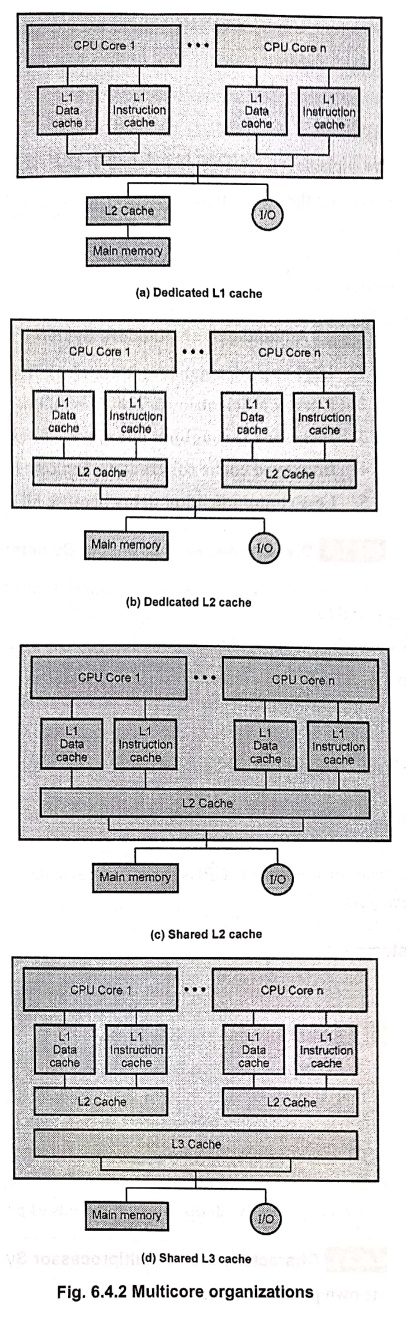
Fig. 6.4.2 shows four general organizations for multicore systems.
•
In the organization shown in Fig. 6.4.2(a), the only on‒chip cache is the L1
cache, with each core having its own dedicated L1 cache. Most of the time, the
L1 cache is divided into Instruction and Data caches. An example of this
organization is the ARM11 MPCore.
•
The organization shown in Fig. 6.4.2(b) has no on‒chip cache sharing. In this
design, there is enough chip area available to include an L2 cache for each
core. An example of this organization is the AMD Opteron.
•
The organization shown in Fig. 6.4.2(c) has a similar allocation of chip space
to memory, but includes a shared L2 cache. The Intel Core Duo uses this
organization.
• The organization shown in Fig. 6.4.2(d) includes a shared L3 cache, with dedicated L1 and L2 caches for each core processor. The Intel Core i7 is an example of this organization.
Advantages of shared L2
cache
1.
Constructive interference among cores reduces the overall miss rate.
2.
Data shared by multiple cores is not replicated at the shared cache level.
3.
With appropriate cache replacement algorithms, the amount of shared cache
allocated to each core becomes dynamic. Thus, threads with lower locality can
utilize more cache space.
4.
Interprocessor communication is easier to implement through shared memory
locations.
5.
The use of a shared L2 cache restricts the cache‒coherency problem to the L1
cache level, which can provide additional performance benefits.
3. Advantages of Multicore Systems
1. Higher performance
at lower clock frequencies.
2. Energy efficient‒lower
heat generation.
3. Increased throughput
due to parallel execution.
4. Improved cache
coherency when cores share caches.
5. Less communication
delay because all cores are on the same chip.
4. Disadvantages of Multicore Systems
1.
Not all applications can exploit parallel execution.
2.
Dual‒core systems rarely provide double the speed (usually 60 ‒ 80%
improvement).
3.
Require parallel programming techniques,
which increase software complexity.
4.
Some operating systems orapplications may not fully utilize all cores.
2. Multiprocessor Systems
•
A multiprocessor system contains two
or more independent physical processors
(CPUs) that share common system resources such as memory, I/O devices, and
the system bus. These processors operate concurrently, allowing multiple
processes or threads to execute in parallel.
•
Examples include dual‒processor (2 CPUs), quad‒processor (4 CPUs), and large‒scale
server systems with dozens or hundreds of processors.
1. Characteristics of Multiprocessor Systems
•
Each CPU may have its own private caches.
•
Processors share main memory (in SMP systems) or have distributed memory (in
NUMA systems).
•
Communication between processors takes place via shared memory or
interconnection networks.
•
Highly reliable ‒ failure of one processor does not halt the entire system.
2. Advantages of Multiprocessor Systems
1. High throughput
due to multiple CPUs executing tasks simultaneously.
2. Fault tolerance ‒
failure in one processor does not affect others,
3.
Ideal for heavy workloads, server systems, database management and scientific
computing.
4.
Well‒suited for true parallel
processing.
3. Disadvantages of Multiprocessor Systems
1.
More traffic and communication delays since processors are physically farther
apart.
2. Complex coordination
and synchronization among processors.
3.
Shared resource contention may reduce throughput.
4.
Expensive due to multiple physical CPUs and supporting hardware.
3. Multicore vs. Multiprocessor Systems
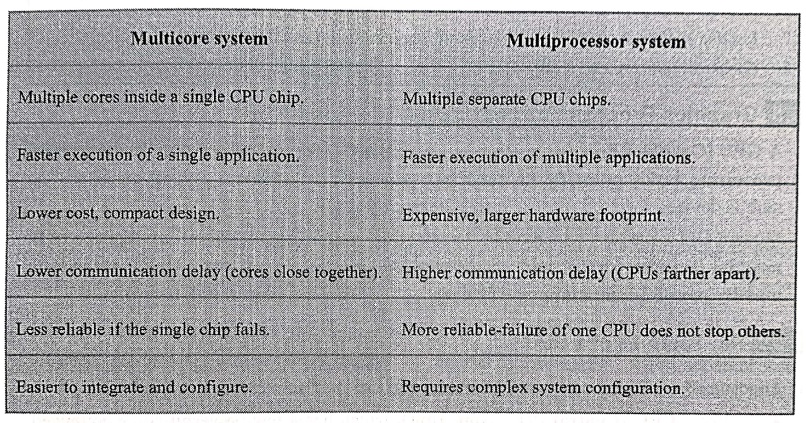
Multicore
system
1.
Multiple cores inside a single CPU chip.
2.
Faster execution of single applications.
3.
Lower cost, compact design.
4.
Lower communication delay (cores close together).
5.
Less reliable if the single chip fails.
6.
Easier to integrate and configure.
Multiprocessor
system
1.
Multiple separate CPU chips.
2.
Faster execution of a multiple application.
3.
Expensive, larger hardware footprint.
4.
Higher communication delay (CPUs farther apart).
5.
More reliable‒failure of one CPU does not stop others.
6.
Requires complex system configuration.
4. Applications and Use Cases
Multicore Systems
■
Smartphones and tablets
■
Laptops and desktops
■
Embedded systems
■
Gaming consoles
■
Graphics processing (GPUs with thousands of cores)
Multiprocessor Systems
■
High‒performance servers
■
Cloud data centers
■
Scientific simulations
■
Large‒scale AI and ML workloads
■
Enterprise databases
Review Questions
1. What is a multicore
system?
2. Explain the
architecture and working of a multicore processor. How do multiple cores
execute instructions in parallel?
3. Describe the four
multicore cache organizations with examples of processors using each.
4. What are the key
advantages of using shared L2 or shared L3 caches in multicore processors ?
5. State and explain
the major advantages and disadvantages of multicore systems.
6. What is a
multiprocessor system?
7. List and explain
the advantages and disadvantages of multiprocessor systems.
8. Compare multicore
and multiprocessor systems.
Computer Organization and Architecture: Chapter 6: Next Generation Computer Architecture : Tag: Computer : Characteristics, Advantages, Disadvantages, Applications, Use Cases - Introduction to Multicore and Multiprocessor Systems
Computer Organization and Architecture: Chapter 6: Next Generation Computer Architecture
Under Subject
Computer Organization and Architecture
CW25201 3rd Semester IT department. | 2025 Regulation | 3rd Semester 2025 Regulation
Related Subjects
Discrete Mathematics
MA25C14 3rd Semester CSE,IT,CY,AIDS departments. | 2025 Regulation | 3rd Semester 2025 Regulation
Data Structures
CS25C08 3rd Semester CSE,IT,CY,AIDS departments. | 2025 Regulation | 3rd Semester 2025 Regulation
Computer Organization and Architecture
CW25201 3rd Semester IT department. | 2025 Regulation | 3rd Semester 2025 Regulation
Object Oriented Programming
CS25C07 3rd Semester IT department. | 2025 Regulation | 3rd Semester 2025 Regulation
Web Technologies
IT25301 3rd Semester IT department. | 2025 Regulation | 3rd Semester 2025 Regulation
English Communication Skills Laboratory I
EN25C03 3rd Semester all department. | 2025 Regulation | 3rd Semester 2025 Regulation
Skill Development Course I
3rd Semester all department. | 2025 Regulation | 3rd Semester 2025 Regulation