Computer Organization and Architecture: Chapter 6: Next Generation Computer Architecture
Overview of Next Generation Processors
Key Characteristics, Examples, Applications
Questions: 1. Explain the concept of Next Generation Processors. 2. Why have traditional processors become insufficient for modern computing workloads ? 3. Describe the heterogeneous architecture of next generation processors. 4. What is on‒device AI acceleration? 5. Explain how integrated NPUs enable edge AI applications. 6. With suitable examples describe the key components of next generation processors and discuss their major application areas.
Overview
of Next Generation Processors
•
Modern computing is driven by demands for high
performance, real‒time responsiveness and maximum energy efficiency.
Traditional processors, which relied solely on continually increasing clock
frequency, have reached fundamental physical and thermal limits (the
"power wall"). To meet the needs of data‒intensive workloads like
Artificial Intelligence (AI), machine learning and high‒speed networking, the
industry has transitioned to Next
Generation Processors.
•
These processors are fundamentally designed to deliver massive parallelism, high throughput and low power consumption by integrating multiple, specialized
compute engines onto a single chip, forming a System‒on‒Chip (SoC).
1. Key Characteristics of Next Generation Processors
•
The primary distinguishing feature of next‒generation processors is their shift
from homogenous (all CPU) to heterogeneous
architectures.
• Heterogeneous
architecture : This design paradigm combines
different types of specialized processing units on a single die, optimizing
each component for specific tasks:
■
Multicore CPUs : Handle general instructions, complex control
logic and sequential processing tasks. Modern CPUs often use a hybrid topology (e.g., ARM's big.LITTLE
or Intel's P‒cores and E‒cores) where faster, high‒power performance cores (P‒cores)
are combined with slower, more power‒efficient cores (E‒cores).
■
High‒performance GPUs : Excel at data‒parallel operations required for
graphics rendering, scientific computing, and particularly AI training. They use thousands of simpler
cores to process large datasets simultaneously.
■
Neural Processing Units (NPUs) AI
Engines : These are Application‒Specific
Integrated Circuits (ASICs) purpose‒built to accelerate neural network tasks, such as matrix
multiplication and convolution operations, which are the computational backbone
of deep learning. They achieve superior performance and power efficiency for AI inference compared to general‒purpose
cores.
• Integrated AI
acceleration : The integration of NPUs allows for on‒device AI (or Edge AI), enabling
applications like real‒time image recognition, noise cancellation, speech
processing and local generative Al models to run directly on the device. This
improves speed, privacy and eliminates reliance on cloud servers for basic AI
tasks. NPUs often use low‒precision arithmetic (e.g., INT8 or lower) to boost
energy efficiency without sacrificing needed accuracy.
•
Advanced fabrication technology :
These processors leverage cutting‒edge semiconductor process nodes (e.g., 7 nm, 5 nm, 3 nm) to pack significantly
more transistors into the same area. This increase in transistor density directly enables higher performance, lower power
leakage and reduced heat generation.
•
High bandwidth memory system :
Data transfer is a major bottleneck for highly parallel workloads. Modern
processors address this with advanced memory solutions :
■
DDR5 / LPDDR5X : Used for general‒purpose
computing, offering improved capacity
and better power management than predecessors.
■ High Bandwidth Memory
(HBM) : Used in high‒end accelerators (GPUs, AI chips) and
servers. HBM stacks DRAM chips vertically using Through‒Silicon Vias (TSVs) and places the stack directly on the
processor package (via an interposer). HBM offers significantly higher bandwidth (often 10x to 20x that of DDR5) and
lower power consumption, making it ideal for large AI models where memory
bandwidth is paramount.
• Improved
energy efficiency
: By offloading specialized tasks to dedicated, power‒
optimized accelerators (NPUs, GPUs) and employing hybrid CPU topologies, these
processors achieve dramatically lower power
consumption per computation (performance per watt), which is essential for
mobile devices and energy‒conscious data centers.
• Enhanced Security
Features : Security is increasingly handled at the
hardware level through features like :
■
Secure enclaves : Dedicated,
isolated areas on the chip for processing and storing sensitive data (e.g.,
biometric authentication keys).
■
Built‒in encryption units : Hardware‒accelerated
cryptography to enhance data privacy and system reliability.
2. Examples and Applications
•
The result of these architectural innovations is a class of processors
optimized for the future
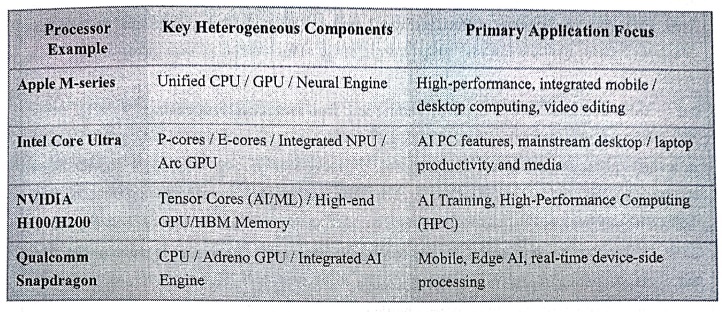
•
The applications for these processors span nearly every segment of the
technology market :
■
Artificial Intelligence : Real‒time
speech translation, natural language processing, on‒ device generative AI (running small‒scale LLMs).
■
Media and Graphics : Advanced
graphics rendering, immersive gaming,
high‒speed al video editing and computational
photography (real‒time image enhancement).
■
Edge Computing : Robotics,
autonomous systems, Internet of Things (IoT) devices and industrial automation
where data must be processed immediately without cloud latency.
Review Questions
1. Explain the concept
of Next Generation Processors.
2. Why have
traditional processors become insufficient for modern computing workloads ?
3. Describe the
heterogeneous architecture of next generation processors.
4. What is on‒device
AI acceleration?
5. Explain how
integrated NPUs enable edge AI applications.
6. With suitable
examples describe the key components of next generation processors and discuss
their major application areas.
Computer Organization and Architecture: Chapter 6: Next Generation Computer Architecture : Tag: Computer : Key Characteristics, Examples, Applications - Overview of Next Generation Processors
Computer Organization and Architecture: Chapter 6: Next Generation Computer Architecture
Under Subject
Computer Organization and Architecture
CW25201 3rd Semester IT department. | 2025 Regulation | 3rd Semester 2025 Regulation
Related Subjects
Discrete Mathematics
MA25C14 3rd Semester CSE,IT,CY,AIDS departments. | 2025 Regulation | 3rd Semester 2025 Regulation
Data Structures
CS25C08 3rd Semester CSE,IT,CY,AIDS departments. | 2025 Regulation | 3rd Semester 2025 Regulation
Computer Organization and Architecture
CW25201 3rd Semester IT department. | 2025 Regulation | 3rd Semester 2025 Regulation
Object Oriented Programming
CS25C07 3rd Semester IT department. | 2025 Regulation | 3rd Semester 2025 Regulation
Web Technologies
IT25301 3rd Semester IT department. | 2025 Regulation | 3rd Semester 2025 Regulation
English Communication Skills Laboratory I
EN25C03 3rd Semester all department. | 2025 Regulation | 3rd Semester 2025 Regulation
Skill Development Course I
3rd Semester all department. | 2025 Regulation | 3rd Semester 2025 Regulation