Computer Organization and Architecture: Chapter 6: Next Generation Computer Architecture
VLIW Architecture
Concept, Core Features, Comparison, Advantages, Disadvantages, Applications
Questions: 1. What is the concept of Very Long Instruction Word (VLIW) architecture? 2. Explain the role of the compiler in VLIW execution. 3. Describe the major components of a VLIW processor architecture. 4. List and explain the core features of VLIW processors. 5. Compare VLIW and superscalar architectures. 6. State the advantages of VLIW architecture. 7. State the disadvantages of VLIW architecture. 8. State the applications of VLIW architecture.
VLIW
Architecture
•
The Very Long Instruction Word (VLIW)
architecture is a processor design technique that exploits Instruction‒Level Parallelism (ILP) by executing multiple
operations in a single, wide instruction.
•
Unlike traditional scalar or superscalar processors that depend on complex
hardware to detect parallel operations at runtime, VLIW shifts this
responsibility to the compiler,
which statically schedules instructions into long instruction words.
•
These instruction words typically contain multiple operations that can be
executed in parallel by the functional/execution units of the processor,
1. Concept of VLIW Execution
•
In traditional architectures‒such as pipelined, superscalar and out‒of‒order
processors‒ hardware is responsible for:
■
Detecting data dependencies
■
Identifying parallelism
■
Scheduling instructions dynamically
■
Handling hazards
•
This significantly increases hardware cost, power consumption, and design
complexity.
• VLIW eliminates most
of this complexity by relying on the compiler to:
■
Analyze the instruction stream
■
Identify independent operations
■
Resolve dependencies
Pack
multiple operations into one long instruction word
•
This statically scheduled VLIW instruction is then issued as a single unit to
the processor's multiple functional units.
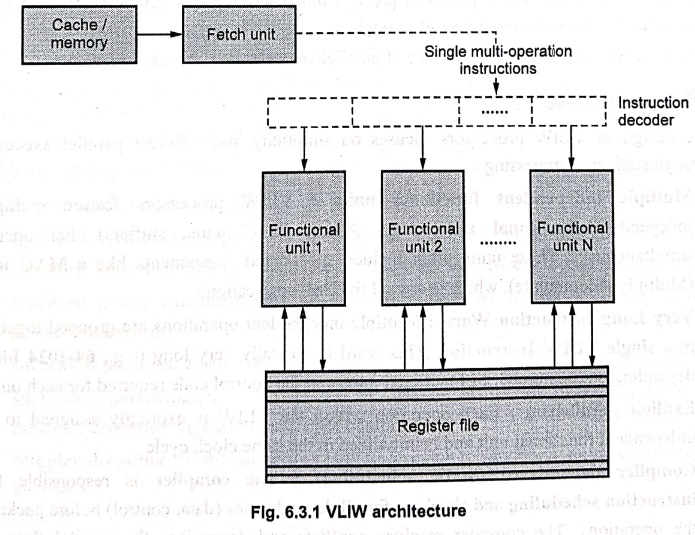
• A
VLIW processor consists of:
1. Instruction cache
that stores long instruction words
2. Instruction decoder
that splits the long word into parallel operations
3. Multiple functional
units such as:
♦
ALUS
♦
MAC units
♦
Shifters
♦
Load/store units
4. Multi‒ported
register file
that allows parallel access from all functional units
5. Memory interface
for data load / store
•
In a VLIW processor, the long instruction word is first fetched from memory, after
which each field within the VLIW packet is directed to its corresponding
functional unit. All the specified functional units then execute their assigned
operations simultaneously, enabling true parallel execution.
•
Once the operations are completed, the results are written back to the common
register file. Meanwhile, load and store operations proceed independently and
concurrently with ALU operations, further enhancing overall throughput.
•
This structure allows for a high degree of parallelism without complex control
logic.
2. Core Features
•
The design of VLIW processors focuses on simplicity and efficient parallel
execution through static pre‒processing:
1. Multiple independent
functional units : VLIW processors feature multiple,
independent functional units (e.g.,
ALUSs, MAC units, shifters) that operate simultaneously. These units often
include specialized components like a MAC
unit (Multiply‒Accumulate), which is crucial for DSP applications.
2. Very Long
Instruction Word : Multiple independent operations
are grouped together in a single VLIW
Instruction. This word is typically very long (e.g., 64‒1024 bits), depending on the number of functional units and the
control code required for each unit.
3. Explicit parallelism
: Each operation within the VLIW is explicitly
assigned to an independent functional unit and is initialized in the same clock
cycle.
4. Compiler dependence
(Static scheduling) : The compiler is responsible for instruction
scheduling and checking for all dependencies (data, control) before packing
the operations. The compiler resolves conflicts and determines the parallel
flow of instructions.
5. Shared register file :
All the functional units share a common
multi‒ported register file for fetching operands and storing results.
Parallel random access to this file is managed via a read/write crossbar.
3. Comparison with Superscalar Architecture
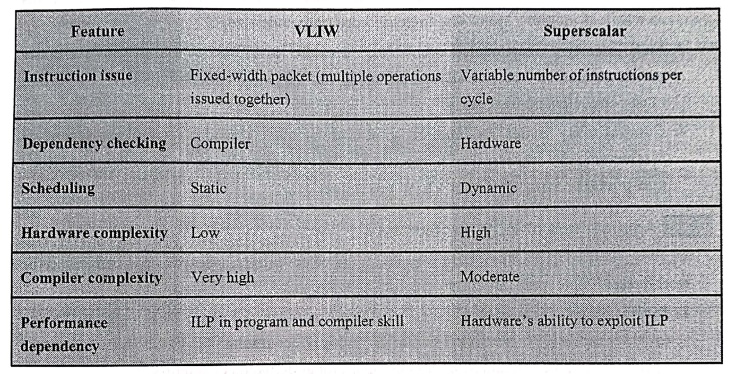
•
VLIW achieves Instruction‒Level Parallelism (ILP) by dramatically simplifying
the hardware complexity found in superscaler architecture.
4. Advantages of VLIW
•
The advantages of VLIW architecture are:
1. Reduced hardware
complexity : Eliminating complex runtime scheduling,
dependency checking, and out‒of‒order execution logic simplifies the processor
core significantly.
2. Reduced power
consumption : Less complex hardware translates
directly to lower power requirements.
3. Increased potential
clock rate : Simpler hardware
logic allows for faster clock cycles.
4. Increased
performance : Maximizes the use of Instruction‒Level
Parallelism by precisely orchestrating execution via the compiler.
5. Simpler decoding :
Instructions are ready to dispatch to functional units without further
analysis.
5. Disadvantages of VLIW
The
disadvantages of VLIW architecture are:
1. Complex compilers
required : The burden of checking dependencies and
optimally packing instructions falls entirely on the compiler, making compiler
design much more challenging.
2. Code expansion :
The use of the very long instruction word often results in un‒filled opcodes if the compiler cannot find enough independent
instructions to pack. This leads to waste
of memory space and increased program code size.
3. Stall penalty :
Unscheduled events (e.g., a cache miss)
lead to a stall that stalls the entire
processor because all operations in
the currently executing VLIW instruction must complete simultaneously.
4. Compatibility issues
: Compiler optimizations must consider technology‒dependent
parameters (like latencies) of a specific VLIW implementation, making compiled
code non‒portable across different
VLIW processors.
6. Applications of VLIW Architecture
•
VLIW is particularly well‒suited for applications where program flow is
predictable and the workloads involve high‒throughput parallel data streams :
1. Digital Signal
Processing (DSP) : VLIW processors are ideal for DSP
applications due to their ability to perform multiple multiply‒accumulate (MAC)
and arithmetic operations in parallel, handling high computational demands
efficiently.
2. Multimedia processing
: Used in video and audio processing, where high
throughput and parallelism are necessary to handle large data streams.
3. Scientific computing
: Utilized for high‒performance computing to solve
complex numerical problems where loops offer substantial potential for static
parallelization.
4. Embedded systems :
Its ability to execute multiple instructions in parallel while consuming
minimal power makes VLIW valuable in embedded systems like medical devices,
automotive control, and industrial automation.
Review Questions
1. What is the concept
of Very Long Instruction Word (VLIW) architecture?
2. Explain the role of
the compiler in VLIW execution.
3. Describe the major
components of a VLIW processor architecture.
4. List and explain
the core features of VLIW processors.
5. Compare VLIW and
superscalar architectures.
6. State the
advantages of VLIW architecture.
7. State the
disadvantages of VLIW architecture.
8. State the
applications of VLIW architecture.
Computer Organization and Architecture: Chapter 6: Next Generation Computer Architecture : Tag: Computer : Concept, Core Features, Comparison, Advantages, Disadvantages, Applications - VLIW Architecture
Computer Organization and Architecture: Chapter 6: Next Generation Computer Architecture
Under Subject
Computer Organization and Architecture
CW25201 3rd Semester IT department. | 2025 Regulation | 3rd Semester 2025 Regulation
Related Subjects
Discrete Mathematics
MA25C14 3rd Semester CSE,IT,CY,AIDS departments. | 2025 Regulation | 3rd Semester 2025 Regulation
Data Structures
CS25C08 3rd Semester CSE,IT,CY,AIDS departments. | 2025 Regulation | 3rd Semester 2025 Regulation
Computer Organization and Architecture
CW25201 3rd Semester IT department. | 2025 Regulation | 3rd Semester 2025 Regulation
Object Oriented Programming
CS25C07 3rd Semester IT department. | 2025 Regulation | 3rd Semester 2025 Regulation
Web Technologies
IT25301 3rd Semester IT department. | 2025 Regulation | 3rd Semester 2025 Regulation
English Communication Skills Laboratory I
EN25C03 3rd Semester all department. | 2025 Regulation | 3rd Semester 2025 Regulation
Skill Development Course I
3rd Semester all department. | 2025 Regulation | 3rd Semester 2025 Regulation