Computer Organization and Architecture: Chapter 6: Next Generation Computer Architecture
Superscalar Processors
Questions: 1. What do you mean by superscalar processor? 2. List the issues which must be considered in implementation of superscaler processor. 3. Discuss various instruction issue policies. 4. What is register renaming?
Superscalar
Processors
•
A superscalar processor is a type of
Central Processing Unit (CPU) that implements a form of parallelism known as Instruction‒Level Parallelism (ILP) within
a single processor. Unlike earlier processors that could execute at most one
instruction per clock cycle, a superscalar design enables the CPU to execute multiple instructions simultaneously in
a given clock cycle by utilizing multiple execution units.
1. Superscalar Architecture and Operation
•
A superscalar processor is characterized by the following architectural
elements:
1.
Multiple Execution Units (E‒units) :
The
processor contains several independent functional units, such as Integer ALUS,
Floating‒Point Units (FPUs) and Load/Store Units (LSUs). These units are
typically pipelined themselves, forming a set of parallel instruction
pipelines.
2. Program Control Unit
(PCU) : The PCU is enhanced to fetch and decode
several instructions simultaneously.
3. Instruction Issue
Logic : This complex unit, often called the instruction scheduler, is responsible
for determining which decoded instructions can be safely dispatched to the
available E‒units for parallel execution. The issue logic is critical as it
must determine if instructions are
independent (i.e., whether the execution of one instruction is dependent on
the result of another). The number of instructions that can be issued
simultaneously is known as the instruction
issue degree (k).
•
To successfully exploit ILP and achieve high performance, the processor must
detect and manage various dependencies and conflicts inherent in the
instruction stream.
2. Challenges in Superscalar Execution
•
To fetch, decode and execute several instruction concurrently, the superscaler
operation requires processor to detect and exploit instruction‒level
parallelism hidden in the programs it executes. It has to handle following
important issues:
■
Instruction type : A floating‒point
add instruction has to be issued to a floating point E‒unit and not to an
integer E‒unit.
■ E‒unit availability :
An instruction can be issued to a pipelined E‒unit only if no collision will
result, as determined by the pipeline's reservation table.
■
True data dependency
■
Procedural dependency
■
Resource conflicts
■
Output dependency
■
Antidependency.
True data dependency
■
Let us see the following instructions:
♦ Sub г1, r2 ; Subtract
the contents of r2 from r1 and store the result in r1
♦ Move г3,г1; Load
register r3 with the contents of r1
♦ In the above instruction sequence, the
second instruction can be fetched and decoded, but cannot be executed until the
first instruction executes. The reason is that this the second instruction
requires the data produced by the first instruction. This situation is referred
to as a true data dependency. This
limits the performance of any type of pipeline.
Procedural dependency
■
We have seen earlier that the branch instructions complicate the pipeline
operation. There are branch prediction techniques, but they cannot improve
performance hundred percent. In branch prediction technique, taken or not taken, we cannot execute
instruction until branch is executed. This situation is referred to as procedural dependency.
Resource conflict
■
While executing number of instructions in parallel, the situation may occur
that two or more instructions require same resource at the same time. For
example, two or more instructions may require references to memories, caches,
buses register‒file ports and functional units at the same time. This situation
is referred to as resource conflict.
Output dependency
■
Let us see the following instructions.
R3
= R3 + R5 ← I1
R4
= R3 +1 ← 12
R3
= R5+1 ← 13
R6
= R3 + R4 ← 14
■
In the above instruction sequence we cannot execute instruction I2 before I1because
of the true data dependency and for similar reasons we also cannot execute
instruction I4 before I3. But there is one more dependency which exists between
instruction I3 and instruction I1. We cannot execute instruction I3 before
instruction I1, because if I3 executes prior to completion of I1, then wrong
value of the contents of R3 will be fetched for the execution of instructions
I1 and I4. This situation is referred to as output dependency.
Antidependency
•
Let us see the following instructions
R3
= R3+ R5 ← I1
R4
= R3+1 ← 12
R3
= R5+ 1 ← 13
R6
= R3+ R4 ← 14
•
In the above instruction sequence instruction I3 cannot be completed its
execution before instruction I2 begins execution and had fetched its operands. This
is so because instruction I3 updates register R3, which is a source operand for
instruction I2. This situation is referred to as antidependency. Here, constraints are exactly reverse that of true
data dependency.
Control dependencies :
To maintain high performance levels, techniques are needed to reduce the impact
of branch instructions on pipeline efficiency.
Program order :
•
Instructions must eventually produce results in the order specified by the
program being executed. The result may, however, be computed out‒of‒order
internally to improve the CPU's performance.
3. Instruction‒Issue Policy
■
Considering the limitations of parallelism processor must able to identify the
next instruction to be fetched, decoded and executed. This process is known as
instruction issue and each processor has its own instruction issue policy.
•
Superscalar processors use following instruction issue policies.
■
In‒order issue with in‒order completion
■
In‒order issue with out‒of‒order completion
■
Out‒of‒order issue with out‒of‒order completion.
In‒order Issue with In‒order Completion
■
In this policy instructions are executed in exact order that would be achieved
by sequential execution.
■
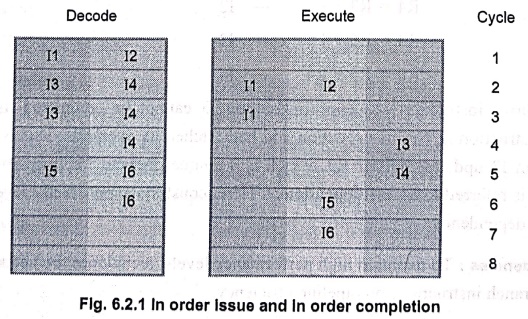
Let us consider the instructions with following constraints :
♦
I1 requires two cycles to execute
♦
I3 and I4 conflict for function unit
♦
I5 depends on the value produced by I4
♦
I5 and I6 conflict for function unit.
■
With above constraints in‒order issue with in‒order completion policy executes
all instructions as shown in Fig. 6.2.1.
In‒order Issue with Out‒of‒order Completion
■
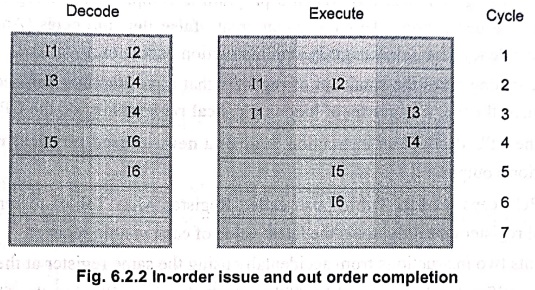
If any instruction requires multiple cycles and the next instruction is
independent of current instruction then it is allowed to execute before the
completion of current instruction. This policy is referred to as in‒order issue
with out‒of‒order completion. This policy is used in scalar RISC processors to
improve the performance of the instructions that require multiple cycles. Fig.
6.2.2 shows the modified execution sequence due to this policy. As shown in
Fig. 6.2.2 the net result is saving of one cycle.
Out‒of‒order Issue with Out‒of‒order Completion
■
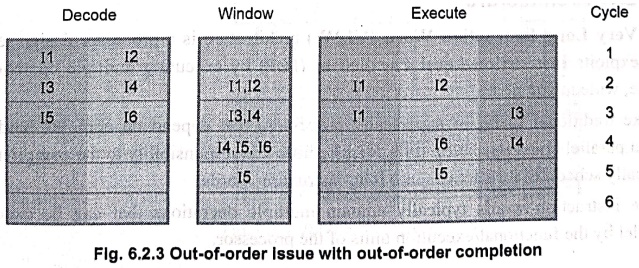
With in‒order issue, the processor decodes the instructions upto the point of a
dependency or conflict. But in out‒of‒order issue, processor decodes the
instruction beyond any dependency or conflict, to achieve look ahead capacity,
allowing it to identify independent instructions that can be brought into the
execute stage. To implement this, processor provides buffer commonly known as
instruction window where decoded instructions are stored. Fig. 6.2.3 shows the
modified execution sequence due to this policy.
4. Register Renaming
•
Register renaming is a hardware technique used in modern superscalar and out‒of‒order
processors to eliminate false data
dependencies that occur due to the reuse of a limited number of
architectural registers. By doing so, it exposes more Instruction‒Level Parallelism (ILP) and allows the CPU to execute
instructions more efficiently and out‒of‒ order.
•
Modern CPUs have a small, fixed number of architectural
registers defined by the instruction set (e.g., R1, R2, F0). When a program
is compiled, these registers are reused across multiple instructions. This
reuse can create false dependencies
(Anti‒dependency, Output dependency) that unnecessarily stall instruction
execution.
•
Register renaming takes the small set of registers that a programmer can see
(like R1, R2, etc.) and maps them to a larger set of hidden physical registers inside the CPU.
1.
When the CPU decodes an instruction, it gives a new, unused physical register for the instruction's output.
2.
The CPU keeps a Map Table (also
called Register Alias Table) to remember which physical register currently
holds the latest value of each visible register.
•
This prevents two instructions from accidentally using the same register at the
same time.
•
It removes artificial delays caused by "fake" dependencies, allowing
the CPU to execute instructions faster
and out‒of‒order.
Review Questions
1. What do you mean by
superscalar processor?
2. List the issues
which must be considered in implementation of superscaler processor.
3. Discuss various
instruction issue policies.
4. What is register
renaming?
Computer Organization and Architecture: Chapter 6: Next Generation Computer Architecture : Tag: Computer : - Superscalar Processors
Computer Organization and Architecture: Chapter 6: Next Generation Computer Architecture
Under Subject
Computer Organization and Architecture
CW25201 3rd Semester IT department. | 2025 Regulation | 3rd Semester 2025 Regulation
Related Subjects
Discrete Mathematics
MA25C14 3rd Semester CSE,IT,CY,AIDS departments. | 2025 Regulation | 3rd Semester 2025 Regulation
Data Structures
CS25C08 3rd Semester CSE,IT,CY,AIDS departments. | 2025 Regulation | 3rd Semester 2025 Regulation
Computer Organization and Architecture
CW25201 3rd Semester IT department. | 2025 Regulation | 3rd Semester 2025 Regulation
Object Oriented Programming
CS25C07 3rd Semester IT department. | 2025 Regulation | 3rd Semester 2025 Regulation
Web Technologies
IT25301 3rd Semester IT department. | 2025 Regulation | 3rd Semester 2025 Regulation
English Communication Skills Laboratory I
EN25C03 3rd Semester all department. | 2025 Regulation | 3rd Semester 2025 Regulation
Skill Development Course I
3rd Semester all department. | 2025 Regulation | 3rd Semester 2025 Regulation