Applied Physics I: Chapter 10: Applied Optics - Lasers
Lasers: Important part-A 2 marks Short Questions and Answers
Important part-A 2 marks Short Questions and Answers - Applied Physics I: Chapter 10: Applied Optics - Lasers
ANNA UNIVERSITY 'PART‒A'
QUESTIONS AND ANSWERS
1. What are Einstein's
A and B coefficients?
The
Einstein's Coefficients A and B accounts for spontaneous and stimulated
emission / absorption probabilities of light by a system of particles. It also
explains the importance of metastable states.
2. What are coherent
sources.
Coherent
sources are the sources which have the same wavelength and frequency. It has
correlation with the amplitude and phase at any point with any other point.
3. What is meant by
population inversion?
In
general, the number of atoms in the ground state will be more than that of the
atoms in the excited state and it is called usual population. The reverse of
this (i.e.) a state of achieving more number of atoms in the higher energy
level than that of the lower energy level is called population inversion.
4. Define metastable
state.
Metastable
state is the state for which the life time is more than the excited state,
i.e., it is the more stable state, which lies between the excited state and the
lower state.
5. Distinguish between
spontaneous and stimulated emission?
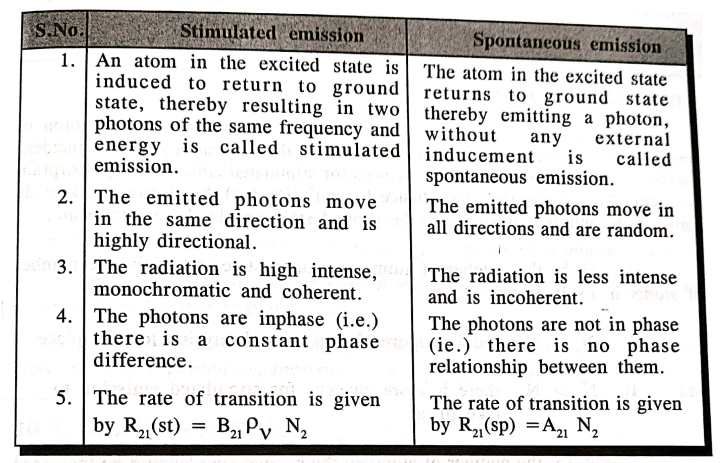
Spontaneous
emission
i.
The atom in the excited state returns to ground state thereby emitting a
photon, without any external inducement is called spontaneous emission.
ii.
The emitted photons move in all directions and are random.
iii.
The radiation is less intense and is incoherent.
iv.
The photons are not in phase (ie.) there is no phase relationship between them.
v.
The rate of transition is given by R21(sp) =A21 N2
Stimulated
emission
i.
An atom in the excited state is induced to return to ground state, thereby
resulting in two photons of the same frequency and energy is called stimulated
emission.
ii.
The emitted photons move in the same direction and is highly directional.
iii.
The radiation is high intense, monochromatic and coherent.
iv.
The photons are inphase (i.e.) there is a constant phase difference.
v.
The rate of transition is given by R11(st) = B21 ρv N2
6. Define coherent
length and coherent time? How are they related to each other?
The
maximum length upto which two waves trains have correlation with the amplitude
and phase is called coherent length and the time upto which they are correlated
is called coherent time.
They
are related as, coherent time = Coherent length / Velocity of light (c).
7. What are the
characteristics of Laser light. (Or) State the properties of laser beam.
The
four important characteristics of the laser beams are:
(i)
It is highly directional.
(ii)
It has high intensity.
(iii)
The beam is purely monochromatic.
(iv)
It has coherence.
8. State some of the
applications of lasers in engineering and Industry field.
(i)
High power lasers are useful to blast holes in diamonds and hard steel.
(ii)
They are used to test the presence of pores, cracks flows, blow holes etc in
the materials.
(iii)
They are used for welding and cutting.
(iv)
Laser is used in alloying, cladding, molding and also in microelectronic
industries.
9. Classify different
types of lasers based on active medium, with one example for each.
Type:
Example
i)
Solid State Laser: Ruby Laser - Active medium is Ruby rod (Al2O3 doped with Cr2O3)
ii)
Gas Laser: Carbon dioxide Laser - Active medium is the mixture of CO2,
N2 and Helium (or) water vapour.
iii)
Liquid Laser: Europium Chelate Laser - Active medium is benzoyl accetonate
dissolved in alcohol.
iv)
Dye Laser: Coumarin Dye Laser - Active medium is coumarin compound.
v)
Semi Conductor Laser: Ga As Laser - Active medium is P‒N junction. diode made
up of Ga and As.
10. What is the role of
nitrogen and Helium in CO2 laser?
In
CO2 laser the nitrogen helps to increase the population of atoms in
the upper level of CO2 while helium helps to depopulate the atoms in
the lower level of CO2 and also to cool the discharge tube.
11. What are the two
types of transitions that are possible in a CO2 gas laser?
i)
Transition from Asymmetric mode [00°1] to bending mode [02°0] will emit laser
of wavelength 9.6μm.
ii)
Transition from Asymmetric mode [00°1] to symmetric mode [10°0] will emit laser
of wavelength 10.6μm.
12. What are different
methods of pumping? (or)
What are the different
methods of achieving population inversion?
There
are five methods by which the pumping can be made, viz.,
(i)
Optical pumping.
(ii)
Direct electron excitation (Electron Discharge).
(iii)
Inelastic atom‒atom collision.
(iv)
Direct conversion.
(v)
Chemical process.
13. What are the
conditions required for laser action?
The
two important conditions required for laser action are:
(i)
Population inversion should be achieved.
(ii)
Stimulated emission should be predominent over spontaneous emission.
14. Can a two‒level
system be used for the production of laser? Why?
No,
two‒level system cannot be used for the production of Laser, because for
population inversion to be achieved, at least three levels are required.
15. Distinguish between
temporal coherence and spatial coherence.
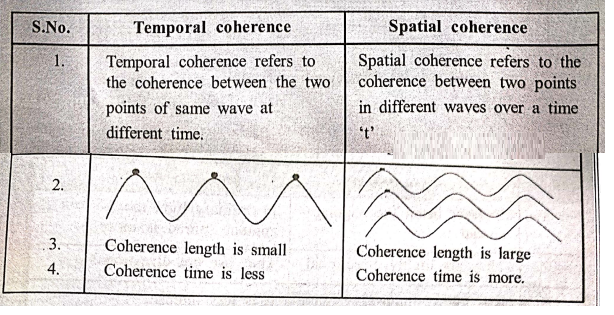
Temporal
coherence
•
Temporal coherence refers to the coherence between the two points of same wave
at different time.
•
Coherence length is small
•
Coherence time is less
Spatial
coherence
•
Spatial coherence refers to the coherence between two points in different waves
over a time 't'
•
Coherence length is large
•
Coherence time is more.
16. Give some
applications of laser in medical field.
(i)
It is used to drill minute holes in cell walls of human body.
(ii)
It is used to treat cancer and tumour in human beings and animals.
(iii)
It is used for the treatment of detached retina.
(iv)
It is used to carry out microsurgery and bloodless operation.
(v)
It is used to shatter the kidney stones.
(vi)
It is used to cut the bones precisely.
17. What is the
Principle for Laser action?
Principle:
Due to stimulated emission, the photons multiply in each step giving rise to an
intense beam of photons that are coherent and moving in the same direction.
Hence the Light is Amplified by Stimulated Emission of Radiation, termed as LASER.
Explanation:
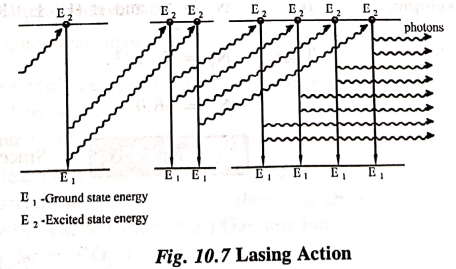
Let us consider many number of atoms in the excited state. We know the photons
emitted during stimulated emission has the same frequency, energy and are in
phase as the incident photon. Thus results in 2 photons of similar properties.
These two photons induce stimulated emission of 2 atoms in excited state
thereby resulting in 4 photons. This 4 photons induce 4 more atoms and give
rise to 8 photons etc., as shown in Fig. 10.7
18. Differentiate
between laser and ordinary light.
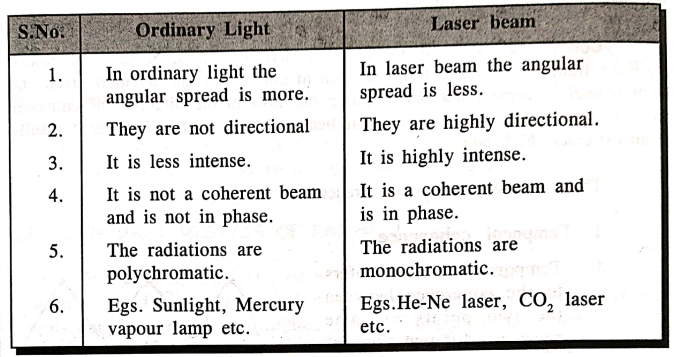
Laser
beam
1.
In laser beam the angular spread is less.
2.
They are highly directional.
3.
It is highly intense.
4.
It is a coherent beam and is in phase.
5.
The radiations are monochromatic.
6.
Egs: He‒Ne laser, CO2 laser etc.
Ordinary
Light
1.
In ordinary light the angular spread is more.
2.
They are not directional
3.
It is less intense.
4.
It is not a coherent beam and is not in phase.
5.
The radiations are polychromatic.
6.
Egs: Sunlight, Mercury vapour lamp etc.
ADDITIONAL PART‒A
QUESTIONS AND ANSWERS
1. What do you
understand by the term of "Coherence of a wave"?
The
coherence of a wave describes the accuracy with which it can be represented by
a pure sine wave throughout the space and time. Thus it tells the purity of
spectral line emitted from the light sources. When the wave is said to be in
phase and if it has high directionality, it is said to be coherent beam.
2. Explain the need of
population inversion in the production of lasers.
When
population inversion is achieved, the majority of atoms are in the excited
state. So, the absorption coefficient will be negative. The negative absorption
coefficient causes the amplification of the incident beam by stimulated
emission. Thus the laser beam is produced. Hence, population inversion is a
must for the production of Laser beam.
3. What is meant by
pumping?
Naturally,
the population inversion is achieved only at negative temperature which is
impossible. Thus, the process by which population inversion is achieved by
artificial means is called pumping.
4. What is the effect
of negative temperature in population inversion?
Under
the conditions of thermal equilibrium, Boltzmann's distribution function
relating N1 and N2 is given by
N1/N1
= e‒(E2‒E1)/KBT
Where
N1 and N2 are the number of atoms in lower and higher
states respectively. In the above equation, if T is negative, then stimulated
emission will dominate over stimulated absorption, (i.e) population inversion
will be achieving only if the temperature is negative.
5. What are Einstein's
coefficients?
In
the Einstein's theory of spontaneous and stimulated emission, if N1
and N2 are the number of atoms in the lower energy state (E1)
and higher energy state (E2) respectively, then the rate of
stimulated absorption is given by R12 = B12 ρv
N1.
The
rate of Spontaneous emission is given by R21(SP) = A21N2
The
rate of stimulated emission is given by R21(ST) = B21 ρv
N2
Here,
ρv is the energy density of the incident radiation and the constants
A21, B12 and B21 in the above three equations
are called Einstein's coefficients.
6. Define active
medium.
The
medium in which the populations inversion can be achieved is called active
medium.
7. What is meant by
optical resonator (or) Resonance cavity?
An
optical resonator (or) a resonance cavity is a feed back system, which consists
of an active medium kept inbetween a 100% mirror and a partial mirror. Here,
the intensity of light produced in the active medium is increased by making the
light to bounce back and forth between the mirrors. Finally the laser beam
comes through the partial mirror.
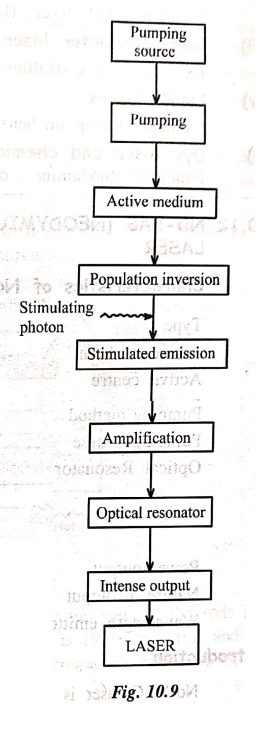
8. Draw the flowchart
for laser action.
The
flowchart for laser action is as shown in Fig. 10 .9.
9. What is principle
used in Nd‒YaG cases?
The
term "Doped Insulator Laser" refers to the active medium, yttrium
aluminium garnet doped with neodymium Nd3+. The neodymium ion has
many energy levels. Due to optical pumping these ions are raised to excited
levels. During the transition from metastable state to E1 state, the
laser beam of wavelength 1.064 μm is emitted.
10. Explain inelastic
atom‒atom collision.
In
this type of pumping method, a combination of two types of gases are used say A
and B both having the same (or) nearly coinciding excited states A* and B*.
During
elastic discharge, the A atom gets excited A* (meta stable state) due to
collision with electrons. The excited A* atoms now, collide with B atom, so
that B goes to excited state B* as shown below:
e‒ + A → A*
A*+B → B* + A
eg.
Helium ‒ Neon laser
11. What is meant by
TEA Laser?
TEA
laser is Transversely Excited Atmospheric pressure CO2 laser. Here
the gas flow is maintained along the axis of the discharge tube and the current
in the arc, flows at right angles to the axis of the discharge tube. Hence the
CO2 molecule will be transversely excited.
12. What is the
Principle used in Rhodamine ‒ 6G Laser.
Organic
dye such as Rhodamine‒6G (or) Xanthene dye dissolved in solvents like water or
alcohol is placed in the Dye cell. The pumping source excites these Dye
molecules to excited state. After achieving population inversion, these
molecules emit photons of the same wavelength, leading to laser action.
13. Mention any two
advantages and disadvantages of Xanthene dye laser.
Advantages
(i)
Dye lasers possess wide range of tunable wavelengths and hence it is used for
various applications.
(ii)
These lasers will achieve very high power output in both pulsed and continuous
wave modes.
(iii)
The dye lasers will have high repetition rates and will allow efficient
cooling.
Disadvantages
/ Limitations
(i)
Dye molecules will degrade in due course of time and hence the lifespan of Dye
laser is less.
(ii)
The experimental setup for Dye laser is complex in nature and hence maintenance
cost will be high.
14. List out any four
applications of a dye laser.
(i)
Dye lasers are widely used in spectroscopy for the study of properties of
materials.
(ii)
In Astronomy, dye lasers are used to create artificial guide stars.
(iii)
Since Dye lasers are Tunable lasers, they are used to selectively excite
molecules and study their reactions in research field.
(v)
Dye lasers are used to separate different isotopes of an element.
(v)
Dye lasers are used to do cosmetic procedures like hair removal, skin
rejuvenation and tattoo removal.
(vi)
In medical field dye lasers plays a vital role in treating eye diseases and
studying the effects of laser light on eye structures.
15. What are the
applications of laser in communication and military fields.
(a)
Communication field
(i)
Laser beam is useful in underwater communication between submarines and
warships.
(ii)
They are very useful in long haul and short haul communication network.
(iii)
Lasers are used in microwave communication due to its narrow band width.
(b)
In military field
(i)
High power and directional laser beam can be used to annihilate objects like aeroplanes,
missiles etc., by pointing the laser beam on them and hence its is called death
ray.
(ii)
It is useful in producing laser guns. It can also serve as a war weapon.
16. What is meant by
LIDAR? Give its use.
LIDAR
stands for Light Detection And Ranging. It is used in Laser Remote Sensing
applications such as
i.
Measuring atmospheric pollutant concentration.
ii.
Ozone concentration.
iii.
Vapour (water) concentration etc.
17. Why do we call
laser as a Non‒material knife?
In
laser surgery, without knife (or) hammer, bloodless operation, cutting tissues
etc. can be made, hence laser is called as non‒material knife.
18. Give the
applications of LASER in material processing.
In
material processing laser is used in
(i)
Micro electronics
(ii)
Cutting
(iii)
Welding
(iv)
Drilling
(iv)
Perforating holes
(v)
Surface hardening
(vi)
Alloying etc.
Applied Physics I: Chapter 10: Applied Optics - Lasers : Tag: Applied Physics : - Lasers: Important part-A 2 marks Short Questions and Answers
Applied Physics I: Chapter 10: Applied Optics - Lasers
Under Subject
Applied Physics I
PH25C01 1st Semester | 2025 Regulation | 1st Semester 2025 Regulation
Related Subjects

English Essentials I
EN25C01 1st Semester | 2025 Regulation | 1st Semester 2025 Regulation

தமிழர் மரபு - Heritage of Tamils
UC25H01 1st Semester | 2025 Regulation | 1st Semester 2025 Regulation
Applied Calculus
MA25C01 Maths 1 M1 - 1st Semester | 2025 Regulation | 1st Semester 2025 Regulation
Applied Physics I
PH25C01 1st Semester | 2025 Regulation | 1st Semester 2025 Regulation

Applied Chemistry I
CY25C01 1st Semester | 2025 Regulation | 1st Semester 2025 Regulation
Makerspace
ME25C04 1st Semester | 2025 Regulation | 1st Semester 2025 Regulation
Computer Programming C
CS25C01 1st Semester | 2025 Regulation | 1st Semester 2025 Regulation
Computer Programming Python
CS25C02 1st Semester | 2025 Regulation | 1st Semester 2025 Regulation
Fundamentals of Electrical and Electronics Engineering
EE25C03 1st Semester | 2025 Regulation | 1st Semester 2025 Regulation
Introduction to Mechanical Engineering
ME25C03 1st Semester | 2025 Regulation | 1st Semester 2025 Regulation

Introduction to Civil Engineering
CE25C01 1st Semester Civil Department | 2025 Regulation | 1st Semester 2025 Regulation
Essentials of Computing
CS25C03 1st Semester - AID CSE IT Department | 2025 Regulation | 1st Semester 2025 Regulation

Applied Physics I Laboratory
PH25C01 1st Semester practical Laboratory Manual | 2025 Regulation | 1st Semester Laboratory 2025 Regulation

Applied Chemistry I Laboratory
CY25C01 1st Semester practical Laboratory Manual | 2025 Regulation | 1st Semester Laboratory 2025 Regulation

Computer Programming C Laboratory
CS25C01 1st Semester practical Laboratory Manual | 2025 Regulation | 1st Semester Laboratory 2025 Regulation

Computer Programming Python Laboratory
CS25C02 1st Semester practical Laboratory Manual | 2025 Regulation | 1st Semester Laboratory 2025 Regulation
Engineering Drawing
ME25C01 EEE Mech Dept | 2025 Regulation | 2nd Semester 2025 Regulation

Basic Electronics and Electrical Engineering
EE25C04 1st Semester ECE Dept | 2025 Regulation | 2nd Semester 2025 Regulation