Linear Algebra: UNIT IV: Matrix Decomposition
Matrix Decomposition: Example Solved Problems
Important Example Solved Problems - Engineering Maths or Mathematics - Matrix Decomposition
MATRIX
DECOMPOSITION
WORKED EXAMPLES
Example 1
Find <x,y> if 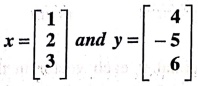
Solution:
<x, y> = 1(4)+2(−5)+3(6) = 4−10+18 = 12
Example 2
Find <x,y> if x =
[20, −4, 30, 10] and y = [10,−5,−8,−6].
Solution:
<x, y> = 20 (10) + (− 4) (− 5) + (30) (−8)
+ 10 (− 6)
= 200+20−240−60
<x, y> = −80
Example 3
Find the magnitude of x
= [2, −3, −4]
Solution:
The
magnitude is defined as <x, x>
<x, x> = 2(2)+(−3) (− 3) + (−4) (−4)
= 4+9+16
= 29
The
magnitude of x is ||x|| = √29
Example 4
Given that 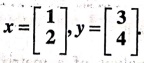 . Find <x, y>, <x, x> and <y,y>.
Solution:
(i)
<x,y> = 1(3)+2(4)=3+8=11
(ii)
<x, x> = (1)2 + (2)2 = 5
(iii)
<y, y> = (3)2 + (4)2 = 25
(iv)
|| x || = √<x, x> = √5
(v)
|| y || = √<x, y> = √25 = 5
Example 5
Given that x = [10, 20,
30] and y = [5,− 7,3]. Find <x,y>, <x, x> and <y,y>.
Solution:
(i)
<x, y> = 10(5) + 20(−7) + 30(3) = 50−140+90=0
(ii)
<x, x> = (10)2 + (20)2 + (30)2 = 100 +
400 + 900 = 1400
(iii)
<y, y> = (5)2 + (−7)2 + (3)2 = 25+49
+9=83
Example 6
Let 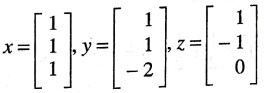 .
Verify whether the given vectors are orthogonal or not.
.
Verify whether the given vectors are orthogonal or not.
Solution:
Let
<x, y> = 1 (1) + 1 (1) + 1 (− 2) = 1+1−2
= 0
<y, z> = 1 (1) + 1 (− 1) + (− 2) (0) = 1−1+0
= 0
<z, x> = 1 (1) + (1) (−1) + 1 (0) = 1−1+0
= 0
Since
<x, y> = <y, z> = <z, x> = 0 is an orthogonal set because
each vector is orthogonal to every other vector.
Example 7
Let 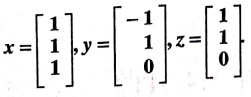 . Verify
these vectors are orthogonal or not.
. Verify
these vectors are orthogonal or not.
Solution:
<x,y> = 1(−1) + 1(1) + 1(0) = −1+1=0
<y, z> = (−1) (1) + (1)(1) + 0(0) = −1+1=0
<z, x> = 1(1) + 1(1) + 1(0) = 1+1 ≠ 20
These
vectors are not orthogonal vectors.
Note:
Zero vector is orthogonal to every vector.
Example 8
Verify whether this set
of vectors 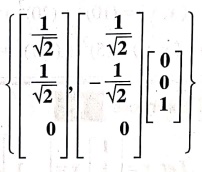 is orthonormal or not.
Solution:
<x,x> = (1/√2)2 + (1/√2)2
+ (0)2 = 1/2 + 1/2 + 0 = 1
<y,y>
= (1/√2)2 + (‒1/√2)2 + (0)2 = 1/2 + 1/2 + 0 =
1
<z, z> = (0)2 + (0)2
+ (1)2 = 0+0+1 = 1
The
given set of vectors are orthonormal.
Example 9
Let A = 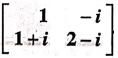 . Calculate
the (i) Frobenius norm (ii) L1 norm and (iii) L∞ norm.
. Calculate
the (i) Frobenius norm (ii) L1 norm and (iii) L∞ norm.
Solution:
(i) Frobenius norm
||A||F = [ |1|2 + |− i|2
+ |1+i|2 + |2− i|2 ]1/2
= [ 1 +
1 + (1 + i)(1 − i) + (2 − i)(2 + i) ] 1/2
= [1 + 1 + 1 − i + i − i2+4+2i−2i−i2
] 1/2
= [1 + 1 + 1 + 1 + 4 + 1]1/2 = [9]1⁄2
||A||F = 3
(ii) L1 −
norm
We
know that || A ||1 =
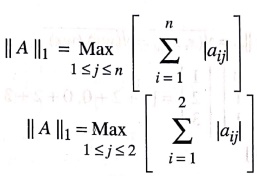
=
Max [ |a11| + |a21|,
|a12| + |a22| ]
=
Max [ |1|+| 1+ i|, |− i│+ |2 − i |
=
Max [ √12 + √(12 + 12), √(−1)2 + √(22
+ (− 1)2) ]
=
Max [1 + √2, 1+ √5]
||A||1
= 1+√5
(iii) L∞ norm
We know that || A ||∞ =
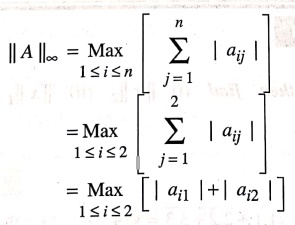
=
Max [ |a11| + |a12| , |a21| + |a22|
]
=
Max [ |1| + |-i| , |1+i| + |2-i| ]
=
Max [ √12 + √(-1)2 , √(12+12) + √(22+(‒1)2)
]
= Max [1 + 1, √2+√5]
=
Max [2, √2 + √5]
||A||∞ = √2+√5
Example 10
Determine ||x||w
and ||y||w for 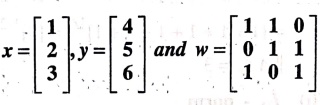
Solution:
We
know that ||x||w = √[(x, x)w] = √[ (wx) (wx) ]
Now
wx = 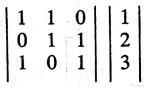
= [1+2+0, 0+2+3, 1+0+3]
wx
= [3, 5, 4]
||x||w = √[(wx) (wx)] = √[32
+52 +42] = √[9 + 25 + 16] = √50
||y||w = √(x, y)w =
√[(wy)(wy)]
Now
wy = 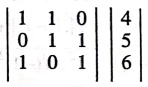
=
[4+5+0, 0+5+6, 4+0+6]
wy
= [9, 11, 10]
||
y ||w = √[(wy) (wy)] = √[92 + 112 + 102]
= √[81 + 121 + 100] = √302.
Example 11
If x=  then find (i) ||x||2
(i) ||x||1 (iii) ||x||∞ and (iv) || x ||5.
then find (i) ||x||2
(i) ||x||1 (iii) ||x||∞ and (iv) || x ||5.
Solution:
(i) ||x||2 = √(x•x) = √(1.1+2.2
+3.3) = √14
(ii) ||x||1 = |1| + |2 | + |3| = 6
(iii) ||x||∞ =Max [ |1|, |2|, |3| ]
= 3
(iv) ||x||5 = [ |1|5 + |2|5
+ |3|5 ]1/5 = (276)1/5 = 3.077.
Example 12
If 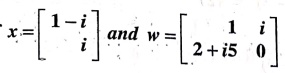 then find (i) ||x||w, (ii) ||x||2, (iii)
||x||1 (iv) ||x||∞
and (v) ||x||4.
then find (i) ||x||w, (ii) ||x||2, (iii)
||x||1 (iv) ||x||∞
and (v) ||x||4.
Solution:
||x||w = √(x, x)w = √[(wx)
(wx)]
Now
wx= 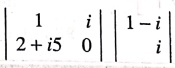
=
[ (1(1 − i) + i2, (2 + i5)(1 − i) + 0(i) ]
=
[1 − i−1, 2−2i + 5i − 5i2]
=
[−i, 7+3i]
(i)
|| x ||w = √[(− i) (i) + (7 + 3i) (7 − 3i)] = √[ (− i2) +
49 − 21i + 21i – 9i2 ]
=
√ [ 1 + 49 + 9 ] = √59
(ii)
||x||2 = √(x, x) = √[(1 − i) (1 + i) + i (−i)] =√[1−i2−i2]
=
√(1+1+1) = √3
(iii)
||x||1 = | 1 − i |+| i | = √[(1 − i) (1 + i)] + √[i (− i)] = √[12
− i2] + √−i2
=
√[1 +1] + √1 = √2 + 1
(iv)
|| x ||∞ = Max [ |1−i|, | i | ] = Max [√[1+(−1)2], √12
]
=
Max [√2, 1] = √2
(v)
||x||4 = [ |1−i|4 + |i|4 ]1/4 = [(√[12
+(− 1)2)4 + (√12)4
]1⁄4
=
[ (√2)4 + (1)4 ]1/4 = [ 4 + 1 ]1/4
= 51/4
Example 13
Find the distance
between x and y with respect to
(i) Euclidean norm
(ii) the inner product
norm with respect to w
(iii) l3
norm for
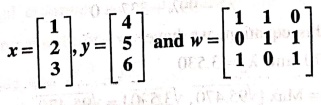
Solution:
For
these vectors, x−y = [1−4, 2−5, 3−6] = [−3, −3, −3]
(i)
|| x − y ||2 = √ [ (−3)2 + (− 3)2 + (− 3)2
] = √27
(ii)
w (x − y) = [−6, −6, −6]
|| x − y ||w = √[ w(x − y) • w (x −
y)]
= √ [ (− 6)2 + (− 6)2 +
(− 6)2 ] = √[36 + 36 +36] = √108
(iii)
|| x − y ||3 = [ |− 3|3 + |− 3|3 + |− 3|3
]1/3
= [27 +27 +27]1/3 = (81)1/3
Example 14
Let 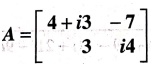 calculate (i) Frobenius norm (ii) L1 norm (iii) L∞ and
(iv) Spectral norm.
calculate (i) Frobenius norm (ii) L1 norm (iii) L∞ and
(iv) Spectral norm.
Solution:
(i)
||A||F = px = [ |4 + i3|2 + |−7|2 + |3|2
+ |i4|2 ]1/2
= √[25 +49 + 9 + 16] = √99
(ii) || A ||1 = Max [ | 4+ 3i | +
|3| , | −7 | + | i4 | ]
=
Max [5 +3, 7+4] = 11
(iii)
|| A ||∞ = Max [ |4+3i| + |−7 |, |3|+|i4| ]
=
Max [5 +7, 3+4] = 12
(iv)
Spectral norm
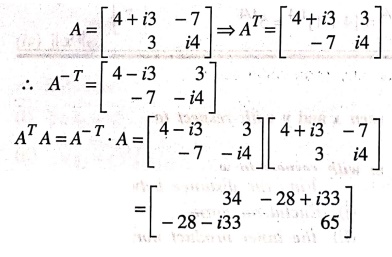
Which
has the characteristic equation
λ2 − 99λ + 337 = 0
By
solving this equation, we have
⇒ λ
= 95.470 and λ2=3.530
|| A ||S = Max [√95.470, √3.530] =
√95.470
Example 15
Let A = 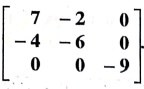 . Calculate (i) Frobenius norm (ie) ||A||F (ii) ||A||1,
(iii) ||A||∞, and (iv) Spectral Norm.
. Calculate (i) Frobenius norm (ie) ||A||F (ii) ||A||1,
(iii) ||A||∞, and (iv) Spectral Norm.
Solution:
(i)
||A||F = 13.638
(ii)
||A||1 = Max [9, 10, 9] = 10
(iii)
||A||∞ = Max [11, 8, 9] = 11
(iv)
A‒TA=ATA = 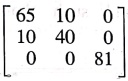
which
has eigenvalues 68.5078, 36.4922 and 81.0
||
A ||S = Max [√68.5078, √36.4922, √81]
=
√81 = 9
Linear Algebra: UNIT IV: Matrix Decomposition : Tag: maths, mathematics : - Matrix Decomposition: Example Solved Problems
Linear Algebra: UNIT IV: Matrix Decomposition
Under Subject
Linear Algebra
MA25C02 2nd Semester | 2025 Regulation
Related Subjects

English Essentials II
EN25C02 2nd Semester | 2025 Regulation | 2nd Semester 2025 Regulation

Tamils and Technology தமிழர்களும் தொழில்நுட்பமும்
UC25H02 2nd Semester | 2025 Regulation | 2nd Semester 2025 Regulation
Linear Algebra
MA25C02 2nd Semester | 2025 Regulation
Transforms and its Applications
MA25C03 2nd Semester EEE Dept | 2025 Regulation | 2nd Semester 2025 Regulation

Applied Physics (CE) II
PH25C02 2nd Semester Civil, Agri Depts | 2025 Regulation | 2nd Semester 2025 Regulation
Applied Physics (CSIE) II
PH25C03 2nd Semester AIDS, CSE, IT, CSE(CY) Dept | 2025 Regulation | 2nd Semester 2025 Regulation
Applied Physics (EE) II
PH25C04 2nd Semester EEE Dept | 2025 Regulation | 2nd Semester 2025 Regulation

Applied Physics (ME) II
PH25C05 2nd Semester Mechanical Dept | 2025 Regulation | 2nd Semester 2025 Regulation
Applied Chemistry (CE) II
CY25C02 2nd Semester Civil Dept | 2025 Regulation | 2nd Semester 2025 Regulation

Applied Chemistry (ME) II
CY25C03 2nd Semester Mechanical Dept | 2025 Regulation | 2nd Semester 2025 Regulation

Electron Devices
EC25C01 2nd Semester ECE Dept | 2025 Regulation | 2nd Semester 2025 Regulation

Digital Principles and Computer Organization
CS25C06 2nd Semester AIDS, CSE, IT, CSE(CY) Dept | 2025 Regulation | 2nd Semester 2025 Regulation

Basic Electrical and Electronics Engineering
EE25C01 2nd Semester | 2025 Regulation | 2nd Semester 2025 Regulation

Basic Civil and Mechanical Engineering
GE25C01 2nd Semester EEE Dept | 2025 Regulation | 2nd Semester 2025 Regulation
Data Structures using CPlusPlus
CS25C05 2nd Semester ECE Dept | 2025 Regulation | 2nd Semester 2025 Regulation
Engineering Drawing
ME25C01 EEE, Mech, Agri, EEE Depts | 2025 Regulation | 2nd Semester 2025 Regulation
Data Structures and Algorithms
CS25C04 2nd Semester EEE Dept | 2025 Regulation

Circuits and Network Analysis
EC25C02 2nd Semester ECE Dept | 2025 Regulation | 2nd Semester 2025 Regulation

Engineering Mechanics
ME25C02 2nd Semester Mech, Civil, Agri Depts | 2025 Regulation | 2nd Semester 2025 Regulation
Object Oriented Programming (OOPs)
CS25C07 2nd Semester CSE, CSE(CY) Depts | 2025 Regulation | 2nd Semester 2025 Regulation