Linear Algebra: UNIT IV: Matrix Decomposition
Positive Definite Matrices
Matrix Decomposition
The eigenvalues of any symmetric matrix are real. This section is about the case in which the eigenvalues are positive.
POSITIVE DEFINITE
MATRICES
The
eigenvalues of any symmetric matrix are real. This section is about the case in
which the eigenvalues are positive. These matrices, which arise whenever
optimization (maximum or minimum) problem are encountered in the fields of
science and engineering.
Definition: Positive definite matrices
A
square matrix is called positive definite, if it is symmetric and all its
eigenvalues λ are positive (ie. λ>0)
Note:
1.
If A is positive definite, then it is invertible and |A|>0.
2.
A symmetric matrix A is positive definite if and only if XTAX>0 for
every column X ≠0 in Rn.
To
know about positive definite matrices, we should familiar with normal matrices
and Hermitian matrices.
Definition: Normal
matrices
The
Hermitian transpose of a matrix A, denoted by AH is the complex
conjugate transpose of A (ie) AH= . A matrix
A is normal if AAH=AHA.
. A matrix
A is normal if AAH=AHA.
Normal
matrices have the following properties.
Properties
1.
Every normal matrix is similar to a diagonal matrix.
2.
Every normal matrix possesses a canonical basis of eigenvectors which can be
arranged to form an orthonormal set.
Definition: Hermitian matrices
A
matrix is Hermitian if it equals its own Hermitian transpose (or complex
conjugate transpose).
(ie) A is Hermitian if A = AH
The
sum of Hermitian matrices is Hermitian, as is the product of a Hermitian matrix
with a real scalar. A Hermitian matrix is also normal because AAH =
AA = AHA.
Properties
1.
The eigenvalues of a Hermitian matrix are real.
2.
If a Hermitian matrix A can be reduced to upper triangular matrix U using only
elementary row operations. Then the diagonals of U contains the same number of
zeros, the same number of positive values and the same number of negative
values as the eigenvalues of A.
3.
An n×n matrix A is Hermitian if and only if <AX, X> is real for all real
and complex n−dimensional vectors X.
Definition: Real symmetric matrices
A
matrix is symmetric if it equals its own transpose. A symmetric matrix that
contains only real elements is Hermitian and therefore, normal. Consequently,
real symmetric matrices possess all the 5 properties from normal matrices and
Hermitian matrices along with
Property
1.
The eigenvectors of a real symmetric matrix can be chosen to be real.
Definition: The Adjoint
The
adjoint of an n×m matrix A is an m×n matrix A* having the property that
(X, AY)w = (A*X, Y)w for
all m−dimensional vectors Y and n−dimensional vectors X.
A* = (WHW)‒1 AH
(WH W).
For
W= 1 (the Euclidean inner product), the above relation for A* reduces to A* = AH.
1.
(A*)* = A
2.
(A+B)* = A* + B*
3.
(AB)* = B*A*
4.
(CA)* =  A* for any scalar C.
Definition: Self Self Adjoint Matrices
A
matrix A is self−adjoint if it equals its own adjoint. Such a matrix is a
square matrix and it satisfies the identity
<X,AY>w = <AX, Y>w
for
all vectors X and Y. A matrix is self−adjoint with respect to the Euclidean
inner product if and only if it is Hermitian.
Definite matrices
Let
an n×n Hermitian matrix be A. It is said to be
(i)
Positive definite: If <AX, X> > 0
(ii)
Positive semi−definite: If <AX.X> ≥ 0
(iii)
Negative definite: If <AX, X> < 0
(iv)
Negative semi−definite: If <AX, X> ≤ 0
Note:
1.
The sum two definite matrices of the same type is again a definite matrix of
that type.
2.
Positive or negative definite matrices are inversible and their inverses are
also positive or negative definite.
1. Tests for positive definiteness
The
following three tests stipulates necessary and sufficient conditions for an n×n
Hermitian matrix A to be positive definite.
That
means, a Hermitian matrix A is positive definite if it satisfies any one of the
three tests.
Test 1:
A is positive definite if and only if it can be reduced to upper triangular
form using elementary row operations and the diagonal elements of the resulting
matrix (the pivots) are all positive.
Test 2:
A principal minor of A is the determinant of any submatrix obtained from A by
deleting its last k rows and k columns (k = 0, 1, 2, 3, 4 …., n−1). A is
positive definite if and only if all its principal minors are positive.
Test 3:
A is positive definite if and only if all its eigenvalues are positive.
The
following tests stipulate necessary condition for an n×n matrix A = [aij]
to be positive definite. A Hermitian matrix that fails any one these tests is
not positive definite.
Test 4:
The diagonal elements of A must be positive.
Test 5:
The elements of A having greatest absolute value must be on the diagonal of A.
Test 6:
aijajj > |aij|2 (i ≠ j)
2. Tests for positive semi−definiteness
All
these 6 tests may be changed to test for positive semi−definite by replacing
the word positive with non−negative and replacing > with ≥.
3. Test for negative definiteness
In
all the above 6 tests, the word positive is to be replaced with the word
negative, and replacing > with <.
4. Test for negative semi−definiteness
In
all the above 6 tests, the word positive is to be replaced with the word non−negative
with non−positive and replacing > with ≤.
Definition: Square roots of matrices
The
square root of a matrix A is a matrix A1/2 having the property that
A=A1/2.A1/2. If A and A1/2 are both
required to be positive definite or positive semi−definite, then A1/2 is unique and the square root is a well
defined function.
5. Cholesky decomposition
Any positive definite matrix A may be factored
into
A=LLH
Where L is the lower triangular matrix having
positive values on its diagonal. This equation defines the Cholesky
decomposition for A which is unique.
The
following algorithm generates the Cholesky decomposition for an n×n matrix A =
[aij] by sequentially identifying the columns of L on and below the
main diagonal.
Step 1: Initialization
Set
all elements of L above the main diagonal equal to zero, and let l11=√a11. The remainder of the
first column of L is the first column of A divided by l11. Set a
counter j=2.
Step 2:
If
j=n+1 stop. The algorithm is complete. Otherwise, define L'i(i = j,
j + 1, j + 2... n) to be a column vector of dimension j−1 whose components are
respectively the first j−1 elements in the ith row of L. These
elements have already been computed.
Step 3:
Compute lij
= √ [ ajj ‒ <L'j, Lj'> ].
Step 4:
If
j=n skip to step 5. Otherwise compute the jth column of L below the
main diagonal.
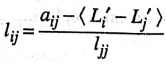
For
each i = j+1, j+2, ... n, compute lij=
[ ajj ‒ <L i' ‒ Lj'> ] / ljj
Step 5:
Increase
j by 1 and return to step 2.
Linear Algebra: UNIT IV: Matrix Decomposition : Tag: : Matrix Decomposition - Positive Definite Matrices
Linear Algebra: UNIT IV: Matrix Decomposition
Under Subject
Linear Algebra
MA25C02 2nd Semester | 2025 Regulation
Related Subjects

English Essentials II
EN25C02 2nd Semester | 2025 Regulation | 2nd Semester 2025 Regulation

Tamils and Technology தமிழர்களும் தொழில்நுட்பமும்
UC25H02 2nd Semester | 2025 Regulation | 2nd Semester 2025 Regulation
Linear Algebra
MA25C02 2nd Semester | 2025 Regulation

Transforms and its Applications
MA25C03 2nd Semester EEE Dept | 2025 Regulation | 2nd Semester 2025 Regulation

Applied Physics (CE) II
PH25C02 2nd Semester Civil, Agri Depts | 2025 Regulation | 2nd Semester 2025 Regulation

Applied Physics (CSIE) II
PH25C03 2nd Semester AIDS, CSE, IT, CSE(CY) Dept | 2025 Regulation | 2nd Semester 2025 Regulation

Applied Physics (EE) II
PH25C04 2nd Semester EEE Dept | 2025 Regulation | 2nd Semester 2025 Regulation

Applied Physics (ME) II
PH25C05 2nd Semester Mechanical Dept | 2025 Regulation | 2nd Semester 2025 Regulation

Applied Chemistry (CE) II
CY25C02 2nd Semester Civil Dept | 2025 Regulation | 2nd Semester 2025 Regulation

Applied Chemistry (ME) II
CY25C03 2nd Semester Mechanical Dept | 2025 Regulation | 2nd Semester 2025 Regulation

Electron Devices
EC25C01 2nd Semester ECE Dept | 2025 Regulation | 2nd Semester 2025 Regulation

Digital Principles and Computer Organization
CS25C06 2nd Semester AIDS, CSE, IT, CSE(CY) Dept | 2025 Regulation | 2nd Semester 2025 Regulation

Basic Electrical and Electronics Engineering
EE25C01 2nd Semester | 2025 Regulation | 2nd Semester 2025 Regulation

Basic Civil and Mechanical Engineering
GE25C01 2nd Semester EEE Dept | 2025 Regulation | 2nd Semester 2025 Regulation
Data Structures using CPlusPlus
CS25C05 2nd Semester ECE Dept | 2025 Regulation | 2nd Semester 2025 Regulation
Engineering Drawing
ME25C01 EEE, Mech, Agri, EEE Depts | 2025 Regulation | 2nd Semester 2025 Regulation
Data Structures and Algorithms
CS25C04 2nd Semester EEE Dept | 2025 Regulation

Circuits and Network Analysis
EC25C02 2nd Semester ECE Dept | 2025 Regulation | 2nd Semester 2025 Regulation

Engineering Mechanics
ME25C02 2nd Semester Mech, Civil, Agri Depts | 2025 Regulation | 2nd Semester 2025 Regulation

Object Oriented Programming (OOPs)
CS25C07 2nd Semester CSE, CSE(CY) Depts | 2025 Regulation | 2nd Semester 2025 Regulation