Linear Algebra: UNIT IV: Matrix Decomposition
Positive Definite Matrices: Example Solved Problems
Important Example Solved Problems - Engineering Maths or Mathematics - Positive Definite Matrices: Example Solved Problems
Positive
Definite Matrices
WORKED EXAMPLES
Example 1
Determine which of the
following matrices are normal.
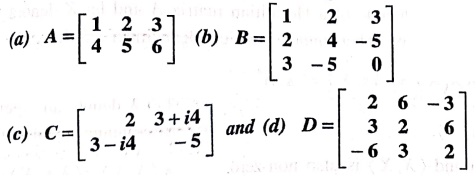
Solution:
(a)
The given matrix A is not a square matrix. Hence, it is not a normal.
(b)
The given matrix B is real and symmetric. Hence it is a normal matrix.
(c)
The given matrix C is a Hermitian matrix and therefore it is normal.
(d)
To verify the matrix D is normal or not, we have to verify it is DDH
= DHD.
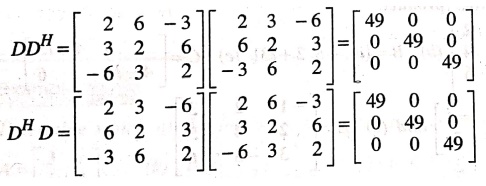
Since
DDH = DHD, it is normal matrix
Example 2
Prove that the
eigenvalues of AHA are non−negative.
Solution:
If
λ is an eigenvalue of AHA, then there must exist a non−zero
eigenvector X associated with λ satisfying the equality AHAX =
λX.
0 ≤ <AX, AX> = <A* AX, X> = <AHAX,
X> = <λX, X> = λ <X, X>.
Since
X is an eigenvector, it is non−zero and <X, X> is positive. Dividing by <X,
X>, it gives λ≥0.
Example 3
Prove that the eigen values
of a Hermitian matrix are real.
Solution:
Let
λ denote an eigenvalue of a Hermitian matrix A and let X denote a corresponding
eigenvector. Then under the Euclidean inner product,
λ<X,X> = <λX,X> = <AX, X> =
<X, A*X>
= <
X, AHX > = < X, λ X > =  < X, X >.
Since
X is an eigenvector, it is non−zero and <X, X> is also non−zero. Dividing
by <X, X> then the above relation gives λ= which implies that λ
is real.
Example 4
Determine the adjoints
of the following matrices with respect to the Euclidean inner product.
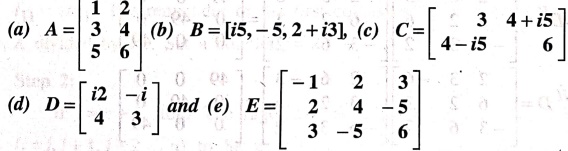
Solution:
We
know that A* = AH (Euclidean inner product)
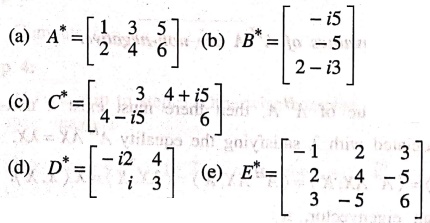
Here
c and e are self−adjoint because both are Hermitian.
Example 5
Determine
the adjoint of A under an inner product with respect to W where 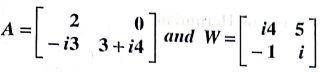
Solution:
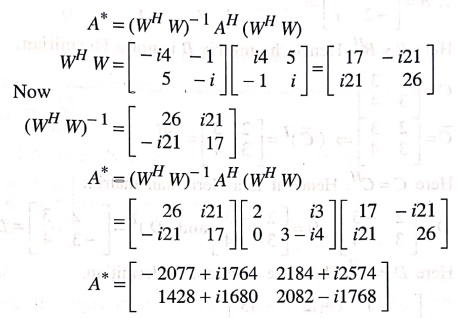
We
know that, the adjoint exists and it is
A* = (WH W)‒1 AH(WHW)
Example 6
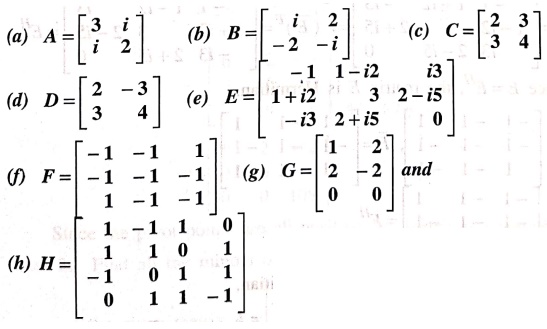
Determine which of the
following matrices are Hermitian.
Solution:
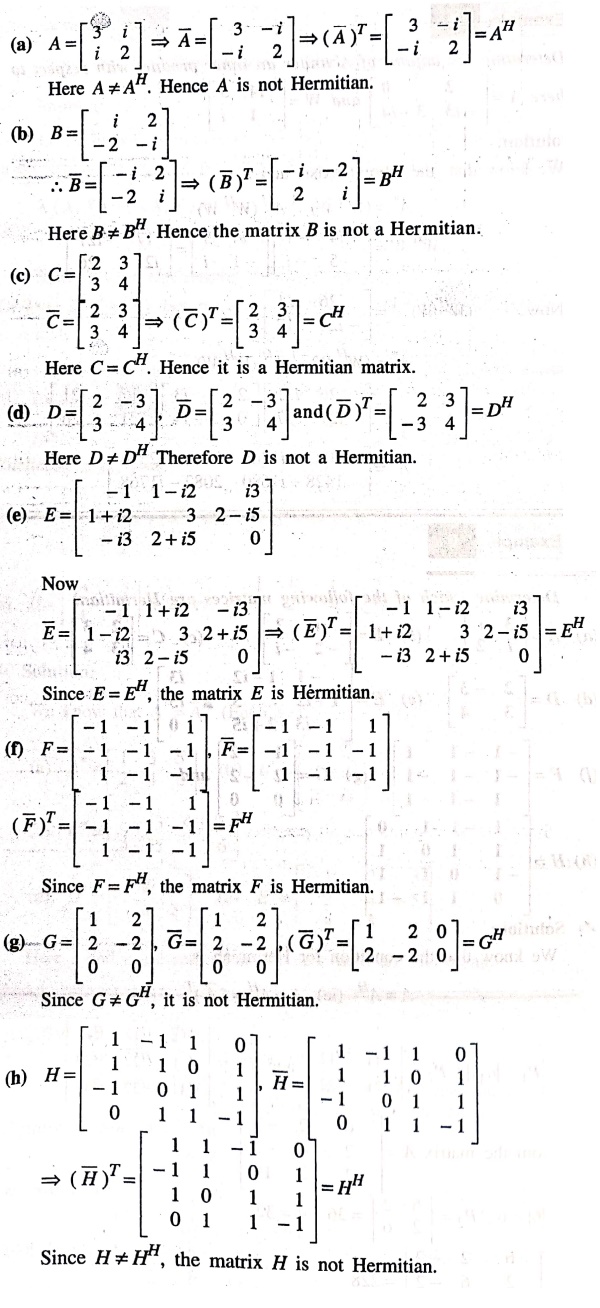
We
know that the condition for Hermitian is
A=AH (ie) A=AH = ( )T
)T
Example 7
Use
the first three tests to verify the given matrix 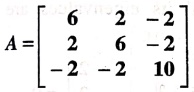 is positive
definite.
is positive
definite.
Solution:
Test 1:
Form the upper triangular matrix for the matrix A by using row operations.
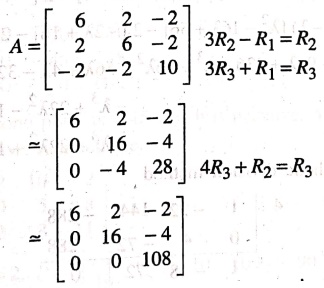
Since
the pivot points are all positive, the matrix is positive definite.
Test 2:
Find all the minors of the matrix A.
Let
the given matrix
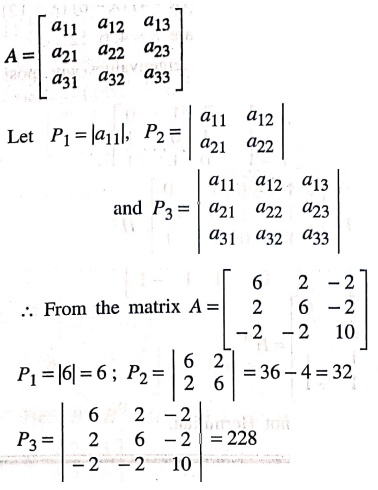
Since
all the three principal minors are positive, the matrix is positive definite.
Test 3:
A is positive definite if and only if all its eigenvalues are positive.
The
characteristic equation |A−λI| =
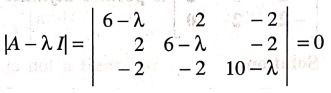
(6−λ) [(6−λ) (10−λ)−4] − 2[2(10−λ)−4]−2[−4+2
(6−λ)]=0
(6−λ)
[60−6λ−10λ +λ2−4]−2[20−2λ−4]−2[−4+12−2λ]=0
(6
− λ) [λ2 – 16λ +56] − 2[−2λ + 16] − 2[− 2λ + 8] = 0
6λ2
− 96λ +336−λ3 +16λ2 − 56λ +4λ − 32 + 4λ − 16 = 0
−
λ3 + 22λ2 − 144λ +288=0
λ3 − 22λ2 + 144λ − 288 =
0
By
using synthetic division method
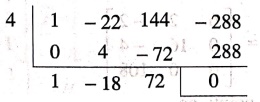
The
eigenvalues are λ = 4, 6, 12.
Since
all the three eigenvalues are positive, the given matrix is positive definite.
Example 8
Use all the tests to determine whether the given matrix is positive definite or not.
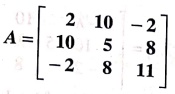 .
.
Solution:
Test 1:
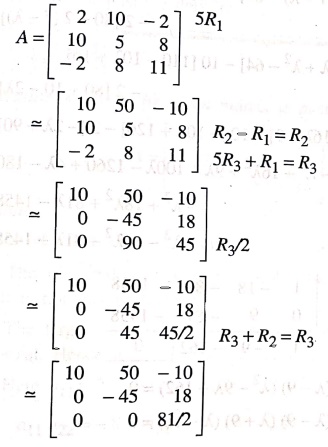
Since
the second pivot is −45 which is negative, A is neither positive definite (or)
positive semidefinite.
Test 2:
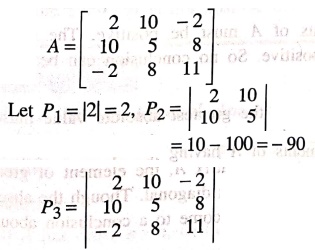
=
2[55−64] − 10[110 + 16] − 2[80 + 10]
=
2[−9]−10[126]−2[90]
=
−18−1260−180
=
−1458
Since
P2 and P3 are negative, A is not positive definite.
Test 3:
To find the eigenvalues, let
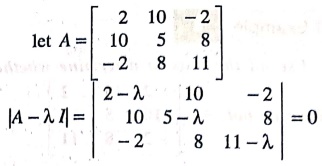
⇒
(2−λ)
[(5− λ) (11− λ)−64] − 10[10(11− λ)+16] − 2[80+2(5− λ) ] = 0
(2 − λ) [55 − 5λ − 11λ + λ2−64] − 10
[110−10λ +16] − 2[80+10−2λ] = 0
(2−λ)[λ2−16λ−9] − 10[−10λ+126] − 2[−2λ+90]
= 0
2λ2−32λ−18− λ3 +16λ2
+9λ + 100λ −1260+4λ−180 = 0
−λ3 + 18λ2 + 81λ – 1458
= 0
λ3 – 18λ2 − 81λ +1458 = 0
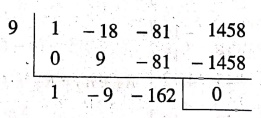
(λ−9) (λ2−9λ−162) = 0
(λ−9) (λ+9) (λ−18) = 0
The
eigenvalues are λ = −9, 9, 18.
Since
all the eigenvalues are not positive, it is not positive definite.
Test 4:
The diagonal elements of A must be positive. The diagonal elements 2, 5 and 11
are all positive. So no conclusion can be attained from this test.
Test 5:
The elements of A having the greatest absolute value must be on the diagonal of
A. From the given matrix A, the element of greatest absolute value is 11. It
appears on the main diagonal. Though the absolute value is on the main
diagonal, we cannot come to a conclusion about be positive definite.
Test 6:
We know that aiiajj > |aij|2 (i ≠ j).
When
i = 1 and j=2, we have from the given matrix A,
a11=2
and a22=5 and a12=10
a11a22 = 2(5) = 10
a12
= 10
|a12|2 =|10|2
= 100
a11a22 > |α12|2
⇒ 10 > 100
Hence
A is not positive definite.
Example 9
Determine whether the
given matrix is positive definite or not.
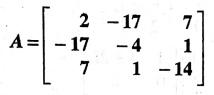
Solution:
Let
us refer the Tests 4, 5 and 6.
Test 4:
The diagonal elements are 2,−4,− 14. Since they are all not positive, it is not
positive definite.
Test 5:
The largest element in absolute value is ‒17. It is not on the main diagonal.
Hence it is not positive definite.
Test 6:
Here a11=2, a22=−4,
a12=−17
a11a22
= −8 > |a12|2
= |‒17|2 = 289
But
−8 < 289
The
matrix A is not positive definite.
Example 10
Prove that the diagonal
element of a positive definite matrix must be positive.
Solution:
If
A has order n×n, define X to be an n−dimensional vector having one of its
components, say the kth equal to unity and all the other components
equal to zero. For this vector 0 < <AX, X> = <AX> .  = akk.
Example 11
Let 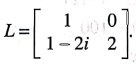 . Find
the Cholesky−Decomposition for L.
. Find
the Cholesky−Decomposition for L.
Solution:
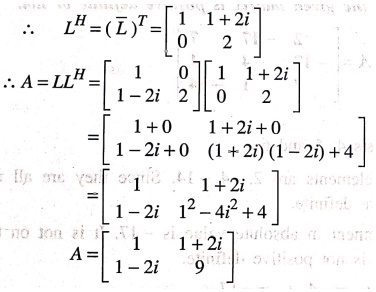
It
is given that
The
Cholesky decomposition is A = LLH
Where
L is the lower triangular matrix and LH is the Hermition matrix of H.
Example 12
Find the Cholesky
factorization of 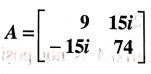
Solution:
We
know that A = LLH.
Where
L is the lower triangular matrix and LH is the Hermitian matrix of L.
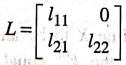
Since
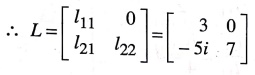
L is the lower triangular matrix, it is in the form of
The
given matrix A is in the form 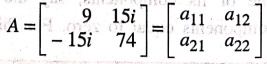
Where
a11=9, a12=15i, a21=−15i and a22=74.
We
start from the first column and its diagonal entry.
Let
l11 = √a11 = √9 = 3
Then
l21 = a21/l11 =
−15i / 3 = ‒5i.
Now
we move to the second column and its diagonal entry
l22
= √[ a22−l21 ]
]
=
√[ 74 − (−5i) (5i) ]
=
√ [ 74 + 25(i2) ]
=
√[ 74−25 ] = √49 = 7
To verify the Cholesky
decomposition
Let
us verify A = LLH.
Where
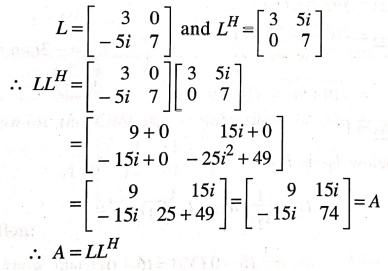
A = LLH
The
Cholesky−Decomposition is verified.
Example 13
Compute the Cholesky
decomposition of 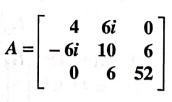 .
.
Solution:
We
know that the Cholesky decomposition is A=LLH.
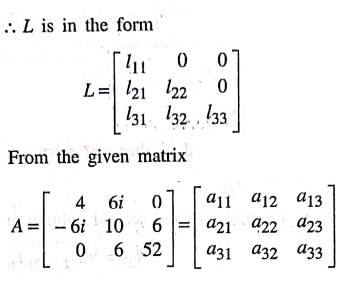
Where
L is the lower triangular matrix and LH is the Hermitian matrix of
L.
We
start from the first column.
Let
l11 = √a11 = √4 = 2.
The
second entry is l21 = a21/l11 = −6i/2 = −3i
The
third entry is l31 = a31/l11 = 0/4 = 0
We
now proceed to the second column, where we start with the entry
l22
= √[a22−l21]
l22=√[10−(−3i)
(3i)] ( l21 = −3i
and = 3i)
=
√[10 + 9i2] = √[10−9] = √1
l22
= 1
The
entry below l22 is l32.
l32
= 1/l22 (a32 − l31)
=
1/1 ( 6–0.(3i) ) = (6 – 0)
l32
= 6
Now
we can go to the third column and find
l33=√
[ a33−l31 −l32
−l32  ]
]
l33
= √[ 52−0.0−6.6]
(l31
= 0, = 0 and l32
= 6, = 6)
l33
= √[52−36] = √16 =4
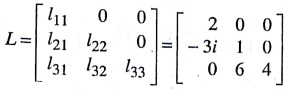
Hence
the triangular matrix used in the decomposition is
To verify the Cholesky
decomposition
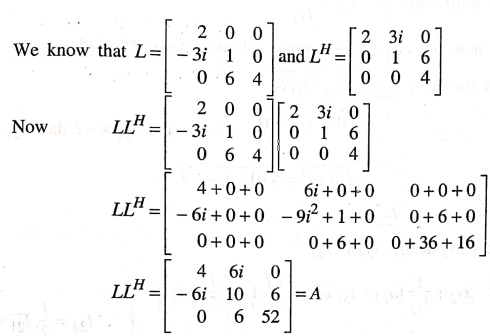
A = LLH Cholesky decomposition is
verified.
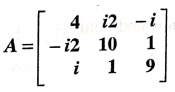
Example 14
Determine the Cholesky decomposition
for the given matrix
Solution:
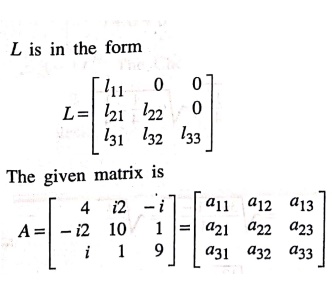
We
know that the Cholesky decomposition is A=LLH.
L is the lower triangular matrix and LH
is the Hermitian matrix of L.
We
start from the first column
Let
l11=√a11 = √4 =
2.
The
second entry is l21 = a21/l11 = −i2/2 = −i
The
third entry is l31 = a31/l11 = i/2
We
now proceed to the second column, where we start
with
the entry l22 = √[a22−]
=
√[ 10 − (−i)(i) ]
(l21
= − i then = i)
=
√[10+ i2] = √[10 – 1] = √9
l22
= 3
The
entry below l22 is l32.
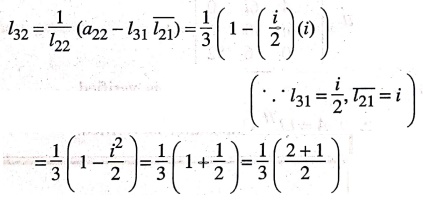
132 = 1/2
Now
we can go the third column and find
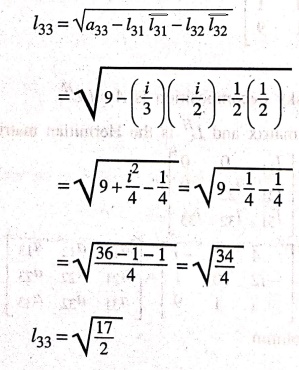
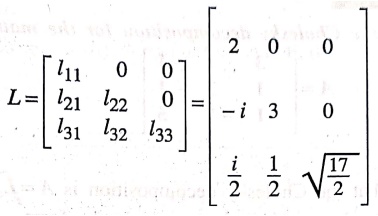
The triangular matrix used in the
decomposition is
To Verify the Cholesky
Decomposition
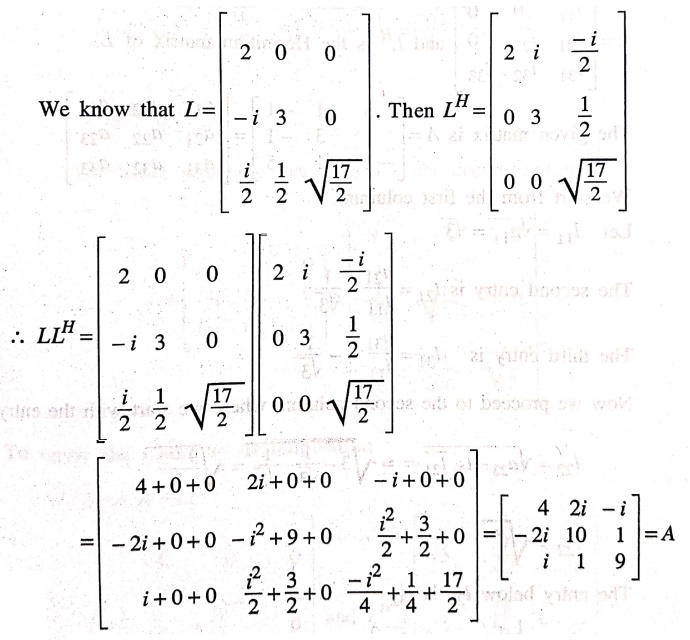
A=LLH. The Cholesky decomposition
is verified.
Example 15
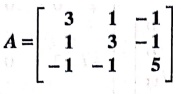
Determine
the Cholesky decomposition for the matrix
Solution:
We
know that the Cholesky decomposition is A=L.LH.
Here L is the lower triangular matrix in the
form
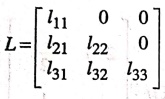 and LH is the
Hermitian matrix of L.
and LH is the
Hermitian matrix of L.
The
given matrix is 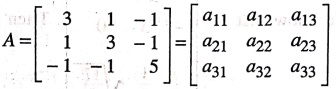
We
start from the first column.
Let
l11 = √a11 = √3
The
second entry is l21 = a21 / l11 = 1/√3
The
third entry is l31 = a31 / l11 = 1/√3
Now
we proceed to the second column, where we start with the entry
l22
= √ [ a22 − l21 ]
= √[ 3 – 1/√3.1/√3 ]
=
√[ (9 – 1)/3 ]
l22
= √(8/3)
The
entry below l22 is l32
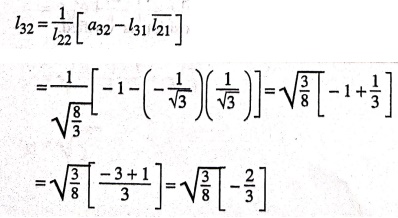
l32=
‒ 1/√6
Now
we can go to the third column and find
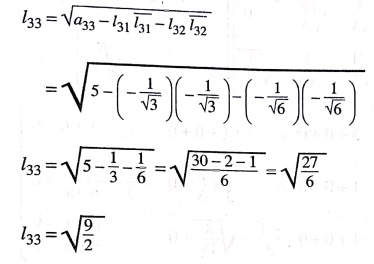
The lower triangular matrix used in the
decomposition is
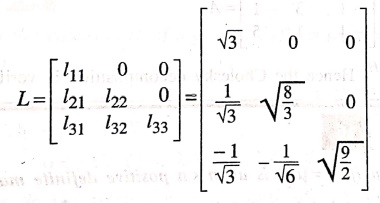
To verify the Cholesky
decomposition
We
have A = LLH
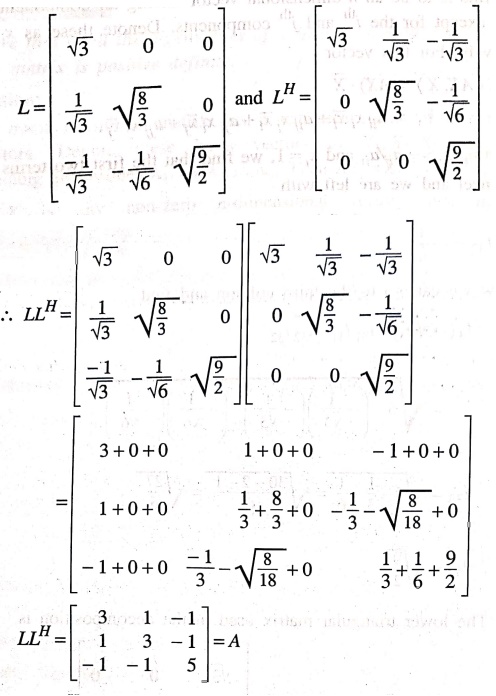
A
= LLH. Hence the Cholesky decomposition is verified.
Example 16
Prove that if A = [aij]
is an n×n positive definite matrix, then for any distinct i and j (i, j = 1, 2,
3 ... n), aiiaij> |aij|2.
Solution:
Define
X to be an n−dimensional vector having all components equal to zero except for
the ith and jth components. Denote these as xi
and xj respectively. For this vector

Setting
xi=−aij/aii and xj= 1, we find that
the first two terms on the right cancel and we are left with
0 < ‒aijaij'/aii
+ ajj = 1/aii (‒ajiaij + aiiajj)
The
desired inequality follows, since aii is positive and because A is Hermitian
aji = 
Example 17
Show that the largest
element in absolute value of a positive definite matrix must lie on the main diagonal.
Solution:
Assume
that the largest element in absolute value does not lie on the main diagonal
but rather in another location, say the (i, j) position, with i≠j. Then |aij|
> aii and | aij | > ajj. It follows that |aij|2=|aij||aij|
> aiiajj, which is a contradiction. Hence the
assumption is incorrect.
Example 18
Prove that the
eigenvalues of a positive definite matrix are positive.
Solution:
Let
A be positive definite with eigenvalue λ and corresponding eigenvector X. Then
for this X,
0 < <AX, X> = <λX, X> = λ<X,X>
……….(1)
Since
X is an eigenvector, it is not zero and <X, X> is positive. Dividing (1)
by <X, X> we obtain λ >0.
Example 19
Prove that if all the
eigenvalues of a Hermitian matrix are positive, then the matrix is positive
definite.
Solution:
An
n×n Hermitian matrix has a canonical basis of orthonormal eigenvectors. Denote
these basis vectors as X1,
X2, X3... Xn with corresponding eigenvalues λ1, λ2, λ3 ... λn. Then AXi = λi
Xi (i = 1, 2... n).
If
X is any non−zero n−dimensional vector, then the set {X1, X2 , X3
..., Xn } is linearly dependent. But eigenvectors are linearly
independent. It follows that there exist constants d1, d2,
d3... dn such that
X=
d1X1 + d2X2
+ d3X3 + ... + dnXn
AX=
d1AX1 + d2AX2 + ... + dnAXn
= d1λ1X1 + d2λ2X2
+ ... + dnλnXn
<AX, X> = <d1λ1X1
+ d2λ2X2 ... + dnλnXn,
d1X1 + d2X2
+ ... + dnXn>
=
|d1|2λ1 +|d2|2λ2
+ ... + |dn|2λn
because
the eigenvectors are orthonormal. Since the eigenvalues are given to be
positive, this last quantity is positive for any non−zero vector X. Thus the
matrix A is positive definite.
Example 20
Show that the
determinant of a positive definite matrix is positive.
Solution:
The
determinant of a matrix is the product of its eigenvalues, and each eigenvalue
of a positive definite matrix is positive.
Example 21
Show that all principal
minors of a positive definite matrix must be positive.
Solution:
Let
A be an n×n positive definite matrix, and let B be a submatrix of A obtained by
deleting from A its last k rows and k columns (k = 0, 1, 2, 3 ... k−1). Then B
has order (n−k) × (n−k). Let Y denote an arbitrary non−zero (n−k) dimensional
vector, and define X to be an n−dimensional vector having its first (n−k)
components identical to those of Y and its last k components equal to zero,
then
0 < <AX, X> = <BY, Y>.
Since
this is true for non−zero Y, it follows that B is positive definite and that |B|
is positive.
Example 22
Show that a positive
definite matrix is invertible.
Solution:
The
determinant of a positive definite matrix is positive and so non−zero and
therefore, that matrix must have an inverse.
Example 23
Find the square root of
a matrix A = 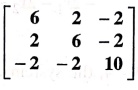 .
.
Solution:
The
characteristic polynomial is |A−λI| = 0
|A−λI| = 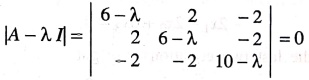
⇒ (6−λ) [(6−λ) (10−λ)−4]
− 2[2(10 − λ) − 4]
−2
[−4+2 (6−λ)] = 0
⇒ (6−λ) [60−6λ−10λ+λ2−4]−2
[20−2λ−4] −2[−4+12−2λ]=0
(6−λ) [λ2−16λ+56] + [4λ−32] − 2 [−2λ+8]
= 0
6λ2
− 96λ +336−λ3 + 16λ2 − 56λ + 4λ − 32 + 4λ − 16 = 0
−λ3 +22λ2 − 144λ + 288 =
0
λ3−22λ2
+ 144λ−288−0
By
using synthetic division method, we can find the roots.
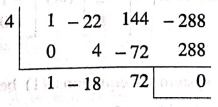
(λ−4) (λ2−18λ+72)=0
(λ−4)
(λ−6) (λ−12)=0
The eigenvalues are λ=4, 6, 12.
To find the
eigenvectors:
To
find the eigenvectors, (A−λI)X=0
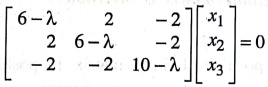
(6−λ)x1+2x2−2x3=0
2x1+(6−λ)x2−2x3=0
−2x1−2x2+(10−λ)x3=0
…………….(1)
Case
(i)
When
λ= 4, the system of equations (1) becomes
2x1 + 2x2 − 2x3
= 0
2x1+2x2−2x3=0
−2x1−2x2+6x3
= 0
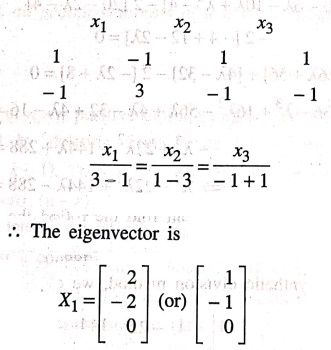
By
solving the last two equations, we get
x1+x2−x3=0
−x1−x2+3x3=0
Case
(ii)
When
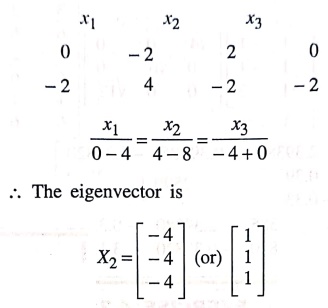
λ=6, the system of equations (1) becomes
0x1+2x2‒2x3=0
2x1+0x2‒2x3=0
−2x1−2x2+4x3=0
Solving
the last two equations
2x1 +0x2‒2x3
= 0
−2x1‒2x2+4x3
= 0
Case
(iii)
When
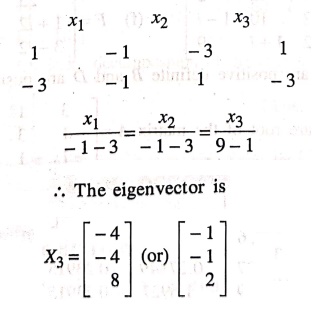
λ= 12, the system of equations (1) becomes
−
6x1+2x2−2x3
= 0
2x1−6x2−2x3
= 0
−2x1‒2x2−2x3
= 0
Considering
the first two equations, we get
−3x1+x2 − x3
= 0
x1−3x2−x3=0
Every
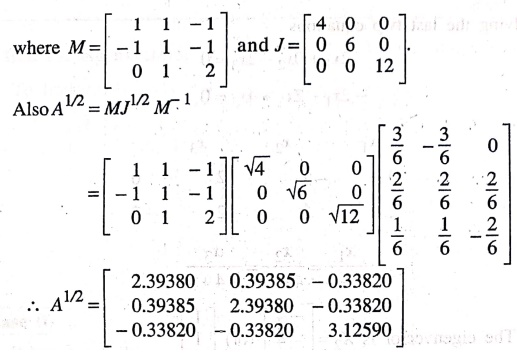
square matrix A is similar to a matrix J in Jordan canonical form. If M is a
modal matrix for A, then
A = MJM‒1
Linear Algebra: UNIT IV: Matrix Decomposition : Tag: maths, mathematics : - Positive Definite Matrices: Example Solved Problems
Linear Algebra: UNIT IV: Matrix Decomposition
Under Subject

Linear Algebra
MA25C02 2nd Semester | 2025 Regulation
Related Subjects

English Essentials II
EN25C02 2nd Semester | 2025 Regulation | 2nd Semester 2025 Regulation

Tamils and Technology தமிழர்களும் தொழில்நுட்பமும்
UC25H02 2nd Semester | 2025 Regulation | 2nd Semester 2025 Regulation
Linear Algebra
MA25C02 2nd Semester | 2025 Regulation

Transforms and its Applications
MA25C03 2nd Semester EEE Dept | 2025 Regulation | 2nd Semester 2025 Regulation

Applied Physics (CE) II
PH25C02 2nd Semester Civil, Agri Depts | 2025 Regulation | 2nd Semester 2025 Regulation

Applied Physics (CSIE) II
PH25C03 2nd Semester AIDS, CSE, IT, CSE(CY) Dept | 2025 Regulation | 2nd Semester 2025 Regulation

Applied Physics (EE) II
PH25C04 2nd Semester EEE Dept | 2025 Regulation | 2nd Semester 2025 Regulation

Applied Physics (ME) II
PH25C05 2nd Semester Mechanical Dept | 2025 Regulation | 2nd Semester 2025 Regulation

Applied Chemistry (CE) II
CY25C02 2nd Semester Civil Dept | 2025 Regulation | 2nd Semester 2025 Regulation

Applied Chemistry (ME) II
CY25C03 2nd Semester Mechanical Dept | 2025 Regulation | 2nd Semester 2025 Regulation

Electron Devices
EC25C01 2nd Semester ECE Dept | 2025 Regulation | 2nd Semester 2025 Regulation

Digital Principles and Computer Organization
CS25C06 2nd Semester AIDS, CSE, IT, CSE(CY) Dept | 2025 Regulation | 2nd Semester 2025 Regulation

Basic Electrical and Electronics Engineering
EE25C01 2nd Semester | 2025 Regulation | 2nd Semester 2025 Regulation

Basic Civil and Mechanical Engineering
GE25C01 2nd Semester EEE Dept | 2025 Regulation | 2nd Semester 2025 Regulation
Data Structures using CPlusPlus
CS25C05 2nd Semester ECE Dept | 2025 Regulation | 2nd Semester 2025 Regulation

Engineering Drawing
ME25C01 EEE, Mech, Agri, EEE Depts | 2025 Regulation | 2nd Semester 2025 Regulation
Data Structures and Algorithms
CS25C04 2nd Semester EEE Dept | 2025 Regulation

Circuits and Network Analysis
EC25C02 2nd Semester ECE Dept | 2025 Regulation | 2nd Semester 2025 Regulation

Engineering Mechanics
ME25C02 2nd Semester Mech, Civil, Agri Depts | 2025 Regulation | 2nd Semester 2025 Regulation

Object Oriented Programming (OOPs)
CS25C07 2nd Semester CSE, CSE(CY) Depts | 2025 Regulation | 2nd Semester 2025 Regulation