Linear Algebra: UNIT IV: Matrix Decomposition
QR Decomposition
Matrix Decomposition
The Gram−Schmidt orthogonalization process yields inaccurate results due to round−off error under finite digit arithmetic.
QR DECOMPOSITION
1. The modified Gram−Schmidt process
The
Gram−Schmidt orthogonalization process yields inaccurate results due to round−off
error under finite digit arithmetic. A modification of that algorithm exists
which is more stable and it generates the same vectors in the absence of
rounding. This modification also transforms a set of linearly independent
vectors { X1, X2,
X3 ... Xn} into a set of orthonormal vectors { Q1,
Q2, Q3 ... Qn} such that each vector Qk(k
= 1, 2, 3 ... n) is a linear combination of X1
through Xk−1. The modified algorithm is iterative, with the kth
iteration given by the following steps.
Step 1:
Set rkk = ||Xk||2 and Qk = (1/rkk)
Xk.
Step 2:
For j=k+1, k+2, k+ 3, ... n, set rkj= <Xj, Qk>.
Step 3:
For j=k+1, k+2, k+3, ... n, replace Xj by Xj−rkjQk.
2. QR−Decomposition
Every
m×n matrix A (m≥n) can be factored into the product of a matrix Q having
orthonormal vectors for its columns, and an upper right triangular matrix R.
The
product A = QR is the QR decomposition of A.
………….(1)
If
A is square, then Q is unitary. The QR decomposition follows immediately from
the modified Gram−Schmidt process applied to the columns A, provided those
columns are linearly independent. If they are, then the columns of Q and the
elements rij(i≤j) of R are the quantities generated by the modified
Gram−Schmidt process.
If
the columns of A are not linearly independent, then one or more of the rkk
values determined in step 1 will be zero. That step must be modified to
Step 1:
Calculate rkk=||Xk||2. If rkk ≠ 0,
then Qk = Xk/rkk. If rkk=0, then choose
Qk to be any normalized vector which is orthogonal to Q1,
Q2, ... Qk−1.
In
practice, rkk is rarely zero. Even if the columns of A are linearly
dependent, round−off will produce an гkk value close to but not equal
to zero, permitting Qk to be calculated in the usual manner. The
result is an incorrect vector. Thus, whenever an rkk value is
sufficiently small, Qk must be checked to guarantee it is orthogonal
to the previously calculated Q vectors. If it is not, the modification given as
step 1' must be implemented.
3. The QR Algorithm
The
QR algorithm is a procedure for determining all eigenvalues of a real matrix A0.
The algorithm sequentially constructs matrices Ak(k=1, 2, 3 ...) by
forming QR decompositions.
Ak−1 = Qk−1 Rk−1
……………(2)
for
Ak−1, and then reversing the order of the product to define
Ak = Rk−1Qk−1
……….. (2)
Each
Ak is similar to its predecessor and has the same eigenvectors. In
general, the sequence {Ak} converges to a partitioned matrix having
either of two forms.
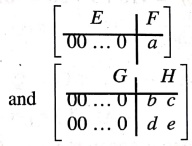
…………….. (5)
If
form (4) occurs, then the element G is an eigenvalue and the remaining
eigenvalues are obtained by applying the QR algorithm to the matrix E. If form
(5) arises, then two eigenvalues can be determined from the characteristic
equation of the 2×2 submatrix in the lower right partition and the remaining
eigenvalues are obtained by applying the QR algorithm to the matrix G. If E or
G is already a 2×2 matrix, its
eigenvalues are determined from its characteristic equation.
4. Accelerating convergence
Convergence
of the QR algorithm is accelerated by a shift at each iteration. If the
matrices have order n×n, then the element in the (n, n) position of Ak‒1
is denoted as Sk−1, and a QR decomposition is constructed for the
shifted matrix Ak−1−Sk−1I. Equation (2) is modified to
Ak−1 − Sk−1I = Qk−1Rk−1
…………..(6)
and
equation (3) is replaced with
Ak = Rk−1Qk−1
+ Sk−1I
……..... (7)
Equations
(6) and (7) constitute the shifted QR algorithm.
Linear Algebra: UNIT IV: Matrix Decomposition : Tag: maths, mathematics : Matrix Decomposition - QR Decomposition
Linear Algebra: UNIT IV: Matrix Decomposition
Under Subject
Linear Algebra
MA25C02 2nd Semester | 2025 Regulation
Related Subjects

English Essentials II
EN25C02 2nd Semester | 2025 Regulation | 2nd Semester 2025 Regulation

Tamils and Technology தமிழர்களும் தொழில்நுட்பமும்
UC25H02 2nd Semester | 2025 Regulation | 2nd Semester 2025 Regulation
Linear Algebra
MA25C02 2nd Semester | 2025 Regulation

Transforms and its Applications
MA25C03 2nd Semester EEE Dept | 2025 Regulation | 2nd Semester 2025 Regulation

Applied Physics (CE) II
PH25C02 2nd Semester Civil, Agri Depts | 2025 Regulation | 2nd Semester 2025 Regulation
Applied Physics (CSIE) II
PH25C03 2nd Semester AIDS, CSE, IT, CSE(CY) Dept | 2025 Regulation | 2nd Semester 2025 Regulation
Applied Physics (EE) II
PH25C04 2nd Semester EEE Dept | 2025 Regulation | 2nd Semester 2025 Regulation

Applied Physics (ME) II
PH25C05 2nd Semester Mechanical Dept | 2025 Regulation | 2nd Semester 2025 Regulation
Applied Chemistry (CE) II
CY25C02 2nd Semester Civil Dept | 2025 Regulation | 2nd Semester 2025 Regulation

Applied Chemistry (ME) II
CY25C03 2nd Semester Mechanical Dept | 2025 Regulation | 2nd Semester 2025 Regulation

Electron Devices
EC25C01 2nd Semester ECE Dept | 2025 Regulation | 2nd Semester 2025 Regulation
Digital Principles and Computer Organization
CS25C06 2nd Semester AIDS, CSE, IT, CSE(CY) Dept | 2025 Regulation | 2nd Semester 2025 Regulation

Basic Electrical and Electronics Engineering
EE25C01 2nd Semester | 2025 Regulation | 2nd Semester 2025 Regulation

Basic Civil and Mechanical Engineering
GE25C01 2nd Semester EEE Dept | 2025 Regulation | 2nd Semester 2025 Regulation
Data Structures using CPlusPlus
CS25C05 2nd Semester ECE Dept | 2025 Regulation | 2nd Semester 2025 Regulation
Engineering Drawing
ME25C01 EEE, Mech, Agri, EEE Depts | 2025 Regulation | 2nd Semester 2025 Regulation
Data Structures and Algorithms
CS25C04 2nd Semester EEE Dept | 2025 Regulation

Circuits and Network Analysis
EC25C02 2nd Semester ECE Dept | 2025 Regulation | 2nd Semester 2025 Regulation

Engineering Mechanics
ME25C02 2nd Semester Mech, Civil, Agri Depts | 2025 Regulation | 2nd Semester 2025 Regulation
Object Oriented Programming (OOPs)
CS25C07 2nd Semester CSE, CSE(CY) Depts | 2025 Regulation | 2nd Semester 2025 Regulation