Computer Organization and Architecture: Chapter 4: Memory and IO
Memory Management Techniques
Types, Advantages, Disadvantages, Comparison
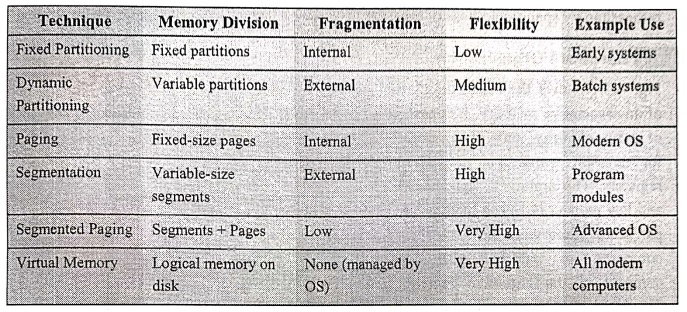
Questions: 1. Explain in detail the different types of memory management techniques used in computer systems. 2. Describe contiguous memory allocation and its types. 3. What is the difference between fixed partitioning and dynamic partitioning? Explain their advantages and disadvantages. 4. Discuss non‒contiguous memory allocation techniques in detail. 5. Explain the concept of paging in memory management. Describe its advantages and disadvantages. 6. What is segmentation? Explain its working, advantages and disadvantages. 7. Write a detailed comparison between various memory management techniques such as fixed partitioning, dynamic partitioning, paging, segmentation, Segmented Paging and Virtual Memory.
Memory
Management Techniques
•
A computer's main memory (RAM) is a
limited and valuable resource. The Memory
Management Unit (MMU) and the Operating
System (OS) work together to allocate, manage and protect memory so that
multiple programs can run efficiently and safely.
• Memory management
is the process of:
■
Allocating memory to programs,
■
Keeping track of used and free memory areas and
■
Reclaiming memory when programs are finished.
The
main goal of memory management is to
achieve :
1. Efficient
utilization of memory.
2. Protection
among multiple processes.
3. Support for
multitasking and virtual memory.
1. Types of Memory Management Techniques
•
Memory management techniques are broadly classified into two categories:
1. Contiguous Memory
Allocation
2. Non‒Contiguous
Memory Allocation
1. Contiguous Memory Allocation
•
In this technique, each process is allocated a single, continuous block of
memory space.
1. Single Contiguous Allocation
■
The simplest method.
■
The operating system occupies one fixed part of memory.
■
The remaining memory is allocated to one user process.
■
Used in early computers or embedded systems.
Limitations:
■
Only one process can run at a time.
■
Inefficient use of memory.
2. Fixed Partitioning
■
The main memory is divided into fixed‒size
partitions.
■
Each partition can hold one process.
■
If a process is smaller than a partition, the remaining space is wasted.
Advantages:
■
Simple to implement.
■
Easy to keep track of memory usage.
Disadvantages:
■
Internal fragmentation occurs
(unused space within a partition).
■
The number of partitions limits the number of processes.
3. Dynamic Partitioning
■
The memory is divided into variable‒sized
partitions based on process needs.
■
When a process ends, its space is freed and can be reused.
Advantages:
■
Reduces internal fragmentation.
■
Memory is allocated exactly as required.
Disadvantages:
■
Causes external fragmentation (free
spaces scattered in memory).
■
Requires compaction (rearranging
processes to make continuous free space).
2. Non‒Contiguous Memory Allocation
•
In this method, a process's memory is not required to be in one continuous
block. It can be spread across different areas of memory.
•
This approach allows efficient use of available space and supports large
programs.
1. Paging
■
The process is divided into fixed‒size
blocks called pages.
■
The main memory is divided into frames
of the same size.
■
A page table keeps track of which
page of the process is stored in which frame of memory.
Advantages:
■
Eliminates external fragmentation.
■
Easy to manage memory allocation.
■
Enables virtual memory.
Disadvantages:
■
May cause internal fragmentation
(unused space inside pages).
■
Page table management adds overhead.
2. Segmentation
■
The process is divided into logical
segments such as code, data, stack, etc.
■
Each segment is of variable size and
has its own base and limit address.
Advantages:
■
Reflects the logical structure of a program.
■
Provides protection and sharing at segment level.
■
Eliminates internal fragmentation.
Disadvantages:
■
Causes external fragmentation.
■
Complex memory management.
3. Segmented Paging (Combined Approach)
■
Combines the benefits of segmentation and paging.
■
Each segment is divided into pages.
■
Logical address → (segment number, page number, offset).
Advantages:
■
Reduces external fragmentation (due to paging).
■
Supports logical program structure (due to segmentation).
■
Used in many modern architectures.
4. Virtual Memory
■
Virtual memory allows execution of programs larger than the available physical memory.
■
Part of the program is kept in main memory and the rest is stored on a secondary storage (like a hard disk).
■
The required parts (pages or segments) are brought into main memory when
needed.
Advantages:
■
Increases effective memory size.
■
Enables multiprogramming.
■
Provides memory protection.
Disadvantages:
■
Involves disk access, which is slower than RAM.
■
Requires complex hardware and OS support.
2. Comparison of Techniques
Review Questions
1. Explain in detail
the different types of memory management techniques used in computer systems.
2. Describe contiguous
memory allocation and its types.
3. What is the
difference between fixed partitioning and dynamic partitioning? Explain their
advantages and disadvantages.
4. Discuss non‒contiguous
memory allocation techniques in detail.
5. Explain the concept
of paging in memory management. Describe its advantages and disadvantages.
6. What is
segmentation? Explain its working, advantages and disadvantages.
7. Write a detailed
comparison between various memory management techniques such as fixed
partitioning, dynamic partitioning, paging, segmentation, Segmented Paging and
Virtual Memory.
Computer Organization and Architecture: Chapter 4: Memory and IO : Tag: Computer : Types, Advantages, Disadvantages, Comparison - Memory Management Techniques
Computer Organization and Architecture: Chapter 4: Memory and IO
Under Subject
Computer Organization and Architecture
CW25201 3rd Semester IT department. | 2025 Regulation | 3rd Semester 2025 Regulation
Related Subjects
Discrete Mathematics
MA25C14 3rd Semester CSE,IT,CY,AIDS departments. | 2025 Regulation | 3rd Semester 2025 Regulation
Data Structures
CS25C08 3rd Semester CSE,IT,CY,AIDS departments. | 2025 Regulation | 3rd Semester 2025 Regulation
Computer Organization and Architecture
CW25201 3rd Semester IT department. | 2025 Regulation | 3rd Semester 2025 Regulation
Object Oriented Programming
CS25C07 3rd Semester IT department. | 2025 Regulation | 3rd Semester 2025 Regulation
Web Technologies
IT25301 3rd Semester IT department. | 2025 Regulation | 3rd Semester 2025 Regulation
English Communication Skills Laboratory I
EN25C03 3rd Semester all department. | 2025 Regulation | 3rd Semester 2025 Regulation
Skill Development Course I
3rd Semester all department. | 2025 Regulation | 3rd Semester 2025 Regulation