Computer Organization and Architecture: Chapter 1: Introduction
Operands of Computer Hardware
Questions: 1. Write a note on the operands of the computer hardware. 2. Explain the load instruction. 3. Explain the store instruction. 4. What do you mean by alignment restriction? 5. What do you mean by spilling registers? 6. Why are frequently used variables stored in registers ?
Operands of Computer
Hardware
1. Register Operands
•
In MIPS, the operands of arithmetic instructions are restricted; they must be
from a limited number of special locations built directly in hardware called registers.
•
Registers are primitives used in hardware design that are also visible to the
programmer.
•
The size of a register in the MIPS architecture is 32‒bits; groups of 32‒bits
occur so frequently that they are given the name word in the MIPS architecture.
•
MIP computers have a limited number of registers, typically 32. This is one of
the significant differences between the variables of a programming language and
registers.
•
MIPS limits the number of 32‒bit registers to 32. The reason for the limit of
32 registers
are:
■ Many registers may increase the clock cycle
time simply because it takes electronic signals longer when they must travel
farther.
■ More registers more bits in the instruction
format.
2. Memory Operands
•
The processor can keep only a small amount of data in registers, but computer
memory contains billions of data elements. Hence, more data and data structures
such as arrays and structures are kept in the computer memory.
•
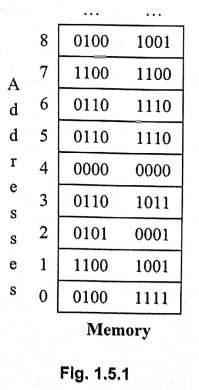
Memory is just a large, single‒dimensional array, with the address as the index
to that array, starting at 0. This is illustrated in Fig. 1.5.1.
•
As mentioned above, arithmetic operations occur only on registers in MIPS
instructions; thus, MIPS must include instructions that transfer data between
memory and registers. Such instructions are called data transfer instructions.
•
The instruction must have the memory address to access a word in the memory.
For example, in Fig. 1.5.1, the address of the fourth data element is 3 and the
value of Memory [3] is 0110 1011.
Load Instruction
•
The data transfer instruction that copies data from memory to a register is
called load.
•
The format of the load instruction is divided into three parts:
■ Name of the operation followed by
■ the register to be loaded, then
■ a constant and register used to access
memory.
•
The sum of the constant portion of the instruction and the contents of the
second register forms the memory address.
•
In MIPS, name for this instruction is lw, which stands for load word.
Example:1
Let's assume that A is an array of
50 words and that the compiler has associated the variables p and q with the
registers $s1 and $s2. Let's also assume that the array's starting address, or
base address, is in $s3. Compile this C assignment statement : p = q + A[7];
Solution:
Here,
one of the operands is in the memory, so we have first to transfer A[7] to a
temporary register. This is achieved by –
lw $t0, 7 ($s3) //
Temporary reg $t0 gets A[7]
The
address of this array element is the sum of the base of the array A, found in
register $s3, plus the number to select element 7.
The
instruction must add q (contained in $s2) to A[7] (contained in $t0) and put
the sum in the register corresponding to p (associated with $s1). This is
achieved by –
add $s1, $s2, $t0 // p = q + A[7]
Note:
The constant in a data transfer instruction is called the offset, and the register added to form the address ($s3) is called
the base register.
Alignment restriction
•
In MIPS, the registers are 32‒bit; hence, the word size is 32‒bit (4 bytes).
•
Since most memories are byte (8‒bits) oriented, virtually all architectures
today address individual bytes. However, the byte should be the starting byte
of the word.
•
Therefore, in MIPS, words must start at addresses that are multiples of 4. This
requirement is called an alignment
restriction and many architectures have it.
•
The 32‒bit word size also affects the array index of the memory. To get the
proper byte address, the offset to be added to the base register $s3 must be
multiplied by 4. For example, to access a byte from A[5], the offset to be
added to the base register, $s3 must be 5 x 4 or 20.
Store instruction
•
The instruction complementary to load is called store; it copies data from a register to memory.
•
The format of a store is similar to that of a load :
■ Name of the operation, followed by
■ the register to be stored, then offset to
select the array element and finally
■ the base register.
•
Once again, in MIPS, the address of the operand is specified in two parts:
Offset and base.
•
In MIPS name for this instruction is sw, which stands for store word.
Example:2
Assume variable p is associated
with register $s2 and the base address of the array A is in $s3. What is the
MIPS assembly code for the C assignment statement A[10]=p+A[7] ?
Solution:
We
have first to transfer A[7] to a temporary register. This is achieved by ‒
lw
$t0, 28 ($s3) //Temporary reg $t0 gets
A[7]
The
instruction must add p (contained in $s2) to A[7] (contained in $t0) and put
the sum in the temporary register since it is finally should be stored in
memory.
add
$to, $s2, $t0 //Temporary reg $t0 gets p + A[7]
The
final instruction stores the sum into A[10], using 40 (4 × 10) as the offset
and register $s3 as the base register.
sw
$t0, 40 ($s3) // Stores p + A[7] back
into A[10]
Register Vs Memory
•
A MIPS data transfer instruction only reads one operand or writes one operand,
without operating on it. However, MIPS arithmetic instruction can read two
registers, operate on them and write the result.
•
Thus, registers take less time to access and have higher throughput than
memory.
•
Many programs have more variables than computers have registers. Consequently,
the compiler tries to keep the most frequently used variables in registers and
places the rest in memory, using loads and stores to move variables between
registers and memory.
•
The process of putting less commonly used variables (or those needed later)
into memory is called spilling
registers.
3. Constant or Immediate Operands
•
The arithmetic instructions in which one operand may be a constant. This
constant operand is also known as an immediate
operand. For example,
addi
$s2, $s2, 5 // $s2 = $s2 + 5
•
The above instruction is an add immediate instruction (addi) and it adds 5 in
the contents of register $s2.
•
By including constants inside arithmetic instructions, operations are much
faster and use less energy than if constants were loaded from memory.
Example: 3
Assume variable b is associated
with register $s2 and the base address of the array A is in $s3. What is the
MIPS assembly code for the C assignment statement below?
A[10] A[5]+b;
Solution:
Although
there is a single operation in the C statement, now two of the operands are in
memory, so we need even more MIPS instructions.
lw
$t0,20($s3) //Temporary reg $t0 gets A[5] using 16 (4 × 5)
add
$t0,$s2,$to //Temporary reg $t0 gets A[5] + b
sw
$t0,40($s3) // Stores b + A[5] back into A[10] using 40 (4
x10) as the offset and
//
register $s3 as the base register.
Example:4
Assume that the variables f, g, h,
i and j are assigned to registers $50, $s1, $s2, $s3, and $s4, respectively.
Assume that the base address of the arrays A and B are in registers $s6 and
$s7, respectively. C Code : f= g + A[B[4]‒B[3]]; For the C statement above,
what is the corresponding MIPS assembly code?
Solution :
lw
$t0, 16($s7) // $t0 = B[4]
lw
$t1, 12($s7) // $t1 = B[3]
sub
$t0, $t0, $t1 // $t0 = B[4] – B[3]
sll
$t0, $t0, 2 // $t0 = $t0 * 4
add
$t0, $t0, $s6 // $t0 = &A[B[4] –
B[3]]
lw
$t1, 0($t0) // $t1 = A[B[4] ‒ B[3]]
add
$s0, $s1, $t1 // f = g + A[B[4] ‒ B[3]]
Example:5
Assume that the variables f and g
are assigned to registers $s0 and $s1 respectively. Assume that the base
address of the array A is in register $$2. Assume f is zero initially.
f = ‒g ‒ A[4]
A[5] = f+100;
Translate the above C statements
into MIPS code. How many MIPS assembly instructions are needed to perform the C
statements and how many different registers are needed to carry out the C
statements?
Solution :
lw
$t0, 16[$s2] // Save A[4] into register
t0
sub
$s0, $s0, $t0 // f = f ‒ A[4]
sub
$s0, $s0, $s1 //f = f‒g
add
i $s0, $s0, 100 // f + 100
lw
20[$s2], $s0 // Save f into A[5]
For
registers are needed to carry out the C statements
Example:6
The following problems deal with
translating from C to MIPS. Assume that the variables f, g, h, i and j are
assigned to registers $s0, $s1, $s2, $s3 and $s4, respectively. Assume that the
base address of the arrays A and B are in registers $s6 and $s7, respectively.
a.ƒ = ‒ g ‒A[5]; b. B[7] =A[ i ‒ j];
Solution :
a.
lw
$t0, 20[$s6] // save A[5] into register
to
add
$t0, $t0, $s1 // g + A[5]
sub
$s0, $zero, $t0 //f=0‒(g+ A[5])
b.
$t0,
$s3, $s4 //i‒j
add
$t0, $t0, $s6 // puts i‒ j into array
lw
$t0, 0($t0) // makes to its own address
sw
$t0, 28($s7) // throws B[7] into
register to
Review Questions
1. Write a note on the
operands of the computer hardware.
2. Explain the load
instruction.
3. Explain the store
instruction.
4. What do you mean by
alignment restriction?
5. What do you mean by
spilling registers?
6. Why are frequently
used variables stored in registers ?
Computer Organization and Architecture: Chapter 1: Introduction : Tag: Computer : - Operands of Computer Hardware
Computer Organization and Architecture: Chapter 1: Introduction
Under Subject
Computer Organization and Architecture
CW25201 3rd Semester IT department. | 2025 Regulation | 3rd Semester 2025 Regulation
Related Subjects
Discrete Mathematics
MA25C14 3rd Semester CSE,IT,CY,AIDS departments. | 2025 Regulation | 3rd Semester 2025 Regulation
Data Structures
CS25C08 3rd Semester CSE,IT,CY,AIDS departments. | 2025 Regulation | 3rd Semester 2025 Regulation
Computer Organization and Architecture
CW25201 3rd Semester IT department. | 2025 Regulation | 3rd Semester 2025 Regulation
Object Oriented Programming
CS25C07 3rd Semester IT department. | 2025 Regulation | 3rd Semester 2025 Regulation
Web Technologies
IT25301 3rd Semester IT department. | 2025 Regulation | 3rd Semester 2025 Regulation
English Communication Skills Laboratory I
EN25C03 3rd Semester all department. | 2025 Regulation | 3rd Semester 2025 Regulation
Skill Development Course I
3rd Semester all department. | 2025 Regulation | 3rd Semester 2025 Regulation