Computer Organization and Architecture: Chapter 1: Introduction
Introduction of Computer Organization and Architecture: Two Marks Important Questions and Answers
Computer Organization and Architecture: Chapter 1: Introduction : Anna University Part A Two Marks Important Questions and Answers
Computer
Organization and Architecture
Chapter 1: Introduction
Two Marks
Questions with Answers
1. Define computer
architecture.
Answer: Computer architecture is defined as the
functional operation of the individual H/W unit in a computer system and the
flow of information among the control of those units.
2. Define computer
H/W.
Answer:
Computer
H/W is the electronic circuit and electro mechanical equipment that constitutes
the computer.
3. Name the
functional units of a computer.
Answer:
The
functional units of a computer are:
1.
Input unit
2.
Output unit
3.
Control unit
4.
Memory unit
5.
Arithmetic and logical unit.
4. What is meant by
Central Processing Unit (CPU)?
Answer:
The
arithmetic and logic unit in conjunction with control unit is commonly called
Central Processing Unit (CPU).
5. What is the
function of input unit ?
Answer:
A
computer accepts a digitally coded information through input unit using input
devices such as keyboard and mouse.
6. What are the
functions of control unit?
Answer:
The
control unit co‒ordinates and controls the activities amongst the functional
units. The basic function of control unit is to fetch the instructions stored
in the main memory, identify the operations and the devices involved in it and
accordingly generate control signals to execute the desired operations.
7. What is the
function of arithmetic and logic unit ?
Answer:
The
Arithmetic and Logic Unit (ALU) is responsible for performing arithmetic
operations such as add, subtract, division and multiplication and logical
operations such as ANDing, ORing, inverting etc.
8. What is the role
of MAR and MDR ?
Answer:
The
MAR (memory address register) is used to hold the address of the location to or
from which data are to be transferred and the MDR(memory data register)
contains the data to be written into or read out of the addressed location.
9. What is the role
of IR ?
Answer:
Instruction
Register (IR) contains the instruction being executed. Its output is available
to the control circuits, which generate the timing signals for controlling the
processing circuits needed to execute the instructions.
10. What is the role
of PC ?
Answer:
The
Program Counter (PC) register keeps track of the execution of the program. It
contains the memory address of the instruction currently being executed. During
the execution of the current instruction, the contents of the PC are updated to
correspond to the address of the next instructions to be executed.
11. What is an
interrupt?
Answer:
An
interrupt is an event that causes the execution of one program to be suspended
and another program to be executed.
12. What are the uses
of interrupts ?
Answer:
1.
Recovery from errors
2.
Debugging
3.
Communication between programs
4.
Use of interrupts in operating system.
13. What do you mean
by alignment restriction?
Answer:
•
In MIPS, the registers are 32‒bit; hence, the word size is 32‒bit (4 bytes).
•
Since most memories are byte (8‒bits) oriented, virtually all architectures
today address individual bytes. However, the byte should be the starting byte
of the word.
•
Therefore, in MIPS, words must start at addresses that are multiples of 4. This
requirement is called an alignment restriction and many architectures have it.
14. Why are the most
frequently used variables stored in registers ?
Answer:
Registers
take less time to access and have higher throughput than memory. Hence, the
compiler tries to keep the most frequently used variables in registers.
15. What is spilling
registers ?
Answer:
The
process of putting less commonly used variables (or those needed later) into
memory is called spilling registers.
16. List various
logical operations supported by MIPS.
Shift
Left, Shift Right, AND, OR and NOT Operations
17. List the decision
making instructions supported by MIPS assembly language.
AND,
OR and NOT Operations
18. What is
instruction set architecture?
Answer:
One
of the most important abstraction is the interface between the hardware and the
lowest‒ level software. Because of its importance, it is given a special name:
The instruction set architecture of a computer. It includes
anything programmer needs to know to make a binary machine language program
work correctly, including instructions, I/O devices and so on.
19. What are the
various types of operations required for instructions ?
Answer:
•
Data transfers between the main memory and the CPU registers
•
Arithmetic and logic operation on data
•
Program sequencing and control
•
I/O transfers.
20. What is operation
code ?
Answer:
The
operation code field in the instruction specifies the operation to be
performed. The operation is specified by binary code, hence the name operation
code or simply opcode.
21. What are
addressing modes ?
Answer:
The
different ways that a processor can access data are referred to as addressing schemes or addressing modes.
22. List different
addressing modes.
Answer:
1.
Register mode
2.
Absolute mode or direct mode
3.
Immediate mode
4.
Indirect mode
5.
Index mode
6.
Relative mode
7.
Autoincrement mode
8.
Autodecrement mode.
23. Differentiate
direct and indirect addressing mode.
Answer:
In
direct addressing mode the address of the location of the operand is given
explicitly as a part of the instruction. On the other hand, in indirect
addressing mode, the effective address of the operand is the contents of a
register or the main memory location whose address is given explicitly in the
instruction.
24. State the need
for indirect addressing mode. Give an example.
Answer:
In
indirect addressing mode, the instruction specifies the address where the
address of the operand is located. In case of register indirect addressing, the
address of the operand is specified by the contents of the register. These
operating modes are needed when we need to access arrays. Specifically, in
register indirect addressing, registers are used as pointers and they are very
useful for dealing with arrays or tables of simple data values.
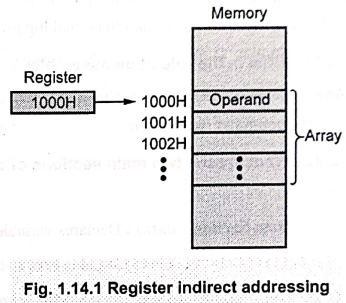
Fig. 1.14.1 Register
indirect addressing
Consider
Fig. 1.14.1, where a data structure consists of a sequence of consecutive byte
values. The pointer register contains (1000)н, corresponding to the first item
in the structure. To access item 2 in the structure we only need to increment
the value in the pointer register.
25. What is CISC
architecture ?
Answer:
CISC
(Complex Instruction Set Computer) architecture uses a large set of complex
instructions, where each instruction can perform multiple low‒level operations,
such as memory access, arithmetic and logic, in a single instruction.
26. What is RISC
architecture ?
Answer:
RISC
(Reduced Instruction Set Computer) architecture uses a small and simple set of
instructions, each designed to execute very quickly, usually within one clock
cycle.
27. Give one example
each of CISC and RISC processors.
Answer:
•
CISC
processor: Intel x86 family
•
RISC
processor : ARM, MIPS, or PowerPC
28. State
one main difference between CISC and RISC.
Answer: CISC has many complex instructions that may take
multiple cycles to execute, while
RISC
has
fewer and simpler instructions that
typically execute in one clock cycle.
29. State the basic
addressing modes supported by RISC processor.
Answer:
The
RISC processor has three basic addressing modes:
•
Register addressing
•
Immediate operand and
•
Relative to PC addressing for branch instructions.
30. What is assembly
language?
Answer:
Assembly
language is a symbolic form of machine language that uses mnemonics (like add,
sub, lw) instead of binary numbers, making programming easier for humans.
31. What is the role
of an assembler ?
Answer:
An
assembler translates assembly language code into machine language (binary
instructions) that the computer can execute.
32. What are the two
main sections of a MIPS program?
Answer:
• Data Section (.data): Declares
variables and constants.
• Text Section (.text)
: Contains executable instructions (program code).
33. Define pseudo‒instruction
with an example.
Answer:
Pseudo‒instructions
are assembler‒provided instructions that make coding easier but are not real
hardware instructions.
Example:
move
$t1, $t2 → translated to add $t1, $t2, $zero.
34. What is the
difference between a real instruction and a pseudo‒instruction?
Answer:
A
real instruction is directly
executed by hardware, while a pseudo‒instruction
is expanded by the assembler into one or more real MIPS instructions.
35. What are the
three steps of translating a program from high‒level language to machine code?
Answer:
1.
High‒Level Language → written by humans (e.g., sum = a + b;)
2.
Assembly Language → symbolic form (add $t0, $t1, $t2)
3.
Machine Language → binary code executed by hardware
36. What is the
function of a compiler ?
Answer:
A
compiler translates high‒level language code into assembly language or machine
language for execution.
37. What is a
benchmark?
Answer:
A
benchmark is a standard program used to measure and compare the performance of
different computer systems.
38. What is the
purpose of SPEC benchmarks ?
Answer:
SPEC
benchmarks provide standardized tests to evaluate CPU performance and energy
efficiency across different systems.
39. Differentiate
between CINT2006 and CFP2006.
Answer:
• CINT2006:
Measures performance of integer‒based programs (e.g., compiling, simulations).
• CFP2006: Measures floating‒point performance
(e.g., scientific or engineering applications).
40. What is SPECratio
and what does it indicate ?
Answer:
SPECratio = Execution time on reference system / Execution time on test system.
A
higher SPECratio means better (faster) performance.
41. What does SPEC
Power benchmark measure ?
Answer:
It
measures a server's energy efficiency ‒ the performance achieved per watt of
power consumed at different load levels.
42. Why did the
industry shift from uniprocessors to multiprocessors ?
Answer:
Because
increasing clock speed caused high power consumption and heat generation.
Multicore processors improved performance through parallelism instead.
43. What is a
multicore processor?
Answer:
A
multicore processor is a single chip containing two or more independent
processing cores that can execute instructions simultaneously.
44. State any two
advantages of multicore processors.
Answer:
1.
Higher throughput (more work done per unit time).
2.
Ability to execute multiple programs or tasks in parallel.
45. What is
parallelism in computer systems ?
Answer:
Parallelism
means performing multiple operations simultaneously to increase computational
speed and efficiency.
46. Mention different
levels of parallelism.
Answer:
•
Instruction‒level parallelism (ILP)
•
Data‒level parallelism (DLP)
•
Thread‒level or task‒level parallelism (TLP)
47. What are the main
challenges in parallel programming?
Answer:
Scheduling,
Load balancing, Synchronization and Communication overhead.
48. What is cache
coherence ?
Answer:
Cache
coherence ensures that all processor cores in a multicore system have the most
recent copy of shared data in their caches.
49. What is the
function of synchronization instructions?
Answer:
They
help coordinate multiple tasks by accessing shared data, preventing conflicts
or race conditions.
50. What is the role
of GPUs in parallel computing ?
Answer:
GPUs
perform thousands of operations simultaneously, making them ideal for data‒parallel
tasks like AI, image processing, and simulations.
51. What is subword
parallelism?
Answer:
Subword
parallelism allows a single instruction to perform operations on multiple
smaller data elements simultaneously, improving performance in multimedia and
scientific applications.
52. What is RAID and
why was it developed ?
Answer:
RAID
(Redundant Array of Inexpensive Disks) combines multiple disks to increase I/O
throughput and improve data reliability through parallel access.
Computer Organization and Architecture: Chapter 1: Introduction : Tag: Computer : - Introduction of Computer Organization and Architecture: Two Marks Important Questions and Answers
Computer Organization and Architecture: Chapter 1: Introduction
Under Subject
Computer Organization and Architecture
CW25201 3rd Semester IT department. | 2025 Regulation | 3rd Semester 2025 Regulation
Related Subjects
Discrete Mathematics
MA25C14 3rd Semester CSE,IT,CY,AIDS departments. | 2025 Regulation | 3rd Semester 2025 Regulation
Data Structures
CS25C08 3rd Semester CSE,IT,CY,AIDS departments. | 2025 Regulation | 3rd Semester 2025 Regulation
Computer Organization and Architecture
CW25201 3rd Semester IT department. | 2025 Regulation | 3rd Semester 2025 Regulation
Object Oriented Programming
CS25C07 3rd Semester IT department. | 2025 Regulation | 3rd Semester 2025 Regulation
Web Technologies
IT25301 3rd Semester IT department. | 2025 Regulation | 3rd Semester 2025 Regulation
English Communication Skills Laboratory I
EN25C03 3rd Semester all department. | 2025 Regulation | 3rd Semester 2025 Regulation
Skill Development Course I
3rd Semester all department. | 2025 Regulation | 3rd Semester 2025 Regulation