Computer Organization and Architecture: Chapter 1: Introduction
Hardware Software Interface
Questions: 1. Explain the concept of the Hardware Software Interface (HSI). 2. Describe the different layers of the Hardware ‒ Software Interface with their roles. 3. Write a note on the role and importance of the Hardware ‒ Software Interface.
Hardware Software
Interface
•
The Hardware‒Software Interface (HSI) is
the communication boundary between a computer's hardware (the physical
components) and software (the programs and instructions). It defines how
software can control and use hardware resources such as the CPU, memory and
input/output (I/O) devices in an efficient and safe manner.
•
The HSI acts like a translator and co‒ordinator ‒ ensuring that programs
written by humans can eventually be executed by the hardware.
1. Layers of the Hardware ‒ Software Interface
•
To manage complexity, computers use
layers of abstraction. Each layer has a specific role, making it easier for
software to work with hardware without directly dealing with electronic
circuits.
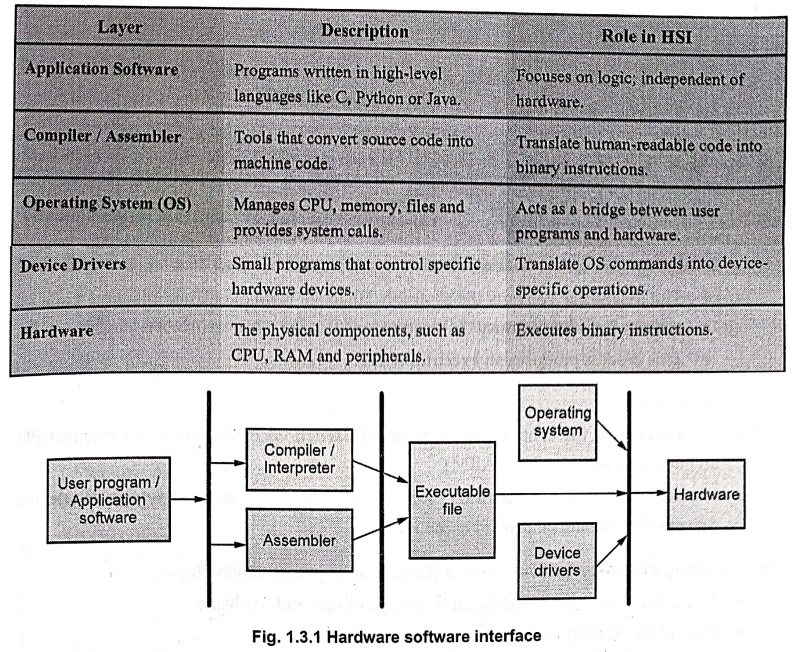
Fig.
1.3.1 illustrates the Hardware‒Software
Interface (HSI) ‒ the process and layers through which a user's program
written in a high‒level language is translated and executed by the physical
hardware. It shows how software
interacts with hardware through several translation and control stages.
1. User program / Application software (High‒level layer)
■
This is the program written by the user in a high‒level language such as C, Java or Python or group of programs
designed for end‒users to perform a
specific, non‒system task (application software).
■
It contains logical instructions (e.g., calculations, input/output, control
flow) that describe what to do, not how to interact with hardware.
2. Compiler / Interpreter and Assembler (Translation layer)
■
Compiler / Interpreter
♦ A compiler
translates the entire high‒level program into machine code (binary glory instructions) before execution.
Example:
C and C++ use compilers,
♦ An interpreter
translates and executes the program line
by line at runtime.
Example:
Python uses an interpreter.
♦ The output of this stage is assembly code or object code (partially machine‒ readable).
■ Assembler
♦ The assembler
converts the assembly language instructions into machine code ‒ a sequence of binary (0s and 1s) instructions that
the CPU can execute directly.
♦
This process produces an executable
file.
3. Executable file
■
The executable file contains machine code instructions ready to run
on a specific CPU architecture (such as x86 or ARM).
■
It cannot directly access hardware ‒ it must go through the operating system and device drivers for safe and controlled
execution.
4. Operating system and Device drivers (Control and communication layer)
■
This layer acts as the middleman
between software and hardware.
■ Operating System (OS)
♦ The OS manages the system's hardware
resources (CPU, memory, files, I/O devices).
♦ It provides system calls and APIs
that the executable file can use to perform actions such as reading a file or
displaying data on the screen.
♦ It ensures protection, scheduling and resource
allocation.
■ Device Drivers
♦ Device drivers are small, hardware‒specific
programs that communicate directly with devices such as printers, disks or
keyboards.
♦ They translate the general OS commands into device‒specific instructions
(e.g.,
writing to I/O registers or memory‒mapped addresses).
♦ Drivers make hardware components function
correctly under the control of the OS.
5. Hardware (Execution layer)
■
This is the physical layer
consisting of components like the CPU,
memory (RAM), disk and input/output devices.
■ It executes the binary instructions
that originated from the user program, performing real operations such as
calculations, data storage and signal transmission.
2. The Role and Importance of the HSI
•
The hardware ‒ software interface plays several important roles:
■
Abstraction and Simplification: It hides complex hardware details, allowing
programmers to focus on writing software logic instead of managing hardware
operations.
■ Portability and Compatibility: Standardized interfaces make software
portable. The same program can run on different machines if the interface
standards are supported.
■ Safety
and Protection: The OS controls all
hardware access, preventing programs from accidentally damaging data or the
system. Mechanisms like the I/O and MMU
(Input/Output and Memory Management Unit) help isolate devices and protect
memory from unauthorized access.
■ Performance Optimization: The
HSI allows efficient operations such as Direct
Memory Access (DMA), where devices transfer data to memory without constant
CPU involvement, improving speed and efficiency.
Review Questions
1. Explain the concept
of the Hardware Software Interface (HSI).
2. Describe the
different layers of the Hardware ‒ Software Interface with their roles.
3. Write a note on the
role and importance of the Hardware ‒ Software Interface.
Computer Organization and Architecture: Chapter 1: Introduction : Tag: Computer : - Hardware Software Interface
Computer Organization and Architecture: Chapter 1: Introduction
Under Subject
Computer Organization and Architecture
CW25201 3rd Semester IT department. | 2025 Regulation | 3rd Semester 2025 Regulation
Related Subjects
Discrete Mathematics
MA25C14 3rd Semester CSE,IT,CY,AIDS departments. | 2025 Regulation | 3rd Semester 2025 Regulation
Data Structures
CS25C08 3rd Semester CSE,IT,CY,AIDS departments. | 2025 Regulation | 3rd Semester 2025 Regulation
Computer Organization and Architecture
CW25201 3rd Semester IT department. | 2025 Regulation | 3rd Semester 2025 Regulation
Object Oriented Programming
CS25C07 3rd Semester IT department. | 2025 Regulation | 3rd Semester 2025 Regulation
Web Technologies
IT25301 3rd Semester IT department. | 2025 Regulation | 3rd Semester 2025 Regulation
English Communication Skills Laboratory I
EN25C03 3rd Semester all department. | 2025 Regulation | 3rd Semester 2025 Regulation
Skill Development Course I
3rd Semester all department. | 2025 Regulation | 3rd Semester 2025 Regulation