Computer Organization and Architecture: Chapter 1: Introduction
Addressing Modes
types, MIPS Modes
Questions: 1. What is the information conveyed by addressing modes? 2. Define addressing mode. Classify addressing modes and explain each type with examples. 3. Differentiate direct and indirect addressing mode. 4. Distinguish between autoincrement and autodecrement addressing mode. 5. Define addressing mode and explain the basic addressing modes with an example for each. 6. What are addressing modes? Explain the various addressing modes with examples. 7. Define addressing mode in a computer. What are the different MIPS addressing modes ? Give one example instruction to each category. 8. What do you mean by addressing modes? Explain the types of addressing modes that exists in modern processors ? 9. What is the need for addressing in a computer system? Explain the different addressing modes with suitable examples. 10. Elaborate the different types of addressing modes with a suitable example. 11. Explain direct, immediate, relative and indexed addressing modes with examples.
Addressing Modes
•
Part of the programming flexibility for each processor is the number and
different kind of ways the programmer can refer to data stored in the memory or
I/O device. The different ways that a processor can access data are referred to
as addressing schemes or addressing
modes.
•
An address computed by the processor when executing a memory access or branch
instruction or when fetching the next sequential instruction is known as Effective Address (EA). An effective
address can be made up from as many as three elements: The base, index and displacement.
•
An addressing mode specifies how to calculate the effective of an operand by
using elements of effective information held in registers and / or constants
contained within a machine instruction or elsewhere.
Types of addressing modes are:
1. Register addressing mode.
2. Absolute or direct addressing
mode.
3. Immediate addressing mode.
4. Indirect addressing mode.
5. Register indirect addressing
mode.
6. Displacement addressing mode.
7. Relative addressing mode.
8. Base register addressing.
9. Index addressing mode.
10. Auto‒increment addressing mode.
11. Auto‒decrement addressing mode.
12. Stack addressing mode.
1.
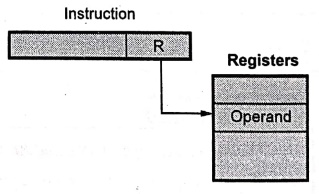
Register addressing mode: The operand is the contents of processor
register. The name of register is specified in the instruction.
■
Example : MOV R2, R1: This
instruction copies the contents of register R2 to register R1:
2.
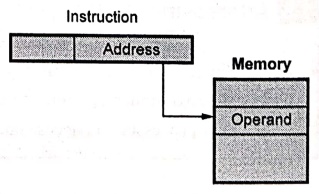
Absolute or direct addressing mode: The address of the
location of the operand is given explicitly as a part of the instruction.
■
Example: MOV 2000, A: This
instruction copies the contents of memory location 2000 into the A register. As
shown in the instruction, here, address of operand is given explicitly in the
instruction.
3.
Immediate addressing mode: The operand is given
explicitly in the instruction.
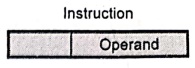
■ Example: MOV # 20, A: This instruction copies operand 20 in the register A. The sign # in front of the value of an operand is used to indicate that this value is an immediate operand.
4.
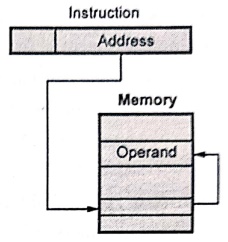
Indirect addressing mode: In this addressing
mode, the instruction contains the address of memory which refers the address
of the operand.
5.
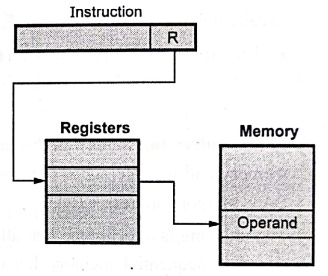
Register indirect addressing mode: The effective address
of the operand is the contents of a register or the main memory location whose
address is given explicitly in the instruction.
■
Example : MOV (R0), A This
instruction copies the contents of memory addressed by the contents of register
R0 into the register A.
6.
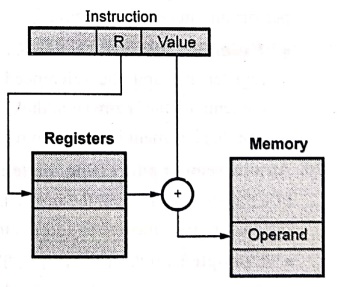
Displacement addressing mode: This addressing mode
combines the capabilities of direct addressing and register indirect addressing.
In this addressing mode, instruction has two address fields: Value and referenced register. The
effective address is computed by adding contents of referenced register to
value.
EA
= Value + (R).
Three
common variation of displacement addressing are:
■ Relative addressing
■ Base register addressing
■ Index addressing.
7.
Relative addressing mode: Here,
the referenced register is Program Counter (PC) and hence this addressing mode
is also known as PC‒relative addressing.
The
effective address is determined by adding the contents of PC to the address
field.
EA
= PC + Address part of instruction.
The
address part is a signed number so that it is possible to have branch target
location either before or after the branch instruction. This addressing mode is
commonly used to specify the target address in branch instructions.
■
Example: JNZ BACK: This
instruction causes program execution to go to the branch target location
identified by the name BACK, if the branch condition is satisfied.
8. Base
register addressing: In this addressing mode, the
referenced register contains the main memory address and address field contains
the displacement. Displacement is usually unsigned integer number. EA = (R) +
Displacement.
■
Example: MOV [R+8], A: This instruction copies the contents of memory whose
address is determined by adding the contents of register R and displacement 8
to the register A.
9. Index
addressing mode: In this addressing mode, the address
field references the main memory and the referenced register contains a
positive displacement from that address.
EA
= Memory address + (R).
The
indexing is a technique that allows programmer to point or refer the data
(operand) stored in sequential memory locations one by one. It is an efficient
mechanism for performing iterative operations.
■
Example: MOV [R1+ RI], R: In this
instruction main memory address is given by register R1 and the referenced
register RI gives the positive displacement. The contents of the memory address
generated by the addition of main memory address and displacement is copied to
register R.
10.
Autoincrement addressing mode: The effective address
of the operand is the contents of a register specified in the instruction.
After accessing the operand, the contents of this register are incremented to
address the next location.
■
Example: MOV RO, (R2)+: The above
instruction copies the contents of register RO into the memory location' whose
address is specified by the contents of register R2. After copy operation, the
contents of register R2 are automatically incremented by 1.
11.
Autodecrement addressing mode: The contents of a
register specified in the instruction are decremented and then they are used as
an effective address to access a memory location.
■
Example: MOV (RO), R1: This
instruction, initially decrements the contents of register R0 and then the
decremented contents of register R0 are used to address the memory location.
Finally, the contents from the addressed memory location are copied into the
register R1.
12. Stack
addressing mode: A
stack is linear array of reserved memory locations. It is associated with a
pointer called Stack Pointer (SP).
In
stack addressing mode, stack pointer always contains the address of Top Of
Stack (TOS) where the operand is to be stored or located. Thus, the address of
the operand (source or destination) is the contents of stack pointer.
This
addressing mode is the special case of register indirect addressing where
referenced register is a stack pointer.
Usually,
stack grows in the direction of descending addresses, (descending stack), starting
from a high address and progressing to lower one. In this stack, SP is
decremented before any items are appended (pushed) on stack and SP is
incremented after any items popped from the stack.
■
Example: PUSH R: This instruction
decrements SP and copies the contents of register R on to the top of stack
pointed by stack pointer.
MIPS Addressing Modes
The
MIPS addressing modes are as follows:
1.
Immediate addressing: In
this addressing mode, the operand is a constant within the instruction itself.

Example:
lui $s0, 61 // Loads decimal 61 in
upper 16 bits register $s0
2.
Register addressing: In this addressing mode, the operand is
a register

Example:
add $t1,$s0, $s1 // Adds contents of $s0
and $s1 and store result in St1.
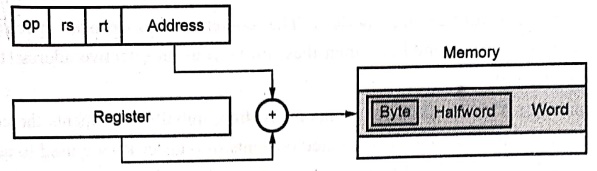
3. Base
or displacement addressing: In this addressing mode, the operand is
at the memory location whose address is the sum of a register and a constant in
the instruction.
Example:
lw $t1, 4 ($t2) // where $t1 = rs,$t2 = base (memory address),
4
= offset value
Thus;
$t1 = Memory [$t2 + 4]
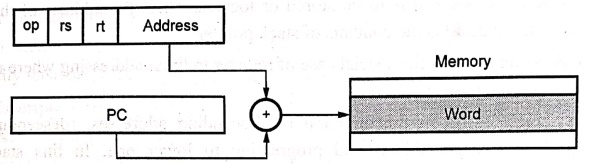
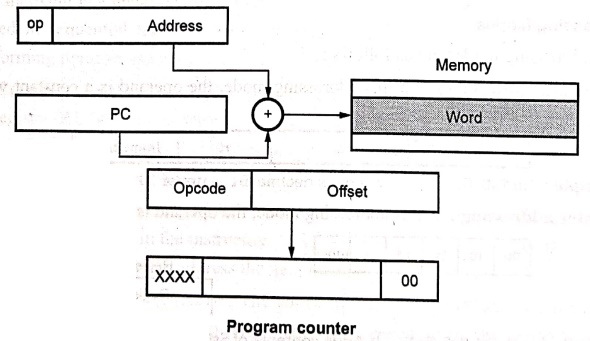
4. PC‒relative
addressing: In this addressing mode, the branch
address is the sum of the dent PC and a constant in the instruction.
Example:
beq $0,$3,Label
5.
Pseudodirect addressing: In this addressing
mode, the jump address is the 26 bits of the instruction concatenated with the
upper bits of the PC. Address in Pseudo‒Direct must be a multiple of four.
Example:
j label // go to location label.
Review Questions
1. What is the
information conveyed by addressing modes?
2. Define addressing
mode. Classify addressing modes and explain each type with examples.
3. Differentiate
direct and indirect addressing mode.
4. Distinguish between
autoincrement and autodecrement addressing mode.
5. Define addressing
mode and explain the basic addressing modes with an example for each.
6. What are addressing
modes? Explain the various addressing modes with examples.
7. Define addressing
mode in a computer. What are the different MIPS addressing modes ? Give one
example instruction to each category.
8. What do you mean by
addressing modes? Explain the types of addressing modes that exists in modern
processors ?
9. What is the need
for addressing in a computer system? Explain the different addressing modes
with suitable examples.
10. Elaborate the
different types of addressing modes with a suitable example.
11. Explain direct,
immediate, relative and indexed addressing modes with examples.
Computer Organization and Architecture: Chapter 1: Introduction : Tag: Computer : types, MIPS Modes - Addressing Modes
Computer Organization and Architecture: Chapter 1: Introduction
Under Subject
Computer Organization and Architecture
CW25201 3rd Semester IT department. | 2025 Regulation | 3rd Semester 2025 Regulation
Related Subjects
Discrete Mathematics
MA25C14 3rd Semester CSE,IT,CY,AIDS departments. | 2025 Regulation | 3rd Semester 2025 Regulation
Data Structures
CS25C08 3rd Semester CSE,IT,CY,AIDS departments. | 2025 Regulation | 3rd Semester 2025 Regulation
Computer Organization and Architecture
CW25201 3rd Semester IT department. | 2025 Regulation | 3rd Semester 2025 Regulation
Object Oriented Programming
CS25C07 3rd Semester IT department. | 2025 Regulation | 3rd Semester 2025 Regulation
Web Technologies
IT25301 3rd Semester IT department. | 2025 Regulation | 3rd Semester 2025 Regulation
English Communication Skills Laboratory I
EN25C03 3rd Semester all department. | 2025 Regulation | 3rd Semester 2025 Regulation
Skill Development Course I
3rd Semester all department. | 2025 Regulation | 3rd Semester 2025 Regulation