Computer Organization and Architecture: Chapter 1: Introduction
Classes of Computer Systems
Questions: 1. Define microcomputer. Give two examples and mention their main characteristics. 2. Differentiate between mainframe computers and supercomputers based on their functions and applications. 3. Explain the features and uses of minicomputers. 4. What are embedded systems? Give two examples from daily life. 5. Write a short note on workstations and servers. How are they different from personal computers?
Classes of Computer
Systems
•
Computer systems can be classified into various categories based on their size,
processing power and application. The major classes of computer systems are
described below.
1. Microcomputers (Personal Computers)
■
Microcomputers are small, low‒cost computers designed for individual users.
They wing contain a single microprocessor as the Central Processing Unit (CPU).
They are widely used in homes, schools and offices for applications such as
word processing, internet bat browsing, entertainment and education.
■
Examples: Desktop computers,
laptops, tablets and smartphones.
■
Characteristics :
♦ Single‒user system
♦ Compact and affordable
♦ Easy to operate and maintain
2. Minicomputers (Midrange Computers)
■
Minicomputers are medium‒sized systems that can support multiple users at the
same time. They provide greater storage and processing capabilities than
microcomputers. These computers are commonly used in small organizations,
laboratories and industries to perform business or scientific tasks.
■
Examples:
DEC
PDP‒11, VAX systems.
■
Characteristics :
♦ Multi‒user capability (10 to 100 users)
♦ Moderate processing speed
♦ Used for data management and control
applications
3. Mainframe Computers
■
Mainframe computers are large and powerful systems capable of handling and
processing very large amounts of data. They are designed to support hundreds or
even thousands of users simultaneously. Mainframes are widely used in large
organizations such as banks, insurance companies and airlines for critical
applications like transaction processing and large database management.
■
Examples:
IBM
zSeries, UNIVAC.
■
Characteristics :
♦ High reliability, speed and security
♦ Supports multiple terminals and users
♦ Operates continuously for long periods
4. Supercomputers
■
Supercomputers are the fastest and most powerful category of computers. They
are used for highly complex scientific, engineering and research applications
that require enormous computational power. They can perform trillions of
calculations per second and are often used in weather forecasting, nuclear
research, space exploration and artificial intelligence.
■
Examples:
PARAM
(India), IBM Summit, Fugaku (Japan).
■ Characteristics :
♦ Extremely high processing speed.
♦ Very high cost and power consumption.
♦ Requires advanced cooling systems and a
large physical space.
5. Workstations
■
A workstation is a high‒performance single‒user computer designed for technical
or scientific applications. It offers higher processing power, better graphics
capabilities and greater memory than a personal computer. Workstations are
typically used by engineers, designers and software developers.
■
Examples: Sun Microsystems
Workstations, HP Z‒series.
■
Characteristics:
♦ High‒speed processor and large memory.
♦ Suitable for CAD/CAM, 3D modelling and
simulation.
♦ Supports advanced graphics and multitasking.
6. Server Computers
■
Server computers are systems that provide resources, data or services to other
computers (clients) over a network. Servers are designed for reliability and
are used in organizations to manage web hosting, databases, emails and file
storage.
■
Examples:
Web
servers, File servers, Database servers.
■
Characteristics :
♦ Multi‒user access and centralized control.
♦ High storage capacity and connectivity.
♦ Always operational for continuous service.
7. Embedded Systems
■
Embedded systems are special‒purpose computer systems built into other devices
to perform dedicated tasks. They consist of microcontrollers or microprocessors
embedded bus within the device and are designed for real‒time operation.
■
Examples: Washing machines,
ATMs, Automobiles, Routers.
■
Characteristics :
♦ Compact and task‒specific.
♦ Low power consumption.
♦ High reliability and efficiency.
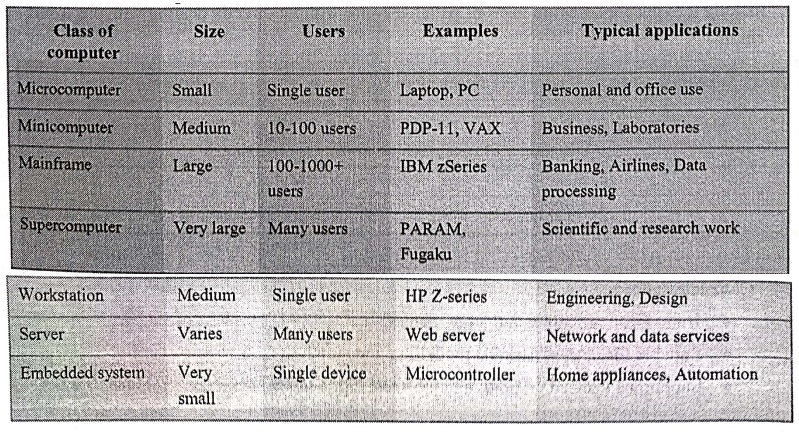
Table
1.2.1 compares various classes of computer systems.
Review Questions
1. Define microcomputer.
Give two examples and mention their main characteristics.
2. Differentiate
between mainframe computers and supercomputers based on their functions and
applications.
3. Explain the
features and uses of minicomputers.
4. What are embedded
systems? Give two examples from daily life.
5. Write a short note
on workstations and servers. How are they different from personal computers?
Computer Organization and Architecture: Chapter 1: Introduction : Tag: Computer : - Classes of Computer Systems
Computer Organization and Architecture: Chapter 1: Introduction
Under Subject
Computer Organization and Architecture
CW25201 3rd Semester IT department. | 2025 Regulation | 3rd Semester 2025 Regulation
Related Subjects
Discrete Mathematics
MA25C14 3rd Semester CSE,IT,CY,AIDS departments. | 2025 Regulation | 3rd Semester 2025 Regulation
Data Structures
CS25C08 3rd Semester CSE,IT,CY,AIDS departments. | 2025 Regulation | 3rd Semester 2025 Regulation
Computer Organization and Architecture
CW25201 3rd Semester IT department. | 2025 Regulation | 3rd Semester 2025 Regulation
Object Oriented Programming
CS25C07 3rd Semester IT department. | 2025 Regulation | 3rd Semester 2025 Regulation
Web Technologies
IT25301 3rd Semester IT department. | 2025 Regulation | 3rd Semester 2025 Regulation
English Communication Skills Laboratory I
EN25C03 3rd Semester all department. | 2025 Regulation | 3rd Semester 2025 Regulation
Skill Development Course I
3rd Semester all department. | 2025 Regulation | 3rd Semester 2025 Regulation