Computer Organization and Architecture: Chapter 1: Introduction
Benchmarks
Computer Organization
Questions: 1. What is the purpose of the SPEC benchmarks? 2. Differentiate between CINT2006 and CFP2006 benchmark suites of SPEC 3. Define SPECratio and explain how it is used to compare computer systems. 4. Describe how the SPEC power benchmark measures the energy efficiency of a system.
Benchmarks
•
When you buy or evaluate a computer, you want to know how well it will perform
for your work. If you ran exactly the same programs every day, you could simply
test one computer, then test another and compare how long your programs took.
But in the real world, most users don't run exactly the same tasks all the
time.
•
So instead of relying on your specific workload, we use benchmarks ‒ these are carefully selected programs that attempt to
reflect typical work. We run these on computers and use the results to compare
performance, hoping the results relate to how the computer will perform on your
real tasks.
• SPEC (System Performance
Evaluation Cooperative) is an organization that gathers
computer vendors and users to create standard
benchmark suites. The SPEC benchmarks
are standardized programs used to measure and compare the performance and power
efficiency of different computer systems. They act as a common workload that lets users predict how well a computer will
handle typical, day‒to‒day tasks, even if the user doesn't have the exact
programs to test.
•
SPEC is critical because it helps solve the problem of comparing different
processors and systems in a fair and standardized way.
•
The original SPEC CPU benchmark (called SPEC89)
measured processor performance. It consists of two main suites:
1. CINT2006 (Integer Benchmarks): A
set of 12 programs covering tasks that rely heavily on integer arithmetic and
memory access, like compiling code, running a chess program, or basic simulations.
2. CFP2006 (Floating‒Point
Benchmarks): A set of 17 programs covering tasks
that require complex, high‒precision calculations, such as fluid dynamics,
molecular modelling and finite element analysis.
•
These benchmarks attempt to stress the CPU, memory subsystem, compilers, etc.,
but they generally do not focus on many other parts of a computer system (such
as network I/O or graphics).
1. SPECratio
•
To provide a simple, single number for comparison, SPEC uses the SPECratio :
■
Normalization: The execution
time of a measured computer is compared against the execution time of a reference processor (a standard
baseline machine).
■
The Ratio: SPECratio =
Execution Time on Reference Computer / Execution Time on Measured Computer.
■
Interpretation: A larger
SPECratio means a faster computer.
For example, a SPECratio of 50 means the measured computer is 50 times faster
than the reference machine.
■
3200 Single summary: The
overall score for CINT2006 or CFP2006 is found by taking the geometric mean of the SPECratios for
all programs in the suite. This mathematical method ensures the final relative
comparison between any two computers remains consistent, regardless of which
computer was chosen as the initial reference.
2. SPEC Power Benchmark: Measuring Efficiency
•
With energy consumption becoming a major concern, the SPEC Power benchmark measures
the energy efficiency of server
systems under varying loads.
•
It runs a Java‒based business application workload (originally SPECJBB2005)
that stresses the processor, memory and caches. The system's performance
(throughput, measured in "ssj_ops") and its electrical power
consumption (in watts) are measured at 10
different workload levels, from 100% load down to 0% (idle).
•
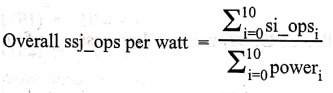
The data is condensed into a single metric that represents overall efficiency :
•
Interpretation: This metric is the
ratio of the total performance achieved across all ten load levels to the total
power consumed at those same levels.
•
Result: A higher "overall
ssj_ops per watt" value indicates a more
energy‒efficient server. It means the server delivers more processing work
for every watt of power it consumes, which is crucial for data centers aiming
to reduce electricity costs.
Review Questions
1. What is the purpose
of the SPEC benchmarks?
2. Differentiate
between CINT2006 and CFP2006 benchmark suites of SPEC
3. Define SPECratio
and explain how it is used to compare computer systems.
4. Describe how the
SPEC power benchmark measures the energy efficiency of a system.
Computer Organization and Architecture: Chapter 1: Introduction : Tag: Computer : Computer Organization - Benchmarks
Computer Organization and Architecture: Chapter 1: Introduction
Under Subject
Computer Organization and Architecture
CW25201 3rd Semester IT department. | 2025 Regulation | 3rd Semester 2025 Regulation
Related Subjects
Discrete Mathematics
MA25C14 3rd Semester CSE,IT,CY,AIDS departments. | 2025 Regulation | 3rd Semester 2025 Regulation
Data Structures
CS25C08 3rd Semester CSE,IT,CY,AIDS departments. | 2025 Regulation | 3rd Semester 2025 Regulation
Computer Organization and Architecture
CW25201 3rd Semester IT department. | 2025 Regulation | 3rd Semester 2025 Regulation
Object Oriented Programming
CS25C07 3rd Semester IT department. | 2025 Regulation | 3rd Semester 2025 Regulation
Web Technologies
IT25301 3rd Semester IT department. | 2025 Regulation | 3rd Semester 2025 Regulation
English Communication Skills Laboratory I
EN25C03 3rd Semester all department. | 2025 Regulation | 3rd Semester 2025 Regulation
Skill Development Course I
3rd Semester all department. | 2025 Regulation | 3rd Semester 2025 Regulation