Computer Organization and Architecture: Chapter 1: Introduction
Performance Metrics of Computer: Example Problems
Measuring Performance: CPU Time, Performance Metrics, Basic performance equation
Example : 1
If computer A runs a program in 10
seconds and computer B runs the same program in 15 seconds, how much faster is
A than B ?
Solution:
We
know that A is n times faster than B if
PerformanceA
/ PerformanceB = Execution timeB / Execution timeA =
n
Thus
the performance ratio is
15/10
= 1.5
and
A is therefore 1.5 times faster than B.
•
In the above example, we could also say that computer B is 1.5 times slower
than computer A, since
Performance
A / PerformanceB = 1.5
means
that
PerformanceA
/ 15 = PerformanceB
•
For simplicity, we will normally use the terminology faster than when we try to
compare computers quantitatively. Because performance and execution time are
reciprocals, increasing performance requires decreasing execution time. To
avoid the potential confusion between the terms increasing and decreasing, we
usually say "improve performance" or "improve execution
time" when we mean "increase performance" and "decrease
execution time".
Example : 2
Computer A runs a program in 12
seconds with a 3 GHz clock. We have to design a computer B such that it can run
the same program with in 9 seconds. Determine the clock rate for computer B.
Assume that due to increase in clock rate, CPU design of computer B is affected
and it requires 1.2 times as many clock cycles as computer A for execution this
program.
Solution:
Given:
Clock rateA = 3 x 10⁹ cycles/sec
CPU
time A = 12 seconds
CPU timeB = 9 seconds
We
have,
CPU
timeA = CPU clcok cyclesA / Clock rateA
12
seconds = CPU clock cyclesA / (3 x 10⁹ cycles/sec)
CPU
clock cyclesA = 12 seconds × 3 × 10⁹ cycle / sec = 36 x
109 cycles
The
CPU time for computer B can be given as
CPU
timeB = CPU clcok cyclesB / Clock rateB = [ 1.2×
CPU clock cyclesA ] / [ Clock rateA ]
9
seconds = [ 1.2 × 36 × 109 cycles ] / [ Clock rateB ]
Clock
rateB = [ 1.2 × 36 × 109 cycles ] / [ 9 seconds ] = 4.8
cycles/sec = 4.8 GHz
Example : 3
A program runs in 10 seconds on computer
A, which has a 2 GHz clock. Try to help a computer designer build a computer,
B, which will run this program in 6 seconds. The designer has determined that a
substantial increase in the clock rate is possible, but this increase will
affect the rest of the CPU design, causing computer B to require 1.2 times as
many clock cycles as computer A for this program. What clock rate should we
tell the designer to target?
Solution:
Given: Clock rateA = 2 ×
109 cycles/sec
CPU
timeA = 10 seconds
CPU
timeB = 6 seconds
We
have,
CPU
timeA = CPU clock cyclesA / Clock rateA
10
seconds = CPU clock cyclesA / [2× 10⁹ (cycles/second)]
CPU
clock cyclesA = 10 seconds × [2× 10⁹ (cycles/second)] = 20 x 109 cycles
CPU
time for B can be found using this equation:
CPU
timeB = [1.2 × CPU clock cyclesA ] / Clock rateB
6
seconds = [1.2 × 20 × 109 cyclesA] / Clock raеB
Clock
rateB = [ 1.2 × 20 × 109 cycles] / 6 seconds = [ 0.2 × 20
× 109 cycles] / seconds
=
[4 × 10⁹ cycles] / seconds = 4 GHz
To
run the program in 6 seconds, B must have twice the clock rate of A.
Basic
performance equation
The
basic performance equation is given by
T
= [N× CPI ] / R = (N× CPI) / Clock rate = N × CPI × Clock cycle time
where
CPI: The average number of clock cycles each instruction takes to execute.
It
is given by
CPI
= CPU clock cycles / Instruction count
N:
Number of instructions.
R:
Clock rate measured in clocks / seconds.
Example: 4
Let us assume that two computers
use same instruction set architecture. Computer A has a clock cycle time of 250
ps and a CPI of 2.0 for same program and computer B has a clock cycle time of
500 ps and a CPI of 1.2 for the same program. Which computer is faster for this
program and by how much?
Solution:
We know that each computer executes the same number of instructions for the
program; let's call this number N. First, find the number of processor clock
cycles for each computer:
CPU
clock cyclesA = N×20
CPU
clock cyclesB = N× 1.2
The
CPU time for each machine will be
CPU
timeA = CPU clock cyclesA × Clock cycle timeA
=
N× 2.0 × 250 ps = 500 N ps
CPU
timeB = CPU clock cyclesB × Clock cycle timeB
=
N × 1.2 × 500 ps = 600 N ps
Thus
we can say that computer A is faster. The amount faster is given by the ratio
of the execution times.
CPU
PerformaceA / CPU PerformanceB = Execution timesB
/ Execution timeA =
600
N ps / 500 N ps =1.2
We
can conclude that computer A is 1.2 times faster than computer B for this
program.
Example: 5
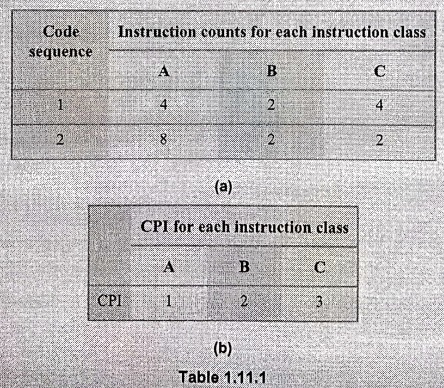
Table 1.11.1 (a) shows the two code
sequences with number of instructions of different instruction classes within
each code sequence, respectively. The instructions are classified as A, B and C
according to the CPI as shown in Table 1.11.1 (b). From the given information:
i) Determine which code sequence
executes the most instructions.
ii) Determine which code sequence
will execute quickly,
iii) Determine the CPI for each
code sequence.
Solution:
i) Code sequence 1 executes : 4+2 + 4 = 10
instructions.
Code
sequence 2 executes : 8+2+2 = 12 instruction.
Therefore,
code sequence 2 executes more instructions.
ii)
CPU clock cycles required to execute these code sequences is given as
CPU
clock cycles 1 = (4 × 1) + (2 × 2) + (4 × 3) = 20 cycles
CPU
clock cycles 2 = (8 × 1) + (2 × 2) + (2 × 3) = 18 cycles
Thus,
we can say that code sequence 2 is faster than code sequence 1, even though it
executes two extra instructions.
iii)
We know that
CPI
= CPU clock cycles / Instruction count
CPI1
= 20 / 10 and CPI2 = 18 / 12 = 1.5
•
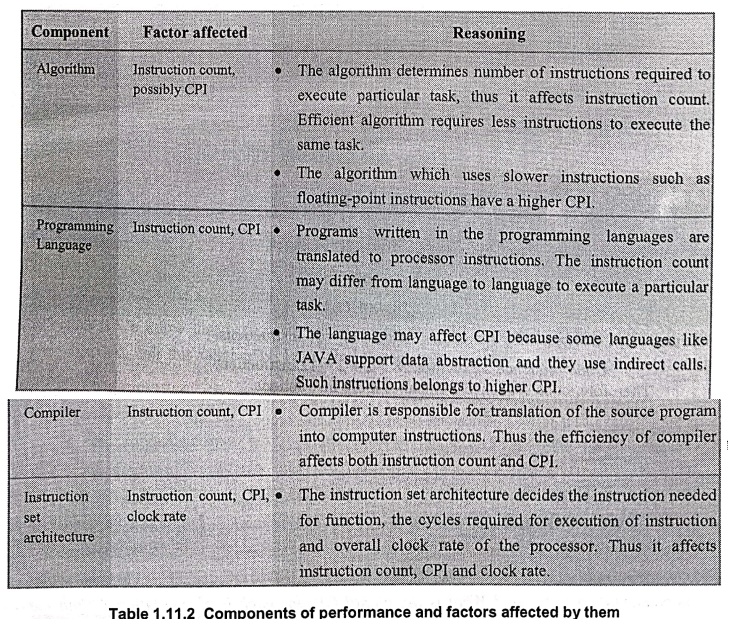
The above example shows that we can not rely on one factor to access
performance. While comparing two computers we must look at all the components
of performance listed in Table 1.11.2.
•
If some of the factors are identical, performance should be determined by comparing
all the nonidentical factors. Since CPI varies by instruction mix (A measure of the dynamic frequency of instructions
across one or many programs), both CPI and instruction count must be compared,
even if clock rates are identical.
•
The performance of a program also depends on the algorithm, the language,
the compiler, the architecture and the actual hardware.
• Table 1.11.2 gives the information of how
these components affect the factors in the CPU performance equation.
Example: 6
Consider three different processors
P1, P2 and P3 executing the same instruction set. Pl has a 3 GHz clock rate and
a CPI of 1.5. P2 has a 2.5 GHz clock rate and a CPI of 1.0. P3 has a 4.0 GHz
clock rate and has a CPI of 2.2.
a) Which processor has the highest
performance expressed in instructions per second?
b) If the processors each execute a
program in 10 seconds, find the number of cycles and the number of instructions
in each processor.
Solution:
a)
P2 has the highest performance.
Performance
of P1 (instructions/sec) = (3 x 10⁹) / 1.5 = 2 × 10⁹
Performance
of P2 (instructions/sec) = (2.5 x 10⁹) / 1.0 = 2.5 × 10⁹
Performance of P3 (instructions/sec) = (4 × 10⁹) / 2.2 = 1.82 x 10⁹b)
Number of cycles = Time × Clock rate
Cycles
(P1) = 10 × 3 × 109 = 30 × 109
Cycles
(P2) = 10 × 2.5 × 109 = 25 × 109
Cycles
(P3) = 10 × 4.0 × 109 = 40 × 109
Time
= (Number of instructions × CPI) / Clock rate
Number
of instructions = (Time × Clock rate) / CPI = Number of cycles / CPI
No.
of Instructions (P1) = 30×109 /1.5 = 20x 109
No.
of Instructions (P2) = 25×109 / 1.0 = 25 × 109
No.
of Instructions (P3) = 40×109 / 2.2 = 18.18 × 10⁹
Example: 7
Consider two different
implementations of the same instruction set architecture. The instructions can
be divided into four classes according to their CPI (class A, B, C and D). P1
with a clock rate of 2.5 GHz and CPIs of 1, 2, 3 and 3 respectively and P2 with
a clock rate of 3 GHz and CPIs of 2, 2, 2 and 2 respectively. Given a program
with a dynamic instruction count of 1.0 × 10⁶ instructions divided into classes as follows: 10% class
A, 20% class B, 50 % class C and 20 % class D, which implementation is faster?
What is the global CPI for each implementation? Find the What is the clock
cycles required in both cases
Solution:
a)
Class A: 105 instruction,
Class
B: 2 × 10⁵ instruction,
Class
C: 5 × 10⁵ instruction,
Class
D: 2 × 10⁵ instruction.
Time
= No. instruction × CPI / clock rate
Total
time P1 = (105 + 2×105×2 + 5×105 × 3 + 2×105×3)
/ (2.5 × 10⁹) = 10.4 × 10 ‒ 4 S
Total
time P2 = (105×2+ 2×105 × 2 + 5×105 × 2+2×105
× 2) / (3 × 10⁹)
= 6.66
× 10‒ 4 S
CPI
(P1) = 10.4× 10‒ 4 × 2.5 × 109 /106 = 2.6.
CPI
(P2) = 6.66 × 10‒ 4 × 3 × 109 /106 = 2.0
P2
implementation is faster.
b)
Clock
cycles (P1) =105 × 1 + 2 × 105 × 2+5 × 105 × 3+2
× 105 × 3 = 26 × 105
Clock
cycles (P2) =105 × 2+2 ×105 ×2+5× 105 ×2 + 2 ×
105 ×2+2 × 105 × 2
=
20 × 105
Computer Organization and Architecture: Chapter 1: Introduction : Tag: Computer : - Performance Metrics of Computer: Example Problems
Computer Organization and Architecture: Chapter 1: Introduction
Under Subject
Computer Organization and Architecture
CW25201 3rd Semester IT department. | 2025 Regulation | 3rd Semester 2025 Regulation
Related Subjects
Discrete Mathematics
MA25C14 3rd Semester CSE,IT,CY,AIDS departments. | 2025 Regulation | 3rd Semester 2025 Regulation
Data Structures
CS25C08 3rd Semester CSE,IT,CY,AIDS departments. | 2025 Regulation | 3rd Semester 2025 Regulation
Computer Organization and Architecture
CW25201 3rd Semester IT department. | 2025 Regulation | 3rd Semester 2025 Regulation
Object Oriented Programming
CS25C07 3rd Semester IT department. | 2025 Regulation | 3rd Semester 2025 Regulation
Web Technologies
IT25301 3rd Semester IT department. | 2025 Regulation | 3rd Semester 2025 Regulation
English Communication Skills Laboratory I
EN25C03 3rd Semester all department. | 2025 Regulation | 3rd Semester 2025 Regulation
Skill Development Course I
3rd Semester all department. | 2025 Regulation | 3rd Semester 2025 Regulation