Applied Physics I: Chapter 4: Oscillations and Waves
Oscillations and Waves: Important Solved Problems
Anna University Solved Problems, Additional Solved Problems, Assignment Problems - Questions with solved Solution and Answer - Applied Physics I: Chapter 4: Oscillations and Waves
ANNA UNIVERSITY SOLVED PROBLEMS
1. A wire of length 1
metre and diameter 1mm is clamped at one of its ends. Calculate the couple
required to twist the other end by 90°. Given modulus of rigidity = 298 Gpa
Given
data
n
= 298 × 109 Pa
θ
= 90° = π/2 radians
r
= 0.5 × 10‒3m
L
= 1m
Solution
Formula:
Twisting Couple C = πnθr4 / 2L
C
= [π × 298 × 109 × π × (0.5×10‒3)4] / [2×2×1]
C
= 0.18363 / 4
C
= 4.59 × 10‒2 NM
Couple
required to twist the other end by 90° = 4.59×10‒2NM.
2. A wire of radius
0.8mm and length 50cm is twisted through an angle of 45° The module of rigidity
of the material of the wire is 8×10¹⁰ N/m2. Calculate the
work done.
Given
data
n
= 8 × 10¹⁰N/m2
r
= 0.8 × 10‒3m
0
= 45° = π/4 radians;
L
= 0.5m
Solution
Formula: Couple
per unit twist C = πnr4 / 2L
3. A torsion pendulum
is made using a steel wire of diameter 0.5mm and a sphere of diameter 3 cm. The
rigidity modulus of steel is 80 GPa and density of the material of the sphere
is 11300 kg/m3. If the period of oscillation is 2 second, find the
length of the wire.
Given
data
n=
80 × 109 Pascals
r
= 0.25 × 10‒3m
R
= 1.5 × 10‒2m
ρ
= 11300 kg/m3
T
= 2 seconds
Solution
Formula:
Rigidity Modulus n = 8πΙl / T2r4
For
sphere the moment of Inertia I = 2/5 MR2
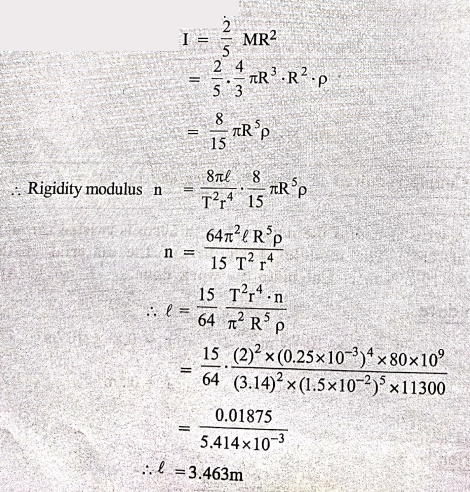
l = 3.463m
Length
of the suspended wire = 3.463m
4. A cylindrical wire
of length 1 m and radius 5 mm is rigidly clamped at one end. Calculate the
couple required to twist the free and through an angle 45°. The rigidity
modulus of the material of the wire is 200×109 Pa.
Given
data
L
= 1 m
r
= 5 × 10‒3 m
0
= 45° = (45° × π) / 360
n
= 200×109 Pa
Solution
Twisting
Couple C = πnθr4 / 2L
C
= (π×200×109 × 45 × 2π × (5×10‒3)4) / (2×1×360)
C
= 154.056 Newton meter
Couple
per unit twist C = 154.056 Nm
5. An elastic wire is
cut into half its original length. How will it affect the maximum load the wire
can support?
Solution:
We
know
(i)
E = (Load/Area) × (original length/change in length)
(ii)
Tensile strength = Maximum tensile load / Original cross sectional area
When
Original Length is halved, strain is changed so that the maximum load that the
wire can support will remain the same as Elastic modulus is constant.
6) The classroom door
is of width 50cm. If the handle of the door is 20 cm from the edge and the
force of 5 N is applied on the handle, compute the torque.
Solution
Given
data
Width
of the door = 50 × 10‒2 m
Handle
of door located = 20 × 10‒2 m
Line
of action = [ 20×10‒2 / 2 ] = 10×10‒2m
Force
aplied (F) = 5N
Torque
= ?
Formula
Torque
(τ) = Force applied (F) × Level Arm distance (d)
Here
Lever arm distance d = Width of the door ‒ Line of action
(i.e.)
d = [ 50 × 10‒2 ] ‒ [ 20×10‒2
/ 2 ]
(or)
d = [ 50×10‒2 ] ‒ [ 10×10‒2 ]
(or)
d = 40 × 10‒2
Torque
(τ) = 5 × 40 × 10‒2
(or)
(τ) = 200 × 10−2
(τ) = 2 NM
∴ Torque (τ) = 2 NM
ADDITIONAL SOLVED PROBLEMS
1. A particle executing
a S.H.M of period 2π seconds has a total energy of 10.24 × 10‒4
Joule. If the displacement of the particle at π/4 second is 0.08√2 metres, then
find the amplitude of the particle.
Solution
Given
Data
E
= 10.24 x 10‒4J;
T
= 2π sec and
y
= 0.08 √2 metres;
t
= π/4 sec.
Formula:
In
S.H.M. The displacement of a particle is given by
y
= A sin ωt
y
= A sin (2π/T)t
0.08√2
= Asin [2π/2π . π/4]
0.113=A
sin π/4
0.113
= A/√2
A
= 0.113× √2
A
= 0.1598 m
Amplitude of the particle = 0.1598 m
2. Calculate the
maximum amplitude of velocity, for a particle executing S.H.M of period 10sec
and amplitude 5.0 cm.
Solution
Given
Data
Displacement
amplitude (A) = 0.05 m
T=
10 sec.
Formula:
The
maximum amplitude of velocity is
Aω
= 0.05 × 2π/T
Aω
= (0.05×2×3.14) / 10
Aω
= 0.0314 m/sec
The
Maximum Amplitude of velocity = 0.0314m/s
3. Find the natural
frequency for a material of mass 1 kg attached to a spring of stiffness
constant 16 N/m.
Solution
Given
Data
Force
constant k = 16 N/m and
m
= 1 kg.
Formula:
For
natural frequency
n
= 1/2π . √(k/m)
n
= 1/2π . √(16/1)
n
= 2/π
n
= 2 / 3.14
n
= 0.64Hz
Natural frequency n=0.64 Hertz
4. A simple pendulum of
one meter length is hang at one end. Considering the oscillations to be of
small displacements, find the period of oscillation, if the mass of pendulum is
2 kg. (Given g = 9.8 m/s2).
Solution
Given
Data
Displacement
= 1 m
mass
(m) = 2 kg
Formula:
Time
period T = 2π √[l/g]
T=2×3.14×√[1/9.8]
T=6.28×0.319
∴ T = 2.003 sec.
Period
of oscillation = 2 seconds
5. A lift is ascending
at an acceleration of 3 m/sec2. What is the period of oscillation of
simple Pendulum of length one meter suspended in the lift? [Given: Acceleration
due to gravity = 9.8 m/g2].
Solution
Given
Data
Acceleration
of lift = 3 m/sec2
length
l =1 metre.
The
lift is ascending at an acceleration 3 m/sec2 and acceleration due
to gravity is g = 9.8 m/sec2.
Hence
the total acceleration (g') is 9.8 + 3 = 12.8 m/sec2
Formula:
Time
period T = 2π√[l/g']
T=2π
√(1/12.8)
T
= 2×3.14×0.2795
T=1.755
sec
or
T=1.76
Period of Oscillation = 1.76 seconds
6) A uniform metal disc
of diameter 0.1 m and mass 1.2kg is fixed symmetrically to the lower end of a
torsion wire of length 1m and diameter 1.44×10‒3m, the upper end is
fixed. The time period of torsional oscillations is 1.98s. calculate the
modulus of rigidity of the material of the wire.
Solution
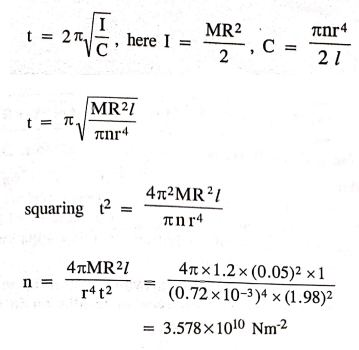
Rigidity modulus of the material = 3.578×10¹⁰ Nm‒2
ASSIGNMENT PROBLEMS
1.
A square metal bar of 25mm side, 0.38mm long and mass 0.8 kg is suspended by a
wire of 0.4 mm long and 0.5 mm radius. It is observed to make 50 oscillations
in 335.7 seconds. Calculate the Rigidity Modulus of the material of the wire. (Ans.34.5 GPa)
2.
A wire of 3m long and 3× 10‒4m in diameter elongates to 1.32×10‒3m,
when stretched by a force of 0.6 kg weight. Find Young's modulus of the
material of the wire. (Ans: 1.9×10¹¹Nm‒2)
3.
A wire of length 1m and diameter 10‒2m is fixed at one end and
twisted at the other end through an angle of 70° by applying a couple of value
0.01Nm. Evaluate the rigidity modulus of the wire. (Ans: 8.281×10¹⁰Nm‒2)
4.
A circular disc of mass 0.25 kg and radius 2.5×10‒2m is fixed
perpendicularly to the end of a wire of length 0.3m and diameter 10‒3m.
Find the rigidity modulus of the wire if the period of oscillation is 1.05 sec.
(Ans: 3.418×10¹⁰Nm‒2)
Applied Physics I: Chapter 4: Oscillations and Waves : Tag: Applied Physics : - Oscillations and Waves: Important Solved Problems
Applied Physics I: Chapter 4: Oscillations and Waves
Under Subject

Applied Physics I
PH25C01 1st Semester | 2025 Regulation | 1st Semester 2025 Regulation
Related Subjects

English Essentials I
EN25C01 1st Semester | 2025 Regulation | 1st Semester 2025 Regulation

தமிழர் மரபு - Heritage of Tamils
UC25H01 1st Semester | 2025 Regulation | 1st Semester 2025 Regulation
Applied Calculus
MA25C01 Maths 1 M1 - 1st Semester | 2025 Regulation | 1st Semester 2025 Regulation
Applied Physics I
PH25C01 1st Semester | 2025 Regulation | 1st Semester 2025 Regulation

Applied Chemistry I
CY25C01 1st Semester | 2025 Regulation | 1st Semester 2025 Regulation

Makerspace
ME25C04 1st Semester | 2025 Regulation | 1st Semester 2025 Regulation
Computer Programming C
CS25C01 1st Semester | 2025 Regulation | 1st Semester 2025 Regulation

Computer Programming Python
CS25C02 1st Semester | 2025 Regulation | 1st Semester 2025 Regulation

Fundamentals of Electrical and Electronics Engineering
EE25C03 1st Semester | 2025 Regulation | 1st Semester 2025 Regulation

Introduction to Mechanical Engineering
ME25C03 1st Semester | 2025 Regulation | 1st Semester 2025 Regulation

Introduction to Civil Engineering
CE25C01 1st Semester Civil Department | 2025 Regulation | 1st Semester 2025 Regulation
Essentials of Computing
CS25C03 1st Semester - AID CSE IT Department | 2025 Regulation | 1st Semester 2025 Regulation

Applied Physics I Laboratory
PH25C01 1st Semester practical Laboratory Manual | 2025 Regulation | 1st Semester Laboratory 2025 Regulation

Applied Chemistry I Laboratory
CY25C01 1st Semester practical Laboratory Manual | 2025 Regulation | 1st Semester Laboratory 2025 Regulation

Computer Programming C Laboratory
CS25C01 1st Semester practical Laboratory Manual | 2025 Regulation | 1st Semester Laboratory 2025 Regulation

Computer Programming Python Laboratory
CS25C02 1st Semester practical Laboratory Manual | 2025 Regulation | 1st Semester Laboratory 2025 Regulation
Engineering Drawing
ME25C01 EEE Mech Dept | 2025 Regulation | 2nd Semester 2025 Regulation

Basic Electronics and Electrical Engineering
EE25C04 1st Semester ECE Dept | 2025 Regulation | 2nd Semester 2025 Regulation