Applied Physics I: Chapter 4: Oscillations and Waves
Standing waves (or) Stationary wave pattern
Definition, Explanation, Cases, Conclusions
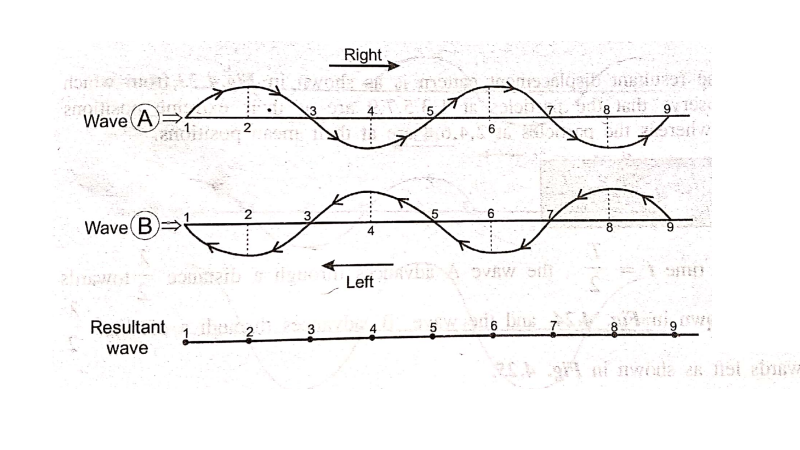
When two waves executing simple harmonic motion travel in opposite directions in a straight line, with same amplitude, same frequency and same time period, then the resultant wave obtained is called a standing wave (or) stationary wave pattern.
STANDING
WAVES (OR) STATIONARY WAVE PATTERN
Definition
When
two waves executing simple harmonic motion travel in opposite directions in a straight line, with same amplitude, same
frequency and same time period, then the resultant wave obtained is called a standing wave (or) stationary wave pattern.
Explanation
Let
us consider two wave trains 'A' and 'B' of same amptitude, same frequency and
wavelength, as shown in Fig. 4.18. & Fig. 4.19.
If
both the wave travel in opposite
direction, then at time t = 0 sec, the resultant wave (or) displacement
curve is a straight line as shown in Fig.4.20, from which, we can see that all
the particles are at their mean positions.

SPECIAL CASES
Case
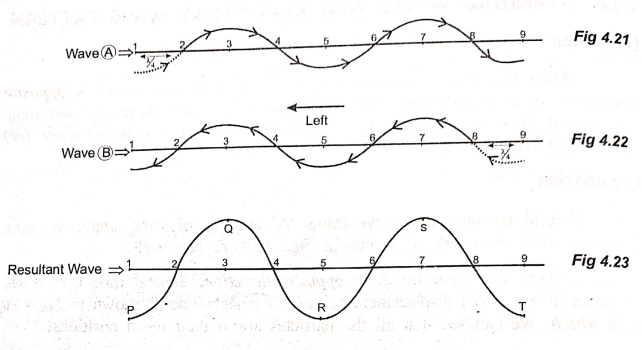
(i): At time t = T/ 4
'
At
time t = T/4, the wave 'A' advances through a distance λ/4 towards right as
shown in Fig.4.21, and the wave 'B' advances through a distance λ/4 towards
left as shown in Fig. 4.22.
The
resultant displacement pattern is as shown in Fig.4.23, from which we can
observe that the particles at 1,3,5,7,9 are at their extreme positions (PQRST),
whereas the particles at 2,4,6,8 are at their mean positions.
Case
(ii) At time t = T/2
At
time t = T/2, the wave A advances through a distance λ/2 towards right as shown
in Fig. 4.24, and the wave 'B' advances through a distance λ/2 towards left as
shown in Fig. 4.25.

The
resultant wave (or) displacement pattern is again a straight line as shown in
Fig. 4.26, i.e., all the particles are at their mean positions.
Case
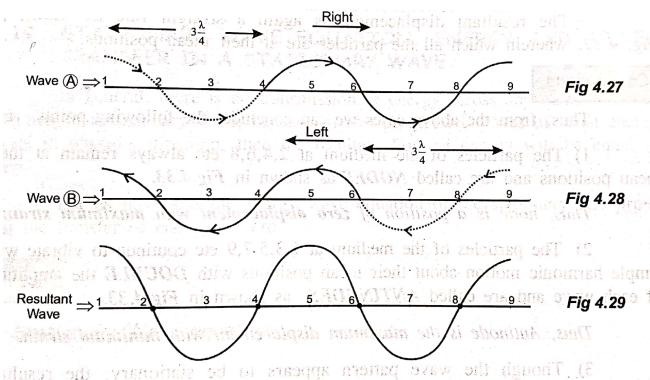
(iii): At time t: 3T/4
At
time t = 3T / 4, the wave 'A' advances through a distance of 3λ/4 towards right
as shown in Fig. 4.27 and the wave 'B' advances through a 3λ/4 distance towards
left as shown in Fig. 4.28.
The
resultant displacement pattern is as shown in Fig. 4.29, from which we can see
that the particles 1,3,5,7 9 are at extreme positions and the particles at
2,4,6,8 are at mean positions.
Case
(iv): At time t = T
At
time t = T the wave 'A' advances through a distance of ' λ' towards right as
shown in Fig. 4.30 and the wave 'B' advances through a distance of ' λ' towards
left as shown in Fig.4.31.

The
resultant displacement is again a straight line as shown in Fig. 4.32, wherein
which all the particles are at their mean positions.
Conclusions
Thus,
from the above cases we can conclude, the following points, viz.,
1)
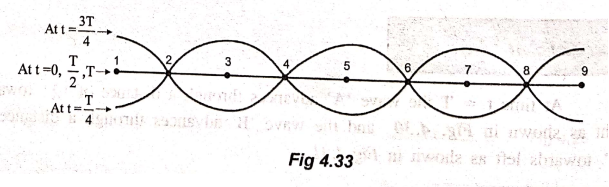
The particles of the medium at 2,4,6,8 etc always remain at their mean
positions and are called NODES as shown in Fig.4.33.
Thus,
node is a position of zero displacement with maximum
strain.
2) The particles of the medium at 1,3,5,7,9 etc continue to vibrate with simple harmonic motion about their mean positions with DOUBLE the amplitude of each wave and are called ANTINODES as shown in Fig.4.33.
Thus,
Antinode is the maximum displacement with minimum strain.
3)
Though the wave pattern appears to be stationary, the resultant displacement
pattern at various intervals of time (t=0,
T/4, T/2, 3T/4, T) is as shown in Fig.4.33.
Applied Physics I: Chapter 4: Oscillations and Waves : Tag: Applied Physics : Definition, Explanation, Cases, Conclusions - Standing waves (or) Stationary wave pattern
Applied Physics I: Chapter 4: Oscillations and Waves
Under Subject
Applied Physics I
PH25C01 1st Semester | 2025 Regulation | 1st Semester 2025 Regulation
Related Subjects

English Essentials I
EN25C01 1st Semester | 2025 Regulation | 1st Semester 2025 Regulation

தமிழர் மரபு - Heritage of Tamils
UC25H01 1st Semester | 2025 Regulation | 1st Semester 2025 Regulation
Applied Calculus
MA25C01 Maths 1 M1 - 1st Semester | 2025 Regulation | 1st Semester 2025 Regulation
Applied Physics I
PH25C01 1st Semester | 2025 Regulation | 1st Semester 2025 Regulation

Applied Chemistry I
CY25C01 1st Semester | 2025 Regulation | 1st Semester 2025 Regulation
Makerspace
ME25C04 1st Semester | 2025 Regulation | 1st Semester 2025 Regulation
Computer Programming C
CS25C01 1st Semester | 2025 Regulation | 1st Semester 2025 Regulation
Computer Programming Python
CS25C02 1st Semester | 2025 Regulation | 1st Semester 2025 Regulation
Fundamentals of Electrical and Electronics Engineering
EE25C03 1st Semester | 2025 Regulation | 1st Semester 2025 Regulation
Introduction to Mechanical Engineering
ME25C03 1st Semester | 2025 Regulation | 1st Semester 2025 Regulation

Introduction to Civil Engineering
CE25C01 1st Semester Civil Department | 2025 Regulation | 1st Semester 2025 Regulation
Essentials of Computing
CS25C03 1st Semester - AID CSE IT Department | 2025 Regulation | 1st Semester 2025 Regulation

Applied Physics I Laboratory
PH25C01 1st Semester practical Laboratory Manual | 2025 Regulation | 1st Semester Laboratory 2025 Regulation

Applied Chemistry I Laboratory
CY25C01 1st Semester practical Laboratory Manual | 2025 Regulation | 1st Semester Laboratory 2025 Regulation

Computer Programming C Laboratory
CS25C01 1st Semester practical Laboratory Manual | 2025 Regulation | 1st Semester Laboratory 2025 Regulation

Computer Programming Python Laboratory
CS25C02 1st Semester practical Laboratory Manual | 2025 Regulation | 1st Semester Laboratory 2025 Regulation
Engineering Drawing
ME25C01 EEE Mech Dept | 2025 Regulation | 2nd Semester 2025 Regulation

Basic Electronics and Electrical Engineering
EE25C04 1st Semester ECE Dept | 2025 Regulation | 2nd Semester 2025 Regulation