Basic Electronics and Electrical Engineering: Chapter 2: DC Machines
Back EMF of DC Motor
The induced emf acts in opposite direction to the applied voltage (As per Lenz's Law) and it is referred as the back emf or counter emf.
BACK
EMF
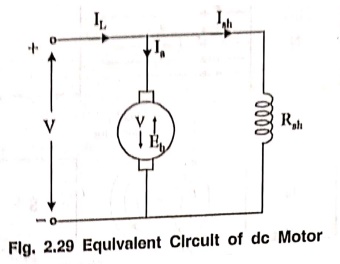
Fig.
2.29 Equivalent Clrcult of dc Motor
When the armature of a
DC motor rotates in the magnetic field, the armature conductor cuts the
magnetic flux. Hence emf will be induced in the conductor according to
Faraday's law of electromagnetic induction. The induced emf acts in opposite
direction to the applied voltage (As per Lenz's Law) and it is referred as the back emf or counter emf Eb.
The back emf is given
by,
Eb
= ( ϕΖΝ / 60 ) × P/A Volts
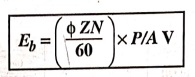
which is same as that
of emf induced in a DC generator.
The relationship
between the current, back emf and the applied voltage for a DC shunt motor is given
by Eb = V ‒ laRa.
where
Eb = back
emf in Volts
V = Supply Voltage in
Volts
la = armature
current in amperes
Ra =
armature resistance in ohms.
The back emf Eb
is always less than that of the applied voltage and hence the current is
flowing against the direction of back emf.
1. Significance of back emf
The back emf acts like
a governor. It makes the DC motor a self regulating machine. i.e., it makes the
motor to draw as much armature current, which is just sufficient to develop the
torque required by the load.
Net voltage across the
armature circuit = V‒Eb
If Ra is the
armature circuit resistance, then,
Ib = [ V‒Eb ] / Ra
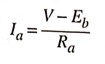
Since V and Ra
are usually fixed, the value of Eb will determine the current drawn
by the motor.
Eb = ( ϕΖΝ /
60 ) × P/A Volt
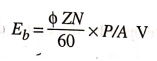
Back emf depends, among
other factors, upon armature speed. If speed is high, Eb is large.
Hence armature current la seen from the above equation is small. If
the speed is less, the Eb is less, hence more current flows which
develops motor torque.
2. Voltage Equation of a Motor
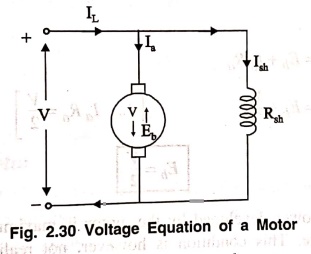
The voltage V applied
across the motor armature has to
(i) Overcome the back
emf Eb and
(ii) Supply the
armature ohmic drop IaRa
∴
V = Eb+laRa
This is known as
voltage equation of a motor.
Vla= EbIa + I2aRa
This is known as power
equation of the DC motor
VIa =
electrical input to the armature
EbIa
= electrical equivalent of mechanical power developed in the armature (Pm)
I2aRa = Cu
loss in the armature
Hence, out of the
armature input, some is wasted in I2R loss and the rest is converted
into mechanical power within the armature.
3. Condition for Maximum Power
The mechanical power
developed by the motor is Pm = Ebla
Now, Pm=VIa
‒ I2aRa
Since, V and Ra
are fixed, power developed by the motor depends upon armature current.
For maximum power, dpm
/ dla should be zero.
dpm / dIa = V ‒ 2IaRa
= 0
or
IaRa
= V/2
Now,
V= Eb+ laRa
V = Eb + V/2
Ra= V/2
Hence mechanical power
developed by the motor is maximum when back emf is equal to half the applied
voltage. This condition is however, not realised in practice, because in that
case current would be much beyond the normal current of the motor. Moreover
half the input power wasted in the form of heat and taking other losses
(mechanical and magnetic) into consideration, the motor efficiency will be well
below 50%.
Basic Electronics and Electrical Engineering: Chapter 2: DC Machines : Tag: Basic Engineering : - Back EMF of DC Motor
Basic Electronics and Electrical Engineering: Chapter 2: DC Machines
Under Subject

Basic Electronics and Electrical Engineering
EE25C04 1st Semester ECE Dept | 2025 Regulation | 2nd Semester 2025 Regulation
Related Subjects

English Essentials I
EN25C01 1st Semester | 2025 Regulation | 1st Semester 2025 Regulation

தமிழர் மரபு - Heritage of Tamils
UC25H01 1st Semester | 2025 Regulation | 1st Semester 2025 Regulation
Applied Calculus
MA25C01 Maths 1 M1 - 1st Semester | 2025 Regulation | 1st Semester 2025 Regulation
Applied Physics I
PH25C01 1st Semester | 2025 Regulation | 1st Semester 2025 Regulation

Applied Chemistry I
CY25C01 1st Semester | 2025 Regulation | 1st Semester 2025 Regulation
Makerspace
ME25C04 1st Semester | 2025 Regulation | 1st Semester 2025 Regulation
Computer Programming C
CS25C01 1st Semester | 2025 Regulation | 1st Semester 2025 Regulation
Computer Programming Python
CS25C02 1st Semester | 2025 Regulation | 1st Semester 2025 Regulation
Fundamentals of Electrical and Electronics Engineering
EE25C03 1st Semester | 2025 Regulation | 1st Semester 2025 Regulation
Introduction to Mechanical Engineering
ME25C03 1st Semester | 2025 Regulation | 1st Semester 2025 Regulation

Introduction to Civil Engineering
CE25C01 1st Semester Civil Department | 2025 Regulation | 1st Semester 2025 Regulation
Essentials of Computing
CS25C03 1st Semester - AID CSE IT Department | 2025 Regulation | 1st Semester 2025 Regulation

Applied Physics I Laboratory
PH25C01 1st Semester practical Laboratory Manual | 2025 Regulation | 1st Semester Laboratory 2025 Regulation

Applied Chemistry I Laboratory
CY25C01 1st Semester practical Laboratory Manual | 2025 Regulation | 1st Semester Laboratory 2025 Regulation

Computer Programming C Laboratory
CS25C01 1st Semester practical Laboratory Manual | 2025 Regulation | 1st Semester Laboratory 2025 Regulation

Computer Programming Python Laboratory
CS25C02 1st Semester practical Laboratory Manual | 2025 Regulation | 1st Semester Laboratory 2025 Regulation
Engineering Drawing
ME25C01 EEE Mech Dept | 2025 Regulation | 2nd Semester 2025 Regulation
Basic Electronics and Electrical Engineering
EE25C04 1st Semester ECE Dept | 2025 Regulation | 2nd Semester 2025 Regulation