Basic Electronics and Electrical Engineering: Chapter 2: DC Machines
Construction of DC Generator
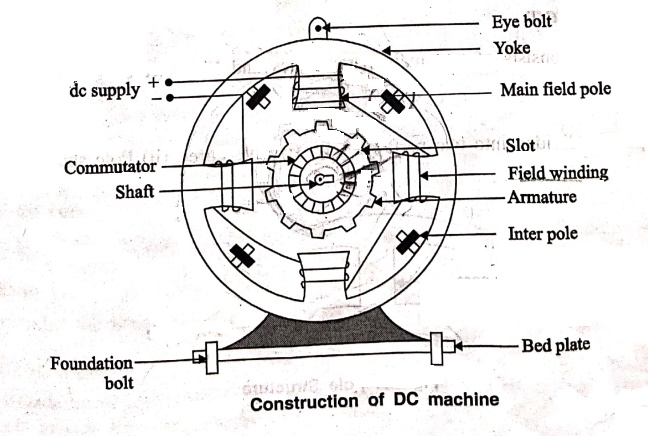
The Stator consist of (i) Yoke or Magnetic frame (ii) Field system‒Poles, Interpoles, Field winding. The Rotor has the following parts. (iii) Armature ‒ Armature core, Armature winding (iv) Commutator (v) Brushes, Bearing
CONSTRUCTION
OF DC GENERATOR
The construction of DC generator and DC motor are the same. Any DC generator can be run as a DC motor and vice‒versa.
All DC machines
(generator or motor) have a Stator and Rotor.
The Stator consist of
(i) Yoke or Magnetic
frame
(ii) Field system‒Poles,
Interpoles, Field winding
The Rotor has the
following parts.
(iii) Armature ‒
Armature core, Armature winding
(iv) Commutator
(v) Brushes, Bearing
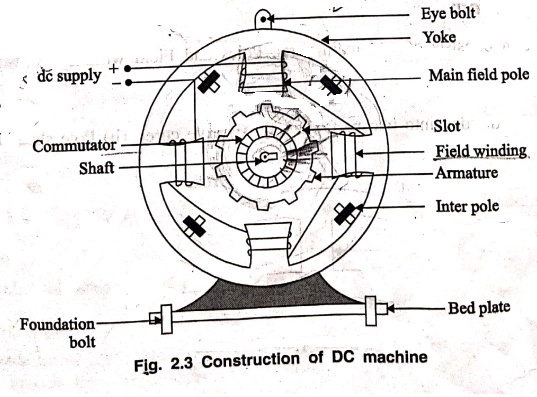
(i) Yoke or Magnetic Frame
1.
Functions
(i) It provides
mechanical support for the poles and acts as a protecting cover for the whole
machine.
(ii) It carries the
magnetic flux produced by the poles.
2.
Choice of Material
To provide low
reluctance path, it must be made up of some magnetic material usually made up
of cast‒iron because it is cheapest. But for large machines rolled steel (or) cast
steel, silicon steel is used which provides high permeability. i.e., low
reluctance and gives good mechanical strength.
(ii) Field system
Field system consists
of two main parts. Poles and Field winding.
1.
Poles
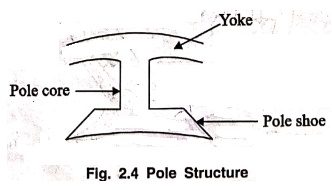
Each pole is divided
into two parts namely: (i) Pole core (ii) Pole shoe. This is shown in Fig. 2.4.
(i)
Functions of pole core and pole shoe
(a) Pole core carries
field winding which is necessary to produce the flux.
(b) Pole shoes spread
out the flux in the air gap, and also, being of larger cross‒section, to reduce
the reluctance.
(c) They support the
exciting coils (or field coils).
(ii)
Choice of material
It is made up of
magnetic material like cast‒iron or cast‒steel.
As it requires a
definite shape and size, laminated construction is used. The laminations of
required size and shape are stamped together to get a pole which is then bolted
to the yoke.
2.
Inter Poles or Commutating Poles
Interpoles or the
commutating poles are fixed to the frame in between main poles. They are in
small size compared with the main poles. They are used for sparkless
commutation (to improve commutation).
3.
Field Winding
The field winding is
placed on the pole core.
(i)
Functions
To carry the current
and to produce the magnetic flux.
(ii)
Choice of material
It is made up of
aluminium or copper.
(iii) Armature
It is further divided
into two parts namely:
1. Armature core
2. Armature winding
1. Armature core
It is cylindrical in
shape with slots on its outer periphery. It is mounted on the shaft.
(i)
Functions
It provides the house
for armature conductors.
(ii)
Choice of Material
It is made up of cast‒iron
or cast‒steel. It is made up of laminated construction to keep eddy current‒loss‒as
low as possible.
2. Armature Winding
The armature windings
are placed into the slots on the armature surface. The ends of the coils are
soldered with commutator segments.
(i)
Functions
(a) When the armature
rotates an emf is induced in the armature conductors in case of generators.
(b) To carry the
current supplied in case of DC motors.
(ii)
Choice of material
Armature winding has to
carry the entire current so it is made up of conducting material, which is
copper.
(iv) Commutator
The basic nature of emf
induced in the armature conductor is alternating. This needs rectification in
case of DC generator, which is made possible by a device called commutator.
1.
Functions
(i) To facilitate the
collection of current from the armature conductors.
(ii) To convert the
alternating current induced in the armature conductors into unidirectional current in the external load
circuit.
2.
Choice of material
As it collects current
from armature, it is also made up of copper segments.
(v) Brushes and Bearings
The function of brushes
is to collect current from commutator. They are usually made up of carbon or
graphite and in the shape of rectangular block. These brushes are housed in brush‒holders
usually of the box‒type variety.
The brushes are made to
press over the commutator with spring tension. The tension of the spring can be
adjusted by changing the position of lever in the notches.
A flexible copper wire
called pigtail is casted at the top of the brush. It conveys current from the
brush to the terminal box mounted on the yoke.
Ball bearings are
frequently employed because of their reliability. But for heavy duty machines,
roller bearing are preferable.
Basic Electronics and Electrical Engineering: Chapter 2: DC Machines : Tag: Basic Engineering : - Construction of DC Generator
Basic Electronics and Electrical Engineering: Chapter 2: DC Machines
Under Subject

Basic Electronics and Electrical Engineering
EE25C04 1st Semester ECE Dept | 2025 Regulation | 2nd Semester 2025 Regulation
Related Subjects

English Essentials I
EN25C01 1st Semester | 2025 Regulation | 1st Semester 2025 Regulation

தமிழர் மரபு - Heritage of Tamils
UC25H01 1st Semester | 2025 Regulation | 1st Semester 2025 Regulation
Applied Calculus
MA25C01 Maths 1 M1 - 1st Semester | 2025 Regulation | 1st Semester 2025 Regulation
Applied Physics I
PH25C01 1st Semester | 2025 Regulation | 1st Semester 2025 Regulation

Applied Chemistry I
CY25C01 1st Semester | 2025 Regulation | 1st Semester 2025 Regulation
Makerspace
ME25C04 1st Semester | 2025 Regulation | 1st Semester 2025 Regulation
Computer Programming C
CS25C01 1st Semester | 2025 Regulation | 1st Semester 2025 Regulation
Computer Programming Python
CS25C02 1st Semester | 2025 Regulation | 1st Semester 2025 Regulation
Fundamentals of Electrical and Electronics Engineering
EE25C03 1st Semester | 2025 Regulation | 1st Semester 2025 Regulation
Introduction to Mechanical Engineering
ME25C03 1st Semester | 2025 Regulation | 1st Semester 2025 Regulation

Introduction to Civil Engineering
CE25C01 1st Semester Civil Department | 2025 Regulation | 1st Semester 2025 Regulation
Essentials of Computing
CS25C03 1st Semester - AID CSE IT Department | 2025 Regulation | 1st Semester 2025 Regulation

Applied Physics I Laboratory
PH25C01 1st Semester practical Laboratory Manual | 2025 Regulation | 1st Semester Laboratory 2025 Regulation

Applied Chemistry I Laboratory
CY25C01 1st Semester practical Laboratory Manual | 2025 Regulation | 1st Semester Laboratory 2025 Regulation

Computer Programming C Laboratory
CS25C01 1st Semester practical Laboratory Manual | 2025 Regulation | 1st Semester Laboratory 2025 Regulation

Computer Programming Python Laboratory
CS25C02 1st Semester practical Laboratory Manual | 2025 Regulation | 1st Semester Laboratory 2025 Regulation
Engineering Drawing
ME25C01 EEE Mech Dept | 2025 Regulation | 2nd Semester 2025 Regulation
Basic Electronics and Electrical Engineering
EE25C04 1st Semester ECE Dept | 2025 Regulation | 2nd Semester 2025 Regulation