Basic Electronics and Electrical Engineering: Chapter 2: DC Machines
Principle of DC Motor
An electric motor is a machine which converts electrical energy into mechanical energy. Its action is based on the principle that when a current‒carrying conductor is placed in a magnetic field, the conductor experiences a mechanical force.
DC
MOTORS
Motor Principle
An electric motor is a
machine which converts electrical energy into mechanical energy. Its action is
based on the principle that when a current‒carrying conductor is placed in a magnetic
field, the conductor experiences a mechanical force. The direction of this
force is given by Fleming's left hand rule and magnitude is given by:
F
= BIl (N)
where,
B = Flux density due to
the flux produced by the field winding
I = Magnitude of current
passing through the conductor
l
= Active length of the conductor
Constructionally, there
is no basic difference between DC generator and DC motor. In fact the same DC
machine can be used interchangeably as a generator or as a motor. In generator
the input mechanical energy is supplied by a prime mover and develops a
voltage, while in a DC motor input electrical energy is supplied by a DC supply
and it develops a torque resulting in mechanical rotation.
Fleming's
Left Hand Rule
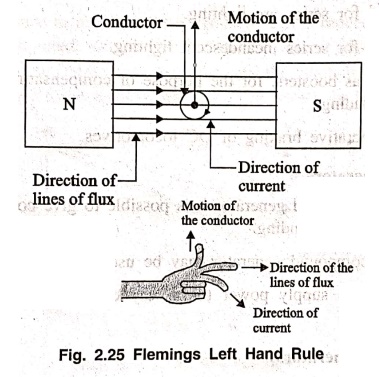
"Keep the fore
finger, middle finger and thumb of the left hand mutually perpendicular to one
another. If the fore finger indicates the direction of magnetic field and the
middle finger indicates the direction of current in the conductor, then the
thumb gives the direction of motion (force experienced) of the conductor".
By knowing the
direction of the magnetic field and the direction of the current in the
conductor, the motion of the conductor can be determined by the Fleming's left
hand rule.
Principle
of operation of DC Motor
Consider a single conductor
placed in a magnetic field as shown in Fig. 2.26 (a).
Fig. 2.26 (b) shows a
conductor excited by separate DC source and carrying current particular
direction. Consider it carrying a current away from an observer, but the field
due to the N and S pole has been removed.
There is no movement of
the conductor in the above two conditions.
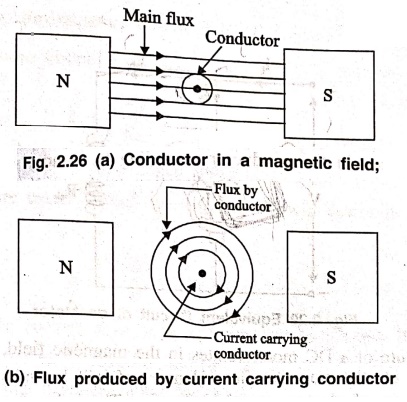
Fig.
2.26 (a) Conductor in a magnetic field; (b) Flux produced by current carrying
conductor
Fig. 2.27 (c) shows the
current carrying conductor placed in magnetic field. It is clear that the
direction of flux above the conductor are same, hence the field due to the
current in the conductor supports the main field above the conductor but
opposes the main field below the conductor.
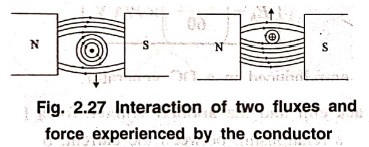
Fig.
2.27 Interaction of two fluxes and force experienced by the conductor
The result is to
increase the flux density in the region directly above the conductor and to
reduce the flux density in the region directly below the conductor. It is found
that a force acts on the conductor, trying to push the conductor downwards as
shown by the arrow.
If the current in the
conductor is reversed, the strengthening of flux the conductor, and the
conductor will be pushed upwards. (Fig. 2.28)). (Fig, 2.28)),

Fig.
2.28 Direction of rotation of conductor
But, practically, a DC
machine will have multiple conductors and each conductor (as explained above)
will be experiencing a force F=BIl
Newton. These forces collectively produce a driving torque which sets the
armature rotating. The machine is then said to be motoring.
Basic Electronics and Electrical Engineering: Chapter 2: DC Machines : Tag: Basic Engineering : - Principle of DC Motor
Basic Electronics and Electrical Engineering: Chapter 2: DC Machines
Under Subject

Basic Electronics and Electrical Engineering
EE25C04 1st Semester ECE Dept | 2025 Regulation | 2nd Semester 2025 Regulation
Related Subjects

English Essentials I
EN25C01 1st Semester | 2025 Regulation | 1st Semester 2025 Regulation

தமிழர் மரபு - Heritage of Tamils
UC25H01 1st Semester | 2025 Regulation | 1st Semester 2025 Regulation
Applied Calculus
MA25C01 Maths 1 M1 - 1st Semester | 2025 Regulation | 1st Semester 2025 Regulation
Applied Physics I
PH25C01 1st Semester | 2025 Regulation | 1st Semester 2025 Regulation

Applied Chemistry I
CY25C01 1st Semester | 2025 Regulation | 1st Semester 2025 Regulation
Makerspace
ME25C04 1st Semester | 2025 Regulation | 1st Semester 2025 Regulation
Computer Programming C
CS25C01 1st Semester | 2025 Regulation | 1st Semester 2025 Regulation
Computer Programming Python
CS25C02 1st Semester | 2025 Regulation | 1st Semester 2025 Regulation
Fundamentals of Electrical and Electronics Engineering
EE25C03 1st Semester | 2025 Regulation | 1st Semester 2025 Regulation
Introduction to Mechanical Engineering
ME25C03 1st Semester | 2025 Regulation | 1st Semester 2025 Regulation

Introduction to Civil Engineering
CE25C01 1st Semester Civil Department | 2025 Regulation | 1st Semester 2025 Regulation
Essentials of Computing
CS25C03 1st Semester - AID CSE IT Department | 2025 Regulation | 1st Semester 2025 Regulation

Applied Physics I Laboratory
PH25C01 1st Semester practical Laboratory Manual | 2025 Regulation | 1st Semester Laboratory 2025 Regulation

Applied Chemistry I Laboratory
CY25C01 1st Semester practical Laboratory Manual | 2025 Regulation | 1st Semester Laboratory 2025 Regulation

Computer Programming C Laboratory
CS25C01 1st Semester practical Laboratory Manual | 2025 Regulation | 1st Semester Laboratory 2025 Regulation

Computer Programming Python Laboratory
CS25C02 1st Semester practical Laboratory Manual | 2025 Regulation | 1st Semester Laboratory 2025 Regulation
Engineering Drawing
ME25C01 EEE Mech Dept | 2025 Regulation | 2nd Semester 2025 Regulation
Basic Electronics and Electrical Engineering
EE25C04 1st Semester ECE Dept | 2025 Regulation | 2nd Semester 2025 Regulation