Computer Organization and Architecture: Chapter 2: Arithmetic for Computers
Binary Division
Arithmetic for Computers
Questions: 1. Draw the flowchart for restoring division algorithm. 2. Draw the flowchart for non‒restoring division algorithm. 3. Compare restoring and non‒restoring division algorithm. 4. Write restoring unsigned division algorithm. 5. Perform the following division using restoring and nonrestoring division algorithm. Dividend = 1100 Divisor = 0011 6. Perform following division using restoring and non‒restoring algorithm. Dividend = 1010 and Divisor = 0011. 7. Perform division of the following numbers using restoring and non restoring division algorithm. A: 1100 and B: 0100
Binary
Division
•
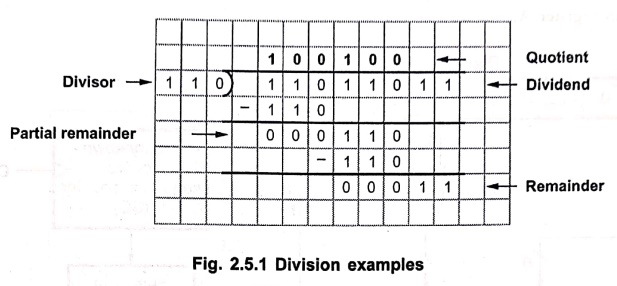
The division process for binary numbers is similar to the decimal numbers. Fig.
2.5.1 shows binary division process.
•
In the division process, first the bits of the dividend are examined from left
to right, until the set of bits examined represents a number greater than or
equal to the divisor.
•
Until this condition occurs, 0's are placed in the quotient from left to right.
•
When the condition is satisfied, a 1 is placed in the quotient and the divisor
is subtracted from the partial dividend. The result is referred to as a partial remainder.
•
From this point onwards, the division process is required. In each repetition
cycle, additional bits from the dividend are brought down to the partial
remainder until the result is greater than or equal to the divisor and the
divisor is subtracted from the result to produce a new partial remainder.
•
The process continues until all the bits of the dividend are brought down and
result is still less than the divisor.
1. Restoring Division Algorithm
•
Fig. 2.5.2 shows the hardware for implementation of restoring division.
•
It consists of n+1‒bit binary adder, shift, add and subtract control logic and
registers A, B, and Q.
•
As shown in Fig. 2.5.2 divisor and dividend are loaded into register B and
register Q, respectively. Register A is initially set to zero. The division operation
is then had carried out.
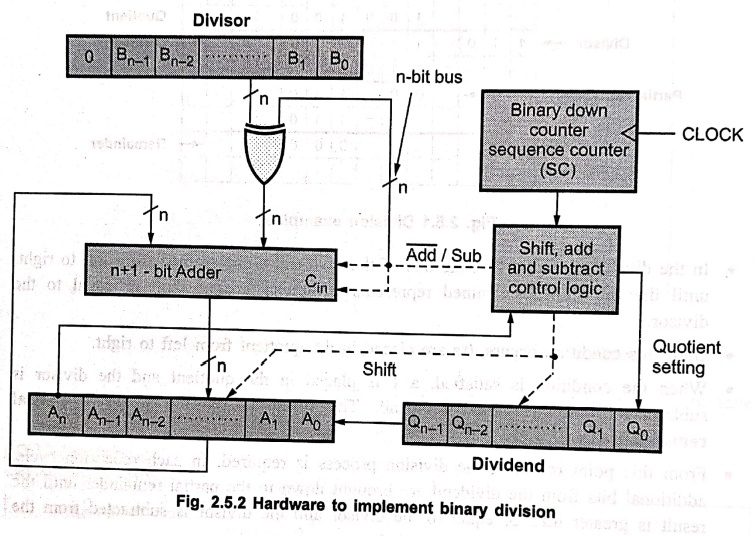
• After the division is complete, the n‒bit quotient is in register Q and the remainder is in register A.
Division
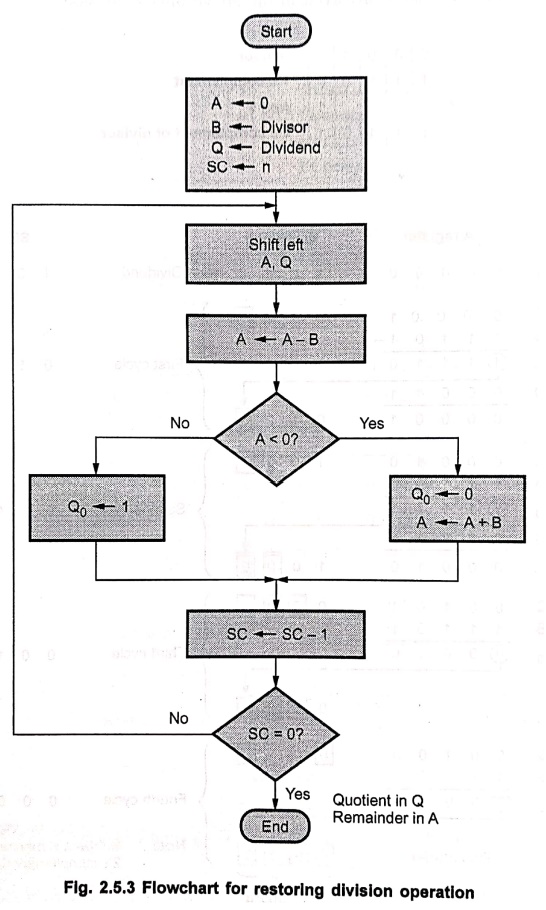
operation steps:
1.
Shift A and Q left one binary position.
2.
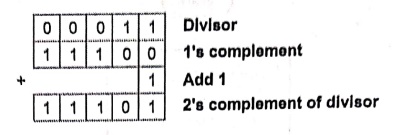
Subtract divisor (i.e. add 2's complement of divisor (B)) from A and place
answer back in A (A← A − B).
3.
If the sign bit of A is 1, set Q0 to 0 and add divisor back to A
(that is, restore A); Otherwise, set Q0 to 1.
4.
Repeat steps 1, 2, and 3 n times.
A
flowchart for division operation is as shown in Fig. 2.5.3.
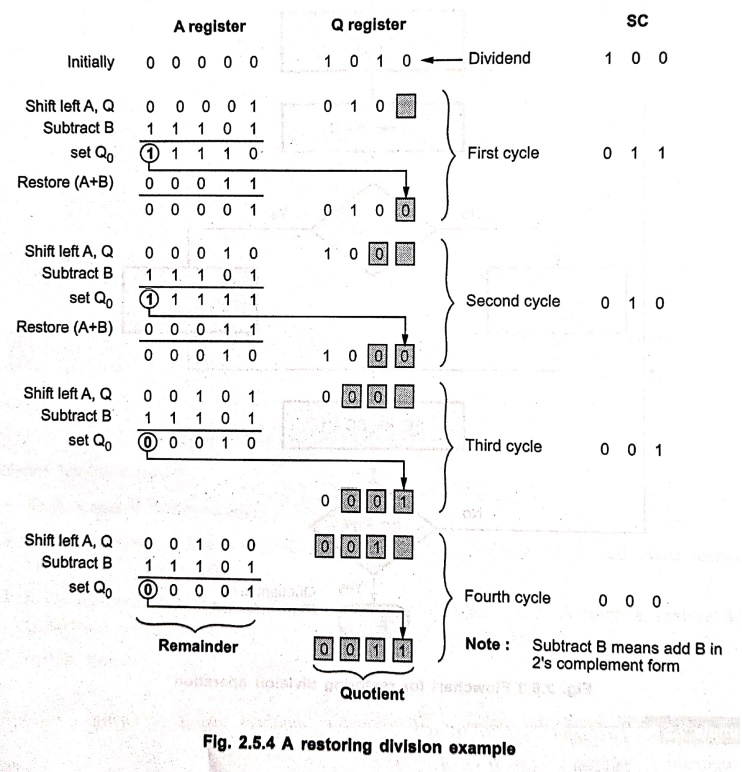
Example: 1
Perform the division of
following numbers using restoring division algorithm.
Dividend = 1 0 1 0
Divisor = 0 0 1 1
Solution:
Fig.
2.5.2 shows steps involved in the above binary division.
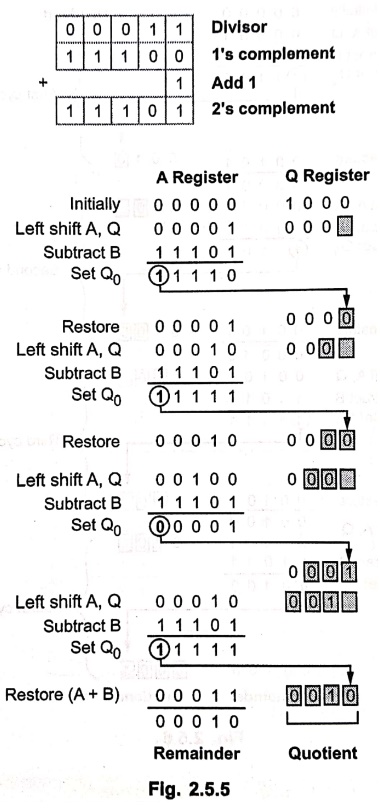
Example: 2
Divide the following unsigned
numbers using restoring division method
Dividend = 1000,
Divisior = 11.
Solution :
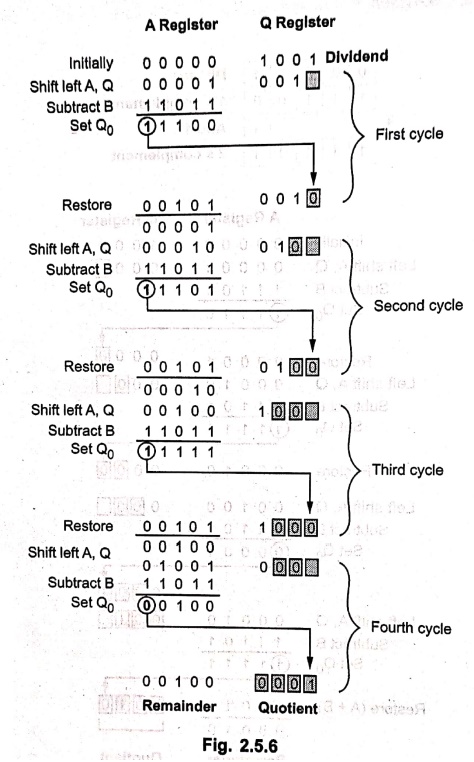
Example: 3
Perform the following
division using restoring division algorithm :
Dividend = 1001
Divisor = 0101.
Solution :
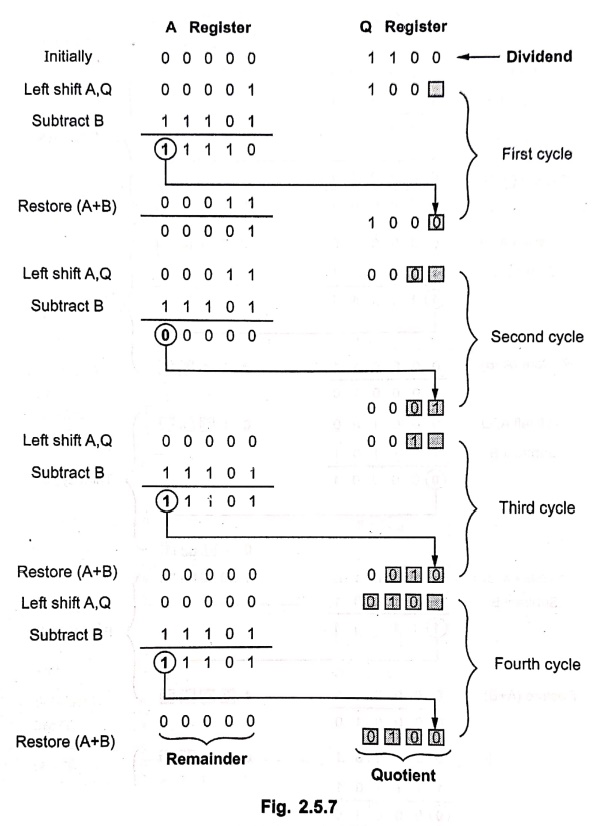
Example: 4
Perform 1100+ 11 using
restoring algorithm.
Solution:
Restoring
Division: Q← Dividend (1100), B← Divisor (11).
2's
Complement of divisor (B) = 11101.
Example: 5
Using restoring
division algorithm solve the following:
Dividend = 17.
Divisor = 03
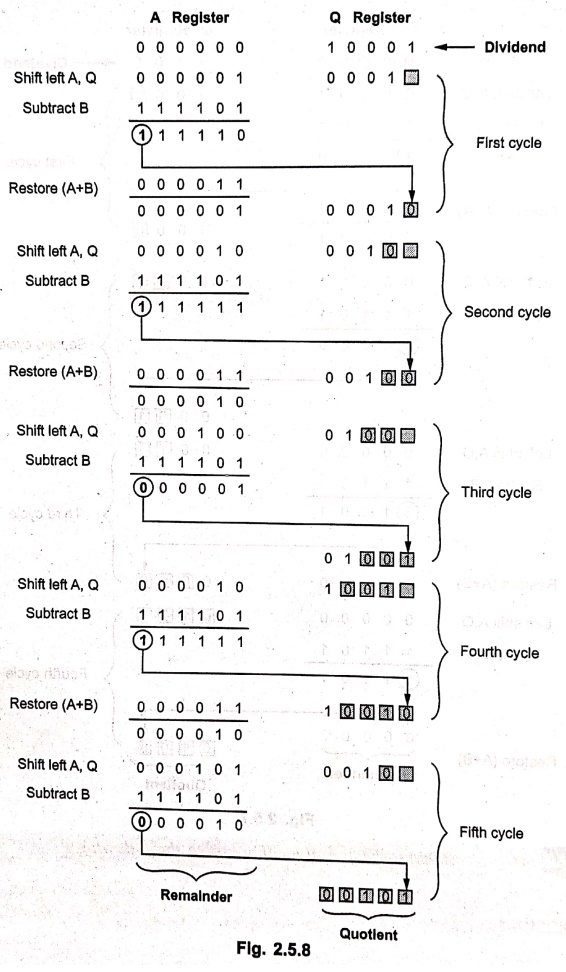
Solution :
Dividend
= 17 = 17 = (10001)2 → Q
Divisor
= 03 = 03 = (00011)2 → B
2's
complement of B = (111101)2
•
The division algorithm just discussed needs restoring register A after each
unsuccessful subtraction. (Subtraction is said to be unsuccessful if the result
is negative). Therefore it is referred to as restoring division algorithm.
Example: 6
Perform restoring
division when divisor V = 3 and dividend D = 7. Also give the results for all
possible combinations of signs of D and V.
Solution:
The
restoring division algorithm assumes positive signs of D and V.
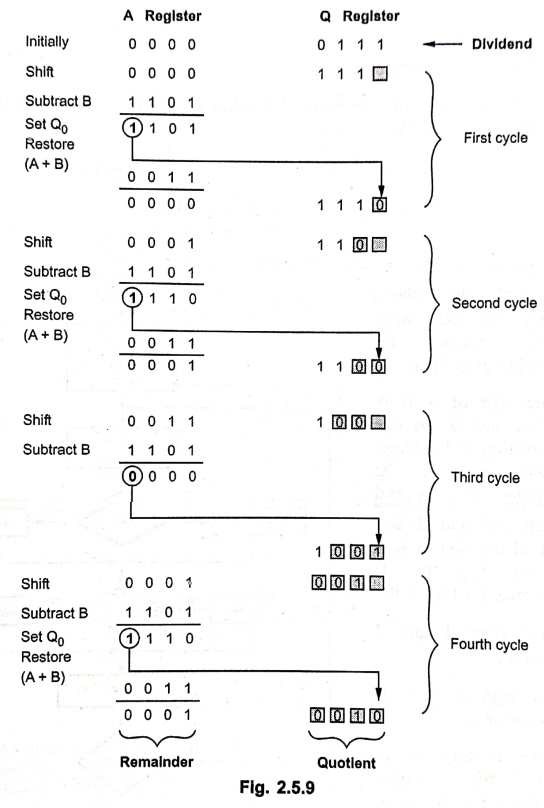
Remainder
= (0001)2 = 1 and Quotient = (0010)2 = 2
•
In the division operation, the magnitudes of quotient (Q) and remainder (R) are
unaffected by the input signs. The signs of Q and R are easily derived from the
signs of D and V using expression: D=Q × V + R
•
The signs of Q and R for all possible combinations of signs of D and V are as
FB follows:
D
=7, V=3 ⇒ Q=2,
R=1
D
=7, V= ‒3 ⇒ Q= ‒2, R=1
D
= ‒7, V=3
⇒ Q= ‒2, R= ‒1
D
= ‒7, V= ‒3 ⇒ Q=2,
R= ‒1
2. Non‒Restoring Division
•
Consider the sequence of operations that takes place after the subtraction
operation in the restoring algorithm.
If A is
positive
Shift
left and subtract divisor →2A ‒ B
If A is
negative
Restore
→ A+B
Shift
left and subtract divisor→ 2 (A+B) – B
=
2A+B
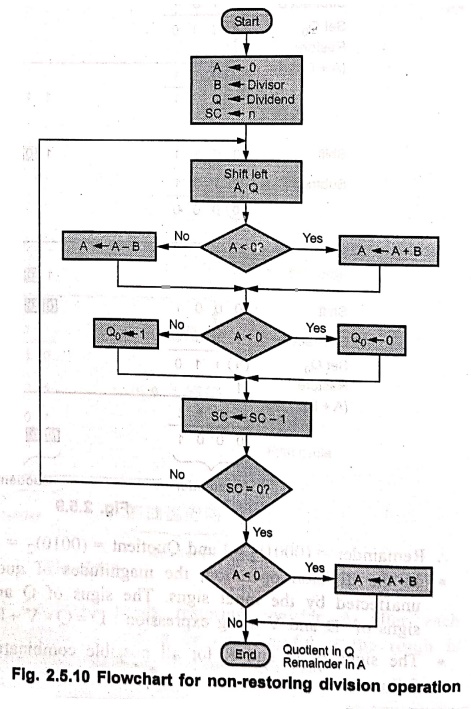
• Looking at the above operations we can write following steps for non‒restoring algorithm.

Step 1:
If the sign of A is 0, shift A and Q left one bit position and subtract divisor
from A; otherwise, shift A and Q left and add divisor to A. If the sign of A is
0, set Q0 to 1; otherwise, set Q0 to 0.
Step 2:
Repeat steps 1 and 2 for n times.
Step 3:
If the sign of A is 1, add divisor to A.
Note: Step
3 is required to leave the proper positive
remainder in A at the end of n cycles.
•
A flowchart for non‒restoring division operation is as shown I Fig. 2.5.10.
Example: 7
Perform the division of
following numbers using non‒restoring division algorithm:
Dividend = 1 0 1 0
Divisor = 0 0 1 1.
Solution:
Fig.
2.5.11 shows steps involved in the non-restoring binary division.
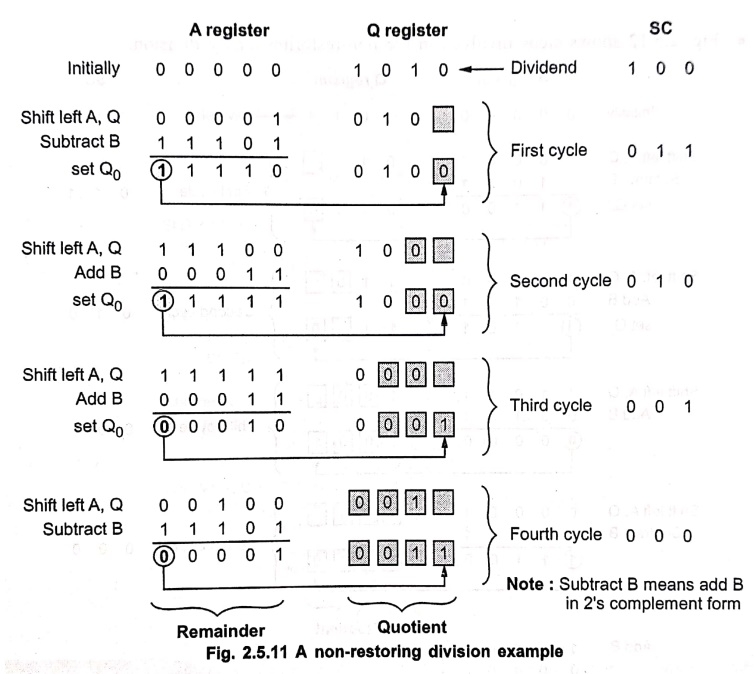
In
this example, after 4 cycles A is positive and hence step 3 is not required.
Example: 8
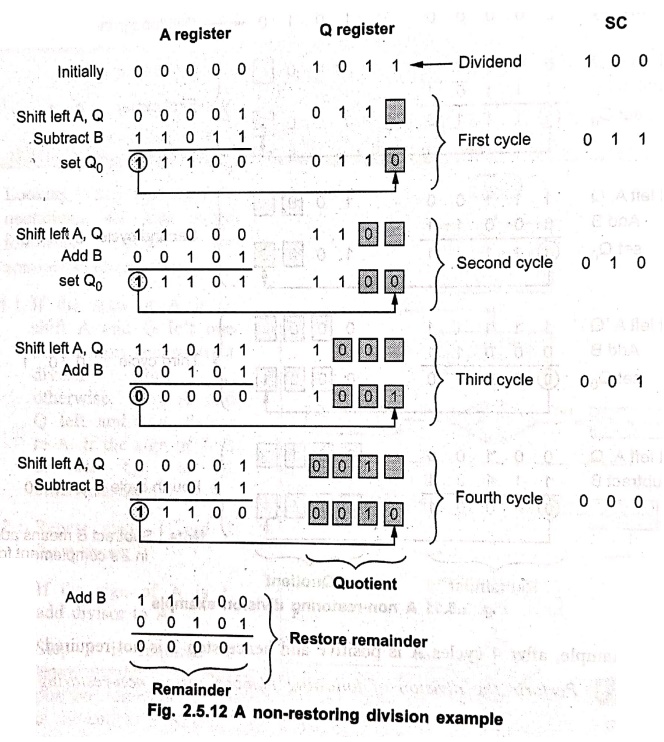
Perform the division of
following numbers using non‒restoring division algorithm:
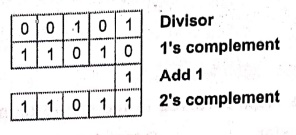
Dividend = 1 0 1 1
Divisor = 0 1 0 1.
Solution :
•
Fig. 2.5.12 shows steps involved in the non‒restoring binary division.
•
The hardware shown in Fig. 2.5.2 can also be used to perform non‒restoring.
algorithm. There is no simple algorithm for signed division. In signed
division, the operands are pre‒processed to transform them into positive
values. Then using one of the algorithms just discussed quotients and
remainders are calculated. The quotients and remainders are then transformed to
the correct signed values.
Example: 9
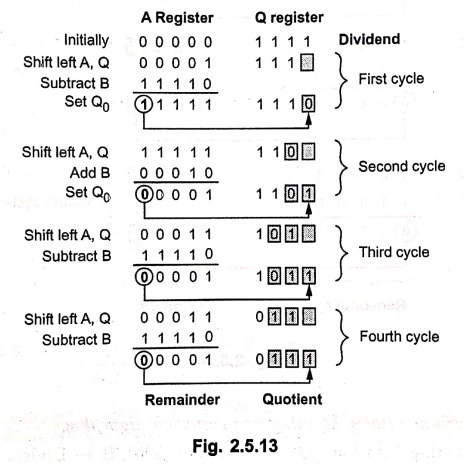
Divide the following
unsigned numbers using non‒restoring division method.
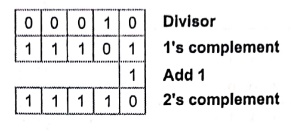
Dividend = (15)10,
Divisor = (2)10
Solution :
Dividend
= (15)10 = (01111)2
Divisor
= (2)10 = (00010)2
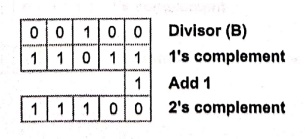
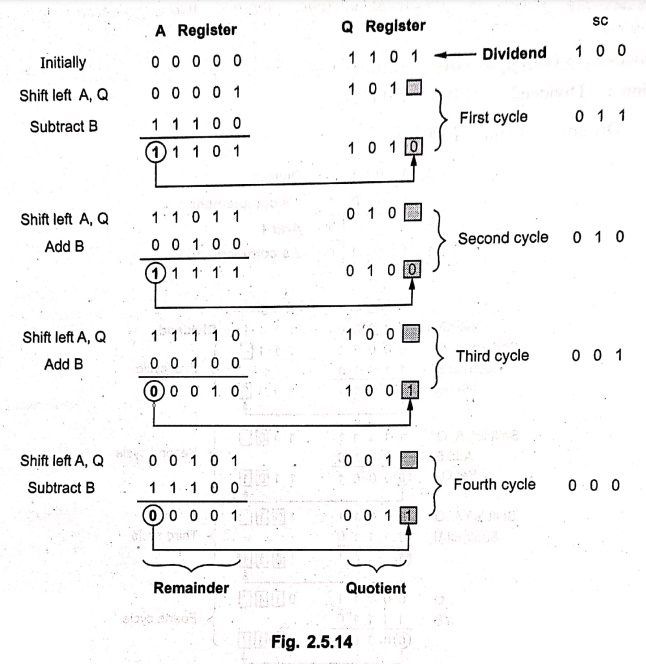
Example: 10
Perform division
operation on the following numbers using the non‒restoring division algorithm.
Dividend = 1101 Divisor
= 0100
Solution :
Example: 11
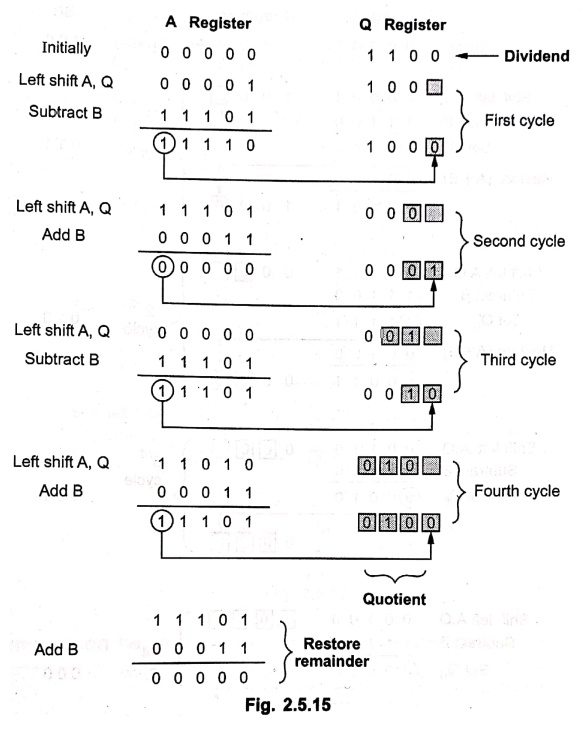
Perform 1100 + 11 using
non‒restoring algorithm.
Solution:
Non‒Restoring
Division: Q← Dividend (1100), B← Divisor (11).
Complement
and divisor (B) = 11101.
Example: 12
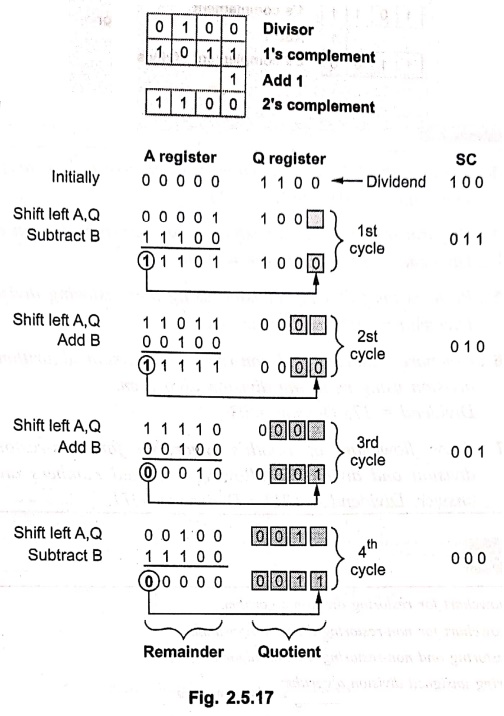
Perform division of the
following numbers using restoring and non restoring division algorithm.
A : 1100 and B : 0100
Solution:
A
= 1100 B = 0100 (Using restoring
division)
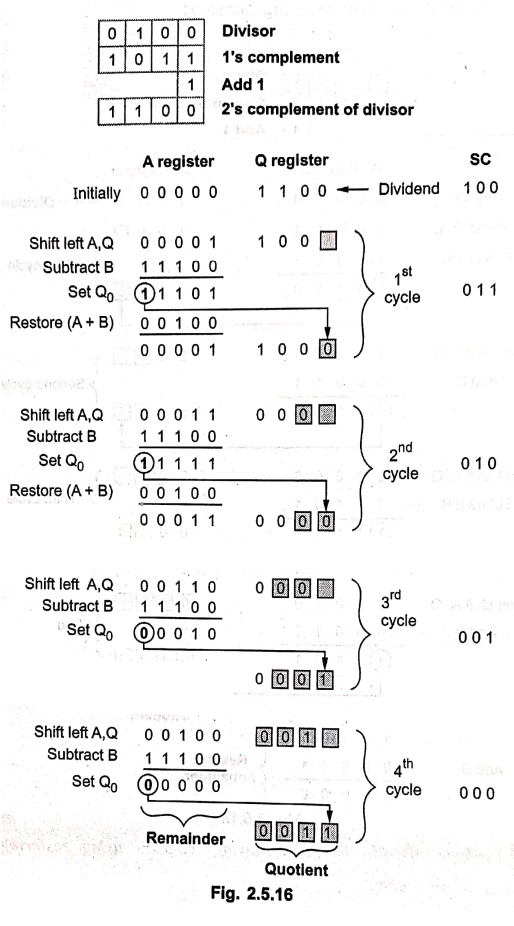
Note: Subtract B means
add B in 2's complement form.
A
= 1100 B = 0100 (Using non restoring
division)
3. Comparison between Restoring and Non‒Restoring Division Algorithm
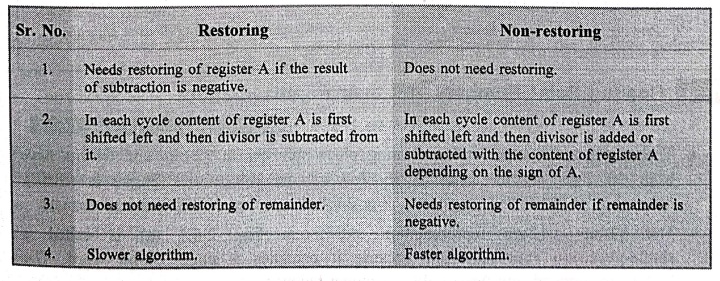
Restoring
1.
Needs restoring of register A if the result of subtraction is negative.
2.
In each cycle content of register A is first shifted left and then divisor is
subtracted from it.
3.
Does not need restoring of remainder,
4.
Slower algorithm.
Non‒restoring
1.
Does not need restoring.
2.
In each cycle content of register A is first shifted left and then divisor is
added or subtracted with the content of register A depending on the sign of A.
3.
Needs restoring of remainder if remainder is negative.
4.
Faster algorithm.
Examples
for Practice
Example: 13
Perform the following
division using non‒restoring division algorithm.
Dividend = 1101,
Divisor = 11.
Example: 14
Perform the following
division using restoring division algorithm.
Dividend = 1100 Divisor
= 0100.
Example: 15
Perform the following
division using non‒restoring division algorithm.
Dividend = 1000, Divisor
=11.
Example: 16
Compare restoring and
non‒restoring division algorithm. Perform the division using restoring division
algorithm.
Dividend = 17; Divisor =
03.
Example: 17
Draw flowchart of
Booth's algorithm for non‒restoring unsigned division and divide the following
unsigned numbers and justify your answer.
Dividend = 1011;
Divisor = 0011.
Review Questions
1. Draw the flowchart
for restoring division algorithm.
2. Draw the flowchart
for non‒restoring division algorithm.
3. Compare restoring
and non‒restoring division algorithm.
4. Write restoring
unsigned division algorithm.
5. Perform the
following division using restoring and nonrestoring division algorithm.
Dividend = 1100
Divisor = 0011
6. Perform following
division using restoring and non‒restoring algorithm.
Dividend = 1010 and
Divisor = 0011.
7. Perform division of
the following numbers using restoring and non restoring division algorithm. A:
1100 and B: 0100
Computer Organization and Architecture: Chapter 2: Arithmetic for Computers : Tag: Computer : Arithmetic for Computers - Binary Division
Computer Organization and Architecture: Chapter 2: Arithmetic for Computers
Under Subject
Computer Organization and Architecture
CW25201 3rd Semester IT department. | 2025 Regulation | 3rd Semester 2025 Regulation
Related Subjects
Discrete Mathematics
MA25C14 3rd Semester CSE,IT,CY,AIDS departments. | 2025 Regulation | 3rd Semester 2025 Regulation
Data Structures
CS25C08 3rd Semester CSE,IT,CY,AIDS departments. | 2025 Regulation | 3rd Semester 2025 Regulation
Computer Organization and Architecture
CW25201 3rd Semester IT department. | 2025 Regulation | 3rd Semester 2025 Regulation
Object Oriented Programming
CS25C07 3rd Semester IT department. | 2025 Regulation | 3rd Semester 2025 Regulation
Web Technologies
IT25301 3rd Semester IT department. | 2025 Regulation | 3rd Semester 2025 Regulation
English Communication Skills Laboratory I
EN25C03 3rd Semester all department. | 2025 Regulation | 3rd Semester 2025 Regulation
Skill Development Course I
3rd Semester all department. | 2025 Regulation | 3rd Semester 2025 Regulation