Computer Organization and Architecture: Chapter 2: Arithmetic for Computers
Floating Point Numbers and their Representation
Arithmetic for Computers
Questions: 1. Define IEEE floating point single and double precision standard. 2. What is denormal? Define NaN ? 3. In conforming to the IEEE standard mention any four situations under which a processor sets exception flag. 4. Define underflow and overflow.
Floating
Point Numbers and their Representation
•
The standards for representing floating point numbers in 32‒bits and 64‒bits
have been developed by the Institute of Electrical and Electronics Engineers
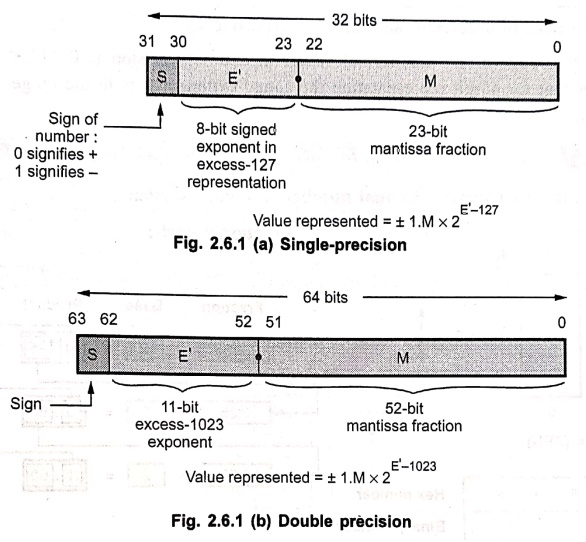
(IEEE), referred to as IEEE 754 standards. Fig. 2.6.1 shows these
IEEE standard formats.
•
The 32‒bit standard representation shown in Fig. 2.6.1 (a) is called single‒precision representation because it occupies a single 32‒bit word. The 32‒bits
are divided into three fields as shown below:
(field
1) Sign ← 1‒bit
(field
2) Exponent ← 8‒bits
(field
3) Mantissa ← 23‒bits
•
Instead of the signed exponent, E, the value actually stored in the exponent
field is E' = E (scaling factor) + bias.
•
In the 32‒bit floating point system (single precision), bias is 127. Hence E'=
E (scaling factor) + 127. This representation of exponent is also called as the
excess‒127 format.
•
The end values of E', namely, 0 and 255, are used to indicate the floating
point values of exact zero and infinity, respectively in single precision.
•
Thus range of E' for normal values in single precision is 0 < E' < 255.
This means that for 32‒bit representation the actual exponent E is in the range
‒ 126 ≤ E ≤ 127.
•
The 64‒bit standard representation shown in Fig. 2.6.1 (b) is called a double‒precision representation because it occupies two 32‒bit words.
•
The 64‒bits are divided into three fields as shown below:
(field
1) Sign ← 1 ‒ bit
(field
2) Exponent ← 11 ‒ bit
(field
3) Mantissa ←52 ‒ bits
•
In the double precision format value actually stored in the exponent field is
given as
E'
= E + 1023
•
Here, bias value is 1023 and hence it is also called excess‒1023 format.
•
The end values of E', namely, 0 and 2047, are used to indicate the floating
point exact values of exact zero and infinity, respectively.
•
Thus the range of E' for normal values in double precision is 0 < E' < 2047.
This means that for 64‒bit representation the actual exponent E is in the range
‒
1022 ≤ E ≤ 1023.
Example: 1
Represent 1259.12510
in single precision and double precision formats.
Solution:
Step 1: Convert decimal
number in binary format
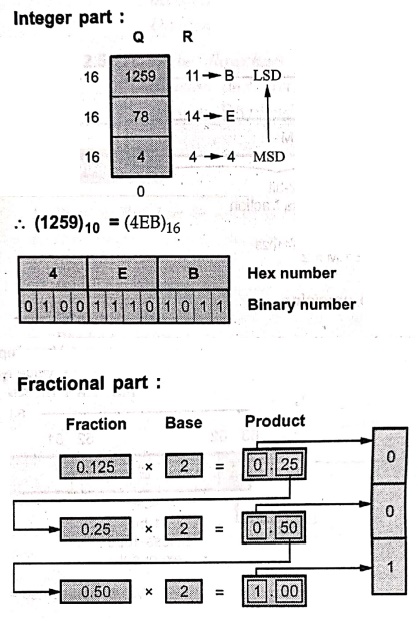
(1259)10
= (100 1110 1011)2
(0.125)10
= (0.001)2
Binary
number = 10011101011+ 0.0 0 1= 1 0 0 1 1 1 0 1 0 1 1 . 0 0 1
Step 2: Normalize the
number
1.
0 0 1 1 1 0 1 0 1 1. 0 0 1
1.
0 0 1 1 1 0 1 0 1 10 0 1 1 × 210
Step 3: Single
precision representation
For
a given number S = 0, E = 10 and M = 0 0 1 1 1 0 1 0 1 1 0 0 1
Bias
for single precision format is = 127
E'
= E + 127 = 10 + 127 = 13710
= 1000
10012
Number
in single precision format is given as

Step 4: Double
precision representation
For
a given number
S
= 0, E = 10, and M = 0 0 1 1 1 0 1 0 1 1 0 0 1
Bias
for double precision format is = 1023
E'
= E+ 1023 = 10 + 1023 = 103310 = 1 0 0 0 0 0 0 1 0 0 12
Number
in double precision format is given as

Example: 2
Represent ‒ 307.187510
in single precision and double precision formats.
Solution:
Step 1: Convert decimal
number in binary format integer part
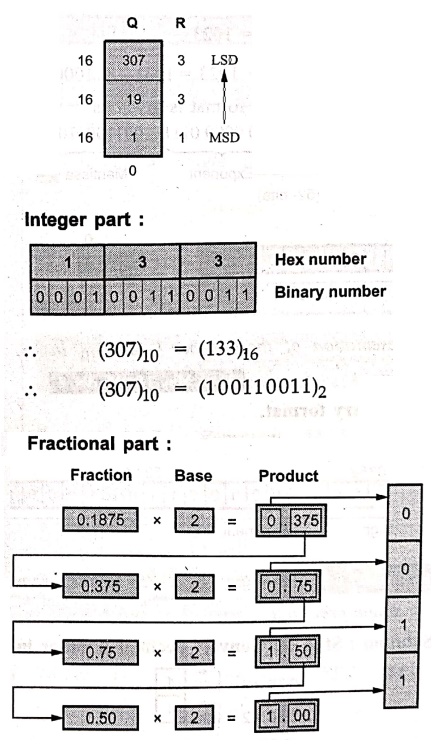
Integer part:
(307)10
= (133)16
(307)10
= (100110011)2
Fractional part :
(0.1875)
10 = (0.0011)2
Binary
number = ‒ 100110011 + .0011
=
‒ 100110011. 0011
Step 2: Normalize the
number
‒100 11001 1.00 11 = ‒ 1.0 0 1 1 0 0 1 1 0 0 1
1 ×28
Step 3: Single
precision representation
For
a given number
S
= 1, E = 8, and M = 0011 0011 0011
Bias
for single precision format is = 127
E' = E + 127 = 8 + 127 = 13510 = 100001112
Number
in single precision format is given as

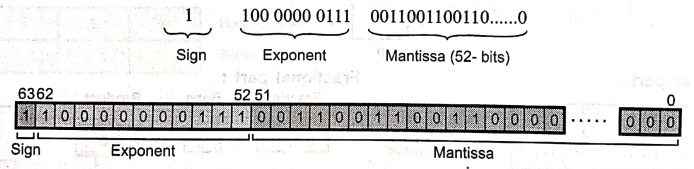
Step 4: Double
precision representation
For
a given number
S
= 1, E = 8 and M = 0011 0011 0011
Bias
for double precision format is = 1023
E'
= E + 1023 = 8 + 1023 = 103110 = 100000001112
Number
in double precision format is given as
Example: 3
Show the IEEE 754
binary representation of the number (‒0.75)10 in single precision.
Solution:
Step 1: Convert decimal
number in binary format.
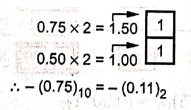
‒
(0.75)10 = ‒ (0.11)2
Step 2: Normalize the
number.
‒
0.11 = ‒1.1×2‒1
Step 3: Single
precision representation
For
a given number S = 1, E = ‒1 and M = 1
Bias
for single precision format is = 127
E'
= E + 127 = (− 1) + 127 12610 = (01111110)2
Number
in single precision format is given as,

Examples
for Practice
Example: 4
Represent (309.1875)10
in single precision and double precision format.
Answer:
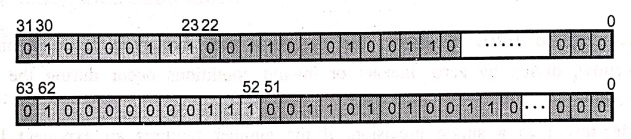
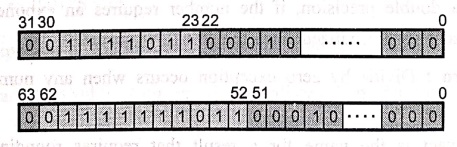
Example: 5
Represent (0.0625)10
Represent (0.0625)10 in single precision and double precision formats.
Answer:
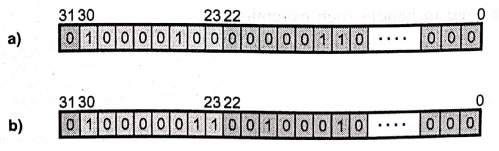
Example: 6
Represent 32.75 and
18.125 in single precision IEEE 754 representation.
Answer:
1. Special Values
•
The extreme values of biased exponent, E' are used to represent special values.
When E' = 0 and the mantissa fraction M is zero, the value exact 0 is
represented. The biased exponent with all 1s is reversed to represent infinity,
where infinity is the result of dividing a normal number by zero. The sign bit
is still part of these representations, so there are ±0 and ±∞ representations.
•
When E' = 0 and M ≠ 0, denormal
numbers are represented. A denormal is a result that causes an underflow and
has leading 0s in the mantissa even after the exponent is adjusted to its
smallest possible value. The E' with all 1s and M ≠ 0 is reserved to represent
Not a Number (NaN). A NaN is the result of performing an invalid operation such
as 0/0 or √‒1.
2. Exceptions
•
According to IEEE standards, the processor sets exception flags if underflow,
overflow, divide by zero, inexact or invalid conditions occur during the
program execution.
Underflow:
In a single precision, if the number requires an exponent less than ‒126 or in
a double precision, if the number requires an exponent less than ‒1022 to
represent its normalized form the underflow occurs.
Overflow :
In a single precision, if the number requires an exponent greater than + 127 or
in a double precision, if the number requires an exponent greater than + 1023
to represent its normalized form the overflow occurs.
Divide by zero:
Divide by zero exception occurs when any number is divided by zero.
Inexact:
Inexact is the name for a result that requires rounding in order to be represented
in one of the normal formats.
Invalid :
An invalid exception occurs if operations such as 0/0 or √1 are attempted. When
exception occurs, the results are set to special values. System and user
defined routines are used to handle such exceptions.
Review Questions
1. Define IEEE
floating point single and double precision standard.
2. What is denormal?
Define NaN ?
3. In conforming to
the IEEE standard mention any four situations under which a processor sets
exception flag.
4. Define underflow
and overflow.
Computer Organization and Architecture: Chapter 2: Arithmetic for Computers : Tag: Computer : Arithmetic for Computers - Floating Point Numbers and their Representation
Computer Organization and Architecture: Chapter 2: Arithmetic for Computers
Under Subject
Computer Organization and Architecture
CW25201 3rd Semester IT department. | 2025 Regulation | 3rd Semester 2025 Regulation
Related Subjects
Discrete Mathematics
MA25C14 3rd Semester CSE,IT,CY,AIDS departments. | 2025 Regulation | 3rd Semester 2025 Regulation
Data Structures
CS25C08 3rd Semester CSE,IT,CY,AIDS departments. | 2025 Regulation | 3rd Semester 2025 Regulation
Computer Organization and Architecture
CW25201 3rd Semester IT department. | 2025 Regulation | 3rd Semester 2025 Regulation
Object Oriented Programming
CS25C07 3rd Semester IT department. | 2025 Regulation | 3rd Semester 2025 Regulation
Web Technologies
IT25301 3rd Semester IT department. | 2025 Regulation | 3rd Semester 2025 Regulation
English Communication Skills Laboratory I
EN25C03 3rd Semester all department. | 2025 Regulation | 3rd Semester 2025 Regulation
Skill Development Course I
3rd Semester all department. | 2025 Regulation | 3rd Semester 2025 Regulation