Basic Electronics and Electrical Engineering: Chapter 4: Synchronous Machines
Construction of an Alternators
Synchronous Machines
An Alternator has 3‒phase winding on the Stator and a DC field winding on the Rotor.
CONSTRUCTION
OF AN ALTERNATORS
An Alternator has 3‒phase
winding on the Stator and a DC field winding on the Rotor.
Stator
It is the stationary
part of the machine and is built up of sheet‒steel laminations having slots on
its inner periphery. In DC machines, the outer frame (or yoke) serves to carry
the magnetic flux but in alternators, it is not meant for that purpose. Here it
is used for holding the armature stampings and windings in position. The
armature core is supported by the stator frame and is built up of laminations
of special magnetic iron or steel alloy. The core is laminated to minimise loss
due to eddy currents. The laminations are insulated from each other and have
spaces between them for allowing is placed in armature slots and serve as the
armature winding on the alternator. The armature winding is always connected in
star and the neutral is connected to ground.
Rotor
The rotor carries a
field winding which is supplied with direct current through two slip rings by a
separate DC source. This DC source (called exciter) is generally a small DC
shunt or compound generator mounted on the shaft of the alternator. Two types
of rotors are used in alternators. (i) Salient pole type and (ii) Smooth
cylindrical type.
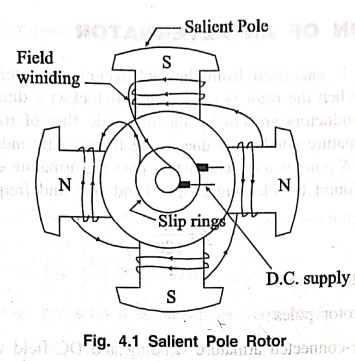
1. Salient (or projecting) pole type
In this type, salient
or projecting poles are mounted on a large circular steel frame which is fixed
to the shaft of the alternator as shown in Fig. 4.1. The individual field pole
windings connected in series in such a way that when the field winding is
energised by the DC exciter, adjacent poles have opposite polarities.
It is used in low‒medium
speed (120‒400 rpm) alternators. This type of alternators are driven by diesel
engines or water turbines. Low‒speed rotors always posses a large diameter to
provide the necessary space for the poles.
2. Non salient pole (smooth cylindrical) type
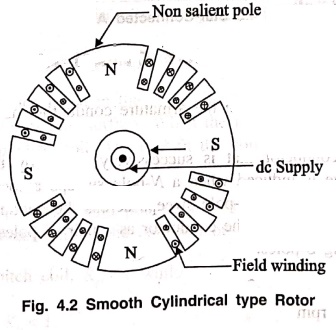
In this type, the rotor
is made of smooth solid forged‒ steel radial cylinder having a number of slots
along the outer periphery. Such rotors are designed mostly for 2‒pole (or 4‒pole)
turbo‒generators running at 3600 rpm (or 1800 rpm). The field windings are
embedded in these slots and are connected in series to slip ring through which
they are energised by the DC exciter. Two (or four) regions corresponding to
the central polar areas are left unslotted as shown in Fig. 4.2.
High speed alternators
(1500 or 3000 rpm) are driven by steam turbines. Since steam turbines run at
high speed and a frequency of 50 Hz is required, we need a small number of
poles on the rotor of high‒speed alternators (also called turbo‒alternators).
We can use number less than 2 poles and this fixes the highest possible speed.
Turbo alternators posses 2 or 4 poles and have small diameters and very long
axial lengths.
Basic Electronics and Electrical Engineering: Chapter 4: Synchronous Machines : Tag: Basic Engineering : Synchronous Machines - Construction of an Alternators
Basic Electronics and Electrical Engineering: Chapter 4: Synchronous Machines
Under Subject

Basic Electronics and Electrical Engineering
EE25C04 1st Semester ECE Dept | 2025 Regulation | 2nd Semester 2025 Regulation
Related Subjects

English Essentials I
EN25C01 1st Semester | 2025 Regulation | 1st Semester 2025 Regulation

தமிழர் மரபு - Heritage of Tamils
UC25H01 1st Semester | 2025 Regulation | 1st Semester 2025 Regulation
Applied Calculus
MA25C01 Maths 1 M1 - 1st Semester | 2025 Regulation | 1st Semester 2025 Regulation
Applied Physics I
PH25C01 1st Semester | 2025 Regulation | 1st Semester 2025 Regulation

Applied Chemistry I
CY25C01 1st Semester | 2025 Regulation | 1st Semester 2025 Regulation
Makerspace
ME25C04 1st Semester | 2025 Regulation | 1st Semester 2025 Regulation
Computer Programming C
CS25C01 1st Semester | 2025 Regulation | 1st Semester 2025 Regulation
Computer Programming Python
CS25C02 1st Semester | 2025 Regulation | 1st Semester 2025 Regulation
Fundamentals of Electrical and Electronics Engineering
EE25C03 1st Semester | 2025 Regulation | 1st Semester 2025 Regulation
Introduction to Mechanical Engineering
ME25C03 1st Semester | 2025 Regulation | 1st Semester 2025 Regulation

Introduction to Civil Engineering
CE25C01 1st Semester Civil Department | 2025 Regulation | 1st Semester 2025 Regulation
Essentials of Computing
CS25C03 1st Semester - AID CSE IT Department | 2025 Regulation | 1st Semester 2025 Regulation

Applied Physics I Laboratory
PH25C01 1st Semester practical Laboratory Manual | 2025 Regulation | 1st Semester Laboratory 2025 Regulation

Applied Chemistry I Laboratory
CY25C01 1st Semester practical Laboratory Manual | 2025 Regulation | 1st Semester Laboratory 2025 Regulation

Computer Programming C Laboratory
CS25C01 1st Semester practical Laboratory Manual | 2025 Regulation | 1st Semester Laboratory 2025 Regulation

Computer Programming Python Laboratory
CS25C02 1st Semester practical Laboratory Manual | 2025 Regulation | 1st Semester Laboratory 2025 Regulation
Engineering Drawing
ME25C01 EEE Mech Dept | 2025 Regulation | 2nd Semester 2025 Regulation
Basic Electronics and Electrical Engineering
EE25C04 1st Semester ECE Dept | 2025 Regulation | 2nd Semester 2025 Regulation