Basic Electronics and Electrical Engineering: Chapter 4: Synchronous Machines
Parallel Operation of Alternators Synchronizing
Synchronous Machines
When an alternator is connected with another alternator (or) with common bus bars, then it is known as parallel operation.
PARALLEL
OPERATION OF ALTERNATORS SYNCHRONIZING
Parallel Operation
When an alternator is
connected with another alternator (or) with common bus bars, then it is known
as parallel operation.
Advantages of parallel operation
1. Continuity of supply
can be maintained properly.
2. Repair and
maintenance of individual generating units can also be done.
3. Maximum efficiency
can be obtained and it is uneconomic to operate on low loads for large
alternators.
4. Several small units
are added depending upon their load requirements and can be operated at near to
their rated capacity.
5. Initial capital cost
of buying large units can be replaced by adding several small units in
parallel.
6. The demand of high
single power can be replaced.
Conditions for parallel operations
Proper synchronization
of alternators is possible only by fulfilling the following conditions.
1. The terminal voltage
of incoming alternator must be same as that of bus bar voltage.
2. The frequency of
incoming alternator must be same as that of bus bar frequency.
3. The phase sequence
of the voltage of incoming alternator should be same as that of bus bar
voltage.
Methods of synchronization
1.
Lamp dark method
2.
Lamp bright method
3.
Using synchroscope
Now we can look up
these above methods in detail.
1. Lamp dark method
This is a method in
which lamps are directly connected across synchronizing switch. In this
operation, the voltages and frequencies of both systems must be made equal. The
assumption is made such that the three lamps will be dark (or) bright together.
Below certain voltage the lamp will be dark.
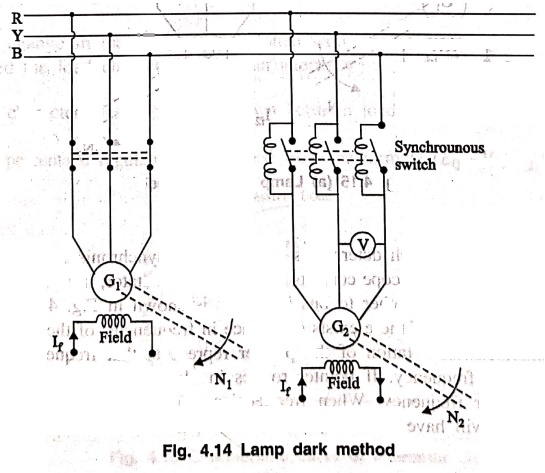
If dark is judged and
switch is closed at middle then the machines are synchronised. If the phase
sequence does not coincide then one lamp will be dark and other two will be
bright and vice versa.
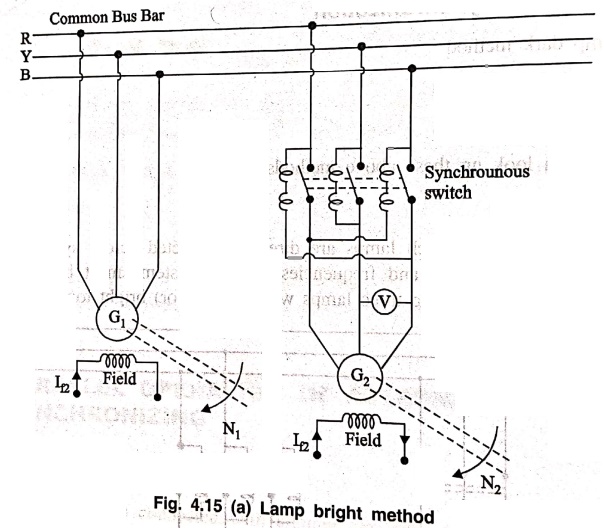
2. Lamp bright method
This is a method in
which lamps are connected assymetrically as shown in Fig. 4.15(a). If the phase
correct, the lamps brightens and glow dim in sequence.
Synchronisation is done
at the moment the uncrossed lamp L1 is in the middle of the dark
period. When uncrossed lamp L1 is dark, then other two crossed lamps
L2 and L3 are dim but equally bright. This method of
synchronising is known as 'two bright and one dark method.
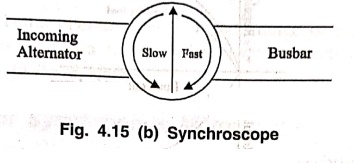
3. By using synchroscope
Synchroscope is one
which determines the instant of synchronism more accurately than the lamp
methods. This synchroscope consists of a rotor and a stator, in which one is
connected to the incoming alternator and other to bus bar. This is shown in
Fig. 4.15(b). The pointer connected to rotor will rotate if there exists
difference in frequencies of the incoming alternator and bus bar. Anticlockwise
rotation of the pointer represents that frequency of alternator lesser than the
busbar frequency. If pointer rotates in clockwise then it indicates frequency
is higher than bus bar frequency. When frequencies are equal the speed of prime
mover driving the alternator will have to be adjusted so that pointer is
stationary.
By closing the switch
the alternator can be switched on to the bus bar.
Basic Electronics and Electrical Engineering: Chapter 4: Synchronous Machines : Tag: Basic Engineering : Synchronous Machines - Parallel Operation of Alternators Synchronizing
Basic Electronics and Electrical Engineering: Chapter 4: Synchronous Machines
Under Subject

Basic Electronics and Electrical Engineering
EE25C04 1st Semester ECE Dept | 2025 Regulation | 2nd Semester 2025 Regulation
Related Subjects

English Essentials I
EN25C01 1st Semester | 2025 Regulation | 1st Semester 2025 Regulation

தமிழர் மரபு - Heritage of Tamils
UC25H01 1st Semester | 2025 Regulation | 1st Semester 2025 Regulation

Applied Calculus
MA25C01 Maths 1 M1 - 1st Semester | 2025 Regulation | 1st Semester 2025 Regulation
Applied Physics I
PH25C01 1st Semester | 2025 Regulation | 1st Semester 2025 Regulation

Applied Chemistry I
CY25C01 1st Semester | 2025 Regulation | 1st Semester 2025 Regulation
Makerspace
ME25C04 1st Semester | 2025 Regulation | 1st Semester 2025 Regulation

Computer Programming C
CS25C01 1st Semester | 2025 Regulation | 1st Semester 2025 Regulation

Computer Programming Python
CS25C02 1st Semester | 2025 Regulation | 1st Semester 2025 Regulation
Fundamentals of Electrical and Electronics Engineering
EE25C03 1st Semester | 2025 Regulation | 1st Semester 2025 Regulation
Introduction to Mechanical Engineering
ME25C03 1st Semester | 2025 Regulation | 1st Semester 2025 Regulation

Introduction to Civil Engineering
CE25C01 1st Semester Civil Department | 2025 Regulation | 1st Semester 2025 Regulation

Essentials of Computing
CS25C03 1st Semester - AID CSE IT Department | 2025 Regulation | 1st Semester 2025 Regulation

Applied Physics I Laboratory
PH25C01 1st Semester practical Laboratory Manual | 2025 Regulation | 1st Semester Laboratory 2025 Regulation

Applied Chemistry I Laboratory
CY25C01 1st Semester practical Laboratory Manual | 2025 Regulation | 1st Semester Laboratory 2025 Regulation

Computer Programming C Laboratory
CS25C01 1st Semester practical Laboratory Manual | 2025 Regulation | 1st Semester Laboratory 2025 Regulation

Computer Programming Python Laboratory
CS25C02 1st Semester practical Laboratory Manual | 2025 Regulation | 1st Semester Laboratory 2025 Regulation
Engineering Drawing
ME25C01 EEE Mech Dept | 2025 Regulation | 2nd Semester 2025 Regulation
Basic Electronics and Electrical Engineering
EE25C04 1st Semester ECE Dept | 2025 Regulation | 2nd Semester 2025 Regulation