Tamils and Technology: Unit II: Design and Construction Technology
Design of the Household Materials in the Sangam period
Tamils and Technology
1. Aryakkal (or) Enthiram 2. Ural - Plunger 3. Grinding Stone (or) Aatural (or) Sekku 4. Ammi 5. Oil Sekku 6. Sugar Factory 7. Telescope
DESIGN OF THE HOUSEHOLD
MATERIALS IN THE SANGAM PERIOD
There
are evidences of the existence of household items in the Sangam period. How the
items were used, and they were designed are found in the evidences.
1. Aryakkal (or) Enthiram
A
tool which is called enthiram (apparatus) is the grinding tool that is found in
every house in the villages of Tamil Nadu. Aariyam is a stone tool used to
grind ragi into powder. Whole grains can be broken into two. Plant crop, gram,
green gram can easily be broken.
Shape
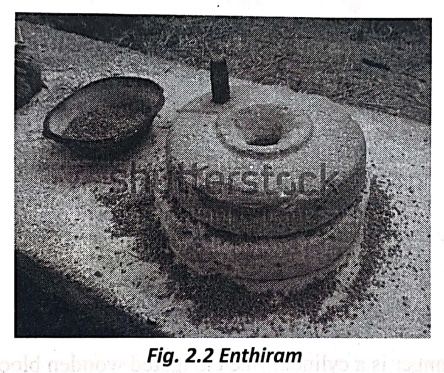
The
lower part of the Aryakkal is a fixed round stone. There is a sprout in the
middle of it. A round stone is found with a hole in the middle at the top. It
revolves around the sprout. There is also a sprout to hold the top stone in
order to move it around. When the stone rotates, the grain or the crop placed
in the circular hole of the upper stone is ground in between and is broken and
falls out.
This
instrument is found in all parts of India. There are many epigraphical
evidences that this instrument was used in every house even during the Sangam
period.
2. Ural - Plunger
Ural
is a very simple tool. This tool is used to remove the husk of paddy, to remove
the skin of rye and to clean the corn.
Shape
The
shape of the ural is like a udukkai. It is made of wood and black stone. It is
also called Kunthani which is made of wood. The upper part of the ural is like
a flat ring with a circular pit in the middle.
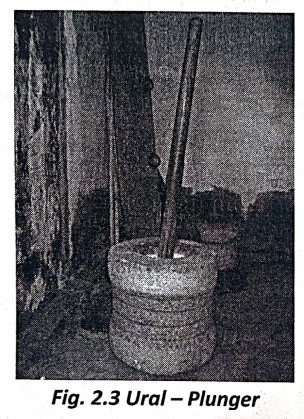
A
plunger is a cylinder-like elongated wooden block with an iron rod attached at
both ends.
Application
During
the Sangam period, to remove the paddy husk, it was pounded with a plunger.
Ural has been used to measure the rainfall in rural areas. If the ural has got
rainwater in full, it is called a 'plough rain'. A village ural pit was filled
with water and measured. The researchers found that it was equivalent to nearly
an inch of rain. Other than the urals at houses, here and there it can be seen
that ural holes were carved in stone rocks in the forest areas.
Proof: Samana
Hermit Cave is located at Jampaik Garat, Thirukovilur Circle, Villupuram
district. It has an inscription of Athiyaman Neduman Anji. Ural is carved in
front of this cave.
3. Grinding Stone (or) Aatural (or) Sekku
Grinding
stone is a device used during the Sangam period for grinding rice flour for
making Idly, Dosa and Chilli mortar.
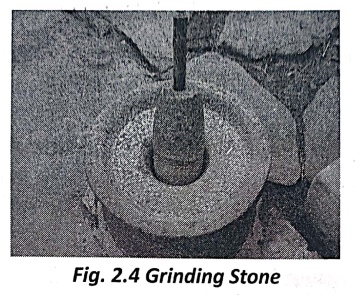
Shape
A
hole dug in stone; a handle for holding and turning the stone suitable for the
pit is the structure of the grinding stone.
Application
Sangam
people used to prepare pongal in forest temples away from the town. Sacrifice
of chicken, goats and pigs is customary. They cook and enjoy eating them. A
grinding stone is required for grinding the necessary chilli paste. The
philanthropists provided such grinding stones and their names are engraved on
them.
Evidences
1.
In the forest temple on the Kalvarayan hill in Salem district there is a
grinding stone engraved on the rock. On analyzing it, it is understood that it
is dated back to the first Paranthaga Chola.
2.
A grinding stone is cut on a stone near a temple under a tree at Manaloorpet in
Tirukoilur circle. It belongs to 7th Century AD. In it, the words 'Srisalavan
Perinaranath'. This may be the oldest written inscription.
3.
An inscription is cut on a large boulder in a forest at Rasipuram in Salem. In
it, in the 12th Century letters, a statement is found.
4. Ammi
The
Ammi and Kuzhavi are used to grind chilli paste.
Shape
The
base part is flat. On the top of it is the rolling Kuzhavi. Turmeric and ginger
are first placed on the base stone and crushed with the Kuzhavi. Then, the
content is ground by rolling and pulling the Kuzhavi.
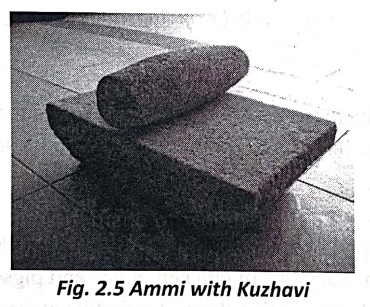
Evidence
There
is an Ayyanar temple in Chingee, Villupuram district. There, a long Ammi has
beautiful carvings on all four sides. It may be the period of Sambuvarayar.
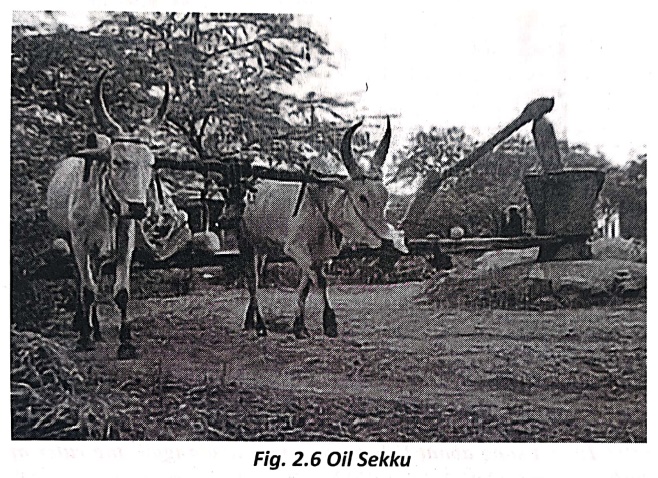
5. Oil Sekku
Sekku
is a tool used to press sesame, groundnut and coconut oil and extract oil.
Structure
Sekku
is mostly made of wood. The kuzhavi is made of iron or wood. Sometimes, the
kuzhavi is made of black stone.
The
compressive force is supplied by the kuzhavi. Two cattle are locked to go round
the sekku. The process of rotating the sekku is called 'Kaanam'.
Evidences
1.
There is a stone sekku in the town called Ennairam, in Villupuram circle.
2.
There is also a town named Marakkanam.
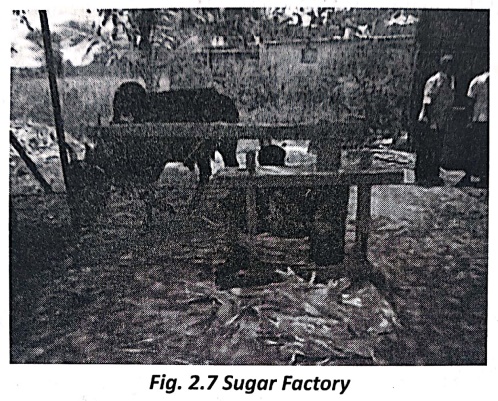
6. Sugar Factory
Sugar
Factory is the place where devices are found to squeeze out sugarcane juice.
Structure
About
50 years ago, wooden rollers were installed and even the toothed wheels that
transferred the force were made of wood. The rollers were rotated by being
pulled by cattle. The sugarcane is inserted in the middle of the cylinder and
the juice is squeezed out and comes out as solid residue.
During
the Sangam period, it was called a locking device. Poets sing that the sound of
lock-clang is always heard.
Proofs
1.
A song about Veliyarkone Veethividangan, the ruler of Tirukoilur contains
lyrics about Sugar Factories.
2.
A scene in Perumbaanaatruppadai mentions that one can always hear the sound of
the sugarcane juicer on the mountainside similar to the trumpeting of an
elephant attacked by yaali.
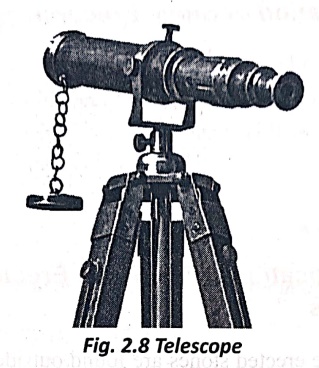
7. Telescope
The
Bosala Kings ruled the state of Karnataka. Uralepeedu is the best among the
Bosal cities. The twin temples here have many beautiful sculptures. Many
Mahabharatha scenes are also found. It was built in the 9th Century AD. In one
of the sculpture scenes, his charioteer 'Sanjayan' holding a telescope in his
hand, looking at the battlefield and narrates the scene to Thirutharashtiran.
That telescope is a long tube.
Tamils and Technology: Unit II: Design and Construction Technology : Tag: Tamil : Tamils and Technology - Design of the Household Materials in the Sangam period
Tamils and Technology: Unit II: Design and Construction Technology
Under Subject
Tamils and Technology தமிழர்களும் தொழில்நுட்பமும்
UC25H02 2nd Semester | 2025 Regulation | 2nd Semester 2025 Regulation
Related Subjects
English Essentials II
EN25C02 2nd Semester | 2025 Regulation | 2nd Semester 2025 Regulation
Tamils and Technology தமிழர்களும் தொழில்நுட்பமும்
UC25H02 2nd Semester | 2025 Regulation | 2nd Semester 2025 Regulation
Linear Algebra
MA25C02 2nd Semester | 2025 Regulation
Transforms and its Applications
MA25C03 2nd Semester EEE Dept | 2025 Regulation | 2nd Semester 2025 Regulation

Applied Physics (CE) II
PH25C02 2nd Semester Civil, Agri Depts | 2025 Regulation | 2nd Semester 2025 Regulation
Applied Physics (CSIE) II
PH25C03 2nd Semester AIDS, CSE, IT, CSE(CY) Dept | 2025 Regulation | 2nd Semester 2025 Regulation
Applied Physics (EE) II
PH25C04 2nd Semester EEE Dept | 2025 Regulation | 2nd Semester 2025 Regulation

Applied Physics (ME) II
PH25C05 2nd Semester Mechanical Dept | 2025 Regulation | 2nd Semester 2025 Regulation
Applied Chemistry (CE) II
CY25C02 2nd Semester Civil Dept | 2025 Regulation | 2nd Semester 2025 Regulation

Applied Chemistry (ME) II
CY25C03 2nd Semester Mechanical Dept | 2025 Regulation | 2nd Semester 2025 Regulation

Electron Devices
EC25C01 2nd Semester ECE Dept | 2025 Regulation | 2nd Semester 2025 Regulation
Digital Principles and Computer Organization
CS25C06 2nd Semester AIDS, CSE, IT, CSE(CY) Dept | 2025 Regulation | 2nd Semester 2025 Regulation

Basic Electrical and Electronics Engineering
EE25C01 2nd Semester | 2025 Regulation | 2nd Semester 2025 Regulation

Basic Civil and Mechanical Engineering
GE25C01 2nd Semester EEE Dept | 2025 Regulation | 2nd Semester 2025 Regulation
Data Structures using CPlusPlus
CS25C05 2nd Semester ECE Dept | 2025 Regulation | 2nd Semester 2025 Regulation
Engineering Drawing
ME25C01 EEE, Mech, Agri, EEE Depts | 2025 Regulation | 2nd Semester 2025 Regulation
Data Structures and Algorithms
CS25C04 2nd Semester EEE Dept | 2025 Regulation

Circuits and Network Analysis
EC25C02 2nd Semester ECE Dept | 2025 Regulation | 2nd Semester 2025 Regulation

Engineering Mechanics
ME25C02 2nd Semester Mech, Civil, Agri Depts | 2025 Regulation | 2nd Semester 2025 Regulation
Object Oriented Programming (OOPs)
CS25C07 2nd Semester CSE, CSE(CY) Depts | 2025 Regulation | 2nd Semester 2025 Regulation