Tamils and Technology: Unit II: Design and Construction Technology
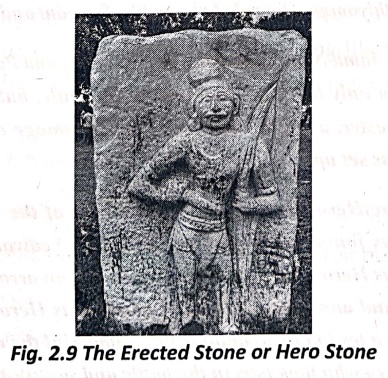
Hero Stone (or) Stones to denote courage
Tamils and Technology
Tamils and Technology: 1. The Period of Stone Erection 2. The Location of the Stone Erected and other Names 3. Load Bearing Stones 4. Other Names 5. Making of Hero Stone (or) Steps Involved in it 6. Different Structures of the Hero Stone 7. Inscriptions on the Hero Stones 8. Method of worshipping the Hero Stone during the Sangam Period
HERO STONE (OR) STONES
TO DENOTE COURAGE
It
is an ancient Tamil tradition to offer final tributes to the dead soldiers and
worship after erecting stones. The stones erected in this way are called
'Nadukal' or 'Hero Stones'. This practice has been existing in many parts of the
world since the Stone Age. Generally, 'Hero Stones' can be placed for any
deceased person. But it is also mentioned in Sangam literature that people used
to worship the Hero Stone of the martyrs.
1. The Period of Stone Erection
In
Tamil Nadu, there has been a custom of erecting stone for soldiers since Sangam
period. The following lines from Tholkapiyam make this clear.
Proof:
Tholkappiyam
2. The Location of the Stone Erected and other Names
Most
of the erected stones are found outside the town, Two or more erected stones
are also found at the same place. It is also common for many warriors who die
in the same battle to have their tombstones found in the same place.
Location
1.
Three Hero stones were found at Puliman Gombai (Theni district) by the Tamil
University department of Epigraphy and Archaeology. Its period is 3rd Century
BC.
2.
The Hero stones were also found during the reign of King Athiyaman who ruled
places like Sengam and Dharmapuri.
3.
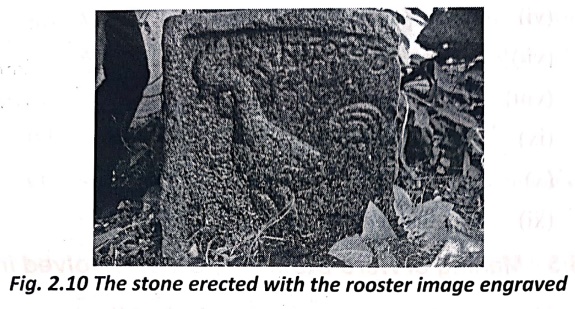
In Tamil Nadu during the Chera, Chola and Pandiya periods not only the men who
died in the battle, but also the war rooster, a statue engraved with the image
of the rooster was set up.
4.
The Hero stone of the Nayaka king of the 16th Century was found in Tirupathur
District in Vedivattam area. In this Hero stone of the archer, he has an arrow
in his right hand and a bow in his left hand. This Hero stone stands as a
testimony to honour the memory of the incomparable hero who took part in the
battle and sacrificed his life as a tribute to the people.
3. Load Bearing Stones
In
Sivagangai District, Manamadurai region villages 'Load bearing stones' (Hero
stones) were erected for the women who died during childbirth.
In
ancient times, if pregnant women died during childbirth, 'Load bearing stones'
were erected on roadsides for making their souls rest in peace. The name of the
pregnant woman, year of death, were noted in the stone. On the death
anniversary bangles, kumkum, turmeric, ribbon and comb were kept and
worshipped.
During
harvest seasons, those who carry rice seed, vegetable loads for a long distance
kept their loads on the 'Load bearing stones' and took rest for sometime. While
doing like that, it was believed that the souls of the dead pregnant women
would rest in peace.
4. Other Names
The
Hero stones are also called by the following names.
(i)
Vethiappan Stone (or) Vethiappan Temple
(ii)
Vedar
(iii)
Krishnarappan
(iv)
Meenarappan
(v)
Sanyasiappan
(vi)
Anjaneya Stone
(vii)
Sirameetan Temple
(viii)
Oomai Vethiappan
(ix)
Double Vethiappan
(x)
Savumettu Vethiappan
(xi)
Naththamettu Vethiappan
5. Making of Hero Stone (or) Steps Involved in it
Hero
stone formation is carried out in the following steps.
Step
1: Katchi: Going to the mountain to
choose a suitable stone.
Step
2: Kalgol: Bringing the chosen stone.
Step
3: Neerpadai: Cleaning the stone
brought with water.
Step
4: Theetuthal: Carving the image,
name, valour of the dead soldier.
Step
5: Erection: Erecting the stone at
the selected place.
Step
6: Perumpadai: Performing abishegam
to the Hero Stone with the peacock feathers and garlands.
Step
7: Salutation: Worshiping like a
deity and prayer sung.
6. Different Structures of the Hero Stone
The
arrangement of Hero stones are made in the following ways.
i)
On the epitome there is a figure of a warrior in combat posture holding a bow
and arrow or with a sword and shield.
ii)
Many epitomes also show the hero with many arrows piercing his body.
iii)
Mostly, a long cloth is also tied around the warrior's waist. There is no clothing
on the body. A hair is seen on the head.
iv)
Some players are found with long braids.
v)
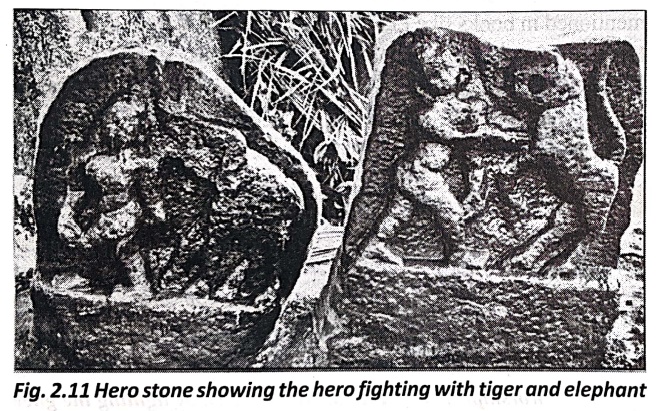
Some Hero stones are seen as if the hero is fighting with a tiger. (Evidence:
in a town called Moththakkal).
vi)
Chicken Stones: Hero stones are also
found for the dead chickens in chicken fights.
7. Inscriptions on the Hero Stones
The
king's reign, year, the name of the martyred hero and the news about him, the
battle, about bringing cattle, about recovering cattle, etc., are engraved on
the Hero stone.
The
epitomes usually have circular letters. There are also some Tamil letters.
Evidences
1.
The stone erected for Pedutheeyan Anthavan who died in the Akol fight held at
Koodal town.
2.
Another Hero stone erected for Pathavan from Vel town.
3.
(i) lynkurunooru. 352, (ii) Akananooru 297.
All
these indications show that there were inscriptions on the erected hero stones
during the Sangam period.
8. Method of worshipping the Hero Stone during the Sangam Period
There
was a custom of offering flowers and smoke to the Hero stones every day. It was
called 'salutation to the Hero stone'. It is mentioned in books like
Purananooru, Silapathikaram, Malaipadu Kadaam. Stones were placed around the
Hero stone to make it a hoard. It is called 'Vallan Padukai God'. They would
beat the udukai, perform pooja with Thoppi, a kind of liquor. They also
sacrificed animals.
Proofs:
i)
Purananooru
Next
to Sirtoor, at the dawn, they poured fresh water to the planted stone and
performed pooja lighting a ghee lamp. Puranaanooru tells the story of the Hero
stone being worshipped, that the smoke produced by lighting the ghee lamp rose
like a cloud and smelt in the street.
ii)
Auvaiyar says that Athiyaman Nedumananji performed pooja with peelisooti
liquor.
iii)
Silapathikaram says that Senkuttuvan appointed Kannagi's friend, Devanthi to
worship the Hero stone erected for her.
iv)
Purananooru 264
Hero
Stone is erected in the town for the hero who lost his life in the battle of
Karandhai to rescue the cattle lured away by the Vetchiyars. The Hero Stone is
garlanded and peacock feathers are put and worshipped.
v)
Silapathikaram, Nadukal Kaathai 235
A
temple was built for Kannagi. Silapathikaram Nadukal brad of Kaathai says that
King Senguttuvan had decided that the statue of Kannagi should be worshipped
with gold ornaments. Flowers should be sprinkled and prayer should be performed
daily. It is also seen with two Vimanams.
Tamils and Technology: Unit II: Design and Construction Technology : Tag: Tamil : Tamils and Technology - Hero Stone (or) Stones to denote courage
Tamils and Technology: Unit II: Design and Construction Technology
Under Subject
Tamils and Technology தமிழர்களும் தொழில்நுட்பமும்
UC25H02 2nd Semester | 2025 Regulation | 2nd Semester 2025 Regulation
Related Subjects
English Essentials II
EN25C02 2nd Semester | 2025 Regulation | 2nd Semester 2025 Regulation
Tamils and Technology தமிழர்களும் தொழில்நுட்பமும்
UC25H02 2nd Semester | 2025 Regulation | 2nd Semester 2025 Regulation
Linear Algebra
MA25C02 2nd Semester | 2025 Regulation
Transforms and its Applications
MA25C03 2nd Semester EEE Dept | 2025 Regulation | 2nd Semester 2025 Regulation

Applied Physics (CE) II
PH25C02 2nd Semester Civil, Agri Depts | 2025 Regulation | 2nd Semester 2025 Regulation
Applied Physics (CSIE) II
PH25C03 2nd Semester AIDS, CSE, IT, CSE(CY) Dept | 2025 Regulation | 2nd Semester 2025 Regulation
Applied Physics (EE) II
PH25C04 2nd Semester EEE Dept | 2025 Regulation | 2nd Semester 2025 Regulation

Applied Physics (ME) II
PH25C05 2nd Semester Mechanical Dept | 2025 Regulation | 2nd Semester 2025 Regulation
Applied Chemistry (CE) II
CY25C02 2nd Semester Civil Dept | 2025 Regulation | 2nd Semester 2025 Regulation

Applied Chemistry (ME) II
CY25C03 2nd Semester Mechanical Dept | 2025 Regulation | 2nd Semester 2025 Regulation

Electron Devices
EC25C01 2nd Semester ECE Dept | 2025 Regulation | 2nd Semester 2025 Regulation
Digital Principles and Computer Organization
CS25C06 2nd Semester AIDS, CSE, IT, CSE(CY) Dept | 2025 Regulation | 2nd Semester 2025 Regulation

Basic Electrical and Electronics Engineering
EE25C01 2nd Semester | 2025 Regulation | 2nd Semester 2025 Regulation

Basic Civil and Mechanical Engineering
GE25C01 2nd Semester EEE Dept | 2025 Regulation | 2nd Semester 2025 Regulation
Data Structures using CPlusPlus
CS25C05 2nd Semester ECE Dept | 2025 Regulation | 2nd Semester 2025 Regulation
Engineering Drawing
ME25C01 EEE, Mech, Agri, EEE Depts | 2025 Regulation | 2nd Semester 2025 Regulation
Data Structures and Algorithms
CS25C04 2nd Semester EEE Dept | 2025 Regulation

Circuits and Network Analysis
EC25C02 2nd Semester ECE Dept | 2025 Regulation | 2nd Semester 2025 Regulation

Engineering Mechanics
ME25C02 2nd Semester Mech, Civil, Agri Depts | 2025 Regulation | 2nd Semester 2025 Regulation
Object Oriented Programming (OOPs)
CS25C07 2nd Semester CSE, CSE(CY) Depts | 2025 Regulation | 2nd Semester 2025 Regulation