Tamils and Technology: Unit II: Design and Construction Technology
Indo - Saracenic architecture in the British (European) Period
Tamils and Technology
1. The Special Features of Indo-Saracen Architecture 2. Indo-Saracenic Architecture in Chennai 3. Chatrapathi Shivaji Terminus (CST)
INDO-SARACENIC
ARCHITECTURE IN THE BRITISH (EUROPEAN) PERIOD
The meaning of Saracen
Saracen
is the ancient name created by the British (European) for Arabic language
talking muslim.
The meaning of Indo-Saracen
The
name saracen was created by the British with a purpose of uniting the Hindus
and Muslims. This is considered to be an attempt of stopping the separation
between Hindus and Muslims. It is a non- religious forum.
Indo-Saracen Architecture
It
is considered to be a combination of three types of architecture. The
Indo-Saracen architecture is an architectural art that combines Mughal
architecture, Hindu temple architecture and the British architecture.
During
the British rule, the layouts of temples and designs were done combining the
elegance of Mughal architecture:
1. The Special Features of Indo-Saracen Architecture
1.
Onion (Kumizh) domes.
2.
Sharp curves (or) bend curves.
3.
Horsetail curves.
4.
Around a bend, contrasting colours of red and white.
5.
Curved roofs in Bengali styles like Char-sala.
6.
Chatri kiosks with a dome on the roof.
7.
Peaks.
8.
Towers (or) Minarets.
9.
Open pavillions.
10.
Jollys (or) open air screens.
11.
Mashrabiya (or) Jeroca style screened window.
2. Indo-Saracenic Architecture in Chennai
This
architecture has a close relationship with Chennai. Chennai is the city with
the most buildings in the Indo-Saracenic style of construction.
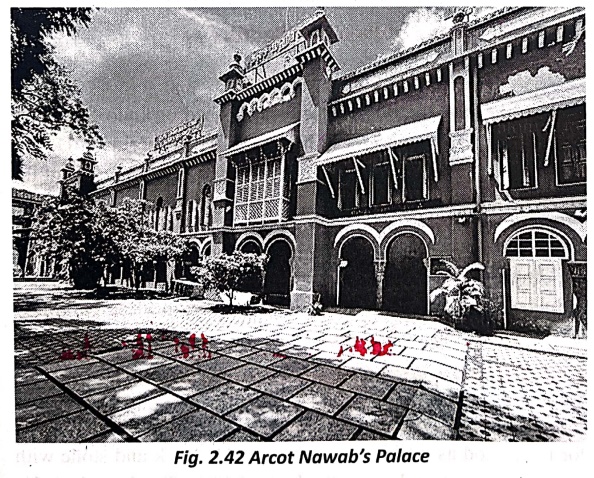
The
first building in Tamil Nadu to use the Indo-Saracenic architecture was the
Arcot Nawab's Palace at Cheppakkam in Chennai, which was completed in 1768.
This palace has been built on 117 acres.
Examples
i)
Chennai University Senate Building,
ii)
Chennai Egmore Railway Station,
iii)
Victoria Public Hall,
iv)
Rippon Building and
v)
Amir Mahal
are
the important buildings built in this style.
Salient Features of this Architecture
All
government offices, courts, railway stations and museums built in the 19th to
20th Centuries are based on Indo-Saracenic architecture. The high towers belong
to Indian heritage. Domes belong to Islamic art. Beautiful floral carvings at
the ends of the buildings and canopies with beautiful carvings deserve
appreciation.
Domed
buildings are special, figures are also carved in such buildings. The windows
are made of stones and don't look like ordinary windows. More pillars can be
seen in these buildings. That is where most of the artistic works are found.
3. Chatrapathi Shivaji Terminus (CST)
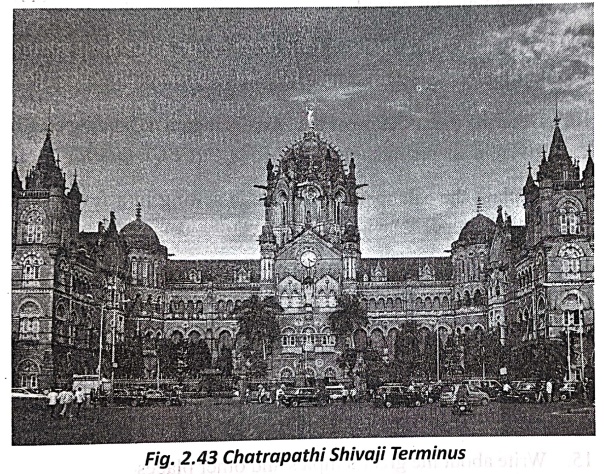
Its
majestic appearance best reflects the architecture of India for the period as
well. The combination of brick and stone with oriental elements enhances the
look of CST. The domed roof is highlighted with patterned decoration. CST is a
combination of Hindu and Islamic styles. It emphasizes domes, towers and
stained glass windows. The Central dome has eight ornate ribs that highlight
Victorian elements. Adding to the beauty of the Station are stained glass
windows, colourful tiles and decorative cast iron grills. Under the dome are
green ornate stained glass windows.
Tamils and Technology: Unit II: Design and Construction Technology : Tag: Tamil : Tamils and Technology - Indo - Saracenic architecture in the British (European) Period
Tamils and Technology: Unit II: Design and Construction Technology
Under Subject
Tamils and Technology தமிழர்களும் தொழில்நுட்பமும்
UC25H02 2nd Semester | 2025 Regulation | 2nd Semester 2025 Regulation
Related Subjects
English Essentials II
EN25C02 2nd Semester | 2025 Regulation | 2nd Semester 2025 Regulation
Tamils and Technology தமிழர்களும் தொழில்நுட்பமும்
UC25H02 2nd Semester | 2025 Regulation | 2nd Semester 2025 Regulation
Linear Algebra
MA25C02 2nd Semester | 2025 Regulation
Transforms and its Applications
MA25C03 2nd Semester EEE Dept | 2025 Regulation | 2nd Semester 2025 Regulation

Applied Physics (CE) II
PH25C02 2nd Semester Civil, Agri Depts | 2025 Regulation | 2nd Semester 2025 Regulation
Applied Physics (CSIE) II
PH25C03 2nd Semester AIDS, CSE, IT, CSE(CY) Dept | 2025 Regulation | 2nd Semester 2025 Regulation
Applied Physics (EE) II
PH25C04 2nd Semester EEE Dept | 2025 Regulation | 2nd Semester 2025 Regulation

Applied Physics (ME) II
PH25C05 2nd Semester Mechanical Dept | 2025 Regulation | 2nd Semester 2025 Regulation
Applied Chemistry (CE) II
CY25C02 2nd Semester Civil Dept | 2025 Regulation | 2nd Semester 2025 Regulation

Applied Chemistry (ME) II
CY25C03 2nd Semester Mechanical Dept | 2025 Regulation | 2nd Semester 2025 Regulation

Electron Devices
EC25C01 2nd Semester ECE Dept | 2025 Regulation | 2nd Semester 2025 Regulation
Digital Principles and Computer Organization
CS25C06 2nd Semester AIDS, CSE, IT, CSE(CY) Dept | 2025 Regulation | 2nd Semester 2025 Regulation

Basic Electrical and Electronics Engineering
EE25C01 2nd Semester | 2025 Regulation | 2nd Semester 2025 Regulation

Basic Civil and Mechanical Engineering
GE25C01 2nd Semester EEE Dept | 2025 Regulation | 2nd Semester 2025 Regulation
Data Structures using CPlusPlus
CS25C05 2nd Semester ECE Dept | 2025 Regulation | 2nd Semester 2025 Regulation
Engineering Drawing
ME25C01 EEE, Mech, Agri, EEE Depts | 2025 Regulation | 2nd Semester 2025 Regulation
Data Structures and Algorithms
CS25C04 2nd Semester EEE Dept | 2025 Regulation

Circuits and Network Analysis
EC25C02 2nd Semester ECE Dept | 2025 Regulation | 2nd Semester 2025 Regulation

Engineering Mechanics
ME25C02 2nd Semester Mech, Civil, Agri Depts | 2025 Regulation | 2nd Semester 2025 Regulation
Object Oriented Programming (OOPs)
CS25C07 2nd Semester CSE, CSE(CY) Depts | 2025 Regulation | 2nd Semester 2025 Regulation