Tamils and Technology: Unit II: Design and Construction Technology
Understanding Model Structures
Tamils and Technology
Tamils and Technology: 1. Madurai Meenakshi Amman Temple 2. Thirumalai Naiyakar Mahal - Understanding Model Structures
UNDERSTANDING MODEL
STRUCTURES
1. Madurai Meenakshi Amman Temple
Madurai
Meenakshi Sundreshwar Temple is a Shiva temple located in the middle of the
temple located in the middle of the temple city of Madurai. The prominent god
and goddess are Sundareshwarar and Ambigai Meenakshiamman. This temple is also
known as Madurai Meenakshiamman Temple. This place is not only an important
Shiva temple but also one of the 51 Sakthi Peedas of Ambigai.
Structure
of the Temple
Madurai
Meenakshi Amman temple is spread over an area of 45 acres. The temple has 8
towers and 2 vimanas. These eight towers have been set up at four point square
shape. There are two towers here. One has been built for goddess Meenakshi and
the other for Andareshwarar. The Karuvarai Vimanas here are called Indra
Vimanas. These are supported by 32 stone lions. 64 Sivaganams and 8 white
elephants.
The
temple measures 847 feet from east to west and 792 feet from South to North.
There are 4 towers of 9 levels on the four sides of the temple's main roads.
Builders
of the Towers
Lord
Shiva appeared in the dream of the Pandya King Kulasekhara Pandyan and he destroyed
the forest called Kadambavanam and built the city of Madurai and this Shiva
Shakti site.
i) East Tower
(Rajagopuram)
It
was built between 1216 AD and 1238 AD by the later Pandyas. The height of it is
161 feet.
ii) West Tower
It
was built in 1323 AD by Maravarman Kulasekara Pandiyan. The height of it is 163
feet.
iii) South Tower
The
South Tower was built by the King Viswanatha Nayak in 1559 AD. Of all the
towers, south tower is the highest (170 feet).
iv) North Tower
History
says that the construction was started by the King Muthuveerappa Nayak from
1564 AD to 1572 AD and completed by the Vainagaram family in 1878 AD. The
height of it is 160 feet.
In
this temple, Potramarai Pond, the Thalavirushtam, Kadambamaram have been set up
in an area of one acre.
Sannithis
1. Moolavar Sannithi
The
prominent god of this temple is Sundareshwar. He is Swayambu Murthy. He is also
called Somasundarar, Sokkar and Sokkanathar. By worshipping him, Indiran got
rid of his sins. That was why he built a temple for the Swayambu Lingam. The
Porminent God's Vimanam is called 'Indira Vimanam'.
2. Ambal Sannithi
In
this site, Ambal (mother) is Meenakshiamman. Her idol is made of emerald. Amman
is called 'Maragatha Valli' because the goddess appears in emerald green
colour. This Sanctum Sanctorum has 32 lion images, 64 Shiva statues and 8 stone
elephants. This Sanctum Sanctorum Vimanam was set up by Devendran. She got the
name Meenakshi because she had eyes like fish.
Parrot
In
the appearance of Meenakshi Amman, there is also a parrot. The parrot is
believed to be saying, repeatedly to remind Ambigai of the devotees' request.
When Indiran came to visit this place to get rid of the curse, the parrots
helped him in the worship of Shiva.
Other names of
Meenakshiamman
For
Meenakshiamman, there are innumerable names like Maragatha Valli, Pachaidevi,
Tadathagai, Abirama Valli, Karpoora Valli, Komagal, Sundaravalli, Pandipratti,
Manikka Valli and Mathurapuri Thalaivi.
Pathivirathai
As
Meenakshi is the queen of Madurai, devotees are not allowed to see her
abisekams. Devotees can see Meenakshiamman after the decoration is fully over.
The first Pooja of this temple is performed to Ambigai Meenakshi. After that,
prayers are offered to Lord Shiva. The reasons for this is that Meenakshi Amman
has always intended to do her faithful duties to her husband. So before waking
up her husband, Ambigai, the wife completes her Abishekam and gets ready. So
the first pooja in the morning is performed to goddess Meenakshi.
Halls (or) Mandapas
The
beautiful sculptures of the temple are different from each mandapam, with
beautiful details and individual features.
1.
Attasathi Mandapam
Attasathi
Mandapam is located in front of Meenakshi Amman Sannithi. Meenakshi
Tirukalyanam is depicted in the form of story between Vinayagar and Murugan
idols on the gate. On the pillars located inside, eight forms of Sakthi are
beautifully painted.
2.
Kambathadi Mandapam
It
was built by Krishnappa Nayak-I in AD 1564 - 1572. The sculptures in this hall
have various forms of Lord Shiva. Meenakshi Thirukkalyana sculpture is world
famous. The Nandhi Mandapam in front of Swami Sannithi is of a single stone.
3.
Mandapam with 1000 Pillars
It
was built in 1494 AD by Veerappa Nayakkar, the ruler of Madurai. It is larger
in size than the other halls in the temple. A. wheel representing 60 Tamil
years is carved on the canopy above the gate of this hall.
4.
Veeravasantharayar Mandapam
It
is found in front of the 1000 pillar hall. It is 400 years old and has 7000
sq.ft. area. In the middle of this Mandapam, there is a Nandhi idol facing the
God.
Musical Pillars
Meenakshi
Amman temple has 5 music pillars on the North road of the temple, 2 music
pillars in the 1000 pillar Mandapam and 7 music pillars in the Meenakshi Amman
Temple itself.
2. Thirumalai Naiyakar Mahal
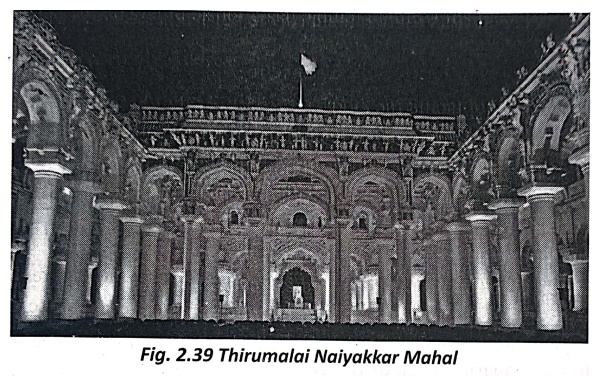
Thirumalai
Naiyakar Mahal or Thirumalai Nayakkar Palace was built in 17th Century by
Thirumalai Nayakkar one of the Nayakka Kings who ruled Madurai. It was designed
by an architect in the Italian Sarocenic style. After the construction of the
new mandapam, the construction of Rajagopuram was started. But, it remains
unfinished.
Structure
This
palace is 58 feet high and 12 feet wide. It is supported by 248 colossal
pillars. The ceiling is painted with mythological scenes of Vishnu and Shiva.
Parts of the Palace
The
palace consisted of two main parts. They are
1.
Heavenly Address
2.
Venue Address
1.
Heavenly Address
This
area was the residence of the king.
2.
Venue Address
This
area was the residence of Muthiyalu Nayak, the king's younger brother.
The
palace consisted of music hall, theatre, palanquin road, weapon road, place of
worship, residences of other royal families and servants, private place
(Anthappuram), parks, lakes, etc., These are located in both the places.
Limestone Building
Thirumalai
Nayakkar building is made of lime called chunnam and egg white mixed with a
mixture of jaggery, gall-nut, gooseberry is coated all over the palace to get a
smooth and shiny look.
Inner Courtyard
It
must be said that the big white pillars that fill the inner hall of this palace
are the favourite of all. This palace was four times larger than it is today
and was completed by Thirumalai Nayak. The palace was surrounded by a very
grand nandavanam, tank, anthappuram and durbar.
Damage and Restoration
None
of those who came to power after Thirumalai Nayaker's death knew the fame of
the palace. Thirumalai Nayakkar's grandson, Chokkanathan took away all the art
objects from the palace to shift his headquarters back to Trichy.
Wooden
pillars with intricate carvings and jewels were taken to Trichy. The fame of
the palace started to decline as he broke the palace in many places and took
away the things. The palace also started to lose its beauty due to the
overflowing flood of the Vaigai river.
The
palace was restored and survives today by Robert the architect of the British
government.
Manimandapam
Thirumalai
Nayakkar was an ardent devotee of Thiruvilliputhur Andal. It was customary to
have lunch after the mid day pooja at Andal Temple every day. When he was in
Madurai, he built many bell halls to guide him to hear the sound of the Andal
Temple prayer bells.
Light and Sound Display
Thirumalai
Nayakkar Mahal was declared a National Monument in 1971. Since 1981,
considering the development of tourism, the Light and Sound show has been going
on till date.
Tamils and Technology: Unit II: Design and Construction Technology : Tag: Tamil : Tamils and Technology - Understanding Model Structures
Tamils and Technology: Unit II: Design and Construction Technology
Under Subject
Tamils and Technology தமிழர்களும் தொழில்நுட்பமும்
UC25H02 2nd Semester | 2025 Regulation | 2nd Semester 2025 Regulation
Related Subjects
English Essentials II
EN25C02 2nd Semester | 2025 Regulation | 2nd Semester 2025 Regulation
Tamils and Technology தமிழர்களும் தொழில்நுட்பமும்
UC25H02 2nd Semester | 2025 Regulation | 2nd Semester 2025 Regulation
Linear Algebra
MA25C02 2nd Semester | 2025 Regulation
Transforms and its Applications
MA25C03 2nd Semester EEE Dept | 2025 Regulation | 2nd Semester 2025 Regulation

Applied Physics (CE) II
PH25C02 2nd Semester Civil, Agri Depts | 2025 Regulation | 2nd Semester 2025 Regulation
Applied Physics (CSIE) II
PH25C03 2nd Semester AIDS, CSE, IT, CSE(CY) Dept | 2025 Regulation | 2nd Semester 2025 Regulation
Applied Physics (EE) II
PH25C04 2nd Semester EEE Dept | 2025 Regulation | 2nd Semester 2025 Regulation

Applied Physics (ME) II
PH25C05 2nd Semester Mechanical Dept | 2025 Regulation | 2nd Semester 2025 Regulation
Applied Chemistry (CE) II
CY25C02 2nd Semester Civil Dept | 2025 Regulation | 2nd Semester 2025 Regulation

Applied Chemistry (ME) II
CY25C03 2nd Semester Mechanical Dept | 2025 Regulation | 2nd Semester 2025 Regulation

Electron Devices
EC25C01 2nd Semester ECE Dept | 2025 Regulation | 2nd Semester 2025 Regulation
Digital Principles and Computer Organization
CS25C06 2nd Semester AIDS, CSE, IT, CSE(CY) Dept | 2025 Regulation | 2nd Semester 2025 Regulation

Basic Electrical and Electronics Engineering
EE25C01 2nd Semester | 2025 Regulation | 2nd Semester 2025 Regulation

Basic Civil and Mechanical Engineering
GE25C01 2nd Semester EEE Dept | 2025 Regulation | 2nd Semester 2025 Regulation
Data Structures using CPlusPlus
CS25C05 2nd Semester ECE Dept | 2025 Regulation | 2nd Semester 2025 Regulation
Engineering Drawing
ME25C01 EEE, Mech, Agri, EEE Depts | 2025 Regulation | 2nd Semester 2025 Regulation
Data Structures and Algorithms
CS25C04 2nd Semester EEE Dept | 2025 Regulation

Circuits and Network Analysis
EC25C02 2nd Semester ECE Dept | 2025 Regulation | 2nd Semester 2025 Regulation

Engineering Mechanics
ME25C02 2nd Semester Mech, Civil, Agri Depts | 2025 Regulation | 2nd Semester 2025 Regulation
Object Oriented Programming (OOPs)
CS25C07 2nd Semester CSE, CSE(CY) Depts | 2025 Regulation | 2nd Semester 2025 Regulation