Linear Algebra: UNIT II: Linear Transformations and Diagonalization
Diagonalizability: Theorems Part 1
Important Theorems for Engineering Maths or Mathematics - Diagonalizability: Theorems Part 1
DIAGONALIZABILITY
THEOREMS PART 1
Theorem 12
Let T be a linear
operator on a vector space V and let λ1, λ2, ... λk
be distinct eigenvalues of T. If v1, v2, v3,
... vk are eigenvectors of T such that λi corresponds to
vi; i=1 to k then {v1, v2, … vk} is
linear independent.
Proof:
The
proof is by mathematical induction on k, suppose that on k = 1, then v ≠
0 since v1 is an eigenvector corresponding to λ1.
Hence
{v1} is linearly independent.
Now
assume that the theorem holds for k−1 distinct eigenvalues.
(ie).
{ v1, v2, ... vk−1} is linearly independent.
Now
we have to prove that
{v1,
v2, ... vk } is linearly independent.
Let
a1v1 + a2v2 + …. + a2v2 = 0
……………(1)
where
ai's are scalars.
Applying
T−λkI on both sides
(T−λkI) (α1v1
+ a2v2 + ... +
ak−1vk−1 + akvk) = (T−λkI)
(0)
(T − λkI) (a1v1) + (T − λkI)(a2v2) + ... + (T −
λkI)(ak−1vk−1) + (T−λkI)(akvk)
= 0
T(a1v1)
− λkα1v1 + T(a2v2) − λka2 v2 +...
a1T
(v1) − λka1v1
+ a2T(v2) − λka2v2 + ...
ak−1T(vk−1) − λkak−1
‒ Vk−1+ akT(vk) − λkakvk
= 0
a1λ1v1
− λka1v1
+ a2λ2v2
− λka2v2 + ak−1λk−1vk−1
− λkak−1vk – 1 + akλkvk
− λkakvk = 0
a1v1(λ1− λk)
+ a2v2(λ2−
λk) + ... + ak−1vk−1(λk−1 − λk)
= 0
by
the induction hypothesis { v1, v2, ... vk−1)
is linearly independent and hence
a1
(λ1− λk) = a2 (λ2 − λk) = ... =
ak−1(λk−1 − λk) = 0
Since
λ1, λ2 ... λk are distinct
a1=a2=
….. = ak−1 = 0
From
(1) ⇒ akvk=0
ak=0
{v1, v2, ... vk−1,
vk} is linearly independent.
Theorem 13
Let T be a linear
operator on a n−dimensional vector space V if T has n−distinct eigenvalues then
T is diagonalizable.
Proof:
Suppose
that T has n distinct eigenvalues λ1, λ2, λ3
... λn. For each i, choose an eigenvector vi
corresponding to λi. Then we know that {v1, v2,
v3 ... vn} is linearly independent, and since dim (V)=n,
this set is a basis for V. Thus T is diagonalizable.
Note
If
the matrix is diagonalizable, the eigenvalues need not be distinct.
(ie)
The converse of theorem is not true.
Definition:
A
polynomial f(t) in P(F) splits over F
if there are scalars c, a1, a2, ... an (not necessarily
distinct) in F such that
f(t)
= c(t−a1) (t−a2) ... (t−an).
Theorem 14
The characteristic
polynomial of any diagonalizable matrix linear operator on a vector space V
over a field F splits over F.
Proof:
Let
T be a diagonalizable linear operator on the n−dimensional vector space V and
let β be an ordered basis for V such that
[T]β = D where D is the diagonal
matrix such that
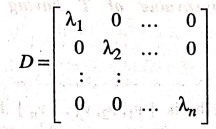
The characteristic polynomial is |D−tI|=0.
f(t) = | D−tI | 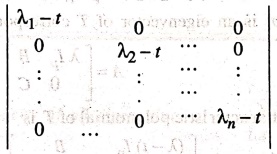
| D−tI | = 0
(λ1 − t) (λ2 − t) ... (λn
− t) = 0
T is a diagonalizable linear operator on an n−dimensional
vector space that fails to have distinct eigenvalues, then the characteristic
polynomial of T must have repeated zeros.
The
converse of the theorem is false. The characteristic polynomial of T may split,
but T need not be diagonalizable.
Definition:
Algebraic multiplicity:
Let λ be an eigenvalue of a linear operator or matrix with characteristic
polynomial f(t). The algebraic multiplicity of λ is the largest positive
integer k for which (t−λ)k is a factor of f(t).
Definition:
Eigenspace:
Let T be a linear operator on a vector space V and let λ be an eigenvalue of T.
Define Eλ = { x ∈ V; T(x) = λx) = N(T−λIV).
The
set Eλ is called the eigenspace of T, corresponding to the
eigenvalue λ. The eigenspace of a square matrix A corresponding to the
eigenvalue λ to be the eigenspace of LA corresponding to λ.
Theorem 15
Let T be a linear
operator on a finite dimensional vector space V, and let λ be an eigenvalue of
T having multiplicity m, then 1 ≤ dim (Eλ) ≤ m.
Proof:
Choose
an ordered basis { v1, v2, v3 ... vn}
for Eλ, extend it to an ordered basis β = { v1, v2,
v3 ... vp, vp+1 ... vn } for V. Let
A = [T]β. Then vi(1≤ i ≤p) is an eigenvector of T
corresponding to λ and therefore,
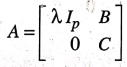
The characteristic polynomial of T is
f(t)
= |A − tIn| = 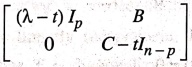
=
|(λ − t) Ip| |C − tIn−p|
=
(λ−t)Pg(t).
where
g(t) is a polynomial. Thus (λ−t)P is a factor of f(t), hence the multiplicity of λ is
atleast p.
But
dim (Eλ) = p and so dim (Eλ) ≤ m.
Linear Algebra: UNIT II: Linear Transformations and Diagonalization : Tag: maths, mathematics : - Diagonalizability: Theorems Part 1
Linear Algebra: UNIT II: Linear Transformations and Diagonalization
Under Subject
Linear Algebra
MA25C02 2nd Semester | 2025 Regulation
Related Subjects

English Essentials II
EN25C02 2nd Semester | 2025 Regulation | 2nd Semester 2025 Regulation

Tamils and Technology தமிழர்களும் தொழில்நுட்பமும்
UC25H02 2nd Semester | 2025 Regulation | 2nd Semester 2025 Regulation
Linear Algebra
MA25C02 2nd Semester | 2025 Regulation
Transforms and its Applications
MA25C03 2nd Semester EEE Dept | 2025 Regulation | 2nd Semester 2025 Regulation

Applied Physics (CE) II
PH25C02 2nd Semester Civil, Agri Depts | 2025 Regulation | 2nd Semester 2025 Regulation
Applied Physics (CSIE) II
PH25C03 2nd Semester AIDS, CSE, IT, CSE(CY) Dept | 2025 Regulation | 2nd Semester 2025 Regulation
Applied Physics (EE) II
PH25C04 2nd Semester EEE Dept | 2025 Regulation | 2nd Semester 2025 Regulation

Applied Physics (ME) II
PH25C05 2nd Semester Mechanical Dept | 2025 Regulation | 2nd Semester 2025 Regulation
Applied Chemistry (CE) II
CY25C02 2nd Semester Civil Dept | 2025 Regulation | 2nd Semester 2025 Regulation

Applied Chemistry (ME) II
CY25C03 2nd Semester Mechanical Dept | 2025 Regulation | 2nd Semester 2025 Regulation

Electron Devices
EC25C01 2nd Semester ECE Dept | 2025 Regulation | 2nd Semester 2025 Regulation

Digital Principles and Computer Organization
CS25C06 2nd Semester AIDS, CSE, IT, CSE(CY) Dept | 2025 Regulation | 2nd Semester 2025 Regulation

Basic Electrical and Electronics Engineering
EE25C01 2nd Semester | 2025 Regulation | 2nd Semester 2025 Regulation

Basic Civil and Mechanical Engineering
GE25C01 2nd Semester EEE Dept | 2025 Regulation | 2nd Semester 2025 Regulation
Data Structures using CPlusPlus
CS25C05 2nd Semester ECE Dept | 2025 Regulation | 2nd Semester 2025 Regulation
Engineering Drawing
ME25C01 EEE, Mech, Agri, EEE Depts | 2025 Regulation | 2nd Semester 2025 Regulation
Data Structures and Algorithms
CS25C04 2nd Semester EEE Dept | 2025 Regulation

Circuits and Network Analysis
EC25C02 2nd Semester ECE Dept | 2025 Regulation | 2nd Semester 2025 Regulation

Engineering Mechanics
ME25C02 2nd Semester Mech, Civil, Agri Depts | 2025 Regulation | 2nd Semester 2025 Regulation
Object Oriented Programming (OOPs)
CS25C07 2nd Semester CSE, CSE(CY) Depts | 2025 Regulation | 2nd Semester 2025 Regulation