Linear Algebra: UNIT II: Linear Transformations and Diagonalization
Null space (or) Kernel N(T) and Range (or) Image R(T)
Definition and Theorem - Null space (or) Kernel N(T) and Range (or) Image R(T)
Null
space (or) Kernel N(T) and Range
(or) Image R(T)
Definition:
Null space (or) Kernel
N (T)
Let
V and W be vector spaces and let T: V→ W be linear, the null space (or kernel)
N (T) of T to be the set of all vectors x in V such that T(x)=0.
(ie) N(T) = { x ∈ V/T (x)=0 }.
Definition:
Range
(or) Image R (T)
The
Range R(T) of T be the subset of W consisting of all images (under T) of
vectors in V
(ie) R(T) = {T(x): x ∈ V} N
Definition:
Identity
and zero transformation
Let
V and W be vector spaces over F, IV: V→V by IV(x) = x for
all x ∈ V.
To:
V→ W by T0 (x) = 0, for all x ∈
V,
Clearly
IV and T0 are linear.
Theorem 1
Let V and W be the
vector spaces and T: V→W be linear. Then prove that N(T) and R(T) are subspaces
of V and W respectively.
Proof:
Given
that V and W be vector spaces.
T:
V→W be linear.
To prove:
N (T) is a subspace of V.
Since
T is linear
T(0v)
= 0w ; 0v− zero vector of V and 0w − zero
vector of W.
T(x)=0
; x ∈ N(T)
Similarly
0v ∈ N(T)
Let x,y ∈
N(T) and c ∈
F
⇒ T(x)=0, T(y)=0
T is linear.
1.
T(x+y) = T(x)+T (y)
=
0w+0w=0w
x + y ≤ N(T)
Let
x ∈ N(T), c ∈ F
T(cx)
= cT (x) = C⋅
0w = 0w
2.
⇒ cx ∈ N(T)
x+y ∈ N(T) and cx ∈ N(T).
N(T) is
a subspace of V.
To prove:
R (T) is a subspace of W.
Since
T(0v) = 0w. (T is linear)
⇒ 0w ∈ R (T)
Let
x, y ∈ R(T) and c ∈ F, then there exists v
and w in V such that T(v)=x and T(w) = y
T(v+w) = T (v) + T (w)
T(v+w)=x+y
⇒ x+y ∈ R(T)
T
(cv) = cT (v) = cx
⇒ cx ∈ R(T)
R(T) is
a subspace of W.
Theorem 2
Let V and W be vector
spaces and let T: V→W be linear. If B = { v1, v2, ... vn
} is a basis for V, then R(T) = span (T (B)) = span ({T (v1), T (v2),
... T (vn) }).
Proof:
Clearly
T (vi) ∈
R(T) for each i.
Since
R (T) is a subspace of W,
α1T(v1) + α2
T(v2) + ... + αnT(vn) ∈ R(T) where αi
∈ F.
Span
({ T(v1), T (v2), ..., T (vn) }) ∈ R(T)
span
(T(B))  R(T)
R(T)
...(1)
To prove:
R(T) span (T(B)).
Suppose
that w ∈ R(T) then there exists
v ∈ V such that T (v) = w.
Since
B={v1, v2, ... vn} is a basis of V.
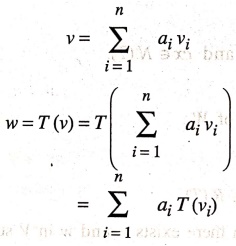
v = a1v1 + a2v2 + ….. + anvn
=
a1 T (v1) + a2T(v2) + ... + anT(vn)
∈ span {T(v1),
T(v2), ... T(vn) }
∈
span (T(B))
Hence
w ∈ span (T (B)) ⇒ R (T) span (T(B))
From
(1) and (2)
R(T)
= span (T (B))
Definition:
Let
V and W be vector spaces, and let T: V→ W be linear. If N(T) and R(T) are
finite−dimensional then we define the nullity of T, denoted by nullity (T) and
the rank of T, denoted by rank (T) to be the dimensions of N (T) and R (T)
respectively.
Nullity (T) = dim (N (T))
Rank (T) = dim (R (T))
Theorem 3
Dimension Theorem: Let
V and W be vector spaces, and let T: V→W be linear. If V is finite−dimensional
then nullity (T) + rank (T) = dim (V)
Proof:
Suppose
that dim (V) = n.
'N (T) is a subspace of V.
dim
(N (T)) n
Let
dim N (T) = k ≤ n, and
{ v1, v2, …… vk}
is a basis of N(T).
We
know that if W is a subspace of a finite dimensional vector space V then any
basis for W can be extended to a basis of V.
we may extend { v1, v2,
v3,..., vk } to a basis
B = { v1, v2, v3,...,
vk, vk+1, …… vn } for V.
Now
we claim that,
s = {T (vk+1), T (vk+2),
... T(vn)} is a basis for R (T).
First
we prove that S generates R (T).
We
know that if B={v1, v2, ..., vn} is a basis
for V, then R (T) = span (T (B)).
Since
{ v1, v2, ..., vk } is a basis for N (T)
⇒ vi ∈ N(T)
⇒ T(vi) = 0
for
all i = 1 to k.
we
have
R(T)
= span ({T (V1), T (V2), ... T(vn) }) then R
(T) = span (T (B))
Since
{ v1, v2, ..., vk} is a basis for N(T)
vi ∈ N(T) ⇒ T (vi) = 0
for all i = 1 to k.
R(T)
= span {T (vk+1), T (vk+2), ... T(vn)}
= span (S)
Next
we prove that S is linearly independent.
Let
bk+1 T (vk+1) + bk+2 T (vk+2) + ...
+ bn T (vn) = 0
where bk + 1, bk +2,... bn
∈ F.
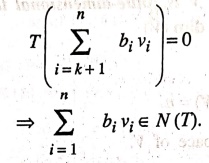
Using
the fact that T is linear, we have
Since
{ v1, v2, ..., vk} is a basis for N(T)
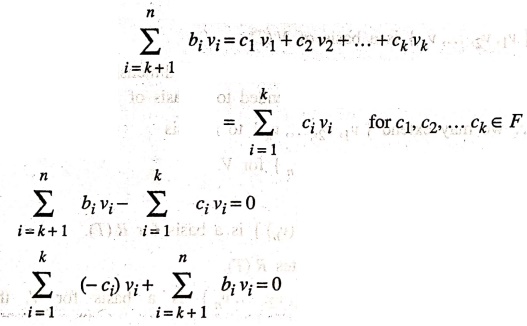
Since
{ v1, v2, v3,..., vk, vk+1,
…… vn } is a basis for V.
(ie) { v1, v2, v3,...,
vn } is linearly independent.
−ci=0
for all i = 1 to k and
bi=0 for all i=k+1 to n.
In
particular
bk+1 = bk+2 = ... = bn = 0
S
= { T (vk+1), T (Vk + 2), ... T (vn) } is
Linearly independent.
S is a
basis for R (D)
dim (R (T)) = n−k
rank (T) = dim V − dim (N (T))
Nullity (T) + rank (T) = dim (V)
Theorem 4
Let V and W be vector
spaces, and let T: V→W be linear. Then T is one−to−one iff N (T) = { 0 }.
Proof:
Assume:
T is 1−1 (one−to−one)
Let
x ∈ N(T)
T(x)=0=T(0)
T(x)
= T (0)
⇒ x=0
(T is 1−1)
N(T) = {0}
Conversely,
Assume:
N (T) = { 0 }
Let
T(x)=T(y)
T(x)−T(y)=0
T(x−y) = 0 ('T is linear)
x−y ∈
N(T) = {0}
x−y=0
x=y
T is 1−1
(one−to−one)
Theorem 5
Let V and W be vector
spaces of equal (finite) dimension and let T:V→W be linear then the following
are equivalent.
(a) T is 1−1
(one−to−one) (b) T is onto (c) rank (T) = dim (V)
Proof:
From
the dimension theorem, we have nullity (T) + rank (T) = dim (V).
T
is 1‒1 iff N (T) = {0}
iff
Nullity (T) = 0
iff
rank (T) = dim (V)
iff
rank (T) = dim (W)
iff
dim R(T) = dim (W)
iff
R (T) = W if T is on to.
Linear Algebra: UNIT II: Linear Transformations and Diagonalization : Tag: maths, mathematics : - Null space (or) Kernel N(T) and Range (or) Image R(T)
Linear Algebra: UNIT II: Linear Transformations and Diagonalization
Under Subject
Linear Algebra
MA25C02 2nd Semester | 2025 Regulation
Related Subjects

English Essentials II
EN25C02 2nd Semester | 2025 Regulation | 2nd Semester 2025 Regulation

Tamils and Technology தமிழர்களும் தொழில்நுட்பமும்
UC25H02 2nd Semester | 2025 Regulation | 2nd Semester 2025 Regulation
Linear Algebra
MA25C02 2nd Semester | 2025 Regulation
Transforms and its Applications
MA25C03 2nd Semester EEE Dept | 2025 Regulation | 2nd Semester 2025 Regulation

Applied Physics (CE) II
PH25C02 2nd Semester Civil, Agri Depts | 2025 Regulation | 2nd Semester 2025 Regulation
Applied Physics (CSIE) II
PH25C03 2nd Semester AIDS, CSE, IT, CSE(CY) Dept | 2025 Regulation | 2nd Semester 2025 Regulation
Applied Physics (EE) II
PH25C04 2nd Semester EEE Dept | 2025 Regulation | 2nd Semester 2025 Regulation

Applied Physics (ME) II
PH25C05 2nd Semester Mechanical Dept | 2025 Regulation | 2nd Semester 2025 Regulation
Applied Chemistry (CE) II
CY25C02 2nd Semester Civil Dept | 2025 Regulation | 2nd Semester 2025 Regulation

Applied Chemistry (ME) II
CY25C03 2nd Semester Mechanical Dept | 2025 Regulation | 2nd Semester 2025 Regulation

Electron Devices
EC25C01 2nd Semester ECE Dept | 2025 Regulation | 2nd Semester 2025 Regulation

Digital Principles and Computer Organization
CS25C06 2nd Semester AIDS, CSE, IT, CSE(CY) Dept | 2025 Regulation | 2nd Semester 2025 Regulation

Basic Electrical and Electronics Engineering
EE25C01 2nd Semester | 2025 Regulation | 2nd Semester 2025 Regulation

Basic Civil and Mechanical Engineering
GE25C01 2nd Semester EEE Dept | 2025 Regulation | 2nd Semester 2025 Regulation
Data Structures using CPlusPlus
CS25C05 2nd Semester ECE Dept | 2025 Regulation | 2nd Semester 2025 Regulation
Engineering Drawing
ME25C01 EEE, Mech, Agri, EEE Depts | 2025 Regulation | 2nd Semester 2025 Regulation
Data Structures and Algorithms
CS25C04 2nd Semester EEE Dept | 2025 Regulation

Circuits and Network Analysis
EC25C02 2nd Semester ECE Dept | 2025 Regulation | 2nd Semester 2025 Regulation

Engineering Mechanics
ME25C02 2nd Semester Mech, Civil, Agri Depts | 2025 Regulation | 2nd Semester 2025 Regulation
Object Oriented Programming (OOPs)
CS25C07 2nd Semester CSE, CSE(CY) Depts | 2025 Regulation | 2nd Semester 2025 Regulation