Linear Algebra: UNIT II: Linear Transformations and Diagonalization
Eigenvalues and Eigenvectors: Theorem 3 - Example Solved Problems
Important Example Solved Problems - Engineering Maths or Mathematics - Eigenvalues and Eigenvectors: Theorem 3
EIGENVALUES
AND EIGENVECTORS – THEOREM 3
EXAMPLE PROBLEMS
Example 8
Find all the
eigenvectors of the matrix A = 
Solution:
ƒ(t) = |A−λIn|
= 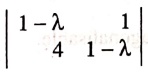 =
λ2−2λ−3 = (λ − 3) (λ + 1)
=
λ2−2λ−3 = (λ − 3) (λ + 1)
The
eigenvalues are λ1 = 3 and λ2 = −1.
To
find eigenvector:
Case
(i): Let us consider λ1=3.
B1
= A – λ1I =
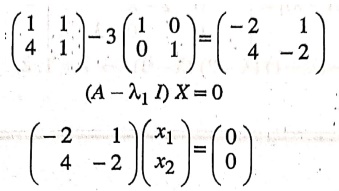
−2x1+x2=0
4x1−2x2=0
Let
us consider
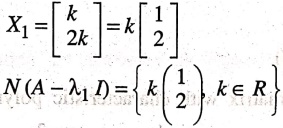
x1=k;
x2=2k.
Case
(ii): Let us consider λ2 = −1.
⇒ B2 = (A−λ2I)
= 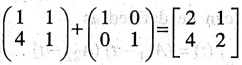
(A − λ2I) X =0
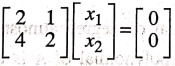
⇒ 2x1+x2=0
and 4x1 + 2x2 =
0.
Put
x1 = k then x2=−2k.
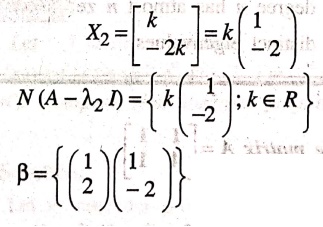
is
a basis of R2 and consisting eigenvector of A.
A is diagonalisable.
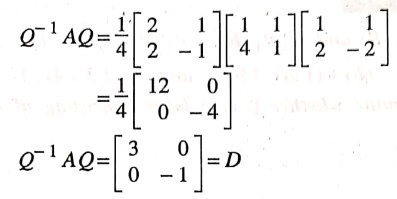
To
find the diagonal matrix
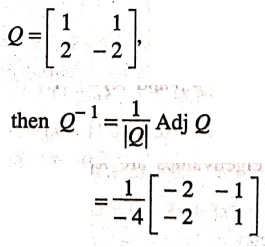
Similarity
transformation:
Example 9
Let V=R2;  .
T is a linear operator on V and β is the ordered basis. Find [T]β
and determine β is a basis consisting of eigenvectors of T.
.
T is a linear operator on V and β is the ordered basis. Find [T]β
and determine β is a basis consisting of eigenvectors of T.
Solution:
It
is given that V=R2 and T: R2 → R2 defined by
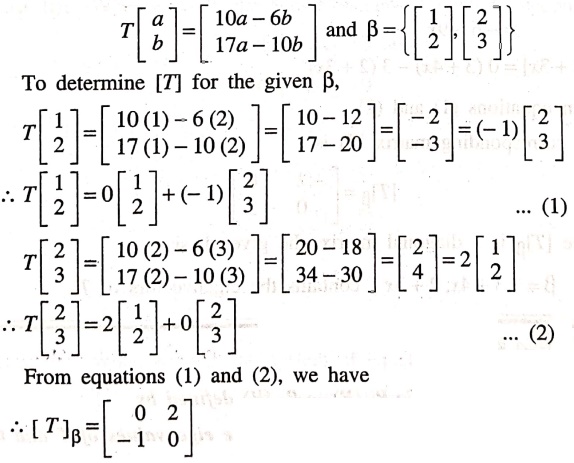
Here
[T]β is not a diagonal matrix.
Therefore 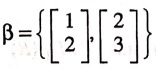 does not contain the eigenvectors of T.
Example 10
Let V=P1(R)
and T: P1(R) → P1(R) defined by T[a + bx]=(6a‒6b)+(12a−11b)x
and β={3+ 4x, 2+3x}. Compute [T]β and determine whether β is a basis
consisting of eigenvectors of T.
Solution:
It
is given that T: P1(R) → P1(R).
T
(a + bx) = (6a − 6b) + (12a – 11b) x and β= {3+4x, 2 + 3x }
T[3+4x]
= [6(3) − 6(4)] + [12(3) ‒ 11(4)]x
=
(18 −24) + (36 – 44)x
=
−6−8x
T[3+4x]
= −2[3+4x] + 0[2x + 3x]
... (1)
T[2+3x]
= [6(2) − 6(3)] + [12(2) ‒ 11(3)]x
=
(12−18) + (24−33)x
=
−6−9x
T[2+3x] = 0(3+4x) − 3(2+3x)
From
equations (1) and (2),
The
corresponding matrix [T] is
[T]β = 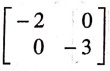
Since
[T]β is a diagonal matrix, the given basis
β
={ 3+ 4x, 2 + 3x } contains the eigenvectors of T.
Example 11
Let V=P1(R)
and T: P1(R) → P1(R) defined by T(ax + b) = (−6a + 2b)x +
(− 6a+b). Find the eigenvalues of T and the basis β such that [T] is diagonal
matrix.
Solution:
It
is given that V=P1(R) and T: P1(R) → P1(R) T(ax+b)
= (−6a+2b)x + (−6a+b).
Then
the matrix representation is obtained as [T] = 
⇒ | T−λI| = 0
⇒ 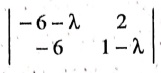 =
(−6−λ) (1− λ) + 12 = 0
=
(−6−λ) (1− λ) + 12 = 0
−6 +6λ −λ + λ2 + 12 =0
⇒ λ2 + 5λ + 6
=0
⇒ (λ+3) (λ+2)=0
The
eigenvalues are λ = −2, – 3.
To
find the eigenvectors, we have [T−λ]X=0, where X= 
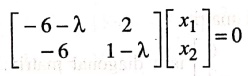
(−6 − 2)x1
+ 2x2 =0 and
− 6x1+
(1 −λ)x2 = 0
Case
(i):
When λ=−2, the above system of equations become
−
4x1+2x2=0 and
6x1+3x2=0
The single equation is −2x1+x2=0
2x1
= x2
x1/1
= x2/1
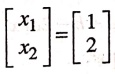
X1
= 
Case
(ii)
When λ=−3, the system of equations become
−3x1+2x2=0
and
−
6x1+4x2=0
The
single equation is − 3x1 +
2x2 = 0
2x2 = 3x1
x2/3
= x1/2
Hence
X2 = 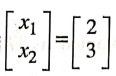
From
equations (1) and (2)
The
basis β = 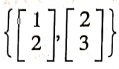
β= { 2x + 3, x+2} is a basis for P1(R)
which consists of T.
Now
T = 
Now
T =  = 4−3 = 10.
Since
|T| ≠ 0, the above vectors are linearly independent.
T is a
diagonal matrix.
Hence
[T] = 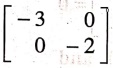 is a diagonal matrix.
Example 12
Let V=P3(R).
Let T: P3(R) → P3(R), defined by T[a + bx + cx2
+ dx3] = (−d) + [−c+d]x + [a+b−2c]x2 + [−b + c −2d]x3
and β={1−x+x3, 1+x2, 1, x+x2} compute [T]β
and determine whether β is a basis of eigenvectors of T.
Solution:
It
is given that T: P3(R) → P3(R).
T[a
+ bx + cx2 + dx3] = (− d) + [− c + d]x + [a + b − 2c]x2
+ [−b+c−2d]x3
and
β = { 1−x+x3, 1+x2, 1, x+x2)
To
prove [T] is linear ac
T[1−x+x3] = T[1−x+0x2+x3]
=
T[a + bx + cx2 + dx3]
By
comparing these equations, we have
a=1,b=−1,
c=0 and d=1
Given
that
T[a
+ bx + cx2 + dx3]
=
[d]+[−c+d]x + [a+b−2c]x2 + [−b+c−2d]x3.
T[1 − x + x3] = [− 1] + [− 0 + 1]x
+ [1 − 1 − 2.0]x2 + [1+0−2 (1)] x3
= (− 1) + (1)x + (0)x2 + (−1)x3
T[1−x+x3] = −1+x−x3
T[1 − x + x3] = − 1(1 − x + x3)
+ (0)(1 + x2) + 0(1) + 0(x + x2)
………..(1)
T[1 + x2] = T [1 +0 • x + 1 • x2
+ 0 ⋅ x3]
Here
a= 1, b = 0, c = 1 and d=0
T [1 + x2] = [− 0] + [− 1 + 0] x +
[1 + 0 − 2.1] x2 + [− 0 + 1 − 2 (0)] x3
=
(− 1) x + (− 1) x2 + (1) x3
=
−x−x2 + x3
T[1 + x2] = 1(1 − x + x3)
+ (− 1)(1 + x2) + 0(1) + 0(x+x2)
………….(2)
T[1]
= T [1+0x+0x2+0x3]
Here
a = 1, b=0, c=0 and d=0.
T[1] = (− 0) + ( − 0 + 0) x + (1 +0 −2•0) x2
+ (− 0 + 0 − 2 • 0) x3
= x2
T [1] =
0 (1 − x + x3) + (1)(1 + x2) + (− 1)(1) + 0(x + x2)
…….... (3)
T[x
+ x2] = T [0 +1 • x + 1 • x2 + 0 • x3]
Here
a = 0, b = 1, c = 1, and d=0.
=
(−0)+(−1+0)x+(0+1−2) x2+(−1+1 −0) x3
T[x+x2]
= − x − x2
T[x + x2] = 0(1 − x + x3)
+ 0(1 + x2) + 0(1) + (−1)(x + x2)
…………..(4)
From
equations (1), (2), (3) and (4) we have
T[x]β =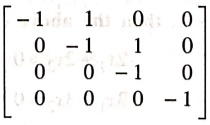
This is not a diagonal matrix.
So the basis β = {1−x + x3, 1 + x2,
1, x+x2} does not contain the eigenvectors of T.
Example 13
For
a matrix A =  ∈
Mn×n(F)
∈
Mn×n(F)
(i)
Find all the eigenvalues and eigenvectors
(ii)
Find a basis consisting of eigenvectors of A.
(iii)
Find an invertible matrix Q and a diagonal matrix D such that Q‒1AQ=D.
Solution:
Given
matrix is A =
(i) To find eigenvalues
Let
|A−λI| =0
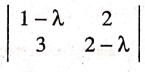 =
0
=
0
⇒ (1 − λ) (2 − λ) − 6 =
0
λ2−3λ−4=0
(λ+1) (λ−4)=0
⇒ λ = −1,4
The eigenvalues are λ = −1, 4
To
find the eigenvectors let us consider (A‒λI)X = 0
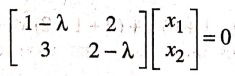
(1 − λ)x1
+ 2x2 =0
3x1
+ (2−λ)x2=0
Case
(i): When λ=−1, then the above equations become,
2x1
+ 2x2 = 0
3x1
+3x2 = 0
The
single equation is x1+x2
= 0
x1
= ‒x2
x1/‒1
= x2/‒1
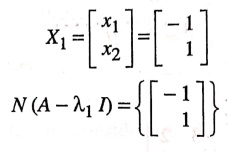
The
eigenvector for λ = −1 is
Case
(ii): When λ=4, then the equations become
−3x1+2x2=0
3x1−2x2=0
We
have a single equation 3x1
− 2x2 = 0
3x1=2x2
x1/2
= x2/3
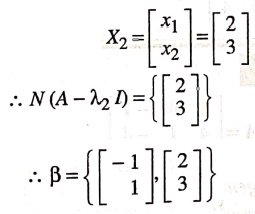
is a basis of R2 and consisting
eigenvectors of A.
A
is diagonalizable.
To
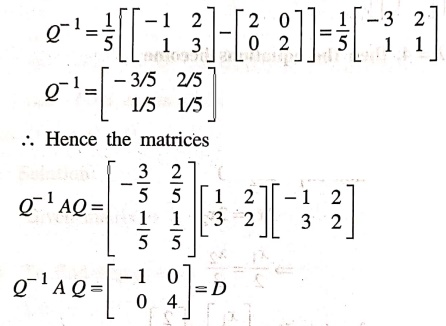
find the diagonal matrix, let Q = 
To
find Q‒1, let us use Cayley Hamilton theorem.
Now
Q =
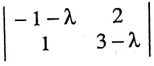 = − (− 1 − λ) (3 − λ) −2 = 0
−3+λ−3λ+λ2−2=0
λ2−2λ−5=0
Q2−2Q−5=0
Multiply
by Q‒1 on both sides, then we get
⇒ Q−2I−5Q‒I = 0
5Q−1
= Q−2I
Q−1 = 1/5 [ Q−2I ]
Example 14
For
a matrix A = 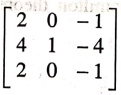
(i) Find all the eigenvalues and eigenvectors.
(ii)
Find a basis consisting of eigenvectors of A.
(iii)
Determine an invertible matrix Q and a diagonal matrix D such that Q‒1AQ=D.
Solution:
Given
that A =
(i) To find the eigenvalues
ƒ(λ) =│A−λI|
= 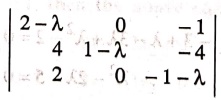
= −λ(1−λ)2
The
characteristic equation is λ(1−λ)2 = 0
⇒ λ=0 or (1−λ)2
= 0
⇒ λ=0 or λ = 1, 1
Hence
the eigenvalues are λ= 0, 1, 1
To
find the eigenvectors
Let
us consider (A−λI)X = 0 where
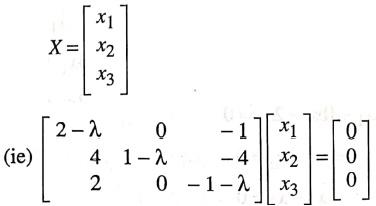
(2−λ)x1
+ 0x2 ‒1x3 = 0
4x1 + (1−λ)x2 −4x3
= 0
2x1 +0x2 + (−1−λ)x3
= 0
………….(1)
Case
(i) when λ = 0:
Put
λ=0 in the system of equations (1)
B1 = A − λ1I becomes
2x1+0x2−x3
= 0
4x1+x2‒4x3
= 0
2x1+0x2
− x3 = 0
To
solve the above three equations, let us use cross multiplication method,
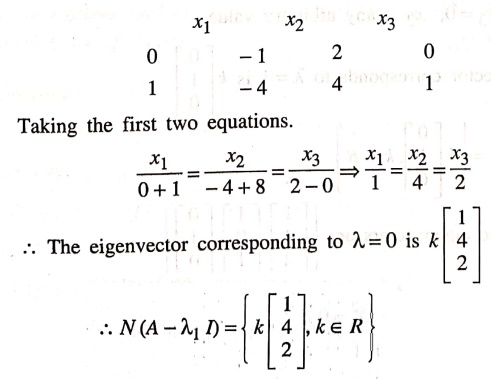
Case
(ii) when λ=1:
Put
λ= 1 in the set of equations (1) (ie) B2 = A − λ2I becomes
x1+0x2−x3=0
4x1+0x2−4x3=0
2x1+0x2‒2x3=0
⇒ x1‒x3=0
x1−x3=0
x1−x3=0
All
the 3 equations are similar.
x1=x3
Put
x1 = k, then x3=k,
x2=0
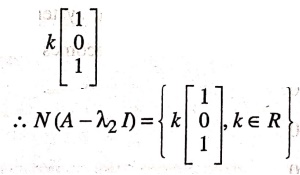
The
eigenvector corresponding to λ= 1 is
Case
(iii) When λ=1:
Similarly
in equation x1−x3=0,
now we put x1 = 0.
x1=0,
x3=0, x2 = any arbitrary value...
The
eigenvector corresponds to λ=1 is 
N(A−λ3I) = { , k∈ R }
The
three eigenvectors are { 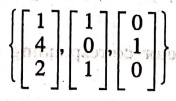 }
}
(ii)
The vectors β = is the basis of A.
Now
|A| = 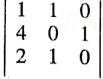
=
1[0−1] − 1[0−2] + 0[4−0]
=
(−1)+2+0
=
1
≠
0
Since
|A| ≠ 0 the above 3 vectors are linearly independent.
(iii) 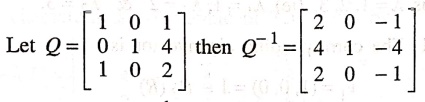
We
know that D=Q−1A Q
⇒ D = Q−1A Q
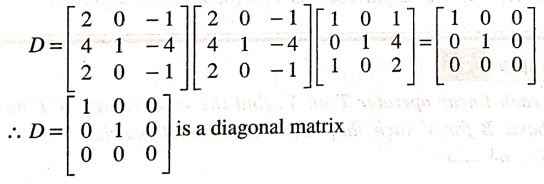
is a diagonal matrix
Example 15
Let T: P2(R)
→ P2(R) be defined as T[f(x)]
= f(x) + (x + 1)ƒ'(x). Find
eigenvalues and corresponding eigenvectors of T with respect to standard basis
of P2(R).
Solution:
We
know that the standard basis of P2 (R) is
P2(R)
= { 1, x, x2 }
Given
that T [f(x)] = ƒ (x) + (x + 1) ƒ′
(x)
T(1) = 1 + (x + 1) (0) = 1 = 1.1+0x+0x2
T(x)=x+(x+1)
(1) = 1 + 2x = 1.1+2x+0x2
T(x2)
= x2+(x+1) (2x) = x2 + 2x2 + 2x
=
2x + 3x2 = 0.1 + 2x + 3x2
The corresponding matrix representation is
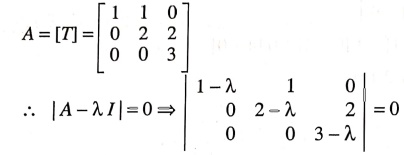
By
expanding the determinant and solving the cubic equation we get the eigenvalues
as λ= 1, 2, 3. (ie) λ1 = 1, λ2 = 2 & λ3 =
3.
When
λ1 = 1; The corresponding eigenvector is
v1 = (1, 0, 0) = 1 ∈ P2(R)
When
λ2=2; The eigenvector is v2 = (1, 1, 0) = 1 + x ∈ P2(R)
When
λ3= 3; The eigenvector is v3 = (0, 0, 1) = x2 ∈ R2(R)
Example 16
For
each linear operator T on V, find the eigenvalues of T and an ordered basis B
for V such that [T] is a diagonal matrix.
Define:
V=R3 and
T
(a, b, c) = (7a−4b+10c, 4a − 3b + 8c, − 2a + b − 2c).
Solution:
Given
that V=R3
T
(a, b, c) = (7a−4b+ 10c, 4a − 3b+8c, − 2a + b − 2c)
Let
B be the standard basis for R3
(ie) B={(1, 0, 0), (0, 1, 0), (0, 0, 1) }
Let
v1 = (1, 0, 0), v2 = (0, 1, 0) & v3 = (0,
0,1)
Then
T(v1) = T(1, 0, 0) = [7 (1) − 4 (0) + 10 (0), 4 (1) − 3 (0) +8 (0), −2(1)+0−2(0)]
⇒ T (1, 0, 0) = (7, 4, −
2)
T
(v2) = T (0, 1, 0)
=
[7 (0) − 4 (1) + 10 (0), 4 (0) − 3 (1) + 8 (0), − 2 (0) + (1) − 2 (0)]
T
(0, 1, 0) = (−4, −3, 1)
T
(v3) = T (0, 0, 1)
=
[7(0) ‒ 4(0) + 10(1), 4(0) ‒ 3(0) + 8(1), − 2(0) + (0) −2(1)]
T
(0, 0, 1) = (10, 8,−2)
The
matrix representation of T is
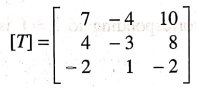
The
characteristic polynomial of T is given by
|T−λI|
= 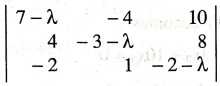 =
−λ3 + 2λ2 + λ − 2
=
−λ3 + 2λ2 + λ − 2
=
(λ+1) (λ−1) (λ−2)
The eigenvalues are λ = −1, 1, 2
To
find the eigenvectors
[T−λI]X = 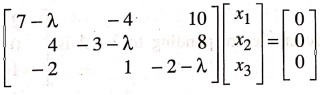
(7
− λ) x1 − 4x2 +
10x3=0
4x1 + (−3−λ)x2 + 8x3
= 0
−2x1
+ 1x2 + (−2−λ)x3 = 0
…………..(1)
Case
(i) when λ=−1
The
system of equations (1) becomes
8x1
− 4x2 + 10x3 = 0
4x1‒2x2+8x3=0
−2x1+x2−x3=0
Solving
the last two equations we get x1
= 1, x2=2 & x3=0
..
The eigenvector corresponding to λ=−1 is 
Case
(ii) when λ=1
The
system of equations (1) becomes
5x1‒4x2+10x3=0
4x1‒5x2+8x3=0
−2x1+x2−3x3=0
Solving
the last two equations, we get x1
= 1, x2 = − 1, & x3 =− 1
The
eigenvector corresponding to λ=1 is 
Case
(iii) when λ=2
The
system of equations (1) becomes
5x1‒4x2+10x3=0
4x1‒5x2+8x3=0
−2x1+x2−4x3=0
Solving
the last two equations, we get x1
= 2, x2 = 0 & x3 = −1
The
eigenvector corresponding to λ=2 is 
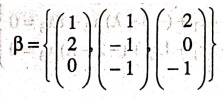
Therefore,
the basis for the matrix T is
Now
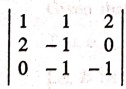
= 1 [1+0] − 1[− 2 − 0] + 2[− 2 + 0] = 1 + 2 −4
= −1 0
The 3 eigenvectors are linearly independent
since | A | ≠ 0.
T
is a diagonal matrix
(ie)
[T] = 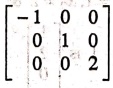 is a diagonal matrix.
Example 17
For
a matrix A = 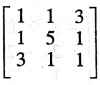
(i)
Find all the eigenvalues and eigenvectors
(ii)
Find a basis consisting of eigenvectors of A
(iii)
Find an invertible matrix Q and a diagonal matrix D such that Q‒1AQ=D
Solution:
Given
that A =
To
find the eigenvalues
Let
|A−λI|=0
⇒ 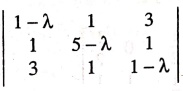 = 0
= 0
On
expanding the determinant we have λ3−7λ2+36=0
By
solving this equation we have λ = −2, 3, 6
To
find the eigenvectors; let [A‒ λI]X=0
(1 −λ) x1
+ x2 + 3x3 = 0
x1+(5−
λ)x2+x3 = 0
3x1+x2+(1−λ)x3
= 0
Case
(i): When λ=−2, the eigenvector is X1
= 
Case
(ii): When λ=3, the eigenvector is X2 = 
Case
(iii): When λ=6, the eigenvector is X3 = 
The
three eigenvectors are {,,}
(ii) The vector β = 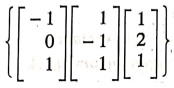 is the basis for
A.
is the basis for
A.
Let
|A | =  = 1[5−1] − 1[1−3] + 3[1−15] = 4+2−42 ≠ 0.
Since
|A| ≠ 0 the above 3 vectors are linearly independent.
(iii)
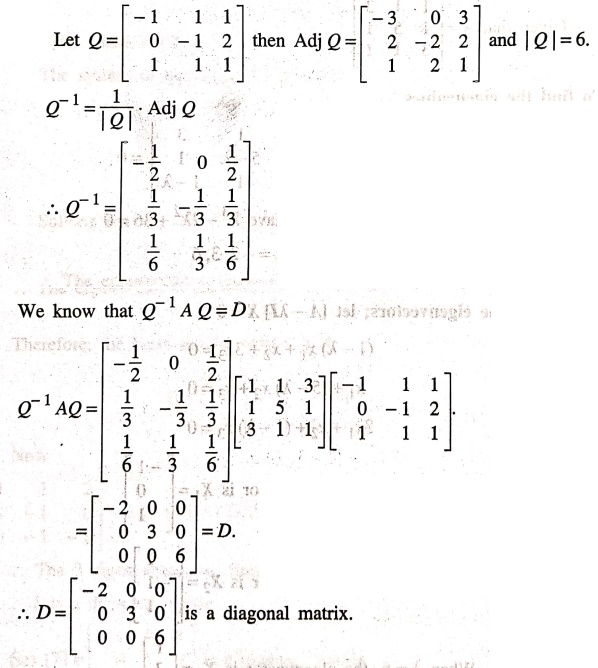
Linear Algebra: UNIT II: Linear Transformations and Diagonalization : Tag: maths, mathematics : - Eigenvalues and Eigenvectors: Theorem 3 - Example Solved Problems
Linear Algebra: UNIT II: Linear Transformations and Diagonalization
Under Subject

Linear Algebra
MA25C02 2nd Semester | 2025 Regulation
Related Subjects

English Essentials II
EN25C02 2nd Semester | 2025 Regulation | 2nd Semester 2025 Regulation

Tamils and Technology தமிழர்களும் தொழில்நுட்பமும்
UC25H02 2nd Semester | 2025 Regulation | 2nd Semester 2025 Regulation
Linear Algebra
MA25C02 2nd Semester | 2025 Regulation

Transforms and its Applications
MA25C03 2nd Semester EEE Dept | 2025 Regulation | 2nd Semester 2025 Regulation

Applied Physics (CE) II
PH25C02 2nd Semester Civil, Agri Depts | 2025 Regulation | 2nd Semester 2025 Regulation

Applied Physics (CSIE) II
PH25C03 2nd Semester AIDS, CSE, IT, CSE(CY) Dept | 2025 Regulation | 2nd Semester 2025 Regulation

Applied Physics (EE) II
PH25C04 2nd Semester EEE Dept | 2025 Regulation | 2nd Semester 2025 Regulation

Applied Physics (ME) II
PH25C05 2nd Semester Mechanical Dept | 2025 Regulation | 2nd Semester 2025 Regulation

Applied Chemistry (CE) II
CY25C02 2nd Semester Civil Dept | 2025 Regulation | 2nd Semester 2025 Regulation

Applied Chemistry (ME) II
CY25C03 2nd Semester Mechanical Dept | 2025 Regulation | 2nd Semester 2025 Regulation

Electron Devices
EC25C01 2nd Semester ECE Dept | 2025 Regulation | 2nd Semester 2025 Regulation

Digital Principles and Computer Organization
CS25C06 2nd Semester AIDS, CSE, IT, CSE(CY) Dept | 2025 Regulation | 2nd Semester 2025 Regulation

Basic Electrical and Electronics Engineering
EE25C01 2nd Semester | 2025 Regulation | 2nd Semester 2025 Regulation

Basic Civil and Mechanical Engineering
GE25C01 2nd Semester EEE Dept | 2025 Regulation | 2nd Semester 2025 Regulation
Data Structures using CPlusPlus
CS25C05 2nd Semester ECE Dept | 2025 Regulation | 2nd Semester 2025 Regulation
Engineering Drawing
ME25C01 EEE, Mech, Agri, EEE Depts | 2025 Regulation | 2nd Semester 2025 Regulation
Data Structures and Algorithms
CS25C04 2nd Semester EEE Dept | 2025 Regulation

Circuits and Network Analysis
EC25C02 2nd Semester ECE Dept | 2025 Regulation | 2nd Semester 2025 Regulation

Engineering Mechanics
ME25C02 2nd Semester Mech, Civil, Agri Depts | 2025 Regulation | 2nd Semester 2025 Regulation

Object Oriented Programming (OOPs)
CS25C07 2nd Semester CSE, CSE(CY) Depts | 2025 Regulation | 2nd Semester 2025 Regulation