Linear Algebra: UNIT II: Linear Transformations and Diagonalization
Null space (or) Kernel N(T) and Range (or) Image R(T): Example Solved Problems - Part 2
Important Example Solved Problems - Engineering Maths or Mathematics - Null space (or) Kernel N(T) and Range (or) Image R(T): Example Solved Problems - Part 2
Null space (or) Kernel N(T) and Range
(or) Image R(T)
Worked Example Problems
– Part 2
Example 10
Let T: R3 →
R2. Define T (a1, a2, a3)
= (a1−a22a3). Find the bases for N(T)
and evaluate the nullity of T.
Solution:
Given
that T: R3 → R
We
know that N (T) = { x ∈
V/T (x) = 0} & R(T) = { x ∈
V/T (x) }
To
find the bases for N (T):
Let
x ∈ R3 and let
x= (a1, a2, α3)
T(x)=0
T(a1, a2, a3)=0
(.N(T)={x
∈ V,T(x)=0 })
(a1−a2, 2a3) = T (a1, a2, α3)
..
T (a1, a2, a3) = (a1−a2, 2a3)=0
….(1)
(ie)
a1−a2=0 &
2a3=0
T(a1, a2, a3)=(0,0)
if a1 = a2 & a3=0.
.Any
element in the null space is of the form (a1, a2, 0)
N (T) = { (a, a, 0) ∈ R3/T (a, a,
0) = 0}
N
(T) = 1 with basis (1, 1, 0)
Example 11
Let T: M2×3(F)
→ M2×2(F).
Define 
Find the basis for N(T)
and calculate N(T).
Solution:
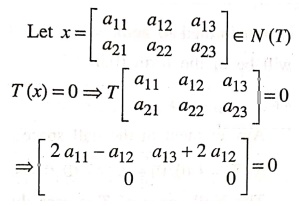
⇒ 2a11−a12=0,
a13+2a12=0
a11=
(1/2)a12 & a13 = ‒2a12
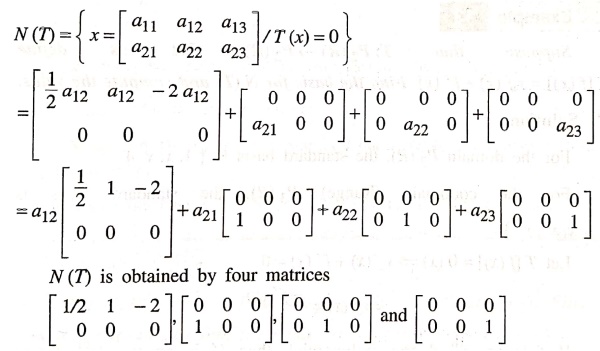
The
number of basis element of N(T) = 4.
N (T) =
4.
Example 12
Let T: R2 →
R3. Define T (a1, a2)=(a1+a2, 0, 2 a1−α2). Find the basis
for N (T) and compute N (T).
Solution:
Let
N.(T) = {x ∈
V,T(x)=0}
Let
x ∈ R2 such
that x= (a1, a2)
Then
T(x)=0
T
(a1, a2) = 0 ⇒
(a1 + a2, 0, 2α1−α2) = 0
⇒ a1+a2=0,
2a1−a2=0 ⇒ a1 = a2 &
…….. (1)
2a1
= a2
…....(2)
From
equations (1) & (2) we get a1
=0 and a2 = 0
The
kernal consists of all that is transformed to zero.
Any
element in the null space will be of the form (0,0)
N(T) = { (0,0) ∈ R2/T (0, 0) = 0 }
The
Null space of T is zero dimensional.
N (T) = 0.
Example 13
Suppose that T: P2(R)
→ P2(R). Let us define T[f(x)]=xf(x)+f
' (x). Find the basis for N(T) and compute the value.
Solution:
For
the domain P2(R), the standard basis is { 1, x, x2 ́}
For
the codomain (Range) P3(R), the standard basis is {1, x, x2,
x3 }
Let
T[f(x)] = 0(x)
⇒ x f(x) + ƒ′ (x)=0
⇒ f(x)
=
‒ f '(x) / x
If
f is an nth degree
polynomial, then f ' is an (n−1)th
degree polynomial and ‒f '(x)/x is an
(n−2)th degree polynomial.
:.
f(x) = ‒f '(x)/x means nth degree polynomial = (n−2)th
degree polynomial.
This is
not possible in {1, x, x2} except at f(x)=0.
N (T) =
0
Example 14
Let T: R3 →
R2. Define T (a1, a2, α3) = (a1−a2, 2a3).
Find the basis for R(T) and find the value of R (T).
Solution:
Given
that T: R3 → R2 and T (a1, a2, a3) = (a1 ‒ a2, 2a3)
To
find the basis for R (T):
For
every (a, b, c) ∈
R3 of T, there exists a T(a, b, c) = (a − b, 2c)
Any
vector in R2 can be written using the transformed elements in R3.
Suppose
that, (x, y) ∈
R2 then we write it as (x, y) = (a−b, 2c) where a, b & c are
real numbers.
⇒ a−b=x,
2c=y.
a−b=x has many solutions and assume that ½ y=c
T (a, b, c) = (a−b, 2c) = (x, y)
Since
{(1, 0), (0, 1)} is a standard basis for R2, it is also a standard
basis for R (T).
Hence
the basis of R (T) is {(1, 0), (0, 1)} and the rank is 2.
Example 15
Let T: R2 →
R3. Define T (a1, a2)
= (a1+a2, 0, 2α1
− a2). Find the basis for
R(T) and find the value.
Solution:
Given
that T: R2 → R3 & T (a1, a2) = (a1 + a2, 0, 2α1 − a2).
We
know that R(T) = { T(x)/x ∈
V}
To
find the basis of R (T)
We
know that, if T: V→W is a linear transformation and B = { v1, v2,
v3 ... vn} is a basis for V.
Then
R (T) = span [T (B)] = span [T (v1), T (v2), T (v3),
... T (Vn)]
Here
B = {(1, 0), (0, 1)} is a standard basis for R3.
R(T) =
span [T (B)] = span [T (1, 0), T (0, 1)]
T (1, 0) = (1+0, 0, 2−0) since T (a1, a2) = (a + a2, 0, 2a1−a2)
=
(1,0,2)
T
(0, 1) = (0 + 1, 0, 2 (0) − 1) = (1, 0, − 1)
R(T)
= span [T (B)]
=
span [T (1, 0), T (0, 1)]
=
span [T (1, 0), T (0, 1)]
=
span [(1, 0, 2), (1, 0, −1)]
(1, 0, 2) & (1, 0, ‒1) are linearly
independent.
{
(1, 0, 2), (1, 0, −1)} is a basis for R (T) & R(T) = 2.
Example 16
Let T: P2(R)
→ P3(R). Define T[f (x)]=xf(x)+f
'(x) Find the basis for R(T) and find the value of R (T).
Solution:
Given that T: P2(R) → P3(R).
T[f(x)]
= xf(x) +ƒ'(x)
R(T) = span [T (1), T(x), T(x2)]
= span [x.1 + 0, x . x + 1, x. x2 +
2x]
=
span [x, x2 + 1, x3 + 2x]
Let
us consider ax + b (x2+1) + c(x2 + 2x) = 0
⇒ ax + bx2+b+cx3
+2cx=0
⇒ cx3 + bx2+x
(a + 2c) + b = 0x3+0x2+0x +0
Equating
the corresponding coefficients on both sides we get
c=0,b=0, a+2c=0
a=b=c
⇒ x,x2+1,x3+2x
are linearly independent.
{ x, x2 + 1, x3 + 2x }
form a basis for R (T).
R(T) =
3
Example 17
Let T: M2×3(F)
→ M2×2(F).
Define: 
Find the basis for R
(T) and also find the value of R (T).
Solution:
Given
that
We
know that the standard basis for the vector M2×3 (F) is

Since
B is a basis for M2x3 (F), we have
R
(T) = span [T (B)]
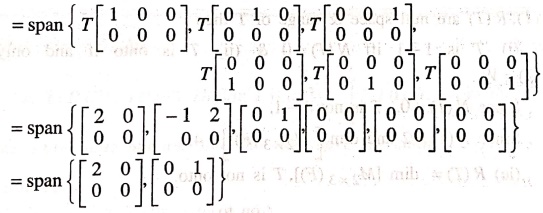
R(T) is
spanned by two matrices 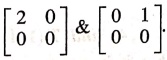
Since
these two matrices are linearly independent, the basis of R(T) is
R(T)
= 2
Example 18
Let T: R2→R3.
Define T (a1, a2)=(a1+a2, 0, 2α1−a2). Verify whether T is
one−to−one or on−to.
Solution:
We
know that if T: V→W is a linear transformation and N (T), R (T) are nullspace
and range of T then,
(i)
T is 1−1 if and only if N (T) = 0 and
(ii)
T is on to iff R (T) = W.
Here
N (T) = 0, So T is 1−1 and T is not on to because T never maps all the values
of R3.
T is 1−1
but not on−to.
Example 19
Let T: M2×3(F)
→ M2×2(F).
Define 
Verify whether T is 1−1
or on−to.
Solution:
We
know that if T: V→W is a linear transformation and N (T), R (T) are null space
& range of T then
(i)
T is 1−1 iff N (T)=0 & (ii) T is onto if and only if R(T) = W.
Since
N (T) ≠
0, T is not 1−1.
Since
R (T) = 2 and dim [ M2×3(F) ] = 4,
(ie)
R (T) ≠ dim [M2×3 (F)], T is not onto.
Hence T
is neither 1−1 nor on to.
Example 20
Let T: R2 → R2
be linear and T (1, 0) = (1, 4) and T (1, 1) = (2, 5). Then find the value of T (2, 3).
Verify whether it is one−to−one or not?
Solution:
Given that T: R2 → R2.
T
(1, 0) = (1, 4) & T (1, 1) = (2,5)
Let
(2, 3) = a (1, 0) + b (1, 1) = (a, 0) + (b, b)
Comparing
on both sides we get a+b=2 & b=3.
Solving
these two equations we get a=−1 & b=3
T
(2,3) = T(−1 (1, 0)) + 3 (1, 1))
=
−1 T (1, 0) + 3 T (1, 1)
=
−1(1, 4) + 3(2,5)
=
(−1,−4)+(6, 15)
=
(−1+6, −4+15)
T
(2, 3) = (5, 11)
We
know that a linear transformation T is one−to−one if and only if N(T) = {(0,0)
}
(ie) If (a, b) ∈ T then T (a, b) = (0, 0) = T (0, 0).
Let
us consider T (a, b) = (0, 0).
⇒ a=0 & b=0
N(T) =
{(0,0)}
Hence
T is one−to−one.
Example 21
Let T: P (R) → P (R).
Define T [f(x)] = 0ʃx
f (t) dt. Prove that T is linear,
one−to−one but not onto, for the above operation.
Solution:
Given
that T: P (R) → P (R) and T [f(x)] = 0ʃx
f(t) dt
To
prove T is linear
To
prove T is linear we have to show that
T
(cx+y)= c T (x) + T (y) for all x, y ∈
V & c ∈
F.
Let
C ∈ F & f, g ∈
P(R).
T[cf(x)+
g(x)] = 0ʃx [cf (t) + g (t)] dt
= 0ʃx cf (t) dt + 0ʃx
g(t) dt
=
c 0ʃx f (t) dt + 0ʃx g(t) dt
=
cT.[f(x)]+ T[g (x)]
Hence
T is linear.
To
prove T is one−to−one
We
know that the linear transformation T is 1−1 if and only if N(T) = 0.
The
standard basis for P (R) is {1, x, x2, x3,... xn}
The
range of T is R(T) = span [(T(1), T (x), T (x2) ... T(xn)]
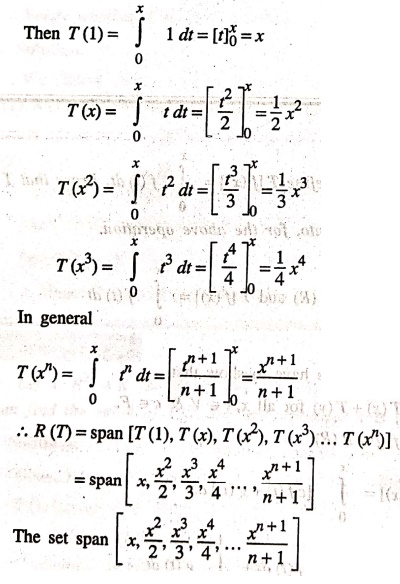
is linearly independent.
Then,
the dimension of the range of T is n+1
(ie)
rank (T) =n+1.
The
dimension theorem states that if V and W are the vector spaces
and
if T: V→W is linear.
Let
V be the finite dimensional.
N
(T) + R (T) = dim (V)
Since
dim [P (R)] = n + 1 & rank (T) = n + 1
N
(T) + R (T) = dim [P (R)]
N(T)
+ (n + 1) = (n+1)
N(T)=0
Since
N (T) = 0, T is one−to−one.
To
prove it is not on−to:
The
basis of P (R) (domain) is span [1, x, x2, x3,... xn]
and the basis for the codomain P (R) (range) is
Span
[ x, x2/2, x3/3, x4/4, x2/2, …. Xn+1/n+1,]
T is not on to, because no integral is equal
to 1.
Example 22
Let V and W be finite
dimensional vector spaces. Define T: V→W be linear. Prove that if dim (V) <
dim (W), then T cannot be onto.
Solution:
By
the dimension theorem, we know that
N(T)+R(T)
= dim (V)
Let
dim (V) < dim (V)
To
prove T is not on to:
Suppose
that T is onto. Then R(T) = dim (W)
……………(1)
And
also by the dimension theorem N (T) + R (T) = dim (V).
Since
the dimension is a non−negative (always positive) number.
N(T)=0
R(T)
= dim (V)
………………(2)
From
equations (1) & (2): dim (W) = dim (V)
But
this a contradiction to our hypothesis dim (V) < dim (W).
Hence
T is not onto.
Example 23
Let V and W be finite
dimensional vector spaces.
Define: T: V→W be linear.
Prove that if dim (V) > dim (W), then T cannot be one−to−one.
Solution:
Let
us consider dim (V) > dim (W).
To
prove T is not one−to−one:
Suppose
T is one−to−one. Then N (T) = 0
Also
since V is finite dimensional T is onto.
Now by dimension theorem we know that N (T) +
R (T) = dim (V)
Since
N (T) = 0 ⇒ R (T) = dim (V)
Also T is one−to−one R (T) = dim (W)
dim (V) = dim (W)
This
is a contradiction to the assumption
dim
(V) > dim (W)
Hence
T is not one−to−one.
Example 24
Let T: P (R) → P (R) be
linear. Define T [f(x)] = f '(x). Prove that T is onto but not
one−to−one.
Solution:
Given
that T: P (R) → P (R), T [ƒ (x)] = ƒ′(x)
To
prove T is onto but not one−to−one:
Let
g(x)=5, & h(x) = 6 both are in P (R).
⇒ g(x) ≠ h(x))
Now
T [g(x)] = g′ (x) = d/dx [g(x)] = d/dx [5] = 0
and
T [h (x)] = h′ (x) = d/dx [h(x)] = d/dx [6] = 0
T(5)=0 & T (6)=0. Null space (T) ≠ 0
Hence
T is not one−to−one.
To
prove T is onto:
For
any element g(x) in P(R), we can find f'(x) = ʃ g(x) dx in
P
(R) which satisfies T[f(x)]=f '(x) = g(x)
g(x) is in the range (T) ⇒ P(R)  R
(T)
R
(T)
Given
that T: P (R) → P (R) we have R(T) P(R)
P
(R) = R(T)
Hence
T is onto.
Example 25
Verify that T: R3
→ R and T (u) = || u || is a linear transformation or not.
Solution:
T(u
+ v) = || u+v || ≤ || u || + || u ||
Here
T (u+v) ≠ T (u) +T (v) for all u, v ∈
R3.
Hence
it is not linear transformation.
Example 26
Let T: R2 →
R3 be defined by T (x, y) = (x + 3y, 0, 2x−4y). Compute the matrix
of the transformation with respect to the standard bases of R2 and R3.
Find N (T) & R (T).
Is T one−to−one? Is T
onto?. Justify your answer.
Solution:
Let
T (1, 0) = (1, 0, 2) = 1 (1, 0, 0) + 0 (0, 1, 0)+2 (0, 0, 1)
T
(0, 1) = (3, 0, −4) = 3 (1, 0, 0) + 0 (0, 1, 0) + (− 4) (0, 0, 1).
………. (1)
A = [T]= Matrix of linear transformation.
A=
N(T)
= {(x, y) / T (x, y) = (0, 0, 0) } = {(x, y)/x+3y=0, 2x−4y=0}=(0, 0).
R(T)
= span { T (1, 0), T (0, 1) } = span { (1, 0, 2), (3, 0, −4) } = xz plane
T
is one to one because N (T) = { (0, 0) }.
T
is not onto because R (T) is in xz - plane
(0,1,0) does not have pre image.
Example 27
Let T: R3→R2,
be defined by T (x, y, z) = (2x−y, 3z). Verify whether T is linear or not. Find
N (T) and R (T) and hence verify the dimension theorem.
Solution:
Let x1,
x2, y1, y2, z1, z2 ∈ R3
T(x1+x2, y1+y2, z1+z2)
= [2x1+2x2−y1−y2, 3z1+3z2]
=
[2x1−y1+ 2x2 ‒ y2, 3z1 + 3z2]
=
(2x1 ‒ y1, 3z1) + (2x2
− y2, 3z2)
=
T(x1, y1, z1) + T(x2, y2, z2)
Now
T[α(x1,y1, z1)] = T (α x1, α y1, α z1)
=
(2αx1 − αу1, 3αz1)
=
α (2x1 − y1, 3z1)
=
α T(x1,y1, z1)
T
is linear.
N(T)
= {(x, y, z) / T (x, y, z) = (0, 0)}
(ie)
N (T) = {(x, y, z)/2x−y=0 & 3z=0}
=
{(x, y, 0)/y = 2x }
The
line y=2x lies on the xy plane
dim N
(T)=1
R(T)
= span {T (1, 0, 0), T (0, 1, 0), T (0, 0, 1)}
=
span { (2, 0), (−1, 0), (0, 3)}
=
span { (2, 0), (0, 3)}
dim
R (T) = 2
Dimension
theorem states that dim N (T) + dim R (T) = dim R3
LHS
= 1+2 = 3 & RHS = 3
Hence
dimension theorem is verified
Example 28
Consider the basis S={v1,
v2, v3} for R3, where v1 = (1, 1,
1), v2 = (1, 1, 0) & v3 = (1, 0, 0). Let T: R3
→ R2 be the linear transformation, such that T(v1) = (1,
0), T (v2) = (2,−1) and T (v3)=(4,3). Find the formula
for T (x1,x2, x3),
then use this formula to compute T (2,−3, 5).
Solution:
Let
us express X = (x1, x2,
x3) as a linear combination of v1 = (1, 1, 1), v2 = (1,
1, 0) and v3 = (1, 0, 0).
If
we write
(x1, x2, x3)
= a (1, 1, 1) + b (1, 1, 0) + c (1, 0, 0)
(x1, x2, x3)
= (a, a, a) + (b, b, 0) + (c, 0, 0)
⇒ a+b+c=x1, a+b=x2, a = x3
⇒ a=x3, b=x2−x3
& c=x1= x2
(x1,
x2, x3) = x3(1, 1, 1) + (x2−x3)(1,
1, 0) + (x1 ‒ x2)(1,
0, 0)
=
x3v1+ (x2−x3)v2 + (x1−x3)v3
T (x1,
x2, x3) = x3T(v1) + (x2 − x3) T (v2) + (x1 − x2)T(v3)
=
x3(1, 0) + (x2 − x3) (2, − 1) + (x1 − x2) (4, 3)
T
(x1, x2, x3)
= (4x1 − 2x2 − x3,
3x1 − 4x2 + x3)
Put
x1 =2, x2 = −3
& x3=5 in the above equation, we get
T
(2, 3, 5)=(9, 23)
Linear Algebra: UNIT II: Linear Transformations and Diagonalization : Tag: maths, mathematics : - Null space (or) Kernel N(T) and Range (or) Image R(T): Example Solved Problems - Part 2
Linear Algebra: UNIT II: Linear Transformations and Diagonalization
Under Subject

Linear Algebra
MA25C02 2nd Semester | 2025 Regulation
Related Subjects

English Essentials II
EN25C02 2nd Semester | 2025 Regulation | 2nd Semester 2025 Regulation

Tamils and Technology தமிழர்களும் தொழில்நுட்பமும்
UC25H02 2nd Semester | 2025 Regulation | 2nd Semester 2025 Regulation
Linear Algebra
MA25C02 2nd Semester | 2025 Regulation

Transforms and its Applications
MA25C03 2nd Semester EEE Dept | 2025 Regulation | 2nd Semester 2025 Regulation

Applied Physics (CE) II
PH25C02 2nd Semester Civil, Agri Depts | 2025 Regulation | 2nd Semester 2025 Regulation

Applied Physics (CSIE) II
PH25C03 2nd Semester AIDS, CSE, IT, CSE(CY) Dept | 2025 Regulation | 2nd Semester 2025 Regulation

Applied Physics (EE) II
PH25C04 2nd Semester EEE Dept | 2025 Regulation | 2nd Semester 2025 Regulation

Applied Physics (ME) II
PH25C05 2nd Semester Mechanical Dept | 2025 Regulation | 2nd Semester 2025 Regulation

Applied Chemistry (CE) II
CY25C02 2nd Semester Civil Dept | 2025 Regulation | 2nd Semester 2025 Regulation

Applied Chemistry (ME) II
CY25C03 2nd Semester Mechanical Dept | 2025 Regulation | 2nd Semester 2025 Regulation

Electron Devices
EC25C01 2nd Semester ECE Dept | 2025 Regulation | 2nd Semester 2025 Regulation

Digital Principles and Computer Organization
CS25C06 2nd Semester AIDS, CSE, IT, CSE(CY) Dept | 2025 Regulation | 2nd Semester 2025 Regulation

Basic Electrical and Electronics Engineering
EE25C01 2nd Semester | 2025 Regulation | 2nd Semester 2025 Regulation

Basic Civil and Mechanical Engineering
GE25C01 2nd Semester EEE Dept | 2025 Regulation | 2nd Semester 2025 Regulation
Data Structures using CPlusPlus
CS25C05 2nd Semester ECE Dept | 2025 Regulation | 2nd Semester 2025 Regulation
Engineering Drawing
ME25C01 EEE, Mech, Agri, EEE Depts | 2025 Regulation | 2nd Semester 2025 Regulation
Data Structures and Algorithms
CS25C04 2nd Semester EEE Dept | 2025 Regulation

Circuits and Network Analysis
EC25C02 2nd Semester ECE Dept | 2025 Regulation | 2nd Semester 2025 Regulation

Engineering Mechanics
ME25C02 2nd Semester Mech, Civil, Agri Depts | 2025 Regulation | 2nd Semester 2025 Regulation
Object Oriented Programming (OOPs)
CS25C07 2nd Semester CSE, CSE(CY) Depts | 2025 Regulation | 2nd Semester 2025 Regulation