Linear Algebra: UNIT II: Linear Transformations and Diagonalization
Linear Transformation: Example Solved Problems
Important Example Solved Problems - Engineering Maths or Mathematics - Linear Transformation
LINEAR
TRANSFORMATION
WORKED EXAMPLE PROBLEMS
Example 1
Show that T is linear
when T: R2→R2 is defined by T (a1, a2)=(2a1+a2, α1)
Solution:
Let
c ∈ F; x, y ∈ V=R2
Let
x=(b1, b2) and y =
(d1, d2).
x+y=(b1+d1,
b2+ d2)
cx+y = (cb1
+ d1, cb2 + d2)
L.H.S
T(cx+y)= T (cb1 + d1, cb2 + d2)
=
(2 (cb1 + d1) +
cb2+ d2, cb1
+ d1)
...(1)
R.H.S
cT(x)
+ T(y) = c (2b1 + b2, b1) + (2d1
+ d2, d1)
=
(2cb1+ cb2 +2d1 + d2, cb1+d1)
=
(2 (cb1+d1) + cb2+ d2, cb1
+ d1) ...(2)
From
(1) and (2)
T(cx+y)
= cT(x) + T(y)
L.H.S
= R.H.S
Hence
T is linear.
Example 2
Show that Tθ
is linear when Tθ: R2 → R2.
Solution:
Tθ
(a1, a2) is the
vector obtained by rotating (a1, a2)
counter clockwise by θ if (a1, a2)
≠ (0, 0) and
Tθ(0, 0) = (0, 0). Then Tθ
: R2 → R2 is a linear transformation.
Example 3
Show that T is linear
when T: R2→R2 is defined by T(a1, a2) = (a1 ‒ a2)
Solution:
Let
c ∈ F: x, y ∈ V = R2.
Let
x=(b1, b2) and y =
(d1, d2)
x+y = (b1
+ d1, b2 + d2)
cx+y = (cb1, cb2)
+ (d1, d2) = (cb1+d1,
cb2+ d2)
Let
us consider the L.H.S
T(cx+y)
= T (cb1 + d1,
cb2+ d2)
=
(cb1+d1, −cb2−d2) ……….(1)
Let
us consider the R.H.S
cT(x)+T
(y) = c(b1, b2)
+ (d1, d2)
=
(cb1,−cb2) + (d1,−
d2)
=
(cb1+d1,− cb2, −d2)
……….(2)
From
equation (1) and (2), we have
T(cx+y) = cT(x) + T(y)
Hence
T is linear.
Example 4
Show that T is not
linear when T: R2→R2 which is defined by T(a1, a2) = (sin a1, 0).
Solution:
It
is given that T (a1, a2)
= (sin a1, 0)
Let
T(2π/2, 0) = Т (π, 0) = (sin π, 0)
=
(0, 0) ...(1)
Now
let T(2π/2, 0) = 2T(2π/2, 0)
=
2(sin(π/2), 0) =
= 2 (1, 0)
= (2,0) ...(2)
From
(1) and (2) we have (0, 0) ≠ (2, 0). Hence T is not linear.
Example 5
Let T: R3→R2
which is defined by T(1,0,3)=(1, 1) and T(−2,0,−6)=(2, 1).
Verify whether T is a
linear transformation or not?
Solution:
It
is given that T(1, 0, 3) = (1, 1) and T(−2, 0, −6)=(2, 1).
To
prove it is linear transformation, we have to show that
T(x+y)=T(x)+T (y) and T (cx) = cT (x).
Now
let us consider T(−2, 0, − 6) = T [− 2 (1, 0, 3)]
=
−2T(1, 0, 3)
= −2(1, 1) (T(1, 0, 3) = (1, 1))
= (−2,−2)
T(−2,0,− 6) ≠ (2, 1)
Therefore
T is not linear transformation on R3 → R2.
Example 6
Define T: R2
→ R3 by T (x, y) = (x+2y, 2x − y, x+5y) show that T is linear.
Solution:
Let
c ∈ F; x, y ∈ V=R3
where
x= (a1, a2) and y=(b1, b2)
cx+y = (ca1, ca2)
+ (b1, b2)
= (ca1
+ b1, ca2 + b2)
T(x+y)
= (x+2y, 2x − y, x+5y)
L.H.S:
T(cx+y) = (ca1 + b1 + 2(ca2+b2),
2(ca1 + b1) − ca2−b2), (ca1 + b1
+ 5(ca2 + b2))
….(1)
RHS:
CT (x) + T (y) = (ca1+2a2c, 2ca1−ca2, ca1
+5ca2) + (b1+2b2, 2b1−b2, b1+5b2)
=
(ca1 + b1 + 2(ca2+ b2), 2(ca1 + b1)
− ca2 − b2, (ca1+b1+ 5(ca2+ b2))
….(2)
From
(1) & (2)
T(x + y) = cT(x) + T(y)
T is linear.
Example 7
Let T: R2 →R2
by T (x, y) = (x+2y, 2x + 3y + 2) check whether T is linear or not.
Solution:
Let
c ∈ F, and x, y ∈ V = R2
where
x = (a1, a2),
y = (b1, b2)
and (cx + y) = (ca1 + b1, ca2+ b2)
LHS:
T(cx+y) = (ca1 + 2ca2 + b1
+2b2, 2ca1 +2b1 + 3ca2 + 3b2+2)
...(1)
R.H.S:
T(x)
= (a1 +2a2, 2a1 + 3α2+2)
cT(x)
= (ca1+2ca2, 2ca1 + 3ca2 + 2c)
T(y)
= (b1+2b2, 2b1+3b2+2)
cT(x)+ T(y) = (ca1 +b1+2ca2 + 2b2, 2ca1
+ 3ca2+2c+2b1+3b2+2)
……….(2)
From
(1) and (2) we have (1) (2)
T is
not linear.
Example 8
Define T: Pn(R)
→ Pn−1 (R) by T (f(x)) =f '(x) where f '(x) denotes the derivative of f(x).
Show that T is linear.
Solution:
Let g(x), h(x) ∈ Pn(R), c ∈ F,
T
(cg(x) + h(x)) = d/dx (cg (x) + h
(x))
= cg'(x) + h'(x)
= cT(g(x)) + T(h (x))
T
is linear.
Example 9
Let T: R2 →R2
be defined by T (a1, a2)
= (a1, a22).
Verify whether T is linear or not.
Solution:
Given
that T(a1, a2)
= (a1, a22)
Let
c ∈ F; x,y ∈ V = R2
Let
x= (b1, b2) and y =
(d1, d2)
x+y=(b1+d1,
b2+ d2)
c(x+y)=(cb1 + d1, cb2 + d2)
T(cx+y)=T(cb1 + d1, cb2 + d2)
=
[cb1 + d1, (cb2+ d2)2]
=
( cb1 + d1, c2b22 + đ22 + 2cb2d2) ...(1)
cT(x) + T(y) = [ c (b1, b22) + ( d1,
d22) ]
= (cb1,cb22)+(d1,d22)
=
(cb1+d1, cb22
+ d22) ...(2)
From
equations (1) & (2), we get T (cx+y) ≠ T (x) + T (y)
T is not linear.
Example 10
A function defined by
T: V→W if T (x + y) = T (x)+T (y) for all x,y ∈
V. Prove that if V and W are vector spaces over the field of rational numbers,
then any additive function from V into W is a linear transformation.
Solution:
Given
that T: V→ W.
Defined
by T(x+y)=T(x) + T(y) for all x, y ∈
V.
Let
c = a/b ∈ Q
Then
now expand the above function upto "b" times
(ie) T(x) = T ( (1/b)x + (1/b)x + (1/b)x + ...
up to b times )
=
bT[ (1/b)x ]
=
b.(1/b)T(x)
=
T(x)
T(x)=T(x)
Then
T (cx) = T ( (1/b)x + (1/b)x +(1/b)x +… up to a times )
=
aT ( (1/b)x )
=
a . (1/b)T(x)
=
a/b . T(x)
T(cx) = c T(x)
T
is linear transformation.
Example 11
Let the function T: R3→R2
defined by T (a1, a2, a3)
= (a1−a2, 2a3). Prove that T is linear.
Solution:
Given
that T (a1, a2, a3)
= (a1, ‒ a2, 2a3)
Let
c ∈ F; x, y ∈ V=R3
Let
x = (a1, a2, α3) and y = (b1, b2, b3)
x+y = (a1, a2, a3)
+ (b1, b2, b3)
=
(a1+b1, a2+ b2, a3 + b3)
c(x+y)=(ca1+b1, ca2+ b2, ca3 +b3)
Now
we have to prove that T(cx + y) = cT(x) + T (y)
Now
T (cx+y)= T (ca1 + b1,
ca2 + b2, ca3 + b3)
=
( (ca1 + b1) − (ca2 + b2), 2 (ca3 + b3) )
=
((ca1 − ca2) + b1 − b2, 2(ca3 + b3))
T(cx+y)=c(a1−a2) + b1
− b2, 2 (ca3 + b3) ………..(1)
Then
cT(x)+T (y) = cT (a1, a2, a3)
+ T(b1, b2, b3)
=
c(a1 − a2, 2a3) + (b1 − b2, 2b3)
=
(ca1−ca2, 2ca3) + (b1−b2, 2b3)
=
ca1−ca2+b1−b2, 2ca3−2b3
=
c(a1 − a2) + b1 − b2, 2(ca3
+ b3) ...(2)
From
equations (1) & (2) we have
T(cx+y) = c T(x) + T(y)
Hence
T is linear.
Example 12
Let T=R2 → R3.
Define T (a1, a2)
= (a1+a2, 0, 2α1
− a2) Verify whether T is
linear or not.
Solution:
Given
that T (a1, a2)
= (a1 + a2, 0, 2a1−a2)
Let
c ∈ F; x, y ∈ R3.
Let
x = (a1, a2)
& y = (b1, b2)
⇒ x+y = (a1, a2) + (b1, b2)
=
(a1+b1, a2+b2)
c(x+y)
= (ca1+b1, ca2+ b2)
T(cx+y)=T(ca1 + b1, ca2+b2)
=
(ca1 + b1 + ca2 + b2, 0, 2 (c a1 +
b1) − (c a2+b2)
=
( c (a1 + a2) + b1 + b2, 0, c (2a1−a2)
+ (2b1−b2))
........(1)
Now
cT(x)+T(y) = cT(a1, a2, a3)
+ T(b1, b2, b3)
=
c(a1+a2, 0, 2a1−a2) + (b1+b2, 0, 2b1−b2)
=
( c (a1 + a2) + b1 + b2, 0, c (2a1 – a2) + (2b1 − b2))
………(2)
From
equations (1) & (2)
We
get T(cx+y)= cT(x)+T(y)
T is
linear.
Example 13
Let T=M2×3
(F) → M2×2 (F).

Prove that T is linear.
Solution:
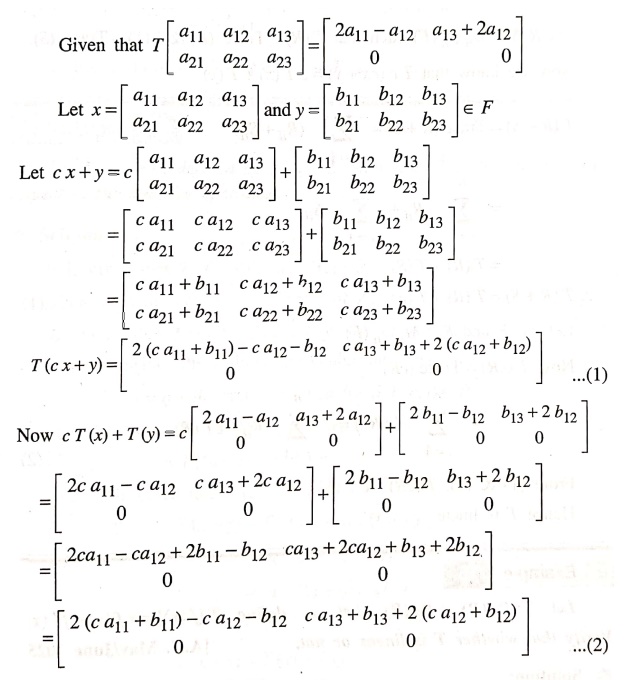
From
equations (1) & (2) we get
T(cx+y)
= cT(x) + T(y)
Hence
T is linear.
Example 14
Let T: Mn×n(F)
→ F. Define T(A) = Trace(A).
Where Trace (4)= nΣi=1
Aii. Prove that T is linear.
Solution:
Given
that T: Mn×n(F) → F and T(A)= Trace (A).
Let
R, S ∈ Mn×n (F)
such that T (R) = Trace (R) & T (S) = Trace (S).
Now
we know that Tc (cx+y) = cT(x) + T(y)
T
(R + S) = Trace (R + S) =
=  (Rii + Sii)
= Rii + Sii
=
T (R) + T(S)
T (R+
S) = T (R) + T (S) ………….(1)
Let
c ∈ F and R ∈ Mn×n(F)
Now
T (cR) Trace (cR)
= (cRii)
=
c Rii
=
cT(R)
From
(1) & (2): T(cR) = cT(R)
Hence
T is linear.
Example 15
Let T: P2(R)
→ P3(R). Let us define T[f(x)]=xf(x)+f
'(x). Verify that whether T is linear or not.
Solution:
Given
that T: P2 (R) → P3 (R) & T[f(x)]=xf(x) +ƒ′(x).
To
prove it is linear, we have to prove that
T(cx+y) = cT(x) + T(y)
T[(f+g)
x] = x(f + g) (x) + (f + g)′ (x)
=
xf(x)+x g(x) +f '(x)+g'(x)
=
xf(x)+f '(x)+ x g(x) + g'(x)
=
T [f(x)] + T [g (x)] ………..(1)
Now
T[cf(x)] = cxf(x)+cf '(x)
=
c[xf(x)+f '(x)]
=
c T [f(x)] ………..(2)
From
(1) & (2) it is clear that T is linear.
Example 16
Let T: C→ C, defined by
T (z) = . Show that T is not linear with respect to the additive
operation.
. Show that T is not linear with respect to the additive
operation.
Solution:
It
is given that T: C→C and T (z) =
where is the complex conjugate of Z.
We
know that T (x, y) = T (x) + T (y) for all x, y ∈ C.
Let
us consider the following complex numbers as
x= a + ib and y=c+id for a, b, c, d ∈ R.
Then
T(x+y)=T(a+ib)+T (c+id)
=
T[(a+c) + i(b + d)]
Since
it is given that T (z) = , then
T(x+y)=T[(a+c)+i
(b+d)]
=
(a+c)−i (b+d)
=
(a−ib)+(c−id)
= 
T(x+y)=T(x)+T
(y)
T
is additive.
Now
we have to consider T (cx) = cT (x)
Let
x = a + ib, α = i ∈
C
T
(αx) = T (ix)= T [i (a + ib)]
=
T[ia+i2b]
=
T (ia − b)
=
T (−b + ia)
('.'T(z) = )
)
T
(αx) = −b−ia ……………(1)
α T(x) = iT(a + ib) = i (a − ib) = b + ia (2)
From
equations (1) and (2), we have
T(αx)
≠ αT(x)
Hence
T is not linear.
Example 17
Let V and W be two
vector spaces. Let T: V→W be linear and { w1, w2, w3
... wn} be a linearly independent subset of R (T). Then prove that if
S={v1, v2, v3... vn} is chosen so
that T (vi)=wi for i = 1,2... n, then S is linearly
independent.
Solution:
Given
that T: V→ W is linear and V and W are two vector spaces.
Let
{w1, w2, w3 ... wn} be a linearly
independent subset of R (T).
Let
S = { v1, v2, v3... vn} be a subset
of V such that
T
(vi) = wi for i = 1, 2, 3 ...n.
To
show that S is linearly independent, we know that
a1v1 + a2ν2 + a3v3 ... + anvn
= 0
T
(a1v1 + a2ν2
+ a3v3 ... + anvn)
= T (0)
T
(a1 v1) +T (a2 v2) +T (a3v3) + ... + T(anvn)
= 0
a1T
(v1) + a2T(v2)
+ ... + anT(vn)=0
a1w1 + a2w2 + a3w3 ... + anwn
= 0
.
The set {w1, w2, w3... wn} is
linearly independent.
⇒ a1=α2=a3=
…. = an = 0
S = { v1,
v2, v3 ..... vn } is linearly independent.
Example 18
Let V be the vector
space of sequences {an}+{ bn } = { an + bn
} and t{an}={tan} where {an} and {bn}
∈ V and t ∈ F. The function T, U: V→V is
defined by T (a1, a2, a3...) = (a2, a3, a4 ...) and U (a1, a2, a3)
= (0, a1, a2...). Prove that T and U
are linear.
Solution:
It
is given that T, U: V→ V and V is a vector space of sequences {an}.
Given
that T (a1, a2, a3 ...) = (α2, a3,
a4 ...)
U (a1, a2, a3...) = (0, a1, a2...)
To
prove T is linear, let (a1, a2, a3 .....), (b1, b2, b3 ...) be any set of V and
c is a scalar.
We
know that T (cx) = cT (x)
..
T (c (a1, a2 ...) + (b1, b2, ...))
=
T (ca1 + b1, ca2 + b2, ca3
+ b3 ...)
=
(ca2 + b2, ca3
+ b3 ...)
=
(ca2, ca3, ca4...) + (b2, b3, b4 ...)
=
c(a2, a3, a4...) + (b2 b3, b4
...)
=
cT (a1, a2...) + T (b1, b2, b3 ...)
Hence
T is linear.
Now
U (c (a1, a2, ...) + (b1, b2, b3 ...))
=
U (ca1+b1, ca2+ b2, ca3+b3, ...)
=
(0, ca1 + b1, ca2 + b2, ca3
+ b3 ...)
=
(0 ca1, ca2, ca3...) + (0, b1, b2, b3 ...)
=
c(0, a1, a2...) + (0, b1, b2, b3 ...)
=
cU (a1, a2, a3
...) + U (b1, b2, b3 ...)
Hence
U is also linear.
Linear Algebra: UNIT II: Linear Transformations and Diagonalization : Tag: maths, mathematics : - Linear Transformation: Example Solved Problems
Linear Algebra: UNIT II: Linear Transformations and Diagonalization
Under Subject
Linear Algebra
MA25C02 2nd Semester | 2025 Regulation
Related Subjects

English Essentials II
EN25C02 2nd Semester | 2025 Regulation | 2nd Semester 2025 Regulation

Tamils and Technology தமிழர்களும் தொழில்நுட்பமும்
UC25H02 2nd Semester | 2025 Regulation | 2nd Semester 2025 Regulation
Linear Algebra
MA25C02 2nd Semester | 2025 Regulation
Transforms and its Applications
MA25C03 2nd Semester EEE Dept | 2025 Regulation | 2nd Semester 2025 Regulation

Applied Physics (CE) II
PH25C02 2nd Semester Civil, Agri Depts | 2025 Regulation | 2nd Semester 2025 Regulation
Applied Physics (CSIE) II
PH25C03 2nd Semester AIDS, CSE, IT, CSE(CY) Dept | 2025 Regulation | 2nd Semester 2025 Regulation
Applied Physics (EE) II
PH25C04 2nd Semester EEE Dept | 2025 Regulation | 2nd Semester 2025 Regulation

Applied Physics (ME) II
PH25C05 2nd Semester Mechanical Dept | 2025 Regulation | 2nd Semester 2025 Regulation
Applied Chemistry (CE) II
CY25C02 2nd Semester Civil Dept | 2025 Regulation | 2nd Semester 2025 Regulation

Applied Chemistry (ME) II
CY25C03 2nd Semester Mechanical Dept | 2025 Regulation | 2nd Semester 2025 Regulation

Electron Devices
EC25C01 2nd Semester ECE Dept | 2025 Regulation | 2nd Semester 2025 Regulation
Digital Principles and Computer Organization
CS25C06 2nd Semester AIDS, CSE, IT, CSE(CY) Dept | 2025 Regulation | 2nd Semester 2025 Regulation

Basic Electrical and Electronics Engineering
EE25C01 2nd Semester | 2025 Regulation | 2nd Semester 2025 Regulation

Basic Civil and Mechanical Engineering
GE25C01 2nd Semester EEE Dept | 2025 Regulation | 2nd Semester 2025 Regulation
Data Structures using CPlusPlus
CS25C05 2nd Semester ECE Dept | 2025 Regulation | 2nd Semester 2025 Regulation
Engineering Drawing
ME25C01 EEE, Mech, Agri, EEE Depts | 2025 Regulation | 2nd Semester 2025 Regulation
Data Structures and Algorithms
CS25C04 2nd Semester EEE Dept | 2025 Regulation

Circuits and Network Analysis
EC25C02 2nd Semester ECE Dept | 2025 Regulation | 2nd Semester 2025 Regulation

Engineering Mechanics
ME25C02 2nd Semester Mech, Civil, Agri Depts | 2025 Regulation | 2nd Semester 2025 Regulation
Object Oriented Programming (OOPs)
CS25C07 2nd Semester CSE, CSE(CY) Depts | 2025 Regulation | 2nd Semester 2025 Regulation