Linear Algebra: UNIT II: Linear Transformations and Diagonalization
Matrix Representation of a Linear Transformation: Example Solved Problems
Important Example Solved Problems - Engineering Maths or Mathematics - Matrix Representation of a Linear Transformation
MATRIX
REPRESENTATION OF A LINEAR TRANSFORMATION
WORKED EXAMPLES
Example 1
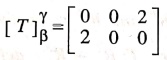
Let R3→R2,
defined by T (x, y, z) = (x+y, y + z), then β = {(‒1, 1, 1), (1, ‒1, 1), (1, 1,
−1)}, and γ= {(1, 0), (0, 1)}. Then find [T].
Solution:
Let
v1 =(1, 1, 1), v2 = (1, 1, 1), v3 = (1, 1, 1),
w1 = (1, 0) and w2 = (0, 1).
T(v1)T(−1,
1, 1) = (−1 + 1, 1 + 1) = (0, 2)
T
(v2)=T(1, −1, 1) = (−1 − 1, − 1 + 1) = (0, 0)
T
(v3)=T(1, 1, −1)=(1+1, 1−1)=(2, 0)
(0,2)=0
(1,0)+2 (0, 1)
(0,
0) = 0 (1, 0)+0 (0, 1)
(2,
0) = 2 (1, 0)+0 (0, 1)
Example 2
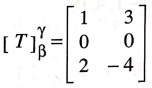
Let T : R2 →
R3, defined by T (a1, a2)
= (a1+3α2, 0,
2α1−4a2), then
β = {(1, 0), (0, 1)} and γ= {(1, 0, 0), (0, 1, 0), (0, 0, 1)}. Then find [T].
Solution:
Let
v1 = (1, 0), v2 = (0, 1), w1 = (1, 0, 0), w2
= (0, 1, 0) and w3 = (0, 0, 1)
T(v1)=T(1,
0) = (1, 0, 2) = 1 (1, 0, 0) + 0 (0, 1, 0) + 2 (0, 0, 1)
=
(1, 0, 0) + (0, 0, 0) + (0, 0, 2) = (1 +0 +0, 0+0+0,0 + 0 + 2) = (1, 0, 2)
T(v2)=T(0,
1)=(3, 0, −4) = 3(1, 0, 0) + 0 (0, 1, 0) ‒ 4 (0, 0, 1)
=
(3, 0, 0) + (0, 0, 0) + (0, 0, − 4) = (3+0 +0,0 +0+0,0 + 0−4) = (3, 0, −4)
Example 3
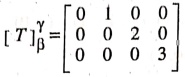
Let T: P3(R)→P2(R)
be the linear transformation defined by T(f(x))
= f '(x). Let β and γ be the standard
bases for P3(R) and P2(R) respectively. Then find [T].
Solution:
Given
that T (f(x)) = f '(x).
T(1)=0=0 (1) + 0 (x)+0(x2)
T(x)=1=1 (1) + 0 (x)+0 (x2)
T (x2) = 2x = 0 (1) + 2 (x) + 0 (x2)
T (x3) = 3x2 = 0 (1) + 0
(x) + 3 (x2)
Example 4
Let β & γ be the
standard bases for Rn and Rm respectively. Let T: Rn→Rm.
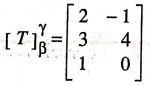
Compute [T]γβ for T: R2 → R3
defined by T (a1, a2)=(2a1−a2, 3a1+4a2, α1)
Solution:
Let
us consider the linear transformation T: Rn → Rm having
standard bases β and γ respectively, for Rn and Rm. The
standard bases for R2 are v1 = (1, 0) & v2
= (0, 1) and for R3 the bases are w1 = (1, 0, 0), w2
= (0, 1, 0) & w3 = (0, 0, 1)
Let
the transformation T: R2 → R3
Defined
transformation is T (a1, a2)
= (2a1−a2, 3α1 +4a2, a1)
T(v1) = T (1, 0) = (2 (1) − 0,3 (1)
+ 0, 1) = (2, 3, 1)
T (v2) = T(0, 1) = (2 (0) − 1, 3(0)+4(1),
0) = (− 1, 4, 0)
The expression of [T] is
Example 5
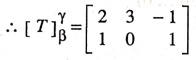
Let T: R3 →
R2, defined by T (a1, a2, a3)
= (2a1 +3a2 − α3, α1 +a3). Let β & γ be the standard bases for Rn
& Rm. Compute [T]βγ.
Solution:
Given
that T: R3 → R2, T (a1, a2, a3)
= (2a1 + 3a2 – a3, a1
+ a3). Let v1 =(1, 0) & v2 = (0, 1) are
the standard standard bases for R2. Let w1== (1, 0, 0), w2
= (0, 1, 0) & w3 = (0, 0, 1) are the standard bases for
Then
T(w1) = T (1, 0, 0) = (2 (1) +3 (0) −0,1+0) = (2, 1).
T
(w2) = T (0, 1, 0) = (2 (0) +3 (1) ‒ 0, 0+0) = (3, 0)
T(w3)
= T (0, 0, 1) = (2 (0) + 3 (0) −1, 0+1) =
(‒1, 1)
Example 6
Let T: R3
→R. Define T (a1, a2, α3) = (2a1+a2−3a3).
Let β & γ be the standard bases for Rn & Rm.
Compute [T]βγ.
Solution:
Let
T: R3 → R
T(a1, a2, a3)
= (2a1 + a2−3a3)
Let
v1 = (1, 0, 0), v2 = (0, 1, 0) & v3 = (0,
0, 1) are the standard bases for R3.
T
(v1)=T(1, 0, 0) = (2 (1) + (0)−3(0))=2(0)
T
(v2) = T (0, 1, 0) = (2 (0) + (1) ‒ 3 (0)) = 1
and
T (v3)= T (0, 0, 1) = (2 (0) + (0)−3(1)) = −3
[ T ]
βγ. = [2 1 − 3]
Example 7
Let T: Rn→Rn.
Define T (a1, a2, az ... an) = (a1, α1, a1,... a1).
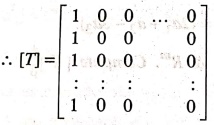
Compute [T].
Solution:
Given
that T: Rn →Rn
T
(a1, a2, a3
... an) = (a1, a1, a1, a1...
a1)
Let
v1 = (1,0,0... 0), v2 = (0, 1, 0... O), v3 =
(0, 0, 1 ... 0)... & vn =
(0, 0, 0 ... 1)
Then
T(v1) = T(1, 0, 0... 0) = (1, 1, 1, ... 1)
T
(v2) = T(0, 1, 0, ... 0) = (0, 0, 0, ... 0)
T
(v3) = T (0, 0, 1, 0 ... 0) = (0, 0, 0 ... 0)
T
(v4) T (0, 0, 0, 1, 0, ... 0) = (0, 0, 0... 0)
:
:
T
(vn) = T (0, 0, 0, ... 1) = (0, 0, 0 ... 0)
Example 8
Let T: R2 →
R3. Define T (a1, a2)
= (a1−a2, a1, 2a1+a2)
Let β be the standard
bases for R2 & γ be the standard bases for R3.
Given that γ = {(1, 1,
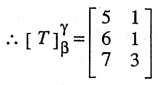
0), (0, 1, 1), (2, 2, 3)). Compute [T] βγ.
Solution:
Given
that T: R2 → R3
T
(a1, a2) = (a1−a2, a1, 2a1+ a2)
Let
β = {(1, 0), (0, 1)} be the standard bases for R2,
and
γ = {(1, 0, 0), (0, 1, 0), (0, 0, 1) } be the standard bases for R3.
Here
it is given that
γ = { (1, 1, 0), (0, 1, 1), (2, 2, 3)} be the
standard bases for R3.
Let
v1 = (1, 0), v2 = (0, 1), w1 = (1, 1, 0), w2
= (0, 1, 1) & w3 = (2, 2, 3)
T(v1)=T(1,
0) = (1−0, 1, 2 (1) + 0) = (1, 1, 2).
T(v2)=T(0,
1)=(0−1, 0, 2 (0) + 1) = (−1, 0, 1)
Given
that γ = { (1, 1, 0), (0, 1, 1), (2, 2, 3)} be the standard bases for R3.
T (v1) = T (1, 0) = (1, 1, 2) = 1
(1, 1, 0) + 1 (0, 1, 1) +2 (2, 2, 3)
=
(1, 1, 0) + (0, 1, 1) + (4, 4, 6)
=
(5, 6, 7)
and
T(v2)=T(0, 1) = (− 1, 0, 1) = − 1 (1, 1, 0) + 0 (0, 1, 1) + 1 (2, 2,
3)
=
(−1, −1, 0)+(0, 0, 0) + (2, 2, 3)
=
(1, 1, 3)
Example 9
Let T: M2×2
(R) → P2 (R)
Define:  = (a+b) + (2d)x +bx2
Let β = {
= (a+b) + (2d)x +bx2
Let β = {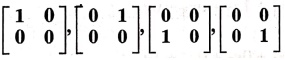 } & γ = {1,x,x2}.
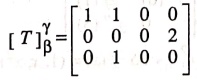
Compute [T]βγ.
Solution:
Given
that T: M2×2 (R) → P2(R)
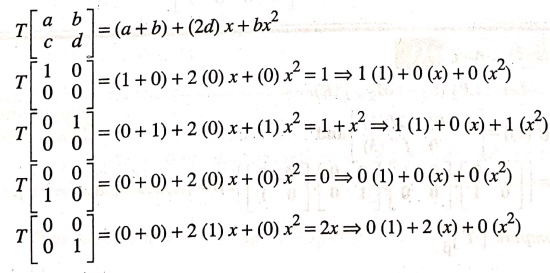
Let
γ = {1, x, x2}
The
coefficients of these linear combinations of the matrix is
Example 10
Let T: M2×2
(F) → M2×2(F).
Let α = {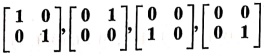 },
β = (1, x, x2) & γ = {1}.
},
β = (1, x, x2) & γ = {1}.
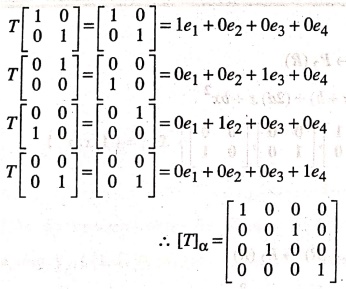
Define T (A)=At,
then compute [T]α.
Solution:
Given
that T (A)=At (or) A' where t or prime is transpose.
(ie)
A= aij ⇒
At (or) A′ = aji
Example 11
Let T: P2
(R) → M2×2 (R). T[f(x)] = 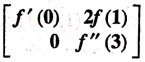 and α =
 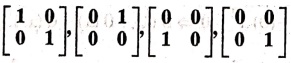 , β = (1,x,x2) & γ={1}.
Compute [T]αβ.
Solution:
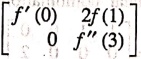
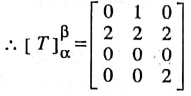
T[β]=[T]β
= 
Hence
β = {1, x, x2}. so f(x)=(1,
x, x2)
f
'(x) = (0, 1, 2x), f ''(x) = (0, 0,
2)
f ′ (0) = (0, 1, 0), 2f(1) = 2 (1, 1, 1) = (2, 2, 2), ƒ"
(3) = (0, 0, 2)
Example 12
Let T: M2×2(F)
→ F
Define: T (A) = Trace
(A), a = {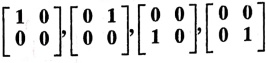 }
}
Β ={1,x,x2 } & γ=[1]. Compute
[T]γα.
Solution:
T:
M2×2(F) → F & T (A) = Trace (A) = a11+ a22 + a33 + …. + ann
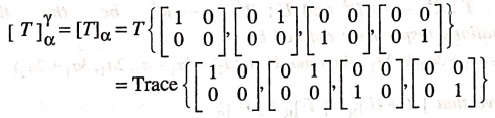
=
[1 + 0, 0 + 0, 0 + 0, 0 + 1]
(by adding diagonal elements)
=
[1, 0, 0, 1]
[
T ]γβ = (1, 0, 0, 1)
Linear Algebra: UNIT II: Linear Transformations and Diagonalization : Tag: maths, mathematics : - Matrix Representation of a Linear Transformation: Example Solved Problems
Linear Algebra: UNIT II: Linear Transformations and Diagonalization
Under Subject
Linear Algebra
MA25C02 2nd Semester | 2025 Regulation
Related Subjects

English Essentials II
EN25C02 2nd Semester | 2025 Regulation | 2nd Semester 2025 Regulation

Tamils and Technology தமிழர்களும் தொழில்நுட்பமும்
UC25H02 2nd Semester | 2025 Regulation | 2nd Semester 2025 Regulation
Linear Algebra
MA25C02 2nd Semester | 2025 Regulation
Transforms and its Applications
MA25C03 2nd Semester EEE Dept | 2025 Regulation | 2nd Semester 2025 Regulation

Applied Physics (CE) II
PH25C02 2nd Semester Civil, Agri Depts | 2025 Regulation | 2nd Semester 2025 Regulation
Applied Physics (CSIE) II
PH25C03 2nd Semester AIDS, CSE, IT, CSE(CY) Dept | 2025 Regulation | 2nd Semester 2025 Regulation
Applied Physics (EE) II
PH25C04 2nd Semester EEE Dept | 2025 Regulation | 2nd Semester 2025 Regulation

Applied Physics (ME) II
PH25C05 2nd Semester Mechanical Dept | 2025 Regulation | 2nd Semester 2025 Regulation
Applied Chemistry (CE) II
CY25C02 2nd Semester Civil Dept | 2025 Regulation | 2nd Semester 2025 Regulation

Applied Chemistry (ME) II
CY25C03 2nd Semester Mechanical Dept | 2025 Regulation | 2nd Semester 2025 Regulation

Electron Devices
EC25C01 2nd Semester ECE Dept | 2025 Regulation | 2nd Semester 2025 Regulation
Digital Principles and Computer Organization
CS25C06 2nd Semester AIDS, CSE, IT, CSE(CY) Dept | 2025 Regulation | 2nd Semester 2025 Regulation

Basic Electrical and Electronics Engineering
EE25C01 2nd Semester | 2025 Regulation | 2nd Semester 2025 Regulation

Basic Civil and Mechanical Engineering
GE25C01 2nd Semester EEE Dept | 2025 Regulation | 2nd Semester 2025 Regulation
Data Structures using CPlusPlus
CS25C05 2nd Semester ECE Dept | 2025 Regulation | 2nd Semester 2025 Regulation
Engineering Drawing
ME25C01 EEE, Mech, Agri, EEE Depts | 2025 Regulation | 2nd Semester 2025 Regulation
Data Structures and Algorithms
CS25C04 2nd Semester EEE Dept | 2025 Regulation

Circuits and Network Analysis
EC25C02 2nd Semester ECE Dept | 2025 Regulation | 2nd Semester 2025 Regulation

Engineering Mechanics
ME25C02 2nd Semester Mech, Civil, Agri Depts | 2025 Regulation | 2nd Semester 2025 Regulation
Object Oriented Programming (OOPs)
CS25C07 2nd Semester CSE, CSE(CY) Depts | 2025 Regulation | 2nd Semester 2025 Regulation