Linear Algebra: UNIT II: Linear Transformations and Diagonalization
Diagonalizability: Theorems Part 2
Important Theorems for Engineering Maths or Mathematics - Diagonalizability: Theorems Part 2
DIAGONALIZABILITY
THEOREMS PART 2
Theorem 16
Let T be a linear
operator, and let λ1, λ2 ... λk be distinct
eigenvalues of T. For each i = 1,2,3...
k, let vi ∈
Eλi, the eigen space corresponding to λi. If v1+v2+v3+...+vn
= 0 then vi= 0 for all i.
Proof:
Suppose
otherwise. By renumbering if necessary, suppose that, for 1≤m≤k, we have vi
≠
0 for 1 ≤i≤m and vi = 0 for i>m. Then, for each i≤m, vi
is an eigenvector of T corresponding to λi and v1+v2
+ v3 + …..+ vn = 0. But this is a contradiction which
states that these ví's are linearly independent. We conclude
therefore, that vi = 0 for all i.
Theorem 17
Let T be a linear
operator on a vector space V, and let λ1, λ2, λ3 ...
λk be distinct eigenvalues of T. For each i=1, 2, 3,... k, let Si
be a finite linearly independent subset of the eigen space Eλi. Then
S=S1∪S2∪S3 ... ∪Sk is a linearly
independent subset of V.
Proof:
Suppose
that for each i, Si = {vi1, vi2, vi3,
... vini }. Then S = { vij ; 1 ≤ j ≤ni; and
1≤i≤k}.
Consider
any scalars {aij} such that 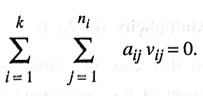
For
each i, let wi =  ajj vij
Then
we Ei ∈
Eλi for each i and w1+w2 + w3 + ...
+ wk = 0.
Therefore,
wi = 0 for all i. But each Si is linearly independent,
and aij=0 for all j.
.
S is linearly independent.
Theorem 18
Let
T be a linear operator on a finite dimensional vector space V such that the
characteristic polynomial of T splits. Let λ1, λ2, λ3
... λk be the distinct eigenvalues of T. Then
(a)
T is diagonalizable if and only if the multiplicity of λi is equal
to dim (Eλi) for all i.
(b)
If T is diagonalizable and βi is an ordered basis for Eλi
for each i, then β = β1∪β2 ∪ β3 ... ∪ βk is an
ordered basis for V consisting of eigenvectors of T.
Proof:
For
each i, let mi denote the multiplicity of λi, di
= dim (Eλi) and n = dim (V).
Suppose
that T is diagonalizable.
Let
β be a basis for V consisting of eigenvectors of T. For each i, let βi=β∪ Eλi, the set
of vectors in β that are eigenvectors corresponding to λi, and let ni
denote the number of vectors in βi. Then ni ≤ di
for each i because βi is a linearly independent subset of a subspace
of dimension di, and di≤m¡. The ni's
sum to n because β contains n vectors. The mi's also sum to n
because the degree of the characteristic polynomial T is equal to the sum of
the multiplicities of the eigenvalues.
Thus  ni ≤ di ≤ mi = ni
(mi‒di)
= 0
Since
(mi ‒ di) ≥ 0 for all i, we conclude that mi =
di for all i.
Conversely,
suppose that mi = di for all i. T is diagonalizable. For each
i, let βi be an ordered basis for Eλi and let β= β1
∪ β2 ∪
β3 ….. ∪ Bk. Then β is
linearly independent. Since di = mi for all i, β contains
di = mi=n
β is an ordered basis for V consisting of
eigenvectors of V and we conclude that T is diagonalizable.
Test for
diagonalization
Let
T be a linear operator on an n−dimensional vector space V, then T is
diagonalizable if both of the following conditions satisfy.
(i)
The characteristic polynomial of T splits.
(ii)
For each eigenvalue λ of T, the multiplicity of λ equals
n− [rank (T−λI)]
Linear Algebra: UNIT II: Linear Transformations and Diagonalization : Tag: maths, mathematics : - Diagonalizability: Theorems Part 2
Linear Algebra: UNIT II: Linear Transformations and Diagonalization
Under Subject
Linear Algebra
MA25C02 2nd Semester | 2025 Regulation
Related Subjects

English Essentials II
EN25C02 2nd Semester | 2025 Regulation | 2nd Semester 2025 Regulation

Tamils and Technology தமிழர்களும் தொழில்நுட்பமும்
UC25H02 2nd Semester | 2025 Regulation | 2nd Semester 2025 Regulation
Linear Algebra
MA25C02 2nd Semester | 2025 Regulation

Transforms and its Applications
MA25C03 2nd Semester EEE Dept | 2025 Regulation | 2nd Semester 2025 Regulation

Applied Physics (CE) II
PH25C02 2nd Semester Civil, Agri Depts | 2025 Regulation | 2nd Semester 2025 Regulation
Applied Physics (CSIE) II
PH25C03 2nd Semester AIDS, CSE, IT, CSE(CY) Dept | 2025 Regulation | 2nd Semester 2025 Regulation
Applied Physics (EE) II
PH25C04 2nd Semester EEE Dept | 2025 Regulation | 2nd Semester 2025 Regulation

Applied Physics (ME) II
PH25C05 2nd Semester Mechanical Dept | 2025 Regulation | 2nd Semester 2025 Regulation
Applied Chemistry (CE) II
CY25C02 2nd Semester Civil Dept | 2025 Regulation | 2nd Semester 2025 Regulation

Applied Chemistry (ME) II
CY25C03 2nd Semester Mechanical Dept | 2025 Regulation | 2nd Semester 2025 Regulation

Electron Devices
EC25C01 2nd Semester ECE Dept | 2025 Regulation | 2nd Semester 2025 Regulation
Digital Principles and Computer Organization
CS25C06 2nd Semester AIDS, CSE, IT, CSE(CY) Dept | 2025 Regulation | 2nd Semester 2025 Regulation

Basic Electrical and Electronics Engineering
EE25C01 2nd Semester | 2025 Regulation | 2nd Semester 2025 Regulation

Basic Civil and Mechanical Engineering
GE25C01 2nd Semester EEE Dept | 2025 Regulation | 2nd Semester 2025 Regulation
Data Structures using CPlusPlus
CS25C05 2nd Semester ECE Dept | 2025 Regulation | 2nd Semester 2025 Regulation
Engineering Drawing
ME25C01 EEE, Mech, Agri, EEE Depts | 2025 Regulation | 2nd Semester 2025 Regulation
Data Structures and Algorithms
CS25C04 2nd Semester EEE Dept | 2025 Regulation

Circuits and Network Analysis
EC25C02 2nd Semester ECE Dept | 2025 Regulation | 2nd Semester 2025 Regulation

Engineering Mechanics
ME25C02 2nd Semester Mech, Civil, Agri Depts | 2025 Regulation | 2nd Semester 2025 Regulation
Object Oriented Programming (OOPs)
CS25C07 2nd Semester CSE, CSE(CY) Depts | 2025 Regulation | 2nd Semester 2025 Regulation