Basic Electronics and Electrical Engineering: Chapter 1: Basic Electronics
Diode Breakdown
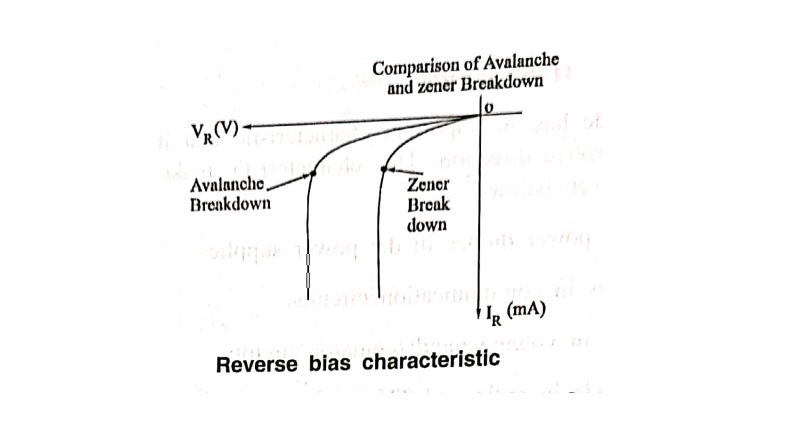
As the reverse‒bias voltage increases, the depletion layer widens and the barrier voltage raises.
DIODE
BREAKDOWN
As the reverse‒bias
voltage increases, the depletion layer widens and the barrier voltage raises.
This later effect causes the diffusion current to decrease eventually it will
be reduced to almost zero. As the process leading to the widening of the
depletion layer continues until a sufficiently high junction voltage develops,
when a new mechanism is set to supply the charge carriers needed to support the
large current (I). The two possible breakdown mechanisms are the zener
mechanism and the avalanche mechanism.
1. Avalanche effect
As discussed earlier on
PN‒ junction the avalanche breakdown occurs, when the accelerated three
electrons acquire sufficient energy to ionize a lattice atom by bombardment. The
additional free electrons created in this way are accelerated by the reverse
field causing more and more ionization. The multiplication of the number of
free electrons causes the reverse current to increase rapidly.
2. Zener effect
The zener breakdown
mechanism is fundamentally different from avalanche breakdown. Zener breakdown
occurs when the electric field in the deflection layer increases to the point
where it can break covalent bonds and generate electron‒hole pairs. The
electrons generated way will be swept by the electric field into N‒side and
holes into P‒sides. Thus, these electrons and holes constitute reverse current
across the junction that helps to supports the external current. In terms of an
energy band structure, in this breakdown process an electron makes a transition
from the valance band to the conduction band without the interaction of any
other particle. Once the Zener effect starts a large number of carriers can be
generated negligible increase in the junction voltage. In fact the zener
process is quantum tunnelling. However, later on the breakdown in junction
which may result from avalanche multiplication or tunneling was in general
called Zener breakdown.
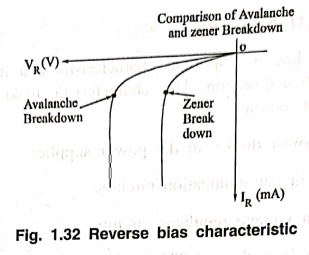
The maximum reverse
bias potential that can be applied before entering the zener region is called
the peak inverse voltage or peak reverse voltage.
Basic Electronics and Electrical Engineering: Chapter 1: Basic Electronics : Tag: Basic Engineering : - Diode Breakdown
Basic Electronics and Electrical Engineering: Chapter 1: Basic Electronics
Under Subject

Basic Electronics and Electrical Engineering
EE25C04 1st Semester ECE Dept | 2025 Regulation | 2nd Semester 2025 Regulation
Related Subjects

English Essentials I
EN25C01 1st Semester | 2025 Regulation | 1st Semester 2025 Regulation

தமிழர் மரபு - Heritage of Tamils
UC25H01 1st Semester | 2025 Regulation | 1st Semester 2025 Regulation
Applied Calculus
MA25C01 Maths 1 M1 - 1st Semester | 2025 Regulation | 1st Semester 2025 Regulation
Applied Physics I
PH25C01 1st Semester | 2025 Regulation | 1st Semester 2025 Regulation

Applied Chemistry I
CY25C01 1st Semester | 2025 Regulation | 1st Semester 2025 Regulation
Makerspace
ME25C04 1st Semester | 2025 Regulation | 1st Semester 2025 Regulation
Computer Programming C
CS25C01 1st Semester | 2025 Regulation | 1st Semester 2025 Regulation
Computer Programming Python
CS25C02 1st Semester | 2025 Regulation | 1st Semester 2025 Regulation
Fundamentals of Electrical and Electronics Engineering
EE25C03 1st Semester | 2025 Regulation | 1st Semester 2025 Regulation
Introduction to Mechanical Engineering
ME25C03 1st Semester | 2025 Regulation | 1st Semester 2025 Regulation

Introduction to Civil Engineering
CE25C01 1st Semester Civil Department | 2025 Regulation | 1st Semester 2025 Regulation
Essentials of Computing
CS25C03 1st Semester - AID CSE IT Department | 2025 Regulation | 1st Semester 2025 Regulation

Applied Physics I Laboratory
PH25C01 1st Semester practical Laboratory Manual | 2025 Regulation | 1st Semester Laboratory 2025 Regulation

Applied Chemistry I Laboratory
CY25C01 1st Semester practical Laboratory Manual | 2025 Regulation | 1st Semester Laboratory 2025 Regulation

Computer Programming C Laboratory
CS25C01 1st Semester practical Laboratory Manual | 2025 Regulation | 1st Semester Laboratory 2025 Regulation

Computer Programming Python Laboratory
CS25C02 1st Semester practical Laboratory Manual | 2025 Regulation | 1st Semester Laboratory 2025 Regulation
Engineering Drawing
ME25C01 EEE Mech Dept | 2025 Regulation | 2nd Semester 2025 Regulation
Basic Electronics and Electrical Engineering
EE25C04 1st Semester ECE Dept | 2025 Regulation | 2nd Semester 2025 Regulation