Basic Electronics and Electrical Engineering: Chapter 1: Basic Electronics
Semiconductor Theory: Atomic Structure, Energy Levels
The solid materials are classified into three types from the consideration of the current carrying capabilities: conductors, insulators and semiconductors.
SEMICONDUCTOR
THEORY
The solid materials are
classified into three types from the consideration of the current carrying
capabilities: conductors, insulators and semiconductors. Conductors have an
abudance of free electrons that act as charge carriers, which means that they
have high conductivity. An insulator on the other hand, has hardly any free
electrons and offers very low level of conductivity. A semiconductor is a
material that has a conductivity level somewhere between extremes of an
insulator and a conductor.
Atomic Structure
The most fundamental
unit of all matter is the atom consisting of three basic particles; the
electron, the proton and the neutron. Neutrons do not carry charge while
protons and electrons are respectively positively and negatively charged. An
atom contains the same number of electrons and protons. The atoms of various
elements differ in number of sub‒atomic particles i.e., electrons, protons and
neutrons they contain.
In the atomic lattice
structure, neutron and proton are the heaviest particles, which make the core
of the atom called nucleus. Electrons revolve around the nucleus in a fixed
orbits. The orbits are denoted by principal quantum numbers or K, L, M, N
shells. Each orbit represents an energy level. Electrons are arranged in order
of 2n2, where n is the
orbit number. For example, first shell contains 2 electrons, second can 8,
third can 18, and so on.
Bohr's model of the two
common semiconductors, germanium and silicon are shown in fig. 1.24. The figure
indicates that germanium atom has 32 orbiting electrons, while silicon has 14
orbiting electrons. In each case, there are 4 electrons in the outermost
(valance) shell. Valance electrons are the electrons in the outermost shell.
The potential (ionization potential) required to remove any of these 4
electrons is lower than that required for any other electron in the structure.

In a good conductor,
the number of valance electrons will be 1 or 2 (eg. copper)
In an insulator, the
outermost orbit will be completely filled. (eg. Xenon)
In a semiconductor, the
outermost orbit will be partially filled. For example, the number of valance
electrons is 4 in Germanium (Ge) and Silicon (Si).
Energy Levels
The range of energies
that an electron may possess in an atom is known as the energy band. Energy
band consists of a very large number of discrete energy levels, which are very
closely spaced. These bands may be thought of as continuous. These energy bands
are separated by forbidden energy gaps, i.e. no electron can have any energy
value within forbidden bands. The three energy bands are explained below:
1. Types of energy bands
(i)
Valance Band
The range of energy
possessed by valance electrons is known as valance band.
(ii)
Conduction Band
The range of energies
possessed by conduction electrons is known as conduction band.
(iii)
Forbidden Band
The energy band in
between the conduction band and the valance band is called forbidden band.
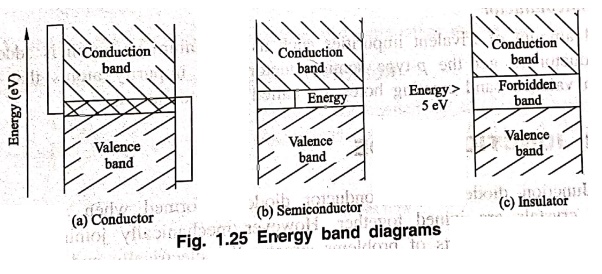
2. Energy band diagrams for materials
The energy band
diagrams of conductor, semiconductor and insulator are shown in fig 1.25.
(i)
Conductor
In conductors, the
conduction band and valance band overlap each other. Refer to fig 1.25 (a)
forbidden energy gap energy gap (Eg = 0). So, a large number of
valance electrons (≈ 1022 per cm3) are available for
conduction in room temperature.
(ii)
Insulator
In insulator forbidden
energy gap Eg is very large (Eg ≈ 4 ‒ 8 eV) and very few electron‒hole pairs
may be created by thermal process. Refer to fig 1.25 (c). Thus insulators or
dielectrics are extremely poor conductors of electricity.
(iii)
Semiconductor
Semiconductors are
those substance whose electrical conductivity lies in between conductors and insulators. In pure
semiconductor, Eg lies in the range of 0.1‒3 eV. Refer to Fig 1.25 (b). Thus
the appreciable number of electron‒hole is created by thermal process.
Increasing temperature causes creation of more electron‒hole pairs hence
resistivity falls. The number of electrons in conduction band or holes in
valance band per unit volume is an ideally pure and perfect semiconductor
crystal is called intrinsic carrier concentration.
Basic Electronics and Electrical Engineering: Chapter 1: Basic Electronics : Tag: Basic Engineering : - Semiconductor Theory: Atomic Structure, Energy Levels
Basic Electronics and Electrical Engineering: Chapter 1: Basic Electronics
Under Subject

Basic Electronics and Electrical Engineering
EE25C04 1st Semester ECE Dept | 2025 Regulation | 2nd Semester 2025 Regulation
Related Subjects

English Essentials I
EN25C01 1st Semester | 2025 Regulation | 1st Semester 2025 Regulation

தமிழர் மரபு - Heritage of Tamils
UC25H01 1st Semester | 2025 Regulation | 1st Semester 2025 Regulation
Applied Calculus
MA25C01 Maths 1 M1 - 1st Semester | 2025 Regulation | 1st Semester 2025 Regulation
Applied Physics I
PH25C01 1st Semester | 2025 Regulation | 1st Semester 2025 Regulation

Applied Chemistry I
CY25C01 1st Semester | 2025 Regulation | 1st Semester 2025 Regulation
Makerspace
ME25C04 1st Semester | 2025 Regulation | 1st Semester 2025 Regulation
Computer Programming C
CS25C01 1st Semester | 2025 Regulation | 1st Semester 2025 Regulation
Computer Programming Python
CS25C02 1st Semester | 2025 Regulation | 1st Semester 2025 Regulation
Fundamentals of Electrical and Electronics Engineering
EE25C03 1st Semester | 2025 Regulation | 1st Semester 2025 Regulation
Introduction to Mechanical Engineering
ME25C03 1st Semester | 2025 Regulation | 1st Semester 2025 Regulation

Introduction to Civil Engineering
CE25C01 1st Semester Civil Department | 2025 Regulation | 1st Semester 2025 Regulation
Essentials of Computing
CS25C03 1st Semester - AID CSE IT Department | 2025 Regulation | 1st Semester 2025 Regulation

Applied Physics I Laboratory
PH25C01 1st Semester practical Laboratory Manual | 2025 Regulation | 1st Semester Laboratory 2025 Regulation

Applied Chemistry I Laboratory
CY25C01 1st Semester practical Laboratory Manual | 2025 Regulation | 1st Semester Laboratory 2025 Regulation

Computer Programming C Laboratory
CS25C01 1st Semester practical Laboratory Manual | 2025 Regulation | 1st Semester Laboratory 2025 Regulation

Computer Programming Python Laboratory
CS25C02 1st Semester practical Laboratory Manual | 2025 Regulation | 1st Semester Laboratory 2025 Regulation
Engineering Drawing
ME25C01 EEE Mech Dept | 2025 Regulation | 2nd Semester 2025 Regulation
Basic Electronics and Electrical Engineering
EE25C04 1st Semester ECE Dept | 2025 Regulation | 2nd Semester 2025 Regulation