Linear Algebra: UNIT I: Vector Spaces
Linear Combination: Example Solved Problems
Important Example Solved Problems - Engineering Maths or Mathematics -
LINEAR
COMBINATION
WORKED
EXAMPLE PROBLEMS
Example 1
Let V=R2,
S={(1, 2), (2, 1) }, v = (2, 2) ∈
V and α, β ∈
F. Check whether v is a linear combination of v1 and v2
(ie) v = αv1 + βv2.
Solution:
Given
that v = αv1 + βv2.
Let(2,
2) = α(1, 2) + β(2, 1) = (α, 2α) + (2β, β)
=
(α + 2β, 2α + β)
Comparing
on both sides we get
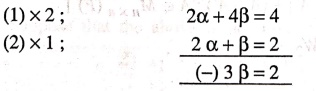
β=2/3
Then
α +2β = 2 becomes
α+2(2/3) = 2
α = 2 – 4/3 = 2/3
α = 2/3
The values of α and β are α=2/3 and β=2/3.
Substitute
the values of α and β in the ordered pair we get,
(2, 2) = α(1, 2) + β(2, 1)
= 2/3(1,2) + 2/3(2,1)
=
(2, 2)
v
= αv1 + βv2
Hence v is a linear combination of v1
and v2.
Example 2
Let V=R3, S
= {(1, 2, 0), (0, −5, −7) } and v = (2,−5,7) ∈
V. Verify whether v is a linear combination of S or not.
Solution:
Let
us consider v = αv1 + βv2
(2,−5,7) = α(1, 2, 0) + β(0, −5,−7) = (α, 2α,
0) + (0, −5β, −7 β)
(2,−5,7) = (α, 2α−5β, −7B)
Comparing
on both sides we get α = 2, 2α−5β = −5 and −7β=7
From
the first and last terms, we have
α=2
and β=− 1.
Substitute
these two values in the middle term, we get
2(2)−5(−1)=−5
⇒ 9 ≠ −5
v
is not a linear combination of S.
Example 3
Let v1 = (2,
1), and v2 = (−4,−2). Verify whether x=(3,5) is a linear combination
of v1 and v2.
Solution:
Let
us consider α, β ∈
F such that αv1 + βv2 = x.
α(2, 1) + β(−4,−2) = (3, 5)
(2α,
α)+(−4β, 2β)=(3,5)
(2α−4β,
α−2β) = (3, 5)
Comparing
on both sides, 2α−4β=3 and
α−2β=5

= −4+4 = 0.
Δ=0, this system is inconsistent. Hence there
is no solution, and x is not a linear combination of v1 and v2.
Example 4
If v = (−2, 0, 3) is a
linear combination of (1, 3, 0) and (2, 4, −1) in R3. Prove that it
is a linear combination of (1, 3, 0) and (2, 4, − 1).
Solution:
We
know that v=αv1+βv2.
Let
(−2, 0,3) = α(1, 3, 0) + β(2, 4, ‒1) = (α, 3α, 0) + (2β, 4β, −β)
(−2,
0, 3) = (α + 2β, 3α + 4β, −β)
Comparing
on bothsides, we have
⇒ α+2β=−2
3α
+4β=0
−β=3
β=−3.
α+2(−3)=−20
α−6=−2
α=
4.
3(4)+4(−3)=0
Hence
(−2, 0, 3) is a linear combination of (1, 3, 0) and (2, 4, −1).
Example 5
Write the vector v =
(1, ‒2, 5) as a linear combination of the vectors e1 = (1, 1, 1); e2
= (1, 2, 3); e3 = (2, − 1,
1).
Solution:
We
know that v = ae1+ be2 + ce3
(we
know that v = αv1+ βv2)
(1,
−2, 5) = a(1, 1, 1) + b (1, 2, 3) + c (2, − 1, 1)
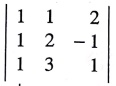
= 1(2+3) − 1(1 + 1) + 2(3−2) = 5−2+2 = 5
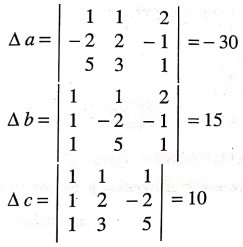
a= Δa / Δ = − 30/5 = ‒6
b= Δb / Δ = 15/5 = 3
c= Δc / Δ = − 10/5 = 2
v = −6e1
+ 3e2 + 2e3.
Example 6
Write the vectors v =
(2,−5, 3) as a linear combination of the vectors e1=(1, − 3, 2), e2=(2,−4,
−1), e3=(1,−5, 7)
Solution:
Let
(2,−5,3) = a(1, −3, 2) + b (2,−4,−1) + c(1, −5, 7)
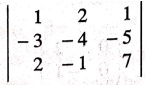 = 1[−28+(−5)]−2 [−21+10] +1 (3+8)
=
−33+22+11=0
The
system is inconsistent and so has no solution.
v is
not a linear combination of e1, e2, e3.
Example 7
For which values of k
will the vector v = (1, − 2, k) in R3 be a linear combination of the
vectors u = (3, 0,−2) and w = (2,−1,−5).
Solution:
Let
(1,−2, k) = α(3, 0, −2) + β(2,−1,−5)
=
(3α, 0, −2α) + (2β, − β,− 5β)
(1,
−2, k) = (3α+2β, −β, −2α−5β)
Comparing
the coefficients on both sides we get
3α + 2β = 1 ….(1)
β = 2 ….(2)
−
2α−5β= k ….(3)
Substitute
equation (2) in equation (1) we get
3α
= 1−2β = 1 − 2(2)
⇒ 3α = −3
α = − 1.
Now
−2α−5β = k becomes
−2(−1)−5(2)
= k, (α=−1, β=2)
2+(−10)=k
k =−8
Example 8
Write the matrix E =  as a linear combination of the matrix
  .
.
Solution:
Let
E = αA+βB+γC
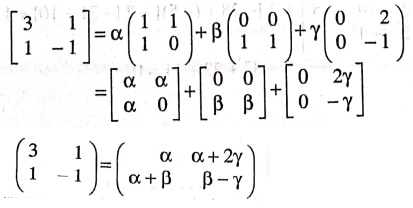
Equating
the corresponding numbers we have
α=3; α+2γ=1, α+β= 1 and β−γ=−1
α = 3
α+2γ=1
2γ=1−3
γ=−1
α+β=1
3+β=1
β=−2
β−
γ =−1
−2+1=−1
E=3A−2B−C
Example 9:
In R3,
verify whether the first vector can be expressed as a linear combination of the
other two or not, for (3, 4, 1), (1, − 2, 1), (− 2, − 1, 1).
Solution:
We
know that v = αv1 +βv2
Let
v = (3, 4, 1), v1 = (1,−2, 1) and v2 = (−2, −1, 1)
(3, 4,
1) = α(1, −2, 1) + β(−2, −1, 1)
= (α, −2α, α) + (−2β, −β, β)
(3,
4, 1) = (α−2β, −2α−β, α+ β)
Comparing
on both sides, we have
α−2β=3, −2α− β = 4 and α + β = 1
Now
− 2α−β = 4
α+β =1
Then
−α=5
α=−5
⇒ α+ β =1⇒
−5+
β =1
⇒ β = 6
α− 2β = 3
⇒ − 5 −2 (6) = − 17 ≠ 3.
Hence
v cannot be expressed as a linear combinations of other two.
Example 10
Verify x3−3x+5
is a linear combination of x3+2x2−x+1 and x3+3x2−1.
Solution:
Let
v=av1+bv2
x3
− 3x + 5 = a (x3 + 2x2 −x + 1) + b(x3 + 3x2
− 1)
= ax3 +2ax2 − ax + a +
bx3 + 3bx2 − b
x3
− 3x + 5 = x3(a + b) + x2(2a + 3b) + x(− a) + (a − b).
Equating
the coefficients on both sides, then we get
a+b=1;
2a+3b= 0; − a=−3 and a−b=5.
From
the last two equations we have a = 3 and b=−2.
a+b=1
⇒ 3−2=1 holds good.
2a+3b=0
⇒2 (3) + 3 (− 2) = 0
holds good.
All the
equations are satisfied.
Hence
x3−3x+5 is a linear combination of x3 + 2x2−x+1
and x3+3x2−1.
Example 11
Verify whether the
first polynomial can be expressed as a linear combination of the other two in P3(R)
for the given x3−8x2+4x, x3−2x2+3x−1
and x3−2x+3.
Solution:
Let
v=av1+bv2
x3− 8x2+4x= a (x3
− 2x2 + 3x − 1) + b (x3 − 2x + 3)
x3−8x2+4x= ax3−2ax2+3ax
− a + bx3 − 2bx+ 3b
= x3(a+b) + x2(−2a) + x(3a−2b)
+ (−a+3b)
Equating
the coefficients on both sides we get
1=a+b, −8=−2a, 4=3a−2b & −a+3b=0
a+b=1 ...(1)
2a
= 8 ...(2)
3a−2b=4 ...(3)
−a+3b=0 ...(4)
From
equation (2): a = 8/2 = 4 ...(5)
b = 1−a = 1−4
b = −3
a = 4 & b = −3.
Substitute
the values of a & b in equation (3) we get
3(4) − 2(− 3) = 12+6 = 18 ≠ 4
Substitute
the values of a & b in equation (4) we get
− (4) + 3(− 3) = −4−9=−13 ≠ 0
For
the values a=4 & b=−3 equations (3) and (4) are not satisfied.
x3− 8x2 + 4x is not a
linear combination of
x3− 2x2 + 3x − 1 & x3
− 2x + 3.
Linear Algebra: UNIT I: Vector Spaces : Tag: maths, mathematics : - Linear Combination: Example Solved Problems
Linear Algebra: UNIT I: Vector Spaces
Under Subject
Linear Algebra
MA25C02 2nd Semester | 2025 Regulation
Related Subjects

English Essentials II
EN25C02 2nd Semester | 2025 Regulation | 2nd Semester 2025 Regulation

Tamils and Technology தமிழர்களும் தொழில்நுட்பமும்
UC25H02 2nd Semester | 2025 Regulation | 2nd Semester 2025 Regulation
Linear Algebra
MA25C02 2nd Semester | 2025 Regulation
Transforms and its Applications
MA25C03 2nd Semester EEE Dept | 2025 Regulation | 2nd Semester 2025 Regulation

Applied Physics (CE) II
PH25C02 2nd Semester Civil, Agri Depts | 2025 Regulation | 2nd Semester 2025 Regulation
Applied Physics (CSIE) II
PH25C03 2nd Semester AIDS, CSE, IT, CSE(CY) Dept | 2025 Regulation | 2nd Semester 2025 Regulation
Applied Physics (EE) II
PH25C04 2nd Semester EEE Dept | 2025 Regulation | 2nd Semester 2025 Regulation

Applied Physics (ME) II
PH25C05 2nd Semester Mechanical Dept | 2025 Regulation | 2nd Semester 2025 Regulation
Applied Chemistry (CE) II
CY25C02 2nd Semester Civil Dept | 2025 Regulation | 2nd Semester 2025 Regulation

Applied Chemistry (ME) II
CY25C03 2nd Semester Mechanical Dept | 2025 Regulation | 2nd Semester 2025 Regulation

Electron Devices
EC25C01 2nd Semester ECE Dept | 2025 Regulation | 2nd Semester 2025 Regulation

Digital Principles and Computer Organization
CS25C06 2nd Semester AIDS, CSE, IT, CSE(CY) Dept | 2025 Regulation | 2nd Semester 2025 Regulation

Basic Electrical and Electronics Engineering
EE25C01 2nd Semester | 2025 Regulation | 2nd Semester 2025 Regulation

Basic Civil and Mechanical Engineering
GE25C01 2nd Semester EEE Dept | 2025 Regulation | 2nd Semester 2025 Regulation
Data Structures using CPlusPlus
CS25C05 2nd Semester ECE Dept | 2025 Regulation | 2nd Semester 2025 Regulation
Engineering Drawing
ME25C01 EEE, Mech, Agri, EEE Depts | 2025 Regulation | 2nd Semester 2025 Regulation
Data Structures and Algorithms
CS25C04 2nd Semester EEE Dept | 2025 Regulation

Circuits and Network Analysis
EC25C02 2nd Semester ECE Dept | 2025 Regulation | 2nd Semester 2025 Regulation

Engineering Mechanics
ME25C02 2nd Semester Mech, Civil, Agri Depts | 2025 Regulation | 2nd Semester 2025 Regulation
Object Oriented Programming (OOPs)
CS25C07 2nd Semester CSE, CSE(CY) Depts | 2025 Regulation | 2nd Semester 2025 Regulation