Linear Algebra: UNIT I: Vector Spaces
Vector SubSpaces: Theorems Part 2 - Example Solved Problems
Important Example Solved Problems - Engineering Maths or Mathematics - Vector SubSpaces: Theorems Part 2 - Example Solved Problems
Vector SubSpaces: Theorems Part 2
Example Problems
Example 7
Show that Fn
is the direct sum of the subspaces
W1 = { (a1, a2 ..... ‚ an) ∈ Fn, an = 0 }
and
W2 = {(a1, a2,..., an) = Fn, a1 = a2 = ... = an−1=0}.
Solution:
Let
us consider p, q ∈
W1.
p = (a1, a2,... an); an=0
q=
(b1, b2, ... bn); bn = 0
αp+βq = α(a1, a2, ... 0) + β(b1, b2, ..... 0)
=
(α a1 + βb1, αa2 + βb2 ,... 0) ∈
W1.
Hence
W1 is subspace of V=Fn.
Let
us consider r, s ∈
W2.
where
r = (0, 0, ... an)
and
s = (0, 0, ..... bn)
ar+βs = (α0+β0, α0+β0, ... , αan+ βbn)
=
(0,0,..., αan + Bbn)
W2 is a subspace of V=Fn
Clearly
W1 ∩ W2 = {0}
W1+
W2 = (a1, a2,... an− 1,0)+(0, 0, ..., 0,
an)
=
(a1, a2, ... an) ∈ Fn
Fn = W1  W2
W2
(ie). Fn is the direct sum of the
subspaces W1 and W2.
Example 8
Let V be the vector
space of all functions from the real field R into R. Show that W is not a
subspace of V where
(i) W={f; f(7) = 2+ƒ
(1) }
(ii) W consists of all
non−negative functions, (ie) All functions "f" for which f(x) ≥0
for all x ∈
R.
Solution:
(i)
Suppose f, g ∈
W
(ie) ƒ(7)=2+ƒ(1) and g (7) = 2 + g (1)
(f+g)
(7)=ƒ(7)+g(7) = 2+f(1)+2+g(1)
=
4+f(1)+g(1) = 4+ (f+g) (1)
≠ 2+(f+g) (1)
Hence
f+g ∉ W and so W is not a
subspace of V.
(ii)
Let k = −2 and f ∈
V be defined by f(x) = x2
then f ∈ W.
Since
f(x) = x2≥0 for all x ∈ R.
kƒ (5) = (− 2) (52) = −50 <0 (k=−2)
Hence
kf ∉ W and so W is not a
subspace of W.
Example 9
In any vector space V,
show that (a+b) (x+y)=ax+ay + bx+by for any x,y ∈
V and any a, b ∈
F.
Solution:
Noting
that (a+b) ∈
F, we have
(∴ α (u+v) = αu+αv)
(a+b)(x+y)=(a+b)x+(a+b)y
=
ax + bx + ay + by = ax + ay + bx + by
as
required.
Example 10
How many matrices are
there in the vector space Mm×n (z2)?
Solution:
There
are 2mn vectors in this vector space.
Example 11
Prove that (aA +bB)t=
aAt +bBt for any A, B ∈
Mmxn (F) for any a, b ∈
F.
Solution:
We
have (aA)ij = a Aij, (bB)ij = b Bij
So
(aA+bB)ij = a•Aij + b•Bij
[(aA
+bB)t]ij = a•Aji + b•Bji
Now
(At)ij
= Aji and (Bt)ij
= Bji
(aAt)ij
= a • Aji and (bBt)ij=b•Bji
[aAt
+ bBt]ij = a•Aji + b.Bji
(aA + bB)t
= aAt + bBt as required.
Example 12:
Prove that (At)t
= A for each A ∈
Mm×n (F).
Solution:
We
have (At)ij=Aji
Thus
[(At)t]ij = (At)ji = Aij
So
that (At)t = A as required.
Example 13:
Prove that A+ At
is symmetric for any square matrix A.
Solution:
We
know that
A+At = At+A
=
At+(At)t
=
(A + At)t
Example 14:
Prove that tr (aA +bB)
= a tr (A) + b tr (B)
Solution:
tr
(aA + bB) =  (aA + bB)ii
= aAii + bBii
=
aAii + bBii
=
a tr (A) + b tr (B)
Example 15:
What are the possible
subspace of R2?
Solution:
(i)
{0} is the subspace of R2.
(ii)
R2 is the subspapce of R2 and
(iii)
Lines through the origin are subspace of R2.
Example 16:
Prove that if U is a subspace
of a vector space V and u1, u2, u3, …. un
∈ U then a1u1 + а2u2 + а3u3 + ... + аnun
∈ U for any scalars (a1, a2, a3
... аn) ∈
F.
Solution:
Given
that U is a subspace of a vector space V and u1, u2, u3
….. un ∈
U then we have to prove that а1u1 + a2u2
+ a3u3 + ….. … + anun
∈ U where a1, a2, a3
... an ∈
F.
Let
us prove this by using mathematical induction.
Let
S (n) = a1u1 +
а2u2 + a3u3
+ ... + аnun
...(1)
To
prove S(1) is true, put n = 1 in (1)
S (1) = a1u1
∈ U
(a1
∈ F, u1 ∈ U ⇒ α1
u1 ∈
U)
Now
assume that S (k) is true.
а1u1
+ a2u2 + a3u3 + ….. … + akuk ∈ U
To
prove S(k+1) is true
а1u1
+ a2u2 + a3u3 + ….. … + akuk + ak+1uk+1
∈ U
S(k) + ak+1
uk+1 ∈
U.
S(k+1)
is true whenever S (k) is true.
а1u1 + a2u2
+ a3u3 + ….. … + anun
∈ U
U is a
subspace of a vector space V.
Example 17
Prove that the
intersection of the subspaces W1 & W2 of a vector
space V is a subspace.
Solution:
Let
us consider x, y ∈
W1 ∩ W2 and a ∈
F.
since
x ∈ W1 ∩ W2,
there must be x ∈
W1 and x ∈
W2.
Similarly
for y ∈ W1 ∩ W2
there must be y ∈
W1 and y ∈
W2.
Since
x, y ∈ W1 ∩
W2 is a subspace of V, x+y ∈
W1 & x+y= W2.
..x
+ y ∈ W1 ∩ W2.
Here
W1 ∩ W2 is a subspace of V.
Example 18
Let V=R3.
Prove that W={(a1, a2, a3)
∈ R3/a1 = 3a2 & a3=−a2} is
a subspace over R3.
Solution:
Let
W = { (a1, a2, a3)/a1 =3a2 and a3
= −ɑ2 }
Let
w1 = (a1, a2, a3}
and w2 = {b1, b2, b3], w1, w2
∈ W.
αw1+βw2 = α (a1, a2, a3)
+ β (b1, b2, b3)
=
[(α a1, α α2, α α3) + (βb1, βb2, βb3)]
=
(αa1 + βb1, αa2 + βb2, αa3 + βb3)
=
3 (α a2+ βb2)
+ (αa2 + βb2) − (αa2 + βb2)
=
3αa2+3βb2+αa2+βb2−αa2−βb2
=
3αa2+3βb2
=
3 (αa2+ βb2)
=
3a2
⇒ αw1 + βw2
∈ W
..
W is a subspace over R3.
Example 19
Let V=R3
prove that W={(a1, a2, a3)
∈ R3/a1+2a2−3a3=1} is not a subspace of
V.
Solution:
W
= {(a1, a2, a3)
∈ R3/a1 +2a2−3a3 = 1}
Let
w1 = (a1, a2, a3)
& w2 = (b1, b2, b3), where w1, w2
∈ W.
αw1+βw2
=α (a1, a2, a3)
+ β(b1, b2, b3)
=
(α a1, α α2, α α3) + (βb1, Bb2, βb3)
=
(α a1 + βb1, αα2 + βb2, αa3 + βb3)
=
(αa1 + βb1) + 2(α a2+ βb2) ‒ 3(αa3
+ βb3).
=
αa1 + βb1 +2α a2 + 2 βb2 − 3αa3 − 3βb3
=
α (a1+2a2−3a3) + β(b1+2b2−3b3)
=
α+B (because a1+2a2 − 3a3 = 1
& b1+2b2−3b3
= 1)
αw1+βw2 = α+β ∉ W
W is
not a subspace of V.
Example 20
Let V=R3.
Prove that W={(a, b, c)/a2+b2+c2=1} is not a subspace of V.
Solution:
Given
that W={(a, b, c) / a2 + b2 + c2 = 1}.
Let
w1 = (a1, a2, a3)
& w2 = (b1, b2, b3), where w1, w2
∈ W.
αw1+ βw2 = α(a1, a2, a3)
+ β(b1, b2, b3)
=
(αа1, αα2, αα3) + (βb1, βb2, βb3)
=
(αa1 + βb1, αa2+ βb2, αa3
+ βb3)
=
(αa1 + βb1)2 + (αа2
+ βb2)2 + (αa3
+ βb3)2
=
α2a12 + β2b12 +
2αβα1b1 + α2a22 + β2b22
+ 2αβa2b2 + α2a32 + β2b32
+ 2αβa3b3
=
α2 (a12 + a22 + a32)
+ β2(b12 + b22 + b32) + 2αβ(a1b1 + a2b2+ a3b3)
=
α2 + β2+2αβ(a1b1+a2b2+a3b3)
αw1
+ βw2 ∉
W.
Hence
W is not a subspace of V.
Example 21
Prove that a subset W
of a vector space V is a sub−space of V if and only if 0 ∈ W and ax+y ∈ W where a ∈ F and x, y ∈ W.
Solution:
It
is given that V is a vector space and W is a subset of V.
Necessary
part: If W is a subspace of V then
(i) 0 ∈
W and (ii) ax+y ∈
W, where a ∈
F and x, y ∈
W.
W
is a subspace of V ⇒
(i) 0 ∈ W.
(ii)
x+y ∈ W where x, y ∈ W.
(iii)
ax ∈ W where a ∈ F and x ∈ W.
These
conditions hold good.
Converse
part:
If (i) 0 ∈
W
(ii) ax + y ∈ W where a ∈ F and x, y ∈ W,
then
W is a subspace of V.
(i)
x+y ∈ W where x, y ∈ W.
(ii)
ax ∈ W where a ∈ F and x ∈ W.
(iii)
0 ∈ W.
(iv)
Each element in W has an additive inverse in W.
(i)
1 ∈ F, if x, y ∈ W then 1.x+y = x+y ∈ W.
(ii)
a ∈
F, x ∈ W, 0 ∈ W then ax+0 = ax ∈ W
(iii)
0 ∈ W by (i)
(iv)
Each vector in W has an additive inverse in W.
If
x ∈ W, then (−1) x ∈ W ⇒ −
x = (− 1) x.
Here
‒1 ∈ F and x ∈ W. Hence the additive
inverse of each element of W is also in W.
Hence
W is a subspace of V.
Example 22
Let V be a vector space
of all 2×2 matrices over R. Verify whether W is a subspace of V or not for the
following
(i) W consists of all
matrices with non−zero determinant.
(ii) W consists of all
matrices A such at A2=A.
Solution:
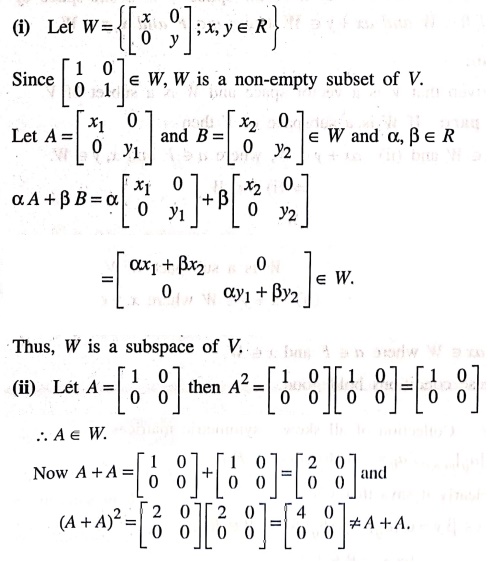
Hence
A+ A ∉ W.
W is
not a subspace of V because W is not closed under addition.
Example 23
Let V be the vector
space of all square n×n matrices over reals. Verify whether the following are
sub−spaces of V or not.
(i) Collection of all
symmetric matrices.
(ii) Collection of all
skew−symmetric matrices.
(iii) Collection of all
scalar matrices.
(iv) Collection of all
singular matrices.
Solution:
It
is given that V = { A : A = [aij]n ×n : αij ∈ R }
(i)
Let W be the collection of all symmetric matrices.
Then
it is obvious that W  V.
V.
Let
x, y ∈ W where x = [bij] for bij = bij
and
y= [cij]
for cij=cji
Now
αx + βy = α[bij] + β[cij]
where α, β ∈
R
=
[αbij + βcij]
=
[dij]
where αbij
+ βcij = dij.
Now
dji = αbji + βcji
=
αbij + βcij
=
dij
Hence
dij=dji
Here
[dij] is a symmetric matrix and dij ∈ W.
Hence
W is a subspace of V.
(ii)
Let W = Collection of all skew − symmetric matrices
W
= { [aij]mxn/ aij
= ‒aj for all aij ∈
R)
Here
clearly it says that W V.
Let
αx+βy = α [aij] + β[bij]
for α, β ∈
R.
=
[α aij + β bij]
=
cij where cij= αaij
+ βbij
Now
cij = αaji + βbji
=
−αaj−βbij
=
− [cij]
[cij] is also skew symmetric.
Hence
W is a subspace of V.
(iii)
Let W= Collection of all scalar matrices.
W
= { [αij]n×n/aij=
k for i = j, k ∈
R }
=
0 for i≠j. Then WV.
W is a
subspace of V.
(iv) Let W = Collection of all singular
matrices.
Here
W is not a subspace of V because W is not closed under the operation addition.
W
is not a subspace of V.
Example 24
Prove that the union of
two subspaces of a vector space is a subspace.
Solution:
Let
A= {(a, 0, 0)/a ∈ R} and B={(0, b, 0)/b ∈ R}
Then
A + B = (a, 0, 0) + (0, b, 0) = (a, b, 0) ∈
W.
Hence
W is a subspace of R3.
Example 25
Prove that the set W = {(a1, a2, a3) ∈ R3, 5a12−3a22+6a32=0} is not a
subspace of V.
Solution:
Let
W= {(a1, a2, a3)
∈ R3, 5a12−3a22+6a32 = 0}
Let
W1 = (a1, a2, a3)
and W2 = (b1, b2, b3) where w1, w2
∈ W
αw1+βw2 = α (a1, a2, a3)
+ β (b1, b2, b3)
=
(α α1, α α2, α α3) + (βb1, βb2, βb3)
=
(α a1+βb1, α a2+ βb2, αa3 + βb3)
=
5 (α a1 + βb1)2 − 3 (α a2 + βb2)2
+ 6 (α a3 + β b3)2
=
5 [a2 a12 +
β2b12 + 2α βa1 b1]
− 3 [α2 a22+β2b22 +
2αβa2b2] + 6 [a2 a32 +β2 b32
+2αβa3b3]
=
5α2a12 +5β2b12+10αβa1b1 − 3a2a22
− 3β2 b22 − 6αβa2b2 + 6α2a32+6β2b32
+ 12αβa3b3.
=
α2 [5a12 − 3a22 + 6a32] + β2[5b12 – 3b22
+ 6b32] + αβ[10a1b1 − 6a2b2 + 12a3b3]
=
α2[0] + β2[0] + 2αβ[5a1b1− 3a2b2 + 6a3b3]
≠ 0
αx + βy ∉
W.
Hence
W is not a subspace of V
Example 26
Let W1 = {(a1, a2, α3) ∈ R3, a1 = 3a2 and a3 = ‒a2} and W2 = {(a1, a2, α3) = R3, 2a1−7a2+a3=0}.
Prove that W1∩W2 is a subspace of R3.
Solution:
It
is given that 2a1−7a2+ a3 = 0.
By using W1 in W2, we
have
2(3a2) − 7(a2) + (− a2)
= 0
6a2−7a2−a2=0
−2a2=0
a2=0
From
W1:
Since
a2 =0, a1 = 3
(0) = 0 and a3 = − (0) = 0
a1 =0, a2 = 0 and a3 = 0
W1
∩
W2 = {0}
The
null set is a subspace of itself and W1 ∩ W2 = 0.
The
set W1 ∩ W2 is a subspace of R3.
Example 27
Let S be any non−empty
set and F be a field. Prove that for any s0 ∈ S {ƒ ∈ F (S, F) : ƒ (s0) = 0 }
is a subspace of F (S,F).
Solution:
It
is given that S be any non−empty set.
(f+g) (s0) =ƒ(s0) + g (s0)
= 0+0 = 0.
Thus
under addition it is satisfied.
cf(s0)
= c(0) = 0. It is satisfied under multiplication.
Then
zero function is in the set.
It is a subspace of F (S, F).
Example 28
Let S be a non−empty
set and F be a field. Let C (S, F) be the set of all functions f ∈
F (S, F) such that ƒ (s) = 0 for all but a finite number of elements. Then
prove that C (S, F) is a subspace of F (S, F).
Solution:
From
the given statement, the number of non−zero points of (f+g) is lesser than the number of non−zero points of ƒ and g.
Then
it is closed under addition operation.
Similarly,
the number of non−zero points of Cf(s)
is equal to the number of f.
Thus
it is closed under multiplication.
Here
zero function is in the set.
It
is a subspace of F (S, F).
Example 29
Is the set of all differentiable
real valued functions defined on R a subspace of C (R).
Solution:
The
sum of two differentiable functions is again differentiable.
The
product of one scalar and one differentiable function is again differentiable
and zero function is also differentiable.
The set of all differentiable real valued
functions defined on R is again a subspace of C (R).
Example 30
Let Cn (R)
be the set of all real valued functions defined on R has a continuous nth
derivative. Then prove that Cn(R) is a subspace of F (R, R).
Solution:
Let
f n and gn are the nth
derivative of f and g.
f n
+ gn is the nth derivative of ƒ+ g.
If
f n and gn are
continuous then f n+gn
is also continuous.
Cf n is the n derivative of C
and it is continuous.
Here
zero function is the null vector.
Cn
(R) is a subspace of F (R, R).
Example 31
Let F1 and F2
be two fields. Prove that the set of all even functions in F (F1, F2)
and the set of all odd functions in F(F1, F2) are the
subspace of F (F1, F2).
Solution:
Let
V be the vector space of all functions.
Let
Ve and Vo be the subsets of even and odd functions.
Now
we have to prove that Ve and Vo are subspace of V.
For even functions
Let
fe and ge ∈Ve and c is
any scalar.
(cfe + ge)(−x) = cfe(−x)
+ ge(− x)
=
cfe (x) + ge(x)
(since it is an even function)
=
(cfe + ge) (x)
Thus
cfe + ge is an
even function.
Hence
fe , ge ∈ Ve implies
cfe + ge ∈ Ve
Hence
Ve is a subspace of V.
For odd functions
Let
f0 and g0 ∈ V0 and c is
any scalar.
(c f0 + g0) (−x) = cf0 (− x) + g0 (−x)
=
c[−f0 (x)] − g0(x)
(.it is an odd function)
=
−[c f0 (x) + g0
(x)]
=
−[c f0 + g0)]
(x).
Thus
c f0 + g0 is an
odd function.
Hence
f0, g0 ∈ V0 which
implies that c f0 + g0
∈ V0.
Hence
V0 is a subspace of V.
Example 32
Is the set W= {f(x) ∈
P(F) ; f (x) = 0 or f (x) has degree n } a subspace of P (F)
if n≥1.
Solution:
The
given set is not a subspace for n ≥1.
When
n=2; the given set W is not closed under addition.
Example 33
Let W1 and W2
be sub spaces of V. (i) Show that W1+ W2 is a subspace of
V that contains W1 and W2. (ii) Show that any subspace of
V that contains W1 and W2 and W1+ W2.
Solution:
(i)
We know that by the definition of subspace
0 ∈
W1 and 0 ∈
W2 ⇒
0+0 ∈ W1 + W2.
W1+ W2 is a non−empty
subset of V.
Let
x, y ∈ W1+ W2
and a, b are any scalars.
x=x1+x2
and y=y1+x2
where x1, y1 ∈ W1 and x2,
x2 ∈
W2.
Since
W1 is a subspace, x1,y1 ∈ W1 and a, b
are scalars.
Then
ax1+by1 ∈
W1.
Since
W2 is a subspace, x2, x2 ∈ W2 and a, b
are scalars then ax2 + bx2 ∈ W2.
(ax1+by1)+(ax2+ bx2)
∈ W1+ W2
(ax1
+ ax2) + (by1 +
bx2) ∈
W1 + W2
a (x1+x2)
+ b (y1+ y2) ∈ W1+ W2
⇒ a(x) +b(y) ∈ W1+ W2
W1+
W2 is a subspace of V.
Here
w1 ∈
W1, means that w1 = w1 + 0
w1
= w1+0 ∈
W1+ W2 as 0 ∈
W2.
That
means W1  W1+ W2
Now
w2 ∈
W2 means that w2=0+ w2
w2 =0+w2 ∈ W1 + W2
as 0 ∈ W1
That
means W2 W1+ W2
From
(1) and (2) W1 W1 + W2 and W2 W1 + W2
(ii)
Let us consider U V be the subspace of V.
(ie)
W1U and W2 U
Now
we have to prove that W1 + W2 U.
ax + y ∈
W1+ W2 (ax ∈
W1 and y∈
W2)
ax ∈ U and y ∈ U
Since
U is a subspace, ax+ye ∈
U
⇒ W1+ W2 U.
Example 34
Let W1 and W2
be two subspaces of V. Prove that V is the direct sum of W1 and W2
iff each vector in V can be written as x1+x2
where x1 ∈ W1 and x2 ∈
W2.
Solution:
Let
W1 and W2 be two subspaces of V.
(i) V=W1 W2.
(ii) For Z ∈
V, z=x1+x2 when
x1 ∈ W1 and x2
∈ W2.
Let
us consider V=W1 W2
⇒
x1 + x2 = z;
x1
∈ W1 and x2
∈ W2
Suppose
that the above is not unique. Then let
Z=x1'+x2';
x1' ∈ W1 and x2'
∈ W2
x1 + x2 = x1′ + x2′ ⇒ x1−x1'=x2−x2
As
W1 and W2 are subspaces x−x1' ∈
W1 and x2−x2' ∈ W2.
⇒ x1x1'
= x2−x2' ∈ W1
∩ W2
Hence
W1∩W2={0} x1=x1' and x2=x2'.
Now
let us consider z=x1+x2
for x1 ∈ W1 and x2
∈ W2.
To
prove W1 ∩ W2 = {0}
Suppose
W1 ∩ W2 has a non−zero vector x, then
x=x+0:
x ∈
W1 and 0 ∈
W2
y=0+y;
0 ∈
W1 and y ∈
W2
This
is a contradiction to our hypothesis.
W1
∩ W2 = {0}
Example 35
A
matrix M is called skew−symmetric if Mt = −M. A skew symmetric
matrix is square. Let F be a field. Prove that the set W1 of all
skew symmetric n×n matrices with entries from F is a subspace of Mnxn
(F). Now assume that F is not characteristic 2 (two) and let W2 be
the subspace of Mnxn (F), consisting of all symmetric n×n matrices.
Prove that Mn×n (F) = W1 W2.
Proof:
We
know that (M1 + M2)t = M1t
+ M2t = − (M1
+ M2)
and
(CM)t = CMt = – CM.
Here
zero matrix is skew symmetric.
The
set of all skew−symmetric matrices is a space.
Define
Mn×n (F) = {A:A ∈
Mn×n(F)}
=
{ (A + A′) + (A − A'); A ∈
Mn×n(F)) }
=
W1+W2
and
also W1 ∩ W2 = {0}.
Then
A+At is symmetric and A−At is skew symmetric.
It
is given that F is of characteristic of 2.
Then
W1 = W2
Mn×n
(F) =W1 W2
Linear Algebra: UNIT I: Vector Spaces : Tag: maths, mathematics : - Vector SubSpaces: Theorems Part 2 - Example Solved Problems
Linear Algebra: UNIT I: Vector Spaces
Under Subject
Linear Algebra
MA25C02 2nd Semester | 2025 Regulation
Related Subjects

English Essentials II
EN25C02 2nd Semester | 2025 Regulation | 2nd Semester 2025 Regulation

Tamils and Technology தமிழர்களும் தொழில்நுட்பமும்
UC25H02 2nd Semester | 2025 Regulation | 2nd Semester 2025 Regulation
Linear Algebra
MA25C02 2nd Semester | 2025 Regulation
Transforms and its Applications
MA25C03 2nd Semester EEE Dept | 2025 Regulation | 2nd Semester 2025 Regulation

Applied Physics (CE) II
PH25C02 2nd Semester Civil, Agri Depts | 2025 Regulation | 2nd Semester 2025 Regulation

Applied Physics (CSIE) II
PH25C03 2nd Semester AIDS, CSE, IT, CSE(CY) Dept | 2025 Regulation | 2nd Semester 2025 Regulation

Applied Physics (EE) II
PH25C04 2nd Semester EEE Dept | 2025 Regulation | 2nd Semester 2025 Regulation

Applied Physics (ME) II
PH25C05 2nd Semester Mechanical Dept | 2025 Regulation | 2nd Semester 2025 Regulation

Applied Chemistry (CE) II
CY25C02 2nd Semester Civil Dept | 2025 Regulation | 2nd Semester 2025 Regulation

Applied Chemistry (ME) II
CY25C03 2nd Semester Mechanical Dept | 2025 Regulation | 2nd Semester 2025 Regulation

Electron Devices
EC25C01 2nd Semester ECE Dept | 2025 Regulation | 2nd Semester 2025 Regulation

Digital Principles and Computer Organization
CS25C06 2nd Semester AIDS, CSE, IT, CSE(CY) Dept | 2025 Regulation | 2nd Semester 2025 Regulation

Basic Electrical and Electronics Engineering
EE25C01 2nd Semester | 2025 Regulation | 2nd Semester 2025 Regulation

Basic Civil and Mechanical Engineering
GE25C01 2nd Semester EEE Dept | 2025 Regulation | 2nd Semester 2025 Regulation
Data Structures using CPlusPlus
CS25C05 2nd Semester ECE Dept | 2025 Regulation | 2nd Semester 2025 Regulation
Engineering Drawing
ME25C01 EEE, Mech, Agri, EEE Depts | 2025 Regulation | 2nd Semester 2025 Regulation
Data Structures and Algorithms
CS25C04 2nd Semester EEE Dept | 2025 Regulation

Circuits and Network Analysis
EC25C02 2nd Semester ECE Dept | 2025 Regulation | 2nd Semester 2025 Regulation

Engineering Mechanics
ME25C02 2nd Semester Mech, Civil, Agri Depts | 2025 Regulation | 2nd Semester 2025 Regulation

Object Oriented Programming (OOPs)
CS25C07 2nd Semester CSE, CSE(CY) Depts | 2025 Regulation | 2nd Semester 2025 Regulation