Linear Algebra: UNIT I: Vector Spaces
Vector Spaces: Theorems Part 4 - Example Solved Problems
Important Example Solved Problems - Engineering Maths or Mathematics - Vector Spaces: Theorems Part 4
Vector Spaces: Theorems Part 4
Example Problems
Example 20
Verify whether the
matrix 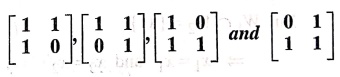 generate M2×2 (R) or not?
Solution:
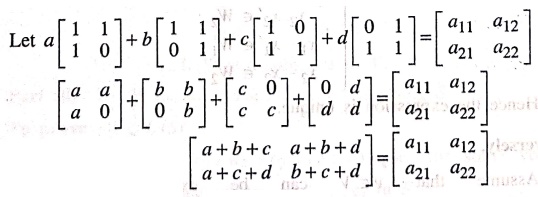
Here
a11, a12, a21
and a22 ∈ F = R.
By
comparing on both sides we have
a+b+c=α11 ……… (1)
a+b+d=a12 ……… (2)
a+c+d=a21 ……… (3)
b+c+d=a22 ……… (4)
From
equations (1), (2), (3) and (4), since an arbitrary matrix A in M2×2(R)
can be expressed as a linear combination of the four given matrices.
The given matrices generate M2×2
(R).
Example 21
Verify the vectors (1,
1, 0), (1, 0, 1) and (0, 1, 1) generate F3 or not.
Solution:
Let
us consider (x, y, z) ∈
F3 and a, b, c ∈
F
Let
(x, y, z) = au + bv + cw
(x,
y, z) = a (1, 1, 0) + b (1, 0, 1) + c (0, 1, 1)
=
(a, a, 0) + (b, 0, b) + (0, c, c)
(x,
y, z) = (a + b, a+c, b+c)
a+b=x ………… (1)
a+c=y ………… (2)
b+c=z ………….(3)
Equation
(2) ‒ (3) gives, a−b = y−z
……….(4)
Equation
(1) + (4) gives, a+b+a−b = x+y−z
⇒ 2a=x+y¬z ……….(5)
From
(5); a = 1/2(x + y −z]
From
(1) b = x−a
b = x – ½ = [ x + y − z] = ½ [ 2x − x − y+z]
b = 1/2 [x−y+z] ... (6)
From
equation (2); a+c=y
c=y−a
c = y − 1/2[x+y−z]
=
½ [2y−x−y+z]
c = ½ [y−x+2] .. (7)
(x, y,
z) = ½ (x + y − z](1, 1, 0) + ½ (x − y + z](1, 0, 1) + ½(y−x + 2](0, 1, 1)
The
given vectors generate F3.
Example 22
Let V=R3; S1
= {(1, 0, 0) } ; S2 = { (1, 0, 0), (2, 2, 0)} then prove that L(S1)  L(S2).
Solution:
L
(S1) = { α (1, 0, 0) / α ∈
F}
L
(S2) = { α (1, 0, 0) + β(2, 2, 0) / α, β ∈ F}
L(S1) L(S2)
{
L(S1) = L(S2) if β=0 }
Note:
If
one vector can be represented as the scalar multiplication of another vector
(ie) v1 = α v2, then the linear span of V will be equal
to linear span of v2.
Example 23
Let V=R3, W1
= {(x, x, x)/x ∈
R} and W2 = {(0, y, z)/y, z ∈
R} are two subspaces of V, then prove that V=W1  W2
W2
Solution:
Clearly W1 ∩ W2 = {0}
If
(x, y, z) ∈
V then we can write
(x, y, z) = (x, x, x) + (0, y − x, z − x) ∈ W1 + W2.
V=W1
+ W2. Hence V is the direct sum of W1 and W2.
(ie)
V = W1 W2
Example 24
Let V=R3, W1
= {(x, y, 0) / x, y ∈
R} and W2 = {(0,y,z) /y, z ∈
R } are clearly subspaces of V. But prove that V is not a direct sum of W1
and W2.
Solution:
Geometrically
W1 and W2 represent set of all points in the xy plane and
set of all points in yz plane respectively.
W1
∩
W2 = set of all points in y axis.
= {(0, y, 0)} ≠ {0}.
V is
not the direct sum of W1 and W2.
Example 25
Show that if 
then the span
of {M1, M2, M3} is the set of all symmetric
2×2 matrices.
Solution:
Since
all the matrices are symmetric, every matrix in their span will be symmetric,
hence we have to show that every symmetric matrix is in their span. Then every
2×2 symmetric matrix has the form of M =  and since we can
write these matrices as M=aM1+cM2+bM3 and in
the span of { M1, M2, M3 }.
and since we can
write these matrices as M=aM1+cM2+bM3 and in
the span of { M1, M2, M3 }.
Example 26
Show that the matrices 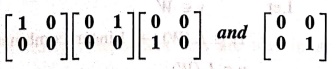 generate M2×2(R).
Solution:
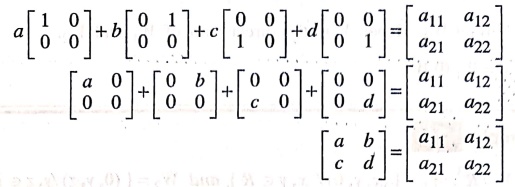
By
comparing on both sides a = a11,
b=a12, c=a21 and d=a22.
The
given matrices generate M2×2(R).
Example 27
Show that Pn(F)
is generated by {1,x,x2, x3,...xn}
Solution:
Let
S = {1, x, x2, x3, x2, ... xn }.
Let
α=a0+a1x+a2x2
+ a3t3… +anxn
be any arbitrary number of Pn where a0, a1, a2 …an ∈
F.
Then
α is the linear combination of polynomials 1, x, x2, x3...
xn over the field F.
S
generates Pn(F).
Linear Algebra: UNIT I: Vector Spaces : Tag: maths, mathematics : - Vector Spaces: Theorems Part 4 - Example Solved Problems
Linear Algebra: UNIT I: Vector Spaces
Under Subject
Linear Algebra
MA25C02 2nd Semester | 2025 Regulation
Related Subjects
English Essentials II
EN25C02 2nd Semester | 2025 Regulation | 2nd Semester 2025 Regulation

Tamils and Technology தமிழர்களும் தொழில்நுட்பமும்
UC25H02 2nd Semester | 2025 Regulation | 2nd Semester 2025 Regulation
Linear Algebra
MA25C02 2nd Semester | 2025 Regulation
Transforms and its Applications
MA25C03 2nd Semester EEE Dept | 2025 Regulation | 2nd Semester 2025 Regulation

Applied Physics (CE) II
PH25C02 2nd Semester Civil, Agri Depts | 2025 Regulation | 2nd Semester 2025 Regulation
Applied Physics (CSIE) II
PH25C03 2nd Semester AIDS, CSE, IT, CSE(CY) Dept | 2025 Regulation | 2nd Semester 2025 Regulation
Applied Physics (EE) II
PH25C04 2nd Semester EEE Dept | 2025 Regulation | 2nd Semester 2025 Regulation

Applied Physics (ME) II
PH25C05 2nd Semester Mechanical Dept | 2025 Regulation | 2nd Semester 2025 Regulation
Applied Chemistry (CE) II
CY25C02 2nd Semester Civil Dept | 2025 Regulation | 2nd Semester 2025 Regulation

Applied Chemistry (ME) II
CY25C03 2nd Semester Mechanical Dept | 2025 Regulation | 2nd Semester 2025 Regulation

Electron Devices
EC25C01 2nd Semester ECE Dept | 2025 Regulation | 2nd Semester 2025 Regulation
Digital Principles and Computer Organization
CS25C06 2nd Semester AIDS, CSE, IT, CSE(CY) Dept | 2025 Regulation | 2nd Semester 2025 Regulation

Basic Electrical and Electronics Engineering
EE25C01 2nd Semester | 2025 Regulation | 2nd Semester 2025 Regulation

Basic Civil and Mechanical Engineering
GE25C01 2nd Semester EEE Dept | 2025 Regulation | 2nd Semester 2025 Regulation
Data Structures using CPlusPlus
CS25C05 2nd Semester ECE Dept | 2025 Regulation | 2nd Semester 2025 Regulation
Engineering Drawing
ME25C01 EEE, Mech, Agri, EEE Depts | 2025 Regulation | 2nd Semester 2025 Regulation
Data Structures and Algorithms
CS25C04 2nd Semester EEE Dept | 2025 Regulation

Circuits and Network Analysis
EC25C02 2nd Semester ECE Dept | 2025 Regulation | 2nd Semester 2025 Regulation

Engineering Mechanics
ME25C02 2nd Semester Mech, Civil, Agri Depts | 2025 Regulation | 2nd Semester 2025 Regulation
Object Oriented Programming (OOPs)
CS25C07 2nd Semester CSE, CSE(CY) Depts | 2025 Regulation | 2nd Semester 2025 Regulation