Linear Algebra: UNIT I: Vector Spaces
Vector Spaces: Theorems Part 1: Example Solved Problems
Important Example Solved Problems - Engineering Maths or Mathematics - Vector Spaces: Theorems Part 1
Vector Spaces: Theorems Part 1
Example Problems
Example 1: Write the zero vector of M3×4
(F).
Solution:
The
given matrix M3×4 is a matrix of order (3 × 4). (ie) Three rows and
4 columns.
The zero vector of M3×4 = 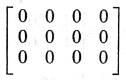
Example 2
If M =  what
are M13, M21 and M22?
what
are M13, M21 and M22?
Solution:
Given
that M is a non−square matrix with 2 rows and 3 column (ie) M2x3
(F).
In
general M2x3= 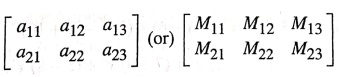
M13=3, M21 =4 and M22
= 5.
Example 3
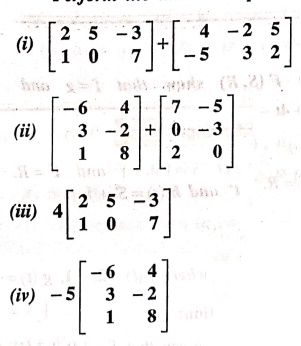
Perform the indicated
operations for the following
(v) (2x4 −
7x3+4x+3) + (8x3 + 2x2 − 6x + 7)
(vi) (−3x3
+7x2 + 8x − 6) + (2x3 − 8x + 10)
(vii) 5(2x7 – 6x4 + 8x2
‒ 3x)
(viii) 3(x5 – 2x3 + 4x +
2)
Solution:
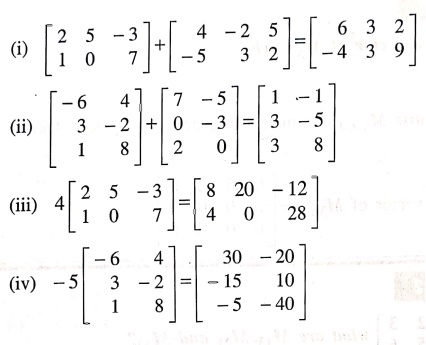
(v)
(2x4 − 7x3+4x+3) + (8x3 + 2x2 − 6x
+ 7)
= (2 + 0)x4 + (− 7 + 8) x3
+ (0 + 2)x2 + (4 − 6)x + (7 + 3)
=
2x4 + x3 + 2x2 − 2x + 10
(vi)
(−3x3 +7x2 + 8x − 6) + (2x3 − 8x + 10)
=
(− 3 + 2)x3 + (7 + 0)x2 + (8 − 8)x + (− 6 + 10)
=
−x3 + 7x2 + 0x + 4
(vii)
5(2x7 – 6x4 + 8x2 ‒ 3x) = 10x7 −
30x4 + 40x2 − 15x
(viii)
3(x5 – 2x3 + 4x + 2) = 3x5 − 6x3 +
12x+6
Example 4
Let S={0,1} and F= R. In
F (S, R) show that f=g and f+g=h where f(t)=2t+1, g (t)=1+4t−2t2 and
h(t)=5t+1.
Solution:
It
is given that S={0, 1} and F= R.
To prove f=g we have to show that this
statement is valid for t=0 and t = 1.
f=g ⇒ 2t+1=1+4t−2t2
when
t=0; 1= 1 and when t=1; 3 = 3
Since
1= 1 and 3=3 the statement f= g is valid.
To
prove f+g=h; then
(2t+1)+(1+4t−2t2) = 5t+1
when
t=0; 1+1=1+1 ⇒ 2=2
when
t = 1; 3+ (3)=5+1 ⇒ 6=6
The statement f+g = h is verified.
Example 5
In any vector space V,
show that (a+b) (x+y)= ax+ay + bx+by for any x,y ∈ V and any a, b ∈ F.
Solution:
We
know that for each element a in F and
each pair of elements x, y in V, then
a (x + y) = ax + ay
and also for each pair of elements (a, b) in F and each element x in V then
(a+b) x = ax + bx.
Based
on these two conditions, (a+b) (x + y) can be written as
(a+b) (x + y) = a (x + y) + b (x+y) (or)
(a+b)x + (a + b)y
= ax + ay + bx+ by (or) ax + bx + ay + by
Example 6
Let V={(a1, a2); a1, a2 = F} where F is a field. Define
addition of elements of V and for C∈F
and (a1, a2)
∈ V, define c (a1, a2) = (a1, 0). Is V
is a vector space over F with these operations.
Solution:
Given
that V = {(a1, a2);
a1, a2 ∈
F}
c (a1, a2)
= (a1, 0) for c ∈
F, (a1, a2) ∈ V.
0 (a1, a2)
= (a1, 0) is the zero vector which is a contradiction the rule 3, that
the zero vector to be unique.
V is
not a vector space over F with these operations.
Example 7
Let V = {(a1, a2); a1, a2 ∈
R}. For (a1, a2),
(b1, b2) ∈ V and c ∈ R, define (a1, a2) + (b1, b2) = (a1 + 2b1, a2+3b2)
and c (a1, a2 = (ca1, ca2).
Verify whether V is a vector space over R with these operations?
Solution:
Given
that V = {(a1, a2):
a1, a2 ∈
R}
Here
(a1, a2), (b1, b2) ∈ V and c ∈ R.
(a1, a2)+(b1, b2) = (a1+2b1, a2 + 3b2) and
c (a1, a2)=(ca1, ca2)
(a1, a2) + (b1, b2) = (a1 +2b1, a2 +3b2)
(b1, b2) + (a1, a2) = (b1 + 2a1, b2 +3α2)
(a1, a2)
+ (b1, b2) ≠ (b1, b2) + (a1, a2)
This
is the contradiction to the rule 1.
V is not a vector space over R, with these
operations.
Example 8
Let V={(a1, a2, a3...
an); ai ∈
R for i = 1, 2, 3 ... n }.. V is a vector space over R.
Define u = (a1, a2, а3 ... an) ∈ Fn
v = (b1, b2, b3 ... bn) ∈
Fn
and c ∈ F. Then u + v = { a1+b1, a2+b2, a3 +b3, ... an+bn}
and cu= (ca1, ca2, ca3, ca4... can).
Is V a vector space
over the field of complex numbers with the operations of coordinate wise
addition and multiplication.
Solution:
No.
A real valued vector scalar multiply with a complex number will not be real
valued vector.
Example 9
Let V={(a1, a2, а3
... аn) ; αi ∈
С for i = 1, 2, 3 ... n} and V is a vector space over C by u= (a1, a2, a3... an) ∈ Fn and
v = (b1, b2, b3 ... bn) ∈ Fn. c ∈ F then,
u+v= (a1+b1, a2 +b2, a3
+ b3 + ...)
cu = (ca1, ca2, ca3... can)
Is V a vector space?
Solution:
All
the eight conditions of vector space are satisfied by the above operations. V
is a vector space over the filed of real numbers, with the operations addition
and multiplication.
[This
example has been already explained in Example. 1 given in examples for vector
space].
Example 10
Verify that the set V
of all ordered triples of real numbers of the form (x, y, 0) and defined the
operations + and • by
(i) (x, y, 0) + (x', y', 0) = (x + x', y+y',
0); (ii) c . (x, y, 0) = (cx, cy, 0) is a vector space or not.
Solution:
Let
us consider u = (x, y, 0) and v = (x′, y′, 0) and w = (x", y", 0) ∈ R3.
(i)
Closure axiom
u+v= (x, y, 0)+(x', y', 0) = (x+x', y+y', 0) ∈ R3
(ii)
Associative property
Let
u+(v+w) = (x, y, 0) + [(x', y', 0)+(x", y", 0)]
=
(x, y, 0)+(x′+x", y′+y", 0]
=
[x+x+x", y+y′+y", 0]
…………(1)
Similarly
(u
+ v) + w = [(x, y, 0) + (x', y', 0)] + (x", y", 0)
= [x + x', y + y', 0] + (x'', y'', 0)
=
[x + x' + x'', y+y'+y", 0]
From
(1) and (2) Associativity holds.
(iii)
Existence of Identity
Let
e = (e1, e2, 0) and u= (x, y, 0).
u+e=(x, y, 0)+(e1, e2,
0) = (x + e1, y + e2, 0) = u.
x+e1
=x, y+e2 = y, 0=0.
e1=0, e2=0, 0=0.
⇒ e=(0, 0, 0) ∈ R3.
(iv)
Existence of inverse
Let
u= (x, y, 0), u' = (x1,y1, 0)
u+u'
= e
⇒ (x, y, 0) + (x1, y1, 0) = (e1, e2, 0)
⇒ x+x1=e1, y+y1=e2,
0+0=0
u' = (x1,y1, 0) exists.
(v)
c(x, y, 0) = (cx, cy, 0) for all real numbers c and all u and v in V.
(vi)
c [d(x, y, 0) = c [dx, dy, 0]
=
[cdx, cdy, 0]
=
d [cx, cy, 0]
=
d[c (x, y, 0)]
(vii)
c [u+v] = c [(x, y, 0) + (x′, y', 0)]
=
[c(x, y, 0) + c(x', y', 0)]
(viii)
(c+d) u = (c+ d) (x, y, 0)
=
c(x, y, 0) + d (x, y, 0)
Since the given functions satisfy all the 8
conditions for vector space, it is a vector space.
Example 11
Consider the set V of
all ordered triples of real numbers (x, y, z) and define the operations + and •
by
(i) (x+y+z) + (x', y',
z') = (x + x', y+y', z+z') (ii) c. (x, y, z) = (cx, y, z) Verify the given
function is a vector space or not under the operations + and •.
Solution:
It
is easy to verify that all the conditions satisfy for the vector space except
the 8th condition. Here 0) = (0, 0, 0) and the negative of the vector (x, y, z)
is the vector (‒x, ‒y, ‒z).
Now
let us verify the last 8th condition.
(ie)
(a + b) (x) = ax + bx
Here
(a+b) (x, y, z) = [(a + b) x, y, z]
Then
ax + bx becomes
a (x, y, z) + b (x, y, z) = (ax, y, z) + (bx,
y, z)
=
[(ax + bx), 2y, 2z]
Hence
(a + b) (x) ≠ ax + bx.
The
above condition is not satisfied by the given function.
V
is not a vector space under the prescribed operations.
Example 12
Let V be the set of all
positive real numbers. Define the vector addition and scalar multiplication as
follows. x+y=xy and kx = xk. Determine whether or not V is a vector
space over R with respect to the above operations.
Solution:
Let
V={(x)/x+y=xy & kx = xk, x, y ∈ R+ = (0, ∞) }
(i)
Let x1 ∈ V & y1 ∈ V ⇒
x1+y1 = x1у1
∈ V
Closure
axion is satisfied.
(ii)
For all x, y ∈
V, x+y=y+x ( commutative law).
Let
x1, y1 ∈
V
Now
x1+y1 = x1y1= y1x1=
y1+x1
(iii)
For all x, y, z ∈
V, (x+y) + z = x + (y + z) (Associative law).
Let
x1, y1, z1 ∈
V then
Now
(x1+y1) + z1 = (x1 y1)
+z1 = x1 y1 z1 ∈ V ...(1)
Then
x1 + (y1 + z1)
= x1 + (y1z1)
= x1 y1 z1 ∈
V ...(2)
From
(1) & (2) we have (x+y) + z = x+(y+z)
(iv) For x ∈
V, there exists 0 ∈ V
such that x+0=x
Let
x1 = V & e ∈ V
x1+e=x1e=ex1 = e +x1
⇒ e=
l ∈ V
(v)
For all x ∈
V, ⇒ 1•x=x
Let
x1 ∈ V ⇒ 1•x1=x=x1
∈ V
(vi)
For any x,y ∈
V ⇒ x+y=0
Let
x1 ∈ V
x1+(−
x1)=(− x1) + x1 = − x1
x1 = 1/x1 ∈ R+ = V
(vii)
For all a, b ∈ F
and x ∈ V, (ab) x = a (bx)
Let
k, l ∈ F and x ∈ V
(kl) x = k(lx) = k(xl) = xlk
= (kl) (x) = k (lx)
(viii)
For a ∈ F, x, y ∈ V ⇒ a (x + y) = ax + ay
Let
k ∈ F and x1,y1 ∈
V
k (x1+y1) = k (x1 y1)
= (x1 y1)k = x1k y1k
= x1k + y1k
= kx1+ky1
(ix) For a, b ∈ F, and x ∈ V then (a + b) x = ax + bx
Let
k, l ∈ F & x1 ∈
V
(k + 1)
x1 = x1k+1
= x1k . x1l = x1k
+ x1l = kx1
+ lx1
Since
all the properties are satisfied, V is a vector space.
Example 13
Determine whether the
set of all 2×2 matrix of the form 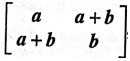 , a, b ∈
R with respect to standard matrix addition and scalar multiplication is a
vector space or not? If not, list all the axioms that fail to hold.
, a, b ∈
R with respect to standard matrix addition and scalar multiplication is a
vector space or not? If not, list all the axioms that fail to hold.
Solution:
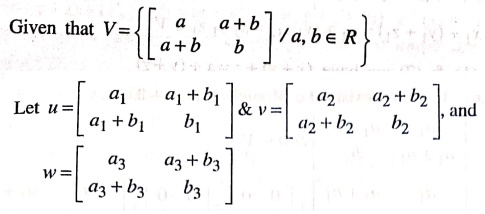
(i)
For all x, y ∈
V, then x+y=y+x (commutative law).
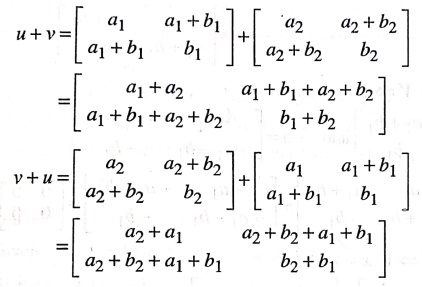
From
equations (1) & (2) we have u+v = v+ u
(ii)
For all x, y, z ∈
V, (x + y) + z = x + (y + z) (Associative law)
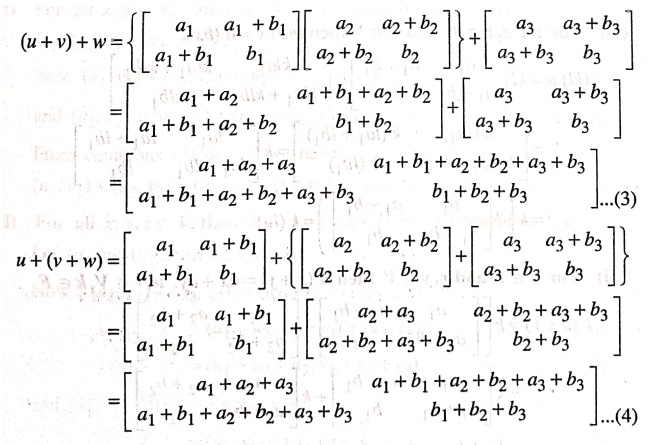
From
equations (3) and (4) (u+v) + w = u + (v+w)
(iii) For x
∈ V, there exists 0 ∈ V such that x+0 = x.
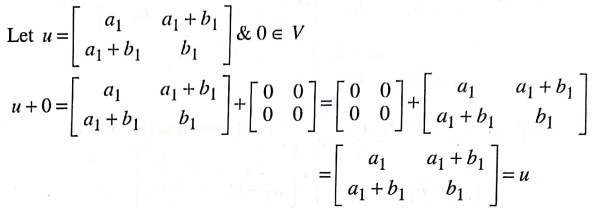
(iv) For all x,y ∈ V ⇒ x+y=0.
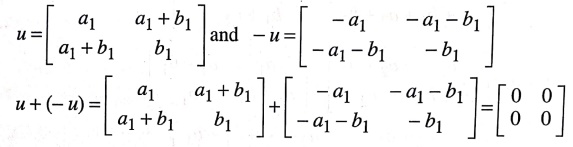
(v) For all x ∈ V
⇒ 1.x=x.
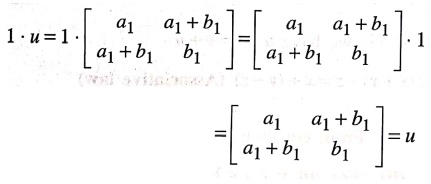
(vi) For all a, b ∈ F and x ∈ V then (ab) x = a
(bx).
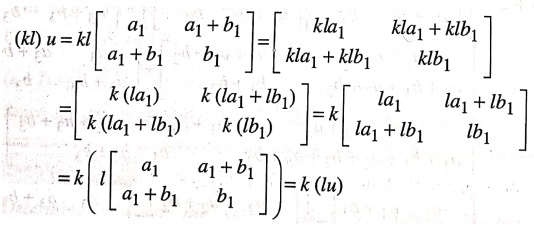
(vii) For a ∈ F and x, y ∈ V then a (x+y)=ax+ay,
u, v ∈ V, k ∈ F.
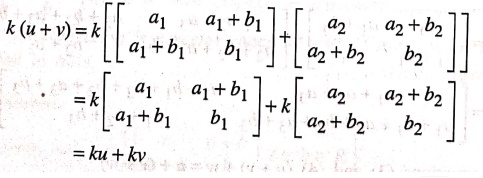
(viii) For a, b = F & x ∈ V then (a + b) x = ax
+ bx
Let
k, l ∈ F & u ∈ V

= ku + lu
Since
all the above 8 results are satisfied V is a vector space.
Example 14
Let U and V be the
vector spaces over a field F. Let Z = {(u, v) | u ∈ U and v ∈ V}. Prove that Z is a vector space
over F under the following operations. (u1, v1) + (u2,
v2) = (u1+u2, v1+v2) and
c (u1, v1) = (cu1, cv1)
Solution:
Given
that Z= {(u,v); u ∈
U and v ∈ V}
Also
(u1, v1) + (u2, v2) = (u1
+ u2, v1+v2) ...(1)
c (u1, v1) = (cu1,
cv1) ...(2)
(i) For all x,y ∈ V, then x+y=y+x (commutative law).
Let
(u1, v1), (u2, v2) ∈ z
Now
(u1, v1)+(u2, v2)=(u1 + u2,
v1+v2) ...(3)
and
(u2, v2)+(u1, v1)=(u2+u1,
v2+v1) ...(4)
From
equations (3) & (4), we have
(u1,
v1) + (u2, v2) = (u2, v2)
+ (u1, v1)
(ii) For all x, y, z ∈ V, then (x + y) + z = x + (y + z)
(Associative law)
Let
(u1, v1) (u2, v2), (u3, v3)
∈ Z.
Now
[(u1, v1) + (u2, v2)] + (u3,
v3)
=
(u1 + u2, v1+v2) + (u3, u3)
=
(u1+u2+u3, v1+v2 + v3) ...(5)
and
(u1, v1) + [(u2, v2) + (u3,
v3)]
=
(u1, v1) + (u2+ u3, v2 +
v3)
=
(u1 + u2 + u3, v1 + v2+
v3) ...(6)
From
equations (5) & (6) we have
[(u1,
v1) + (u2, v2)] + (u3, v3)
= (u1, v1) + [(u2, v2) + (u3,
V3)]
(iii) For x ∈ V, there exists 0 ∈ V such that x+0=x.
Lt
(0u, 0v) ∈
Z
(u, v) + (0u, 0v) = (u + 0u, v + 0v) = (u, v)
(0u, 0v) is the zero vector in Z.
(iv) For all x,y ∈ V ⇒ x+y=0.
Let
(u, v) ∈ Z then there exists (‒u,
‒v) ∈ Z
(u, v) + (−u, −v) = (u−u, v − v) = (0, 0) = (0u,
0v) = 0z
(v) For all x ∈ V ⇒
1.x=x.
Let
(u, v) ∈ Z ⇒ 1 (u, v) = (lu, 1v) =
(u, v)
(vi) For all a, b ∈ F and x ∈ V, (ab) x = a (bx).
Let
a, b ∈ F and (u, v) ∈ Z
(ab) (u, v) = (abu, abv) = a (bu, bv) = a [b
(u, v)]
(vii) For a ∈ F, x, y ∈ V, then a (x+y) = ax+ay
Let
c ∈ F & (u1,
v1), (u2, v2) ∈ Z
c[ (u1, v1) + (u2,
v2) ] = c[ u1 + u2, v1 + v2
]
=
[cu1 + cu2, cv1 + cv2 ]
=
c(u1, v1)+c (u2, v2)
(viii) For a, b ∈ F and x ∈ V, (a + b) x = ax + bx.
Let
(a, b) ∈ F, (u, v) ∈ Z then
(a + b) (u, v) = (au + bu, av + bv)
=
(au, av) + (bu, by)
=
a(u, v) + b(u, v)
From
the above 8 results, Z is a vector space over F.
Example 15
Let V be the set of all
m×n matrices with real entries. Let F be the field of rational numbers. Let us
define (A+B)ij=Aij+Bij for all A, B ∈ Mm×n (F) & C ∈ F, also (CA)ij=CAij,
Prove that V is a vector space over the field F.
Solution:
Let
us consider A=[aij]m×n
, B = [bij] m×n
, C = [cij]m×n and aij,
bij, cij ∈ F.
(i) For all x,y ∈ V, x+y=y+x (commutative law.)
A
+ B = [aij]m×n +
[bij]m×n = [αij
+ bij]m×n
=
[bij + aij]m×n = [bij]m×n +[aij]m× n = B+A
A
+ B = B+A
(ii) For all x, y, z ∈ V, (x + y) + z = x + (y + z).
[A + B] + C = [ [aij]m×n + [bij]m×n ] + [Cij]m×n
=
[αij + bij]m×n
+ [Cij]m×n
=
[aij + bij + Cij]m×n
=
[aij + (bij + Cij)]m×n
= [aij]m×n
+ [ [bij]m×n
+ [Cij]m×n ]
=A+
(B+C)
(A + B)
+C = A+(B+C)
(iii) For x ∈ V, there exists 0 ∈ V such that x+0=x.
A+0 = [aij]m×n
+ [0]m×n = [aij+0]m×n = [αij]m×n
= A
Similarly,
0+ A = A ⇒
0=[0]m×n is the identity matrix.
(iv) For all x, y ∈ V, x+y=0
A+ (−A) = [aij]m×n + [−aij]m×n
= [aij − aij]m×n = [0]m×n
Also (−A)
+ A = [−aij]m×n
+ [aij]m×n = [−
aij + aij]m×n = [0]m×n
−A is the additive inverse of the matrix A.
(v) For all x ∈
V, 1⋅
x = x.
1 • A =
1 [aij]m×n = [1
⋅ αij]m×n
= [aij]m×n =A.
(vi) For all a, b ∈ F and x ∈ V then (ab) x = a (bx)
(ab) A = (ab) [aij]m×n = [(ab) aij]m×n = [ a (baij) ]m×n
=
a[baij]m×n = a
[b [aij]m×n] =
a(bA)
(ab) A = a (bA)
(vii) For a ∈ F and x,y ∈ V then a (x + y) = ax+ay
a [A + B] = a [[aij]m×n
+ [bij]m×n] = a
[aij+bij]m×n
=
[a (aij + bij)]m×n
=
[aaij + abij]m×n
=
[aaij]m×n + [abij]mxn
= a [aij]mxn = a
[bij]m×n
=
aA + aB
a [A+B]
= aA + aB.
(viii) For a, b ∈ F and x ∈ V then (a+b) x = ax + bx
(a+b) A = (a+b) [aij]m×n
=
a[αij]m×n + b[aij]m×n
= aA +bA
(a + b)A = aA + bA
From
the above 8 results, the set of all m×n matrices with real entries is a vector
space over F.
Example 16
Given that V = {(u1,
u2) / u1, u2 ∈
R}. Also (u1, u2), (v1, v2) ∈ V and C ∈ R. Define (u1, u2)
+ (v1, v2) = (u1+2v1, u2+3v2)
and c (u1, u2) = (cu1, cu2). Prove
that V is not a vector space over R for the above operations.
A Solution:
Given
that V={(u1, u2) / u1, u2 ∈ R }
(u1,
u2), (v1, v2) ∈ V and c∈R
Define
that (u1, u2) + (v1, v2) = (u1
+ 2v1, u2 + 3v2) ...(1)
and
c (u1, u2)=(cu1, cu2) ...(2)
(i) For x,y ∈ V, x+y=y+x (commutative law).
(u1,
u2) + (v1, v2) = (u1 + 2v1,
u2+3v2) ...(3)
(v1,
v2) + (u1, u2) = (V1+2u1,
v2+3u2) ...(4)
From
(3) & (4)
(u1,
u2) + (v1, v2) ≠ (v1, v2)
+ (u1, u2)
which
is a contraction to the first rule.
V is
not a vector space over R with the above operations.
Example 17
Prove that the set of
all polynomials over the field F is a vector space V.
Solution:
Let
us consider the set of all polynomials be
(a) u(x)=a0+a1x+a2x2 + a3x3
+ a4x2 + ……. + anxn
where
a0, a1, a2, a3... an ∈ F
(a)
v(x)=b0+ b1x+ b2x2
+ b3x3 + b4x2 + ……. + bnxn
where
b0, b1, b2, b3... bn ∈ F
(c)
u(x)+v(x) = (a0 + b0) + (a1 + b1)x
+ (a2 + b2)x2
+ ... + (an+bn)
xn
(d)
cu (x) = ca0 + ca1x
+ ca2x2 + ……. + canxn where c ∈
F.
(i) For x, y ∈ V, then x+y=y+x (commutative law).
u(x) + v(x)=(a0+b0) + (a1 + b1) x + (α2+ b2) x2 + ... + (an+bn)
xn
v(x) + u(x) = (b0 + a0)
+ (b1 + a1)x + (b2+ a2)x2 + …. + (bn+an)xn.
u(x) + v(x) = v(x) + u(x)
(ii) For x, y, z ∈ V, (x + y) + z = x + (y + z)
(Associative law).
Here
u (x), v (x), w (x) ∈
V.
we
can easily prove that
[u
(x) + v(x)] + w(x) = u(x) + [v (x)+w (x)]
(iii) For x ∈ V there exists 0 ∈ V such that x+0=x.
0(x) + u(x) = (0 +0x + 0x2 + 0x2
+ ... + 0xn) + (a0 + a1x
+ a2x2 + ... +
anxn)
=
(0+a0) + (0+a1)x+(0
+ a2)x2 + ... +
(0+ a1) xn
=
a0 + a1x + a2x2
+ a3x3 + ... +anxn
=
u(x)
Similarly
we can prove that u (x) + 0 (x) = u(x)
From
the above two relations 0(x) is the additive identity in V.
(iv) For x,y ∈ V such that x+y=0.
Here
u(x) ∈ V ⇒ u (x) ∈ V
u(x) + [−u (x)] = 0(x) and also [−u (x)] +
u(x) = 0 (x)
− u (x) is the additive inverse of u (x).
(v) For x ∈ V, 1.x=x
Here
u(x) ∈ V and 1 ∈ F
1 ⋅
u (x) = 1 (a0 + a1x
+ a2x2 + a3x3 + ... + anxn)
=
(1a0) (1.a1)x+(1.a2)x2
+ (1.a3)x3 + ... +(1.an)xn
=
a0 + a1x+a2x2
+ α3x3 + ... + anxn = u(x)
1 • u (x) = u(x)
(vi) For a, b ∈ F and x ∈ V, (ab) x = a (bx)
Here
u(x) ∈ V and a, b ∈ F.
(ab)
u (x) = (ab) [a0 + a1x
+ a2x2 + a3x3 + ... + anxn]
=
ab a0 + ab a1x
+ ab a2x2 + aba3x3 + ... + ab anxn
=
a [ba0 + ba1x +
ba2x2 + ba3x3 + ... + banxn]
=
a [bu (x)]
⇒ (ab) u (x) = a [bu
(x)]
(vii) For a ∈
F and x, y = V, a (x + y) = ax+ay
a [u(x) + v(x)] = a [(a0+b0)
+ (a1 + b1) x + (a2 + b2) x2
+ ... + (an + bn)
xn]
=
aa0 + ab0 + aa1x
+ ab1x + aa2x2
+ ab2x2 +….. + aanxn + abnxn
=
a [a0 + a1x + a2x2
+ a3x3 + ... + anxn] + a [b0
+ b1x + b2x2
+ ... + bnxn]
=
a u(x) + b v (x)
a [u
(x) + v (x)] = a u (x) + b v (x).
(viii) For a, b ∈ F and x ∈ V, (a + b) x = ax + bx.
(a + b)
u (x) = (a + b) [a0 + a1x
+ a2x2 + a3x3 + ... + anxn]
=
[aa0+aa1x+aa2x2
+ aa3x3 + ... + aanxn] + [ba0+ba1x+ba2x2
+ ba3x3 + ... + ba,xn]
=
a [a0 + a1x +
... anxn] + b
[a0 + a1x + a2x2
+ ... + anxn]
=
a u(x) + b u(x)
From
the above 8 results it is proved that the set of all polynomials over a field F
is a vector space V.
Example 18
Let V be the set of
sequences {an} of real numbers. Define: {an}+{bn}={an+bn}
and t {an}={tan}. Prove that V is a vector space over R
with the above operations.
Solution:
Given
that
{an},{bn}
∈ V
{an}
+ {bn} = {an+bn} .......(1)
t{an} = {tan} .......(2)
(i) For all x,y ∈ V, x+y=y+x (commutative law)
Here
{an}, {bn} ∈ V
Then
{an}+{bn}={an+bn} ...(3)
also
{bn}+{an}={bn + an} ...(4)
From
(3) & (4) {an}+{bn}
= {bn} + {an}
(ii) For all x, y, z ∈ V, (x + y)+z = x+(y+z)
(Associative law)
[{an}
+ { bn } ] + { cn
} ] = {an+bn }
+ { cn } = { an+bn+cn} …..(5)
{an
} + [ { bn } + { cn
} ] = {an} + { bn + cn } = {an + bn + Cn } …..(5)
From
(5) & (6) [{an}+{bn}
] + { cn} = {an}+[ {bn}+{
cn}]
(iii) For x ∈ V, there exists 0 ∈ V such that x+0=x
{ an } + {0} = {an + 0 }
= { an }
(iv) For all x, y ∈ V, x+y=0
{an} + {−an} = {an
+ (−an) } = { 0 }
(v) For x ∈ V, 1.x=x
1.{an} = { 1an } = {an}
(vi) For all a, b ∈ F and x ∈ V, then (ab)x = a(bx)
(ab)
{xn} = { ab xn} by
(2).
a{bxn}={ab xn} by (2).
ab {xn}
= a {bxn}
(vii) For a ∈ F and x,y ∈ V, a (x+y)=ax+ay.
a[{xn} + {yn } ] = a { xn
+ yn } = {a (xn + yn) } = { axn+ayn
}
……….(7)
a{xn}+a{yn} = {axn}
+ { ayn } = { axn + ayn }
………..(8)
From
(7) and (8) a[{xn}+{ yn } ] = a { xn } + α { yn
}
(viii) For a, b ∈ F and x ∈ V then (a + b) x = ax + bx.
(a + b) { xn} = {(a + b) xn
} = { axn + bxn}
……….(9)
a{xn}+b{xn}={axn}
+ { bxn } = { axn + bxn} ……….(10)
From
(9) & (10), (a+b) {xn} = a{xn} + b{xn}
From
the above 8 results, V is a vector space over R.
Linear Algebra: UNIT I: Vector Spaces : Tag: maths, mathematics : - Vector Spaces: Theorems Part 1: Example Solved Problems
Linear Algebra: UNIT I: Vector Spaces
Under Subject

Linear Algebra
MA25C02 2nd Semester | 2025 Regulation
Related Subjects

English Essentials II
EN25C02 2nd Semester | 2025 Regulation | 2nd Semester 2025 Regulation

Tamils and Technology தமிழர்களும் தொழில்நுட்பமும்
UC25H02 2nd Semester | 2025 Regulation | 2nd Semester 2025 Regulation
Linear Algebra
MA25C02 2nd Semester | 2025 Regulation

Transforms and its Applications
MA25C03 2nd Semester EEE Dept | 2025 Regulation | 2nd Semester 2025 Regulation

Applied Physics (CE) II
PH25C02 2nd Semester Civil, Agri Depts | 2025 Regulation | 2nd Semester 2025 Regulation

Applied Physics (CSIE) II
PH25C03 2nd Semester AIDS, CSE, IT, CSE(CY) Dept | 2025 Regulation | 2nd Semester 2025 Regulation

Applied Physics (EE) II
PH25C04 2nd Semester EEE Dept | 2025 Regulation | 2nd Semester 2025 Regulation

Applied Physics (ME) II
PH25C05 2nd Semester Mechanical Dept | 2025 Regulation | 2nd Semester 2025 Regulation

Applied Chemistry (CE) II
CY25C02 2nd Semester Civil Dept | 2025 Regulation | 2nd Semester 2025 Regulation

Applied Chemistry (ME) II
CY25C03 2nd Semester Mechanical Dept | 2025 Regulation | 2nd Semester 2025 Regulation

Electron Devices
EC25C01 2nd Semester ECE Dept | 2025 Regulation | 2nd Semester 2025 Regulation

Digital Principles and Computer Organization
CS25C06 2nd Semester AIDS, CSE, IT, CSE(CY) Dept | 2025 Regulation | 2nd Semester 2025 Regulation

Basic Electrical and Electronics Engineering
EE25C01 2nd Semester | 2025 Regulation | 2nd Semester 2025 Regulation

Basic Civil and Mechanical Engineering
GE25C01 2nd Semester EEE Dept | 2025 Regulation | 2nd Semester 2025 Regulation

Data Structures using CPlusPlus
CS25C05 2nd Semester ECE Dept | 2025 Regulation | 2nd Semester 2025 Regulation
Engineering Drawing
ME25C01 EEE, Mech, Agri, EEE Depts | 2025 Regulation | 2nd Semester 2025 Regulation

Data Structures and Algorithms
CS25C04 2nd Semester EEE Dept | 2025 Regulation

Circuits and Network Analysis
EC25C02 2nd Semester ECE Dept | 2025 Regulation | 2nd Semester 2025 Regulation

Engineering Mechanics
ME25C02 2nd Semester Mech, Civil, Agri Depts | 2025 Regulation | 2nd Semester 2025 Regulation

Object Oriented Programming (OOPs)
CS25C07 2nd Semester CSE, CSE(CY) Depts | 2025 Regulation | 2nd Semester 2025 Regulation