Linear Algebra: UNIT I: Vector Spaces
Vector Spaces: Basic Example Problems
Important Example Basic Solved Problems - Vector Spaces
VECTOR
SPACES
BASIC
EXAMPLE PROBLEMS
Example 1
The set of all n−tuples
with entries from a field F is denoted by Fn. This set is a vector
space over F with the operations of coordinate wise addition and scalar
multiplication.
Solution:
(ie)
If u= (a1, a2, a3... an) ∈ Fn
v
= (b1, b2, b3,... bn) ∈ Fn and C
∈ F then
u+v = (a1, a2 ... an) + (b1, b2 ... bn)
= (a1 + b1, a2 + b2, ... an + bn)
cu = c(a1, a2... an) = (ca1, ca2, ca3, ... can)
Thus
R3 is a vector space over R.
Here
(3,−2,1) + (2,− 5, 2) = (3 + 2, −2−5, 1+2) = (5, −7, 3) and −4 (2, 4, 0) = (−8,
16, 0)
Similarly,
C2 is a vector space over C.
Let
(2+i,3)+(2−4i, 2i) = (4−3i, 3+2i) and
i(2
− i, 4) = (2i – i2, 4i) = (2i + i2, 4i) = (1 + 2i, 4i)
Example 2
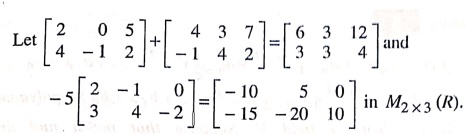
The set of all m×n
matrices with entries from a field F is a vector space, which is denoted by Mm×n
(F), with the following operations of matrix addition and scalar
multiplication.
Solution:
For
A, B ∈ Mm×n (F)
and c ∈ F
(A+B)ij
= Aij+Bij and (CA)ij =cAij, for 1 ≤
i ≤ m and 1≤j≤n.
Example 3
Let S be any non−empty
set and F be any field, and let F (S, F) denote the set of all functions, from
S to F. Two functions ƒ and g in F (S, F) are called equal if ƒ (s) = g(s) for
each s ∈
S. The set F (S, F) is a vector space with the operations of addition and
scalar multiplication defined for f,g ∈
F (S, F) and c ∈
F by (f+g) (s) = f (s) + g(s) and (cf) (s) = c [ƒ (s)] for each s ∈ S.
Example 4
A polynomial with
coefficients from a field "F" is an expression of the form.
ƒ(x) = anxn + an−1
xn-1 + an−2 xn-2 + …. + a1x + a0
where
n is a non−negative integer and each ak, called the coefficient of xk
is in F. If f(x)=0, if an=an-1 = an−2
= an−3 = … a0 = 0, then x f(x) is called the zero polynomial and
its degree is defined to be ‒1 otherwise, the degree of a polynomial is defined
to be the largest exponent of x that appears in the representation.
ƒ(x)
= anxn + an−1 xn-1 + an−2
xn-2 + …. + a1x + a0
with a non−zero coefficient.
Two
polynomials
ƒ(x)
= anxn + an−1 xn-1 + an−2
xn-2 + …. + a1x + a0
and
g(x)
= bmxm + bm−1
xm-1 + bm−2 xm-2 + …. + b1x + b0
are called equal if m=n and ai = bi;
for i=0, 1, 2 ... n.
Example 5
Let ƒ(x) = anxn + an−1 xn-1
+ an−2 xn-2 +
…. + a1x + a0
and g(x) = bmxm
+ bm−1 xm-1 + bm−2 xm-2 + …. + b1x + b0 be polynomials with
coefficients from a field F. Suppose that m≤n and define bm +1=bm
+2=bm + 3 = bn = 0.
Then
g(x) can be written as
g(x) = bnxn + bn−1
xn-1 + bn−2 xn-2 + …. + b1x + b0
Define
f(x)
+ g(x) = (an+bn)xn + (an-1+bn−1)xn-1 + (an-2+bn−2)xn-2
+ …. + (a1+b1)x + (a0+b0),
and
for any c ∈
F, define
cƒ(x) = canxn + can−1
xn-1 + can−2 xn-2 + …. + ca1x + ca0
With
these operations of addition and scalar multiplication, the set of all
polynomials with coefficients from F is a vector space, which is denoted by P
(F).
Example 6
Let
F be any field. A sequence in F is a function σ from the positive integers into
F. The sequence such that σ (n) = an for n = 1, 2, ... is denoted by
(an). Let V consists of all the sequences (an) in F. For
(an) and (bn) in V and t ∈ F, define (an) + (bn) = (an+bn) and t(an) =
(tan), with these operations V is a vector space.
Example 7
Let S = {(a1, a2); a1, a2 ∈
R}. For (a1, a2),
(b1, b2) ∈ S and C ∈ R, define (a1, a2) + (b1, b2) = (a1 + b1, a2+b2) and C(a1, a2) = (Ca1, Ca2)
Since
the properties
1.
x+y = y+x for all x, y ∈
V
2.
(x+y) + z = x + (y + z) for all x, y, z ∈
V
3.
(a+b) x = ax + bx for a, b ∈
F and x ∈ V.
fail
to hold, S is not a vector space with these operations.
Example 8
Let S = {(a1, a2) ; a1, a2 ∈ R ).
For
(a1, a2), (b1, b2) ∈ S and c ∈ R, define
(a1, a2)+(b1, b2) = (a1+b1, 0) and
c (a1, a2)
= (ca1, 0).
Then
S is not a vector space with these operations since properties 3, 4, and 5
fail.
Linear Algebra: UNIT I: Vector Spaces : Tag: maths, mathematics : - Vector Spaces: Basic Example Problems
Linear Algebra: UNIT I: Vector Spaces
Under Subject
Linear Algebra
MA25C02 2nd Semester | 2025 Regulation
Related Subjects
English Essentials II
EN25C02 2nd Semester | 2025 Regulation | 2nd Semester 2025 Regulation
Tamils and Technology தமிழர்களும் தொழில்நுட்பமும்
UC25H02 2nd Semester | 2025 Regulation | 2nd Semester 2025 Regulation
Linear Algebra
MA25C02 2nd Semester | 2025 Regulation
Transforms and its Applications
MA25C03 2nd Semester EEE Dept | 2025 Regulation | 2nd Semester 2025 Regulation

Applied Physics (CE) II
PH25C02 2nd Semester Civil, Agri Depts | 2025 Regulation | 2nd Semester 2025 Regulation
Applied Physics (CSIE) II
PH25C03 2nd Semester AIDS, CSE, IT, CSE(CY) Dept | 2025 Regulation | 2nd Semester 2025 Regulation
Applied Physics (EE) II
PH25C04 2nd Semester EEE Dept | 2025 Regulation | 2nd Semester 2025 Regulation

Applied Physics (ME) II
PH25C05 2nd Semester Mechanical Dept | 2025 Regulation | 2nd Semester 2025 Regulation
Applied Chemistry (CE) II
CY25C02 2nd Semester Civil Dept | 2025 Regulation | 2nd Semester 2025 Regulation

Applied Chemistry (ME) II
CY25C03 2nd Semester Mechanical Dept | 2025 Regulation | 2nd Semester 2025 Regulation

Electron Devices
EC25C01 2nd Semester ECE Dept | 2025 Regulation | 2nd Semester 2025 Regulation
Digital Principles and Computer Organization
CS25C06 2nd Semester AIDS, CSE, IT, CSE(CY) Dept | 2025 Regulation | 2nd Semester 2025 Regulation

Basic Electrical and Electronics Engineering
EE25C01 2nd Semester | 2025 Regulation | 2nd Semester 2025 Regulation

Basic Civil and Mechanical Engineering
GE25C01 2nd Semester EEE Dept | 2025 Regulation | 2nd Semester 2025 Regulation
Data Structures using CPlusPlus
CS25C05 2nd Semester ECE Dept | 2025 Regulation | 2nd Semester 2025 Regulation
Engineering Drawing
ME25C01 EEE, Mech, Agri, EEE Depts | 2025 Regulation | 2nd Semester 2025 Regulation
Data Structures and Algorithms
CS25C04 2nd Semester EEE Dept | 2025 Regulation

Circuits and Network Analysis
EC25C02 2nd Semester ECE Dept | 2025 Regulation | 2nd Semester 2025 Regulation

Engineering Mechanics
ME25C02 2nd Semester Mech, Civil, Agri Depts | 2025 Regulation | 2nd Semester 2025 Regulation
Object Oriented Programming (OOPs)
CS25C07 2nd Semester CSE, CSE(CY) Depts | 2025 Regulation | 2nd Semester 2025 Regulation