Linear Algebra: UNIT I: Vector Spaces
Linear Dependence and Linear Independence: Example Solved Problems
Important Example Solved Problems - Engineering Maths or Mathematics - Linear Dependence and Linear Independence
LINEAR
DEPENDENCE AND LINEAR INDEPENDENCE
WORKED
EXAMPLE PROBLEMS
Example 1
Verify whether the
following given sets are linearly dependent or linearly independent.
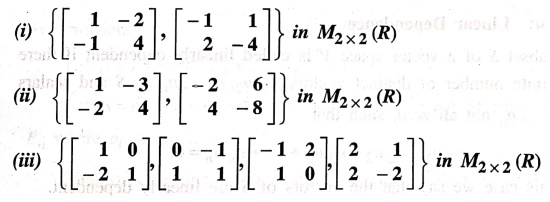
Solution:
(i)
To show that it is linearly independent, we must find scalars a1 and a2 such that a1u1 + a2u2 = 0.
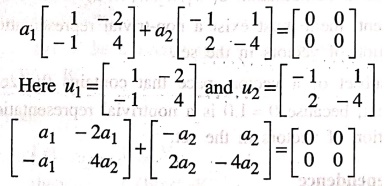
a1− a2=0 ……. (1)
−2a1
+ a2 = 0 ……. (2)
−a1+2a2=0 ……. (3)
4a1−4a2=0 ……. (4)
From
equations (1) and (4), we have a1
= a2 ⇒ a1 = 0 and a2 = 0.
a1 = 0 and a2 =0 satisfy all the above 4 equations.
Hence
u1 and u2 are linearly independent.
(ii)
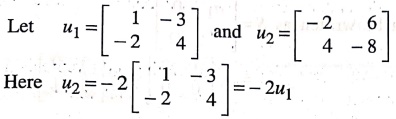
u2 = −2u1
Here
u1 and u2 are linearly dependent.
(iii)
Let a1u1+ а2u2
+ a3u3 + a4u4
= 0 where
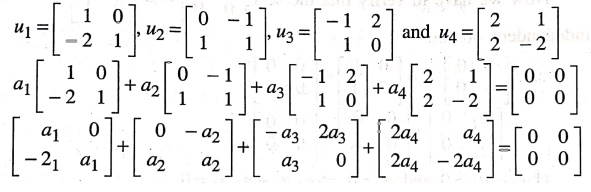
a1−a3+2a4=0 ……(1)
−α2+2a3 +α4=0 ……(2)
−2a1 + a2+ a3 +2a4 = 0 ……(3)
a1+a2−2a4=0 ……(4)
By
solving these above four equations, we get
a1
= 0, a2 = 0, a3 = 0 and a4
= 0.
.
The given sets are linearly independent.
Example 2
The set of diagonal
matrices of M2×2(F) is a subspace. Find a linearly independent set
that generates this subspace.
Solution:
Let
S = { ∈ M2×2: a,b ∈ F }
To
prove that it is linearly independent set that generates S.
Let
us first find the set that generates S.
Let
u ∈ S then u =
The vector u can be written as
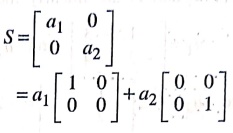
S = a1u1 + a2u2
The
set generates S is { ,
, }
}
Now
we have to verify that the sets and are linearly independent
or not.
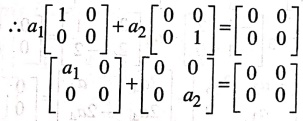
Hence
a1 =0 and a2=0 ⇒ a1u1
+ а2u2 = 0.
The
given sets are linearly independent.
Example 3
Prove that if {A1, A2, A3 ... Ak} is a linearly independent
subset of Mn×n (F), then {A1t, A2t, A3t, A4 t ... Akt
} is also linearly independent.
Solution:
Let
A1, A2, A3
... Ak ∈
Mn×n (F).
Then
a1A1+ a2 A2 + a3A3 + ... + akAk
= 0
which
means a1 = 0, a2 = 0... ak = 0.
Let
a1, a2, a3... ak be the
scalars such that
a1A1t
+ a2A2t
+ a3A3t + ... + akA1t
= 0
By
taking transpose on both sides we get
[ a1A1t
+ a2A2t
+ a3A3t + ... + akA1t
]t = 0
⇒ a1(A1t)t
+ a2(A2t)t
+ a3(A3t)t
+ …. + ak(Akt)t = 0
⇒ a1А1
+ a2 A2 + a3А3
+ ... akAk = 0
That
means a1 = a2 = a3 = a4 …… = ak = 0,
since { A1, A2 ...
Ak} is a linearly independent.
{ A1t, A2t, A3t ... Atk}
is linearly independent.
Example 4
Let us consider the set
S={(1, 3, −4,2), (2, 2, − 4, 0), (1, 3, 2, 4), (−1, 0, 1, 0)} in R4.
Show that S is linearly dependent and express one of the vectors in S as a
linear combination of the other vectors in S.
Solution:
To
show that S is linearly dependent, we must find scalars a1, a2, a3 and a4
not all zero such that
a1(1,3,−4,
2) + a2(2, 2, −4, 0) + a3(1, −3, 2,−4) + a4(−1,
0, 1, 0) = 0.
(a1, 3a1, − 4a1, 2a1)
+ (2a2, 2a2, − 4a2, 0) + (α3, − 3a3, 2a3, − 4a3)
+ (−α4, 0, α4, 0)=0
Finding
such scalars amounts to find a non−zero solution to the system of linear
equations
a1+2a2+ a3−a4=0
3a1+2a2−3a3+0α1
=0
−4a1−4a2+2a3+a4 = 0
2a1+0a2 − 4a3+0a4=0
Solving
these 4 equations for a1, a2, a3
and a4 we get
a1=4,
a2=−3, a3 = 2
and a4 = 0.
Thus
S is a linearly dependent sub set of R4 and
4 (1, 3, ‒4, 2) ‒3 (2, 2, ‒4, 0) + 2(1,−3, 2,−4)
+ 0(−1, 0, 1, 0) = 0
(4, 12, ‒16, 8) + (−6, −6, 12, 0) + (2, ‒6,4,−8)
= 0
⇒ 4−6+2=0,
12−6−6=0,− 16+ 12+4=0 and 8+0−8=0
Example 5
Verify whether the
given set in M2×3(R) is linearly dependent or not.

Solution:
To
show that S is linearly dependent, we must find scalars a1, a2, a3 such that
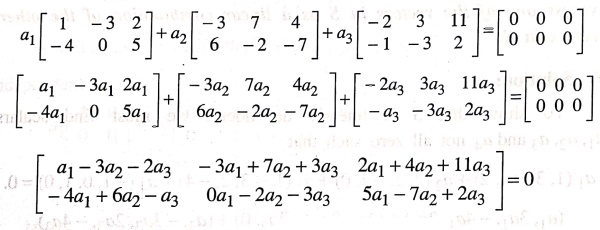
а1 − 3а2 − 2а3
= 0
−3a1+7a2 + 3a3 = 0
2a1 +4a2+11a3
= 0
−4a1+6a2−a3
= 0
0a1−2a2−3a3=0
5a1−7a2+2a3 = 0
By
solving these 6 equations we get the values as
a1=5,
a2 = 3, a3 = −2.
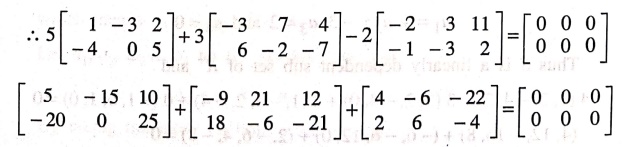
It
is linearly dependent.
Example 6
Prove that the set
S={(1, 0, 0, −1), (0,
1, 0, −1), (0, 0, 1, −1), (0, 0, 0, 1)} is linearly independent.
Solution:
Now
we must show that the only linear combinations of vectors in S that equals the
zero vector is the one in which all the coefficients are zero.
Suppose
that a1, a2, a3
and a4 are scalars such
that
a1(1,
0, 0, −1)+ a2(0, 1, 0, −1)
+ a3(0, 0, 1, −1) + a4(0, 0, 0, 1) = (0, 0, 0, 0)
(a1, 0, 0, −a1) + (0, a2, 0, − a2) + (0, 0, a3, −a3)
+ (0, 0, 0, a4) = (0, 0, 0, 0)
⇒ a1=0;
a2=0; a3=0
−a1−a2−a3 + a4 =0
⇒ а4=0.
Clearly
the only solution to this system is
a1
=0, a2 = 0, a3=0 and a4 = 0 and so S is linearly
independent.
Example 7
For k = 0, 1, 2, 3, ...
n.
Let Pk(x) =
xk + xk+1 + x
k+2 + ...+ xn. Then
prove that the set {P0(x), P1(x), P2(x), ... Pn(x)}
is linearly independent in Pn(F).
Solution:
Let
us consider
a0P0(x) + a1P1(x) + a2P2(x) +...+ anPn(x)
= 0
for
some scalars a0, a1, a2, ... an.
Then
a0+(a0+a1)x + (a0+a1+a2)x2 + (a0+a1+a2+a3)x3 + … + (a0
+ a1 + a2 ... + an) xn = 0.
By
equating the coefficient of xk on both sides of this equation for k
= 1, 2, 3 ... n, we obtain
a0 = 0, a0 + a1 = 0, a0 + a1 + a2 = 0... and
so on.
a0
+ a1 + a2 + …. + an
=0
Clearly
the only solution to this system of linear equation is a = 0, a1 = 0, a2 = 0 ... an
= 0 and so it is linearly independent.
Example 8
If V=P (x) is a vector
space over F. Let S = {1, 1+x, 1 + x + x2 }. Check whether S is
linearly independent or not.
Solution:
a
(1) + b (1 + x) + c (1+x+x2)=0
c
+ a + b + bx + cx + cx2 = 0x2+0x +0
(a+b+c)
+ (b + c) x + cx2 = 0x2+0x+0.
Comparing
the coefficients on both sides, we have
a+b+c=0; b+c=0; c=0.
⇒ a=0;b=0;
c=0
S is
linearly independent
Example 9
Let V=R4. Prove
that V1 = (1, 0, 1, 0); v2 = (0, 1, 0, 1), v3 =
(0, 0, 0, 2) are linearly independent.
Solution:
We
know that av1+bv2+cv3=0
a(1,
0, 1, 0) + b(0, 1, 0, 1) + c(0, 0, 0, 2) = 0
(a,
0, a, 0) + (0, b, 0, b) + (0, 0, 0, 2c) = (0, 0, 0, 0)
(a,
b, a, b + 2c) = (0, 0, 0, 0)
a=0;
b=0; b+2c=0.
⇒ c = 0
a=0=b=c
The
vectors v1, v2, v3 are linearly independent.
Example 10
Verify whether the
following vectors are linearly dependent or linearly independent v1
= (2, 4, 14), v2 = (7, −3, 15), v3 = (− 1, 4, 7)
Solution:
We
know that av1 + bv2+cv3 = 0
a(2, 4, 14) + b(7,−3, 15) + c (−1, 4, 7) = (0,
0, 0)
(2a, 4a, 14a) + (7b, − 3b, 15b) + ( ‒c, 4c,
7c) = (0, 0, 0)
2a+7b−c=0
4a−3b+4c=0
14a+15b+7c=0
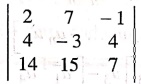
= 68 ≠ 0
The
vectors v1, v2, v3 are linearly independent.
Linear Algebra: UNIT I: Vector Spaces : Tag: maths, mathematics : - Linear Dependence and Linear Independence: Example Solved Problems
Linear Algebra: UNIT I: Vector Spaces
Under Subject
Linear Algebra
MA25C02 2nd Semester | 2025 Regulation
Related Subjects
English Essentials II
EN25C02 2nd Semester | 2025 Regulation | 2nd Semester 2025 Regulation

Tamils and Technology தமிழர்களும் தொழில்நுட்பமும்
UC25H02 2nd Semester | 2025 Regulation | 2nd Semester 2025 Regulation
Linear Algebra
MA25C02 2nd Semester | 2025 Regulation
Transforms and its Applications
MA25C03 2nd Semester EEE Dept | 2025 Regulation | 2nd Semester 2025 Regulation

Applied Physics (CE) II
PH25C02 2nd Semester Civil, Agri Depts | 2025 Regulation | 2nd Semester 2025 Regulation
Applied Physics (CSIE) II
PH25C03 2nd Semester AIDS, CSE, IT, CSE(CY) Dept | 2025 Regulation | 2nd Semester 2025 Regulation
Applied Physics (EE) II
PH25C04 2nd Semester EEE Dept | 2025 Regulation | 2nd Semester 2025 Regulation

Applied Physics (ME) II
PH25C05 2nd Semester Mechanical Dept | 2025 Regulation | 2nd Semester 2025 Regulation
Applied Chemistry (CE) II
CY25C02 2nd Semester Civil Dept | 2025 Regulation | 2nd Semester 2025 Regulation

Applied Chemistry (ME) II
CY25C03 2nd Semester Mechanical Dept | 2025 Regulation | 2nd Semester 2025 Regulation

Electron Devices
EC25C01 2nd Semester ECE Dept | 2025 Regulation | 2nd Semester 2025 Regulation
Digital Principles and Computer Organization
CS25C06 2nd Semester AIDS, CSE, IT, CSE(CY) Dept | 2025 Regulation | 2nd Semester 2025 Regulation

Basic Electrical and Electronics Engineering
EE25C01 2nd Semester | 2025 Regulation | 2nd Semester 2025 Regulation

Basic Civil and Mechanical Engineering
GE25C01 2nd Semester EEE Dept | 2025 Regulation | 2nd Semester 2025 Regulation
Data Structures using CPlusPlus
CS25C05 2nd Semester ECE Dept | 2025 Regulation | 2nd Semester 2025 Regulation
Engineering Drawing
ME25C01 EEE, Mech, Agri, EEE Depts | 2025 Regulation | 2nd Semester 2025 Regulation
Data Structures and Algorithms
CS25C04 2nd Semester EEE Dept | 2025 Regulation

Circuits and Network Analysis
EC25C02 2nd Semester ECE Dept | 2025 Regulation | 2nd Semester 2025 Regulation

Engineering Mechanics
ME25C02 2nd Semester Mech, Civil, Agri Depts | 2025 Regulation | 2nd Semester 2025 Regulation
Object Oriented Programming (OOPs)
CS25C07 2nd Semester CSE, CSE(CY) Depts | 2025 Regulation | 2nd Semester 2025 Regulation