Linear Algebra: UNIT I: Vector Spaces
Vector Spaces: Theorems Part 6 - Example Solved Problems
Important Example Solved Problems - Engineering Maths or Mathematics - Vector Spaces: Theorems Part 6
Vector Spaces: Theorems Part 6
Example Problems
Example 11
Let V=R3 and
S1 = {(1, 0, 0), (2, 2, 0), (5, 7, 2)}. Show that S1 is a
minimal generating set.
Solution:
x(1, 0, 0) + y(2, 2, 0) + z (5, 7, 2) = (a, b,
c)
(x,
0, 0) + (2y, 2y, 0) + (5z, 7z, 2z) = (a, b, c)
⇒ x+2y+5z=a,
0+2y+7z=b & 0+0+2z = c
x+2y+5z=a ...(1)
2y+7z
b ...(2)
2z
= c ...(3)
From
equation (3), we have z = c/2.
From
equation (2); 2y = b − (7c/2)
y
= (2b−7c) / 4
From
equation (1); x=a−2y−5z
=
a − 2(2b−7c / 4) − 5(c/2)
=
(4a−4b+ 14c − 10c) / 4
=
(4a−4b+ 4c) / 4
x
= a−b+ c
L(S1)
= V.
S2
= {(1, 0, 0) } is a proper subset of S1.
then
L
(S2) = { α (1, 0, 0)} → x - axis
S3
= {(2,2, 0)}
L(S2)
= {α (2, 2, 0)) → xy plane
Hence
S1 is a minimal generating set.
Example 12
Determine whether the
vectors v1 = (1, − 2, 3), v2 = (5, 6, − 1), v3
= (3, 2, 1) form a linearly dependent or linearly independent set in R3.
Solution:
We
know that
av1 + bv2 + cv3
= 0
a(1,
−2,3) + b(5, 6−1) + c(3, 2, 1) = 0
(a,−
2a, 3a)+(5b, 6b,− b) + (3c, 2c, c) = 0
a+5b+3c=0
−2a + 6b+2c=0
3a−b+c=0
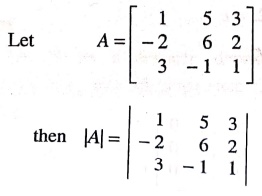
=
1 [6+2]−5 [−2−6]+3 [2−18]
=
1 [8] − 5[8] + 3[16]
=
8+40−48
=
48−48=0
The
given vectors are linearly dependent.
Example 13
In a matrix Mm×n
(F), let Eij denote the matrix whose only non−zero entry is 1 in the
ith row and jth column. Show that {Eij/1≤i≤m,1≤j≤n} is linearly
independent.
Solution:
Let
S = {Eij/1≤i≤m,1≤j≤n}
Given
that Eij is a matrix whose only non−zero entry is 1 in the ith
row and jth column. All the remaining entries in that matrix are
zero.
Let
us consider the matrices
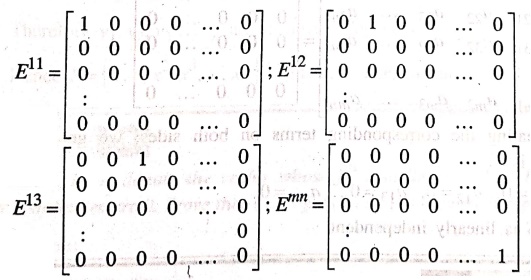
The
show that S is linearly independent, we must find scalars
a11,
a12, a13, a14
…..amn
Let
the linear combination of the elements of S as
a11E11 + a12E12
+ a13E13 + ….. + amnEmn = 0
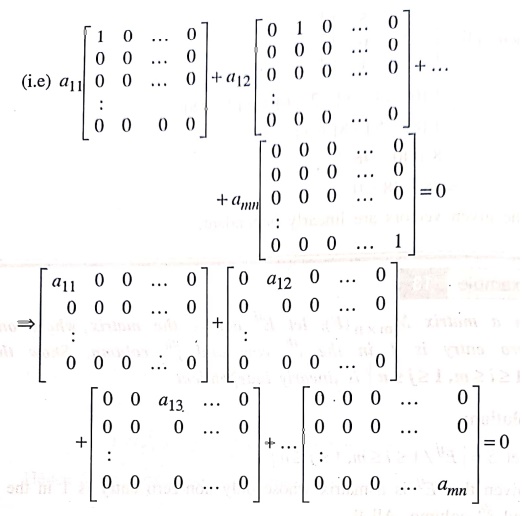
By
adding all the above matrices we get
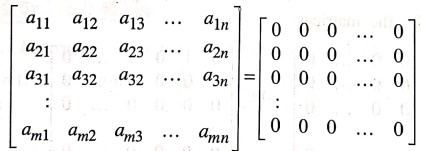
Equating
the corresponding terms on both sides, we get the only solution is
a11=0,
a12=0, a13=0... amn = 0
S is
linearly independent,
Example 14
Prove that the set
{1,x,x2...xn } linearly independent in Pn(F).
Solution:
Let
us consider Pn(F) = { a0
+ a1x + a2x2 + a3x3 + … + anxx
}
where a1, a2, α3... an ∈ F.
Let
S = {1, x, x2, x3... xn }
suppose
that v1 = 1 = (1, 0, 0, 0 ... 0)
v2=x=(0,
x, 0, 0... 0)
v3
= x2= (0, 0, x2, 0, 0, ... 0)
v4
= x3 = (0, 0, 0, x3,0, ... 0)
vi
= xi = (0, 0, 0, ..... 0, xi, 0 ...... 0)
:
:
vn=xn
= (0, 0, 0, 0, ... 0, xn)
Suppose
that a1, a2, a3 ... an are
scalars such that
a1v1
+ a2v2 + a3v3
+…. + anvn=0.
a1
(1, 0, 0 ... 0) + a2 (0, x, 0 ... 0) + ... + an (0, 0, 0 ... xn) = 0
⇒ (a1, 0, 0 ...
0) + (0, a2x, 0 ... 0) + (0, 0, a3x2,
0... 0) + (0, 0, 0, a4x3, 0 ... 0) + ... + (0, 0, ... anxn-1)=0
⇒ a1=0,
a2 = 0, a3 =0,….
an = 0
Therefore
v1, v2, v3 …. vn are linearly
independent
Hence
S={1, x, x2, x3, ...xn} is linearly
independent.
Example 15
In Fn, let ej
denote the vector whose jth coordinate is 1 and whose other
coordinates are 0. Prove that {e1, e2, e3... en
} is linearly independent.
Solution:
In
Fn, let us consider
e1 = (1, 0, 0 ... 0), e2
= (0, 1, 0... 0), e3 = (0, 0, 1, 0 ... 0)
e4 = (0, 0, 0, 1, 0... 0) and in
general, en=(0, 0, 0... 0, 1)
If
a1, a2, a3... an are scalars
then
a1е1
+ a2е2 + a3e3
+ ... + anen = 0
a1(1,
0, 0... 0) + a2 (0, 1, 0... 0) + a3(0, 0, 1, 0... 0) + a4(0, 0, 0, 1, 0... 0) + ... + an(0, 0, ...
1) = 0
⇒ (a1, 0... 0) + (0,
a2, 0, ... 0) + (0, 0, a3
... 0) + (0, 0, 0, a4, 0... 0) + ... + (0, 0... an)=0
⇒ (a1, a2, a3... an) = (0, 0, 0... 0) = 0.
а1
= 0, a2 = 0, a3 = 0 ... an = 0
Hence
e1, e2, e3 ... en are linearly
independent.
Example 16
Let S = {(1, 1, 0), (1,
0, 1), (0, 1, 1)} be the subset of F3.
(i) Prove that if F=R,
then S is linearly independent.
(ii) Prove that if F
has characteristic 2, then S is linearly dependent.
Solution:
Given
that S={(1, 1, 0), (1, 0, 1), (0, 1, 1)).
(i)
To prove S is linearly independent, let us consider a1, a2 and a3 are
scalars such that
a1(1, 1, 0) + a2 (1, 0, 1) +
a3 (0, 1, 1) = (0, 0, 0)
(a1, a1, 0)+(a2, 0, a2)+(0, a3, a3)
= (0, 0, 0)
a1+
a2 = 0 ………..(1)
a1+a3=
0 ………..(2)
a2+a3=0 ………..(3)
By
solving these above three equations.
We
get a1=0, a2 =0 and a3 =
0.
Hence
(1, 1, 0),(1, 0, 1), (0, 1, 1) are linearly independent in R3.
(ii)
Suppose that F has characteristic 2, then let us consider a1 = 1, a2 = 1 and a3 = 1.
a1
(1, 1, 0) + a2 (1, 0, 1) + a3 (0, 1, 1) = 1 (1, 1, 0) + 1 (1, 0, 1) + 1 (0, 1, 1)
=
(1, 1, 0) + (1, 0, 1) + (0, 1, 1)
=
(2, 2, 2)
≠
(0, 0, 0)
The
linear combinations
a1
(1, 1, 0) + a2 (1, 0, 1) + a3 (0, 1, 1) = (0, 0, 0)
has
non−trivial solution a1 =
1, a2 = 1 and a3 =
1.
The
given set S={(1, 1, 0) (1, 0, 1) (0, 1, 1) } are linearly dependent.
Example 17
Verify the following
sets P3(R) are linearly dependent or linearly independent.
(i) { x3 + 2x2, − x2
+ 3x + 1, x3− x2+2x−1}
(ii). {x3 −x, 2x2+4, −2x3+3x2+2x+6
}
Solution:
(i) Let us consider v1 = x3
+2x2
v2 = − x2 + 3x + 1
v3 = x3− x2+2x−1
Suppose that a1, a2, a3 are
scalars such that a1v1
+ a2 v2 + a3v3
= 0
a1
(x3 + 2x2) + a2 (− x2 + 3x + 1) + a3 (x3 − x2+2x−1)=0
a1x3
+ 2α1x2 − a2 x2 + 3a2x + a2 + a3x3 – a3x2 + 2a3x
– a3 = 0
x3[a1 + a3] + x2[2a1−a2−a3] +x [3a2+2a3]
+ (a2 − a3) = 0
By Comparing the coefficients of x on both sides,
we have
a1+a3=0 ... (1)
2a1−a2−a3=0 ... (2)
3α2+2a3 = 0 ... (3)
a2−a3 = 0 ... (4)
Solving
these equations we get a1
=0, a2 = 0 and a3=0
Hence
the given set is linearly independent.
(ii)
Let us consider v1 =x3−x,
v2=2x2+4
v3 = −2x3 +3x2+2x+6
Suppose
that a1, a2, a3
are scalars such that a1v1
+ a2v2 + a3v3 = 0
a1
(x3 − x) + a2 (2x2 + 4) + a3(−
2x3 + 3x2 + 2x + 6) = 0
a1x3
− a1x + 2a2x2
+ 4a2 − 2a3x3 + 3a3x2+2a3x+6a3 = 0
x3[a1 − 2a3] + x2 [2a2 + 3a3] + x[− a1
+2a3] + [4a2 +6a3]=0
By
comparing the coefficients of x on both sides, we have
a1−2a3=0 ……..(1)
2a2+3a3=0 ……..(2)
−a1+2a3=0 ……..(3)
4a2+6a3=0 ……..(4)
From
(1) and (3): a1−2a3=0
⇒ a1=2a3
From
(2) and (4): 2a2+3a3
= 0 ⇒ 2a2 = −3a3
a1
= 2a3 and 2a2=−3a3
If
we put a3 = 2:
Then
a1 = 4, a2 = −3
and a3=2.
a1v1
+ a2v2 + a3v3 = 0
⇒ 4v1−3v2+2v3
= 0
Hence,
the set V1, V2, V3 are linearly dependent.
Example 18
Verify whether the
given sets in R3 are linearly dependent or linearly independent.
(i) {(1, −1, 2), (1,
−2, 1), (1, 1, 4)}
(ii) {(1,−1,2), (2, 0,
1), (− 1, 2, −1)}
Solution:
(i)
Let v1 = (1, 1, 2), v2 = (1, − 2, 1), v3 = (1,
1, 4)
We
know that a1v1
+ a2v2 + a3ν3=0
a1(1,−1,
2) + a2(1, −2, 1) + a3(1, 1, 4) = (0, 0, 0)
(a1, −a1, 2a1)
+ (a2, − 2a2, a2)
+ (a3, a3, 4a3)
= 0
a1 + a2 + a3=0 ………(1)
−a1−2a2+a3=0
………(2)
2α1 + a2 + 4a3 = 0 ………(3)
From
(1) and (2) ⇒
(1) + (2)
⇒ − a2+2a3 = 0
⇒ a2=2a3 ………(4)
Substitute
equation (4) in (3)
2a1+2a3+4a3=0
a1=−3a3 ……….(5)
Put
a3 = 1; then a1 = −3, a2 = 2
⇒ −3v1 + 2v2 + v3
= 0
Hence
v1, v2, v3 linearly dependent.
(ii)
Let v1 = (1,−1, 2), v2 = (2, 0, 1) and v3 = (−1,2,−1)
We
know that a1v1 + a2v2
+ a3v3 = 0
a1(1,
− 1, 2) + a2(2, 0, 1) + a3(− 1, 2, − 1) = 0
(a1,−a1, 2a1)
+ (2a2, 0, a2) + (−a3, 2a3, −a3)
= 0
a1+2a2−a3=0 ... (1)
−a1+2a3=0 ... (1)
2α1+a2−a3=0 ….(3)
By
solving these 3 equations, we get a1
=0, a2 =0 and a3 =
0.
Hence
the sets v1, v2, v3 are linearly independent.
Example 19
Determine
the given set in P4(R) is linearly dependent or linearly independent
for x4−x3+5x2−8x+6, −x4+x3−5x2+5x−3,
x2+3x2 − 3x+5 and 2x4+x3+4x2
+ 8.x.
Solution:
Let
us consider
v1
= x2 − x3 +5x2 − 8x+6
v2
= −x4 +x3 − 5x2 + 5x−3
v3
= x2+3x2−3x+5
v4
= 2x2+x3 + 4x2 + 8x
Suppose that a1, a2, a3 & a4
are scalars such that
a1v1
+ a2v2 + a3v3 + a4v4
= 0
⇒ a1 (x4 − x3 +5x2 −
8x+6) + a2 (− x2 + x3− 5x2
+ 5x − 3) + a3(x4 + 3x2 − 3x+5) + a4(2x4+x3
+ 4x2 + 8x) = 0
⇒
a1x4 − a1x3
+ 5a1x2 − 8a1x + 6α1 − a2x4
+ a2x3−5a2x2 + 5a2x − 3α2+
a3x4 + 3a3x2
− 3a3x2 + 5a3
+2a4x4 +α4x3 +4α4x2
+ 8а4x = 0
x4 [a1 − a2+ a3
+2a4] + x3[− a1
+ a2+a4] + x2 [5a1 − 5a2+ 3a3
+ 4a4] + x[− 8a1
+5a2 − 3a3 + 8a4]
+ [6α1−3α2+5α3] = 0
Comparing
the coefficients on both sides we get
a1−a2+ α3+2a4 = 0 ...(1)
−α1+
a2+ 0а3 + a4
= 0 ...(2)
5a1−5α2+3α3
+ 4a4 =0 ...(3)
−8a1+5a2−3a3 + 8a4 =0 ...(4)
6a1−3a2+5a3+0α4=0 ...(5)
From
(1) + (2): a3+3a4=0
⇒ a3 = −3a4 ...(6)
From
(3) + (4): −3a1+12a4
= 0
⇒ a1 = 4a4 ...(7)
From
(2): −4a4 + a2+a4 = 0.
а2=3а4 ...(8)
By
solving these equations and putting these values
a1=4,
a2=3, a3=−3 & a4 = 1.
Hence,
the given set in P4(R) is linearly dependent.
Linear Algebra: UNIT I: Vector Spaces : Tag: maths, mathematics : - Vector Spaces: Theorems Part 6 - Example Solved Problems
Linear Algebra: UNIT I: Vector Spaces
Under Subject
Linear Algebra
MA25C02 2nd Semester | 2025 Regulation
Related Subjects

English Essentials II
EN25C02 2nd Semester | 2025 Regulation | 2nd Semester 2025 Regulation

Tamils and Technology தமிழர்களும் தொழில்நுட்பமும்
UC25H02 2nd Semester | 2025 Regulation | 2nd Semester 2025 Regulation
Linear Algebra
MA25C02 2nd Semester | 2025 Regulation
Transforms and its Applications
MA25C03 2nd Semester EEE Dept | 2025 Regulation | 2nd Semester 2025 Regulation

Applied Physics (CE) II
PH25C02 2nd Semester Civil, Agri Depts | 2025 Regulation | 2nd Semester 2025 Regulation
Applied Physics (CSIE) II
PH25C03 2nd Semester AIDS, CSE, IT, CSE(CY) Dept | 2025 Regulation | 2nd Semester 2025 Regulation
Applied Physics (EE) II
PH25C04 2nd Semester EEE Dept | 2025 Regulation | 2nd Semester 2025 Regulation

Applied Physics (ME) II
PH25C05 2nd Semester Mechanical Dept | 2025 Regulation | 2nd Semester 2025 Regulation
Applied Chemistry (CE) II
CY25C02 2nd Semester Civil Dept | 2025 Regulation | 2nd Semester 2025 Regulation

Applied Chemistry (ME) II
CY25C03 2nd Semester Mechanical Dept | 2025 Regulation | 2nd Semester 2025 Regulation

Electron Devices
EC25C01 2nd Semester ECE Dept | 2025 Regulation | 2nd Semester 2025 Regulation

Digital Principles and Computer Organization
CS25C06 2nd Semester AIDS, CSE, IT, CSE(CY) Dept | 2025 Regulation | 2nd Semester 2025 Regulation

Basic Electrical and Electronics Engineering
EE25C01 2nd Semester | 2025 Regulation | 2nd Semester 2025 Regulation

Basic Civil and Mechanical Engineering
GE25C01 2nd Semester EEE Dept | 2025 Regulation | 2nd Semester 2025 Regulation
Data Structures using CPlusPlus
CS25C05 2nd Semester ECE Dept | 2025 Regulation | 2nd Semester 2025 Regulation
Engineering Drawing
ME25C01 EEE, Mech, Agri, EEE Depts | 2025 Regulation | 2nd Semester 2025 Regulation
Data Structures and Algorithms
CS25C04 2nd Semester EEE Dept | 2025 Regulation

Circuits and Network Analysis
EC25C02 2nd Semester ECE Dept | 2025 Regulation | 2nd Semester 2025 Regulation

Engineering Mechanics
ME25C02 2nd Semester Mech, Civil, Agri Depts | 2025 Regulation | 2nd Semester 2025 Regulation
Object Oriented Programming (OOPs)
CS25C07 2nd Semester CSE, CSE(CY) Depts | 2025 Regulation | 2nd Semester 2025 Regulation