Linear Algebra: UNIT II: Linear Transformations and Diagonalization
Linear Transformation and Diagonalization: 2 Marks Important Questions with Answer
Linear Algebra
Important Two Marks Questions with Answers - Linear Algebra: UNIT II: Linear Transformations and Diagonalization
LINEAR TRANSFORMATION
AND DIAGONALIZATION
2
Marks Important Questions with Answer
1. If T is linear transformation,
then prove that T (0) = 0.
Proof:
We
know that T(x+y)=T(x)+T (y) and
T(0)
= T (0+0) = T (0) + T (0)
=
0 and
T(0)=T(0x)=0T
(x)=0.
2. If T is linear, then prove that
T (cx+y)=cT (x)+T (y) for all x,y ∈ V and c ∈ F.
Proof:
Assume
T is linear
T
(cx+y) = T (cx) + T (y)
= cT (x)+T (y)
Conversely,
Assume
T (cx + y) = cT (x) + T (y)
put
c=1
T
(x + y) = T (x) + T (y).
y ∈
V; y = 0 ∈
V
y(cx+0)
= cT (x)+T (0)
=
cT(x)+0 = cT(x)
T is linear
3. If T is linear then prove that
T(x−y) = T(x) − T (y) for all x, y ∈ V.
Proof
To
prove T (ax+by) = aT(x)+bT (y) for x, y ∈
V and a, b ∈
F.
The
scalars are considered as 1,1 ∈
F, we assume
a = 1 and b = −1
T(x
− y) = (1)T (x) + (− 1) T(y) = T(x) − T(y)
T(x−y)=T(x)−T(v)
4. Show that T is not linear when T:
R2 → R2 which is defined by T (a1, a2) = (sin a1, 0).
Solution:
It
is given that T (a1, a2)
= (sin a1, 0)
Let
T(2π/2, 0) = Т (π, 0) = (sin π, 0)
=
(0, 0) ...(1)
Now
let T(2π/2, 0) = 2T(2π/2, 0)
=
2(sin(π/2), 0) =
= 2 (1, 0)
= (2,0) ...(2)
From
(1) and (2) we have (0, 0) ≠ (2, 0). Hence T is not linear.
5. Let T:Pn(R) → Pn−1(R).
Define T[f(x)]=f '(x) where f '(x)
denotes the derivatives of ƒ(x). Show that T is linear.
Solution:
Let g(x), h(x) ∈ Pn(R), c ∈ F,
T
(cg(x) + h(x)) = d/dx (cg (x) + h
(x))
= cg'(x) + h'(x)
= cT(g(x)) + T(h (x))
T
is linear.
6. State the dimension theorem in
vector space
Proof:
Suppose that dim (V) = n.
'N (T) is a subspace of V.
dim (N (T))  n
n
Let dim N (T) = k ≤ n, and
{ v1, v2, …… vk} is a basis of N(T).
We know that if W is a subspace of a finite dimensional vector space V then any basis for W can be extended to a basis of V.
we may extend { v1, v2, v3,..., vk } to a basis
B = { v1, v2, v3,..., vk, vk+1, …… vn } for V.
Now we claim that,
s = {T (vk+1), T (vk+2), ... T(vn)} is a basis for R (T).
First we prove that S generates R (T).
We know that if B={v1, v2, ..., vn} is a basis for V, then R (T) = span (T (B)).
Since { v1, v2, ..., vk } is a basis for N (T)
⇒ vi ∈ N(T)
⇒ T(vi) = 0
for all i = 1 to k.
we have
R(T) = span ({T (V1), T (V2), ... T(vn) }) then R (T) = span (T (B))
Since { v1, v2, ..., vk} is a basis for N(T)
vi ∈ N(T) ⇒ T (vi) = 0 for all i = 1 to k.
R(T) = span {T (vk+1), T (vk+2), ... T(vn)}
= span (S)
Next we prove that S is linearly independent.
Let bk+1 T (vk+1) + bk+2 T (vk+2) + ... + bn T (vn) = 0
where bk + 1, bk +2,... bn ∈ F.
Using the fact that T is linear, we have
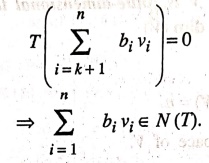
Since { v1, v2, ..., vk} is a basis for N(T)
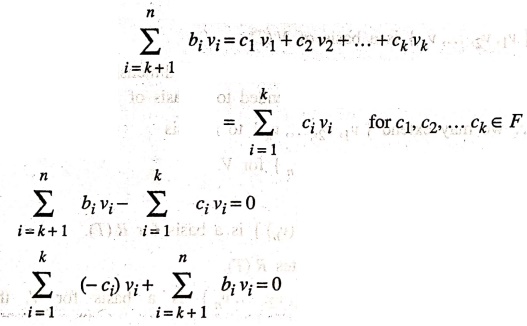
Since { v1, v2, v3,..., vk, vk+1, …… vn } is a basis for V.
(ie) { v1, v2, v3,..., vn } is linearly independent.
−ci=0 for all i = 1 to k and
bi=0 for all i=k+1 to n.
In particular
bk+1 = bk+2 = ... = bn = 0
S = { T (vk+1), T (Vk + 2), ... T (vn) } is Linearly independent.
S is a basis for R (D)
dim (R (T)) = n−k
rank (T) = dim V − dim (N (T))
Nullity (T) + rank (T) = dim (V)
7. Is there a linear transformation
T: R3 → R2 such that T (1, 0, 3) = (1, 1) and T (−2, 0, −
6) = (2, 1).
Solution:
T
(− 2, 0, − 6) = T (− 2 (1, 0, 3))
=
−2T (1, 0, 3)
=
−2 (1, 1)
=
(−2,−2)
(2,
1) ≠ (−2,−2)
It
is not a linear transformation.
8. Let T: R2 → R3.
Define T(a1, a2)
= (a1+a2, 0, 2a1−a2). Verify whether T is one−to−one or on−to
Solution:
We
know that if T: V→W is a linear transformation and N (T), R (T) are nullspace
and range of T then,
(i)
T is 1−1 if and only if N (T) = 0 and
(ii)
T is on to iff R (T) = W.
Here
N (T) = 0, So T is 1−1 and T is not on to because T never maps all the values
of R3.
T is 1−1
but not on−to.
9. Verify that T: R3 → R
and T(u) = || u || is a linear transformation or not.
Solution:
T(u
+ v) = || u+v || ≤ || u || + || u ||
Here
T (u+v) ≠ T (u) +T (v) for all u, v ∈
R3.
Hence
it is not linear transformation.
10. Prove that similar matrices have
the same characteristic polynomial.
Solution:
Let
A and B be two similar matrices and p(k) denote the kth degree polynomial.
Now
we have to prove that p(A) and p(B) are similar matrices.
Since
A and B are similar matrices, B = P‒1AP for some matrix P.
Now
let
|B| = |P‒1AP| = |P‒1| |A|
|P|
=
|A| |P‒1| | P |
=
|A| |P‒1P|
=
|A| |I|
=
|A|
|B|
= |A|
Now
P(B)
= | B−λI |
(B ‒
λI) = P‒1 AP − λI = P‒1 AP − λ(P‒1IP)
=
P‒1(A−λI)P
Since
|B−λI| is same as A−λI
⇒ P(A) and P (B) are
similar matrices.
The similar matrices have the same
characteristic polynomial.
11. Let be a square matrix. Prove
that A and AT have the same eigen values.
Solution:
To
prove A and AT have the same eigenvalues let λ be the eigenvalue of
A.
Then
its characteristic equation is |A−λI|.
| A − λI | = | (A − λI)T | = | (AT
– λIT) |
|A− λI|
= |AT − λI |
Since
the characteristic equations of A and AT are identical in any field,
the eigenvalues are same.
Thus
A and AT have the same characteristic equations and have the same
eigenvalues.
12. Prove that similar matrices have
the same trace.
Solution:
Trace
of [A]n×n Sum of its diagonal elements.
Let
A & B be two matrices of same order n.
Trace
(A) = nΣi=1 Aii
Let
A and B be two similar matrices.
Trace
(AB) = Trace (BA)
Then
there exists an invertible matrix P such that B = PAP−1.
Trace
(B) = Trace (P A P‒1) = Trace (P‒1AP)
=
Trace (P−1 PA)
=
Trace (IA)
=
Trace (A)
Trace
(B) = Trace (A)
Hence,
similar matrices have the same trace.
13. Find the eigenvalues of the
matrix A =  ∈ M2×2(R).
Solution:
Let A =  then the characteristic equation is
f(t) = |A − λI| = 0
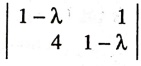 = (1 – λ)2 ‒ 4 = 0
1+ λ2−2λ−4 = 0
λ2−2λ−3=0
(λ − 3) (λ + 1) = 0
The eigenvalues are 3,− 1.
14. Let T be the linear operator on
P2(R) defined by T[f(x)] =
f(x) + (x + 1)ƒ'(x). Let B be the
standard ordered basis for P2(R). Compute characteristic polynomial
and eigenvalue of T.
Solution:
Let
us consider β = { 1, x, x2 }
T(1)=1+0
(1+1)=1=1+0x+0x2
T(x)=x+1(1+x)=1+2x=1+2x+0x2
T(x2) = x2 + (x + 1)2x =
3x2+2x=0+2x+3x2
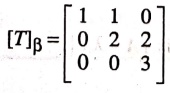
f(t) = |A−λ| = 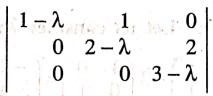 = − λ3 + 6λ2 − 11λ + 6
=
− λ3 + 6λ2 − 11λ + 6
=
−(λ−1) (λ−2) (λ−3)
⇒ λ=1, 2, 3
The
eigenvalues are 1, 2, 3.
15. Test the matrix A =  ∈ M2×2(R) for diagonalizable.
Solution:
f(t)
=|A ‒ λIn| = 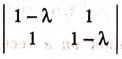
= λ2 − 2λ = λ(2−2)
λ=0,
λ =2.
⇒ λ=0,2 the eigenvalues
are distinct.
They
are diagonalizable.
16. Test the matrix A =  ∈ M2×2(R) for diagonalizable.
Solution:
Given
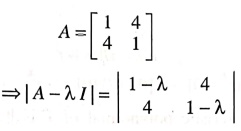
Then
|A− λI| = (1−λ)2−16=1+λ2−2λ−16
=
λ2−2λ−15 = (λ − 5) (λ+3)
(ie)
λ = −3 and λ = 5.
λ=−3, 5. Since the two eigenvalues are
distinct, it is diagonalizable.
17. Find the algebraic multiplicity
of all eigenvalues of 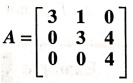
Solution:
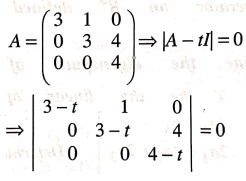
⇒ (3 − t) [(3 − t) (4−t)
− 0] − 1[00] + [0+0] = 0
⇒ (3−t)2 (4−t)
= 0
f(t)
= (3 − t)2 (4 − t)
⇒ t = 3,3 and t=4
The
algebraic multiplicity of λ=3 is 2
The
algebraic multiplicity of λ=4 is 10
Linear Algebra: UNIT II: Linear Transformations and Diagonalization : Tag: maths, mathematics : Linear Algebra - Linear Transformation and Diagonalization: 2 Marks Important Questions with Answer
Linear Algebra: UNIT II: Linear Transformations and Diagonalization
Under Subject
Linear Algebra
MA25C02 2nd Semester | 2025 Regulation
Related Subjects

English Essentials II
EN25C02 2nd Semester | 2025 Regulation | 2nd Semester 2025 Regulation

Tamils and Technology தமிழர்களும் தொழில்நுட்பமும்
UC25H02 2nd Semester | 2025 Regulation | 2nd Semester 2025 Regulation
Linear Algebra
MA25C02 2nd Semester | 2025 Regulation
Transforms and its Applications
MA25C03 2nd Semester EEE Dept | 2025 Regulation | 2nd Semester 2025 Regulation

Applied Physics (CE) II
PH25C02 2nd Semester Civil, Agri Depts | 2025 Regulation | 2nd Semester 2025 Regulation
Applied Physics (CSIE) II
PH25C03 2nd Semester AIDS, CSE, IT, CSE(CY) Dept | 2025 Regulation | 2nd Semester 2025 Regulation
Applied Physics (EE) II
PH25C04 2nd Semester EEE Dept | 2025 Regulation | 2nd Semester 2025 Regulation

Applied Physics (ME) II
PH25C05 2nd Semester Mechanical Dept | 2025 Regulation | 2nd Semester 2025 Regulation
Applied Chemistry (CE) II
CY25C02 2nd Semester Civil Dept | 2025 Regulation | 2nd Semester 2025 Regulation

Applied Chemistry (ME) II
CY25C03 2nd Semester Mechanical Dept | 2025 Regulation | 2nd Semester 2025 Regulation

Electron Devices
EC25C01 2nd Semester ECE Dept | 2025 Regulation | 2nd Semester 2025 Regulation
Digital Principles and Computer Organization
CS25C06 2nd Semester AIDS, CSE, IT, CSE(CY) Dept | 2025 Regulation | 2nd Semester 2025 Regulation

Basic Electrical and Electronics Engineering
EE25C01 2nd Semester | 2025 Regulation | 2nd Semester 2025 Regulation

Basic Civil and Mechanical Engineering
GE25C01 2nd Semester EEE Dept | 2025 Regulation | 2nd Semester 2025 Regulation
Data Structures using CPlusPlus
CS25C05 2nd Semester ECE Dept | 2025 Regulation | 2nd Semester 2025 Regulation
Engineering Drawing
ME25C01 EEE, Mech, Agri, EEE Depts | 2025 Regulation | 2nd Semester 2025 Regulation
Data Structures and Algorithms
CS25C04 2nd Semester EEE Dept | 2025 Regulation

Circuits and Network Analysis
EC25C02 2nd Semester ECE Dept | 2025 Regulation | 2nd Semester 2025 Regulation

Engineering Mechanics
ME25C02 2nd Semester Mech, Civil, Agri Depts | 2025 Regulation | 2nd Semester 2025 Regulation
Object Oriented Programming (OOPs)
CS25C07 2nd Semester CSE, CSE(CY) Depts | 2025 Regulation | 2nd Semester 2025 Regulation