Basic Electronics and Electrical Engineering: Chapter 6: Measurement and Instrumentation
Measurement and Instrumentation: 2 Marks Important Questions with Answers
Basic Electronics and Electrical Engineering: Chapter 6: Measurement and Instrumentation : 2 Marks Important Questions with Answers
Basic Electronics and
Electrical Engineering
CHAPTER
6: MEASUREMENT AND INSTRUMENTATION
2 Marks Important
Questions with Answers
1.
State the requirements of any measuring instruments?
(i) The operation,
output and condition of the actual circuit should not be affected / altered
with the presence of measuring instruments.
(ii) The quantity to be
measured should not affected by the measuring instruments.
(iii) The measuring
instruments should consume less power as low as possible.
2.
Give the classification of measuring instruments?
Measuring instruments
broadly classified as:
(i) Primary
Instruments.
(ii) Secondary
instruments.
According to nature of
reading
(a) Indicating
instruments.
(b) Integrating
Instruments.
(c) Recording
Instruments.
3.
Which are the essential torques required in measuring instruments?
(i) Deflecting Torque,
Td.
(ii) Controlling
torque, TC.
(iii) Damping torque.
4.
State the various methods of producing deflecting torque in measuring instruments?
(i) Magnetic effect
(ii) Electrodynamic
effect
(iii) Electromagnetic
effect
(iv) Thermal effect
(v) Chemical effect
(vi) Electrostatic
effect
5.
Which are two methods of producing, controlling torque in measuring
instruments?
(i) Spring control
(ii) Gravity control
6.
State the important functions of controlling system in measuring instruments.
(i) It produces a
torque equal and opposite to the deflecting torque in order to make the
deflection of pointer at a definite magnitude. If this system is absent, then deflection
will be come indefinite.
(ii) It brings the
moving system back to zero position when the force which causes the movement of
the moving system is removed.
7.
What are the methods available for providing damping torque in measuring instruments?
(i) Air friction
damping
(ii) Fluid friction
damping
(iii) Eddy current
damping
8.
List the possible errors in PMMC instruments?
(i) Errors due to
weakening of permanent magnets
(ii) Errors due to
weakening of springs
(iii) Change of
resistance
9.
Why MI instruments can be used for both ac and dc quantities?
The deflecting torque
is proportional to the square of the operating current. So, whatever may be the
direction of current, the deflecting torque will be produced in forward
direction only. Hence MI instruments can be used for both ac and dc
measurements.
10.
List the possible errors in MI instruments?
(i) Errors with both ac
and de
(a) Hysteresis error
(b) Temperature error
(c) Error due to stray
magnetic fields.
(ii) Errors with AC
only:
(a) Frequency error
(b) Error due to
reactance
(c) Error due to
reactance
11.
How to increase the range of an dc ammeter and dc voltmeter?
By keeping a shunt (low
resistance parallel path) across the meter, the range of an ammeter can be
extended
By keeping a multiplier
(high resistance series path) through the meter, we can extend the range of a
voltmeter.
12.
Explain the various adjustments required in an energy meter.
(i) Preliminary light
load adjustment
(ii) Full load unity
power factor
(iii) Lag adjustment
(iv) Light load
adjustment
(v) Creep adjustment
13.
What is Creep?
In some meters a slow,
but continuous rotation is obtained when the potential coils are excited but
with no load currents flowing. This is known as creep. This may be due to
(i) Incorrect friction
compensation
(ii) Vibration
(iii) Stray magnetic
field
(iv) the voltage of the
supply circuit is in excess of the normal.
14.
Why cannot a moving coil instrument be used in AC circuits?
In moving coil
instruments, the operating torque depends on the direction of the operating
current. Thus, this type of instruments are polarised. So, if moving coil
instrument are connected for AC circuits, then the deflecting torque is a
pulsating one and the meter will not read. That is, the meter will read the
average value of the measuring quantity.
15.
State the principle of Dynamometer type watt meter.
It works on the
principle which can be said as "The pressure coil produces a flux which is
proportional to the applied voltage. The flux produced by the pressure coil is
nearly in phase with the applied voltage. The current coil produces a flux
which is in phase with the load current. These two fluxes link each other and a
torque is produced on the moving system".
This principle will
look similar to the principle of operation of motor.
16.
List the essential requirements (torque) of an instrument.
(i) Deflecting torque
(ii) Controlling torque
(iii) Damping torque
17.
What are the main parts of the operating mechanism in an energy meter?
(i) Driving system
(ii) Moving system
(iii) Braking system
(iv) Registering
(counting) system:
18.
What are the coils in wattmeter?
Symbol:
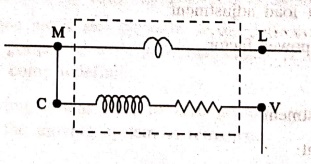
(i) Fixed coil (or)
Series coil (or) Current coil (M‒L)
(ii) Moving coil (or)
Shunt coil (or) Pressure coil (or) Potential coil (or) Voltage coil (C‒V)
19.
State the different type of instruments based on their operating principles.
(i) Moving coil
instruments (ii) Moving iron instruments
20.
Mention the three torques required for the proper operation of indicating
instrument.
(i) Deflecting Torque,
Td; (ii) Controlling torque, TC; (iii) Damping torque.
21.
Define the principle of moving iron instrument for attraction type.
When the moving iron
piece is brought near either ends of the current carrying coil winding, the
iron piece will be attracted towards that portion where magnetic flux density
is more. This movement is used to measure the current and voltage which
produces the magnetic field.
22.
Define ‒ Transducer.
Transducer is defined
as a device that receives energy from one system and transmits it to another,
often is a different form.
23.
Write the parameters of electrical transducer.
The parameters of
electrical transducer are,
(i) Linearity
(ii) Sensitivity
(iii) Dynamic range
(iv) Repeatability
24.
List out the advantages of electrical transducers.
The advantages of
electrical transducers are,
(i) Electrical
amplification and attenuation can be easily done.
(ii) Mass inertia
effects are minimized.
(iii) Effects of
friction are minimized.
(iv) Using very small
power level.
(v) Electrical output
can be easily used, transmitted and processed for the purpose of measurement.
(vi) The output can be
indicated and recorded remotely at a distance from the sensing medium.
25.
List out the types of potentiometer.
The types of
potentiometer are
(i) Translatory
(ii) Rotational
(iii) Helipot
26.
List out the limitations of thermistor.
The limitations of
thermistor are
(i) Non‒linearity in
resistance Vs temperature characteristics.
(ii) Unsuitable for
wide temperature range.
(iii) Very low
excitation current to avoid self‒heating.
(iv) Need of shielded
power lines, filters etc., due to high resistance.
27.
Write short notes on LVDT.
LVDT (Linear Variable
Differential Transformer) converts the mechanical energy into differential
electrical energy. It has single primary, winding, and two secondary windings
wound on a hollow cylindrical former. A movable soft iron slides within the
hollow former and therefore affects the magnetic coupling between the primary
and the two secondaries.
28.
List out the advantages of LVDT.
The advantages of LVDT
are,
(i) High range of
displacement measurement.
(ii) Friction and
electrical isolation.
(iii) Immunity from
external effects.
(iv) High input and
high sensitivity.
(v) Ruggedness.
(vi) Low hysteresis and
lower consumption.
29.
List out the limitations of LVDT.
The limitations of LVDT
are
(i) Large displacements
are required for appreciable differential output.
(ii) They are sensitive
to stray magnetic fields
(iii) Dynamic response
is limited.
(iv) Temperature also
affects the transducer.
30.
List out the two physical parameters in strain guage.
The two physical
parameters in strain gauge are,
(i) The change in gauge
resistance.
(ii) The change in
length.
Basic Electronics and Electrical Engineering: Chapter 6: Measurement and Instrumentation : Tag: Basic Engineering : - Measurement and Instrumentation: 2 Marks Important Questions with Answers
Basic Electronics and Electrical Engineering: Chapter 6: Measurement and Instrumentation
Under Subject

Basic Electronics and Electrical Engineering
EE25C04 1st Semester ECE Dept | 2025 Regulation | 2nd Semester 2025 Regulation
Related Subjects

English Essentials I
EN25C01 1st Semester | 2025 Regulation | 1st Semester 2025 Regulation

தமிழர் மரபு - Heritage of Tamils
UC25H01 1st Semester | 2025 Regulation | 1st Semester 2025 Regulation
Applied Calculus
MA25C01 Maths 1 M1 - 1st Semester | 2025 Regulation | 1st Semester 2025 Regulation
Applied Physics I
PH25C01 1st Semester | 2025 Regulation | 1st Semester 2025 Regulation

Applied Chemistry I
CY25C01 1st Semester | 2025 Regulation | 1st Semester 2025 Regulation
Makerspace
ME25C04 1st Semester | 2025 Regulation | 1st Semester 2025 Regulation
Computer Programming C
CS25C01 1st Semester | 2025 Regulation | 1st Semester 2025 Regulation
Computer Programming Python
CS25C02 1st Semester | 2025 Regulation | 1st Semester 2025 Regulation
Fundamentals of Electrical and Electronics Engineering
EE25C03 1st Semester | 2025 Regulation | 1st Semester 2025 Regulation
Introduction to Mechanical Engineering
ME25C03 1st Semester | 2025 Regulation | 1st Semester 2025 Regulation

Introduction to Civil Engineering
CE25C01 1st Semester Civil Department | 2025 Regulation | 1st Semester 2025 Regulation
Essentials of Computing
CS25C03 1st Semester - AID CSE IT Department | 2025 Regulation | 1st Semester 2025 Regulation

Applied Physics I Laboratory
PH25C01 1st Semester practical Laboratory Manual | 2025 Regulation | 1st Semester Laboratory 2025 Regulation

Applied Chemistry I Laboratory
CY25C01 1st Semester practical Laboratory Manual | 2025 Regulation | 1st Semester Laboratory 2025 Regulation

Computer Programming C Laboratory
CS25C01 1st Semester practical Laboratory Manual | 2025 Regulation | 1st Semester Laboratory 2025 Regulation

Computer Programming Python Laboratory
CS25C02 1st Semester practical Laboratory Manual | 2025 Regulation | 1st Semester Laboratory 2025 Regulation
Engineering Drawing
ME25C01 EEE Mech Dept | 2025 Regulation | 2nd Semester 2025 Regulation
Basic Electronics and Electrical Engineering
EE25C04 1st Semester ECE Dept | 2025 Regulation | 2nd Semester 2025 Regulation