Basic Electronics and Electrical Engineering: Chapter 6: Measurement and Instrumentation
Measurement of Power
1. Classification of Wattmeters 2. Measurement of power in three phase power by using two watt meter method
MEASUREMENT
OF POWER
Power the rate of doing
work. In the electrical system, the unit of power is "watt". In DC
system the power is given by the product of voltage and current.
P = V*I (DC Circuit).
This power can be
calculated by using voltmeter and ammeter or by a wattmeter.
In a AC circuit the
instantaneous power is given by p=vi,
where p, v, i are the average
instantaneous values of power, voltage and current respectively. We can prove
that the power over a cycle is given by,
P = VI cos ϕ (AC
circuit)
Where,
P = average power
V = voltage.
I = current
cos ϕ = Power factor of
the load.
Thus, we should know
the power factor of the load, in AC circuit to calculate the power. So, a
wattmeter is used which takes the power factor of the load also into account.
In ac circuit the power
is measured by using voltmeter, ammeter and a power factor meter or mostly
using a wattmeter. Wattmeter comes under the group of indicating instruments.
Classification of Wattmeters
Wattmeters are mainly
classified into three groups namely,
1. Dynamometer type
2. Induction type
3. Electrostatic type
wattmeters
Dynamometer
type wattmeter
Dynamometer type
wattmeters are sub‒divided into two groups:
(i) Pivoted coil direct
indicating wattmeters.
(ii) Suspended tension
wattmeters.
Measurement of power in three phase power by using two watt meter method
Using two wattmeter
method, the power measured by the two wattmeters i.e. the sum of the two
wattmeter readings is equal to root 3 times of the phase voltage and line
voltage (√3VLILcos ϕ) which is the actual power consumed
in a 3 phase balanced load. The connection diagram of a 3 phase balanced load
connected as Star Connection is shown below.
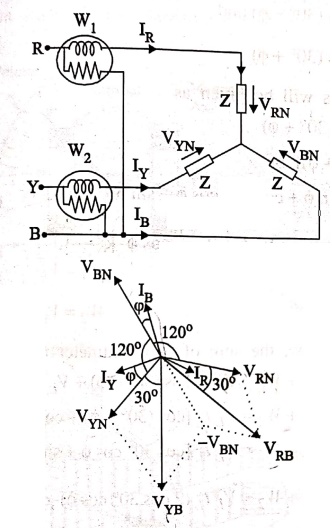
The load is considered
as an inductive load. The three voltages VRN, VYN and VBN,
are displaced by an angle of 120 degrees electrical as shown in the phasor
diagram. The phase current lag behind their respective phase voltages by an
angle ϕ. Now, the current flowing through the current coil of the Wattmeter, W1
will be given as
W1 = IR
Potential difference
across the pressure or potential coil of the Wattmeter, W1 will be

To obtain the value of
VYB, reverse the phasor VBN and add it to the phasor VYN
as shown in the phasor diagram. The phase difference between VRB and
IR is (30° – ϕ).
Therefore, the power
measured by the Wattmeter, W1is
W1 = VRBIR
COS (30° ‒ ϕ)
Current through the
current coil of the Wattmeter, W2 is given as
W2 = IY
Potential different
across the wattmeter, W2 is
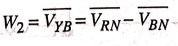
The phase difference VYB
and IY is (30°+ϕ).
Therefore, the power
measured by the Wattmeter, W2 is given by the equation shown below.
W2 = VYBIY
cos (30°+ϕ)
Since, the load is in
balanced condition, hence,
IR=IY=IB=IL
and
VRY= VYB=
VBR=VL
Therefore, the
wattmeter readings will be
W1 = VLIL
cos (30° − ϕ) and
W2 = VL
IL cos (30° + ϕ)
Now, the sum of two
wattmeter readings will be given as
W1+ W2
= VLIL cos (30°‒ϕ) + VLIL cos (30°
+ ϕ)
W1+ W2
= VLIL [ cos (30°‒ϕ) + cos (30° + ϕ) ] or
W1+ W2
= VLIL [cos 30° cos ϕ + sin 30° sin ϕ + cos 30° cos ϕ ‒ sin 30° sin ϕ ] or
W1+ W2
= VLIL (2cos 30° cos ϕ ) or
W1+ W2
= VLIL (2 √3/2 cosϕ)
W1+ W2
= √3VLILcosϕ
W1+ W2
= P
The above equation (1)
gives the total power absorbed by a 3 phase balanced load.
Thus, the sum of the
readings of the two Wattmeters is equal to the power absorbed in a 3 phase
balanced load.
Circuit
diagram
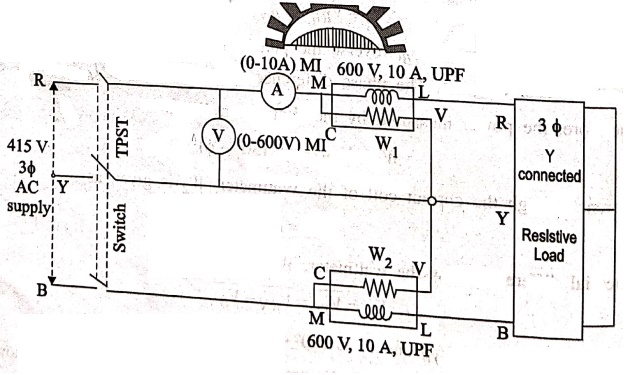
Basic Electronics and Electrical Engineering: Chapter 6: Measurement and Instrumentation : Tag: Basic Engineering : - Measurement of Power
Basic Electronics and Electrical Engineering: Chapter 6: Measurement and Instrumentation
Under Subject

Basic Electronics and Electrical Engineering
EE25C04 1st Semester ECE Dept | 2025 Regulation | 2nd Semester 2025 Regulation
Related Subjects

English Essentials I
EN25C01 1st Semester | 2025 Regulation | 1st Semester 2025 Regulation

தமிழர் மரபு - Heritage of Tamils
UC25H01 1st Semester | 2025 Regulation | 1st Semester 2025 Regulation
Applied Calculus
MA25C01 Maths 1 M1 - 1st Semester | 2025 Regulation | 1st Semester 2025 Regulation
Applied Physics I
PH25C01 1st Semester | 2025 Regulation | 1st Semester 2025 Regulation

Applied Chemistry I
CY25C01 1st Semester | 2025 Regulation | 1st Semester 2025 Regulation

Makerspace
ME25C04 1st Semester | 2025 Regulation | 1st Semester 2025 Regulation
Computer Programming C
CS25C01 1st Semester | 2025 Regulation | 1st Semester 2025 Regulation
Computer Programming Python
CS25C02 1st Semester | 2025 Regulation | 1st Semester 2025 Regulation
Fundamentals of Electrical and Electronics Engineering
EE25C03 1st Semester | 2025 Regulation | 1st Semester 2025 Regulation

Introduction to Mechanical Engineering
ME25C03 1st Semester | 2025 Regulation | 1st Semester 2025 Regulation

Introduction to Civil Engineering
CE25C01 1st Semester Civil Department | 2025 Regulation | 1st Semester 2025 Regulation
Essentials of Computing
CS25C03 1st Semester - AID CSE IT Department | 2025 Regulation | 1st Semester 2025 Regulation

Applied Physics I Laboratory
PH25C01 1st Semester practical Laboratory Manual | 2025 Regulation | 1st Semester Laboratory 2025 Regulation

Applied Chemistry I Laboratory
CY25C01 1st Semester practical Laboratory Manual | 2025 Regulation | 1st Semester Laboratory 2025 Regulation

Computer Programming C Laboratory
CS25C01 1st Semester practical Laboratory Manual | 2025 Regulation | 1st Semester Laboratory 2025 Regulation

Computer Programming Python Laboratory
CS25C02 1st Semester practical Laboratory Manual | 2025 Regulation | 1st Semester Laboratory 2025 Regulation
Engineering Drawing
ME25C01 EEE Mech Dept | 2025 Regulation | 2nd Semester 2025 Regulation
Basic Electronics and Electrical Engineering
EE25C04 1st Semester ECE Dept | 2025 Regulation | 2nd Semester 2025 Regulation